Labrador Tea (Ledum groenlandicum)
Ledum groenlandicum (also classified as Rhododendron groenlandicum), commonly known as Labrador Tea, is a distinctive aromatic evergreen shrub of the boreal bogs and northern wetlands of northeastern North America. A member of the Ericaceae (Heath) family, this compact shrub produces beautiful clusters of small white flowers in late spring, and its thick, leathery leaves — woolly-rust beneath — have been steeped into a tea by northern Indigenous peoples and early settlers for centuries, giving the plant its common name. The leaves contain a volatile aromatic oil whose fragrance is reminiscent of strong herbal tea, and which has both attracted and cautioned human use throughout the plant’s history.
Native to the cold, acidic bogs, fens, and moist boreal forests of northern North America, Labrador Tea is supremely adapted to nutrient-poor, waterlogged conditions that exclude most other shrubs. It is a characteristic species of sphagnum bogs, bog margins, and wet coniferous forests from Greenland and Labrador southward through the boreal regions of New England, the Great Lakes, and the Pacific Northwest. In New England, it is found throughout Maine, New Hampshire, and Vermont, typically in the wet, acidic habitats associated with Black Spruce, tamarack bogs, and blueberry heaths at higher elevations and in the north.
As a garden plant, Labrador Tea offers year-round evergreen structure, spring floral interest, and exceptional value in moist, boggy sites where few attractive shrubs will grow. Its compact 3-foot stature, distinctive foliage with rusty-woolly undersides, and tolerance for standing water make it an excellent choice for rain gardens, bog gardens, wetland edges, and moist native plant gardens in cool northern climates. It is a plant that rewards those willing to work with challenging wet-site conditions rather than against them.
Identification
Labrador Tea is a compact, densely branched evergreen shrub typically growing 1–3 feet (30–90 cm) tall, occasionally reaching 4 feet in optimal conditions. The upright to spreading branches bear distinctive leathery leaves and, in late spring, produce attractive terminal clusters of white flowers. The entire plant has a characteristic aromatic smell when leaves are crushed, releasing volatile compounds with a distinctive herbal-medicinal quality.
Bark & Stems
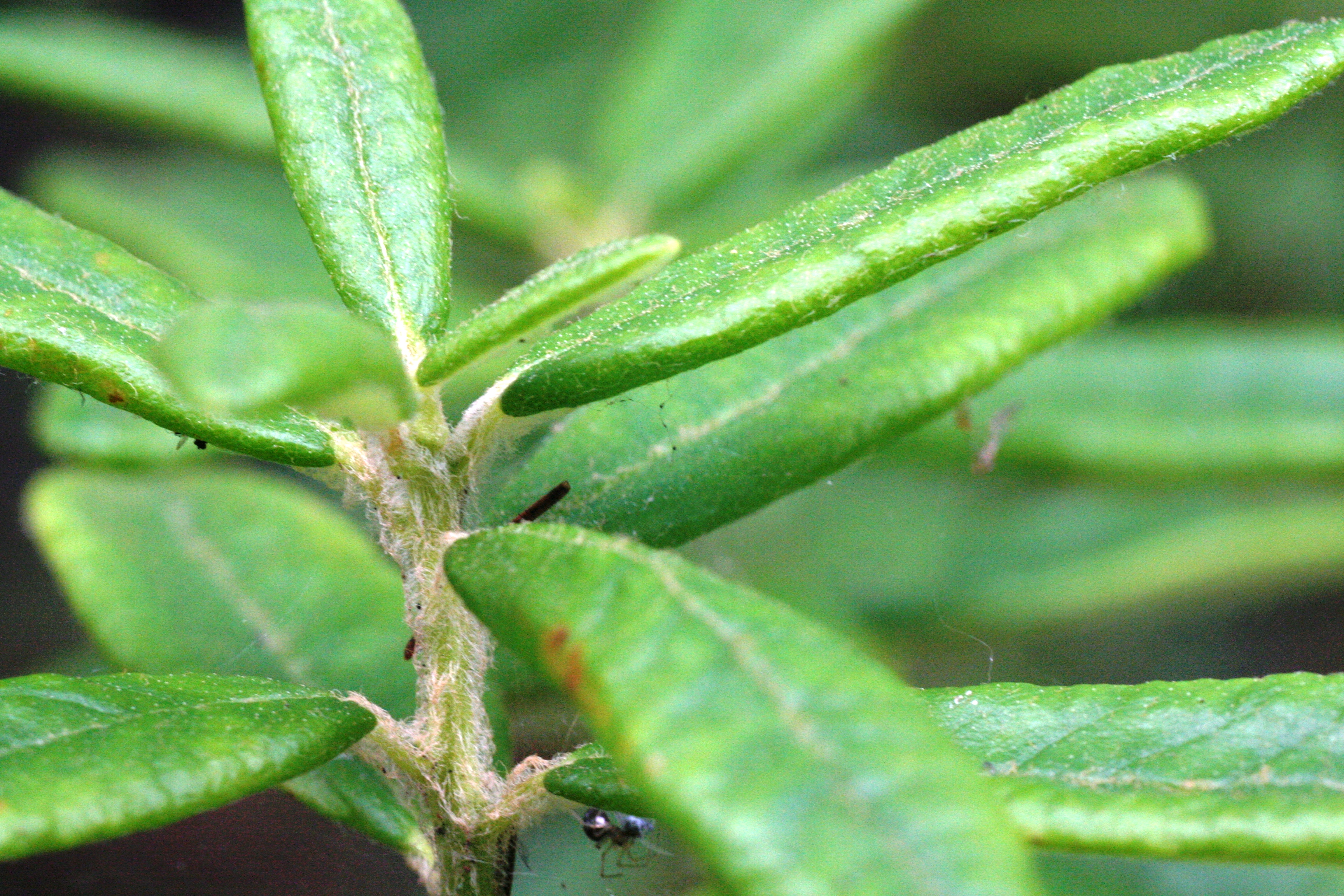
Young stems are covered with dense, woolly, rust-colored to whitish hairs — a characteristic feature visible even on casual inspection. Older stems lose the woolly covering and become smooth and brown. The branching pattern is somewhat irregular and spreading, with young shoots emerging from the upper portions of branches. The overall plant structure is dense and compact in open, exposed bog conditions; taller and more open in shaded situations.
Leaves
The leaves are perhaps the most distinctive feature of Labrador Tea. They are evergreen, alternate, leathery, and oblong to linear, measuring 1–2 inches (2.5–5 cm) long. The margins are distinctly rolled under (revolute), giving the leaf a distinctive cylindrical appearance when viewed from the side. The upper surface is dark green, slightly glossy, and dotted with fine glands. The lower surface is densely covered with woolly, rust-brown to tawny hairs that give the underside a distinctive felt-like texture. This woolly covering, along with the rolled margins, is an adaptation to conserve moisture and reduce water loss in the exposed, wind-swept bog environments the plant inhabits.
Flowers & Fruit
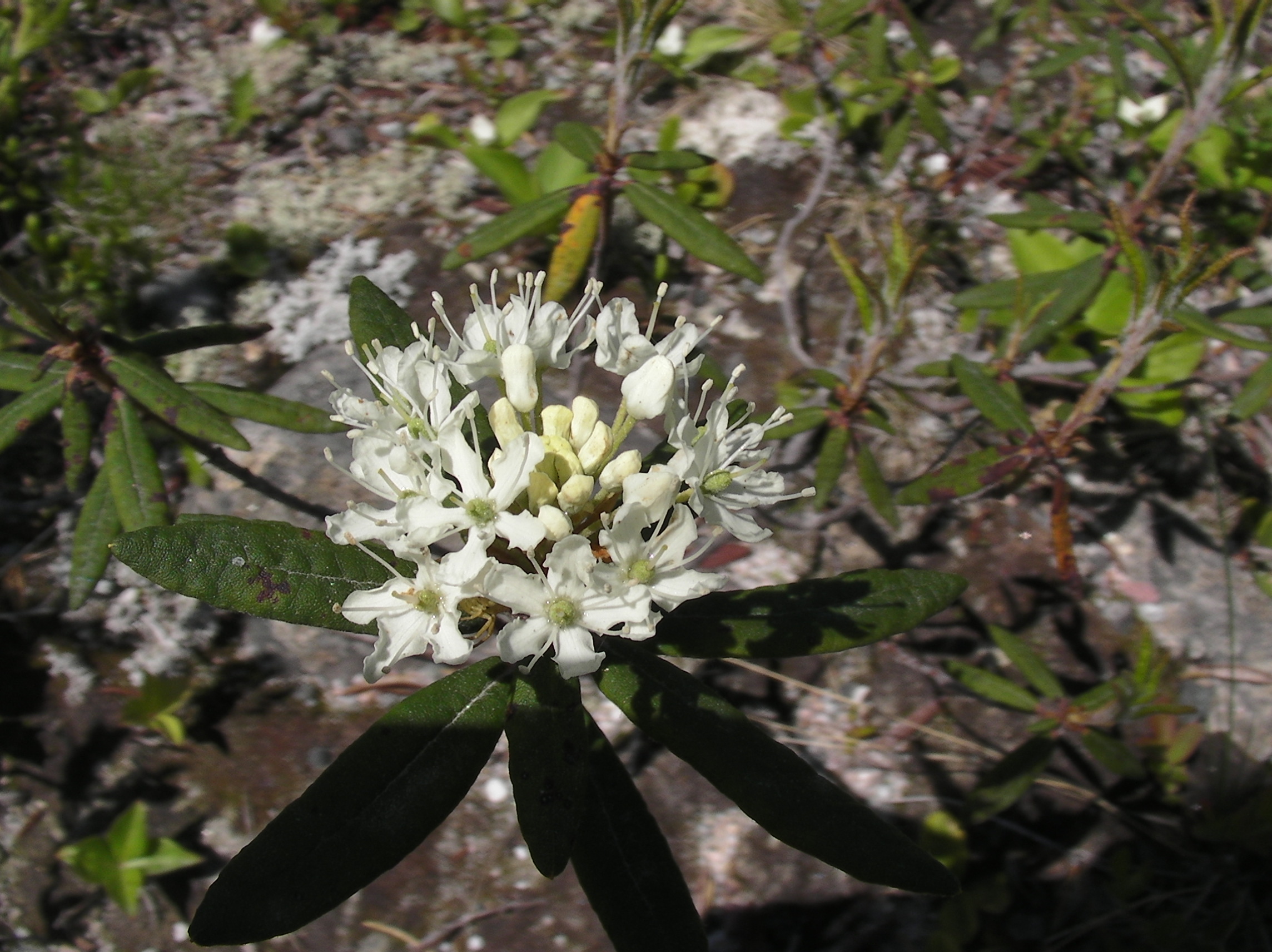
The flowers are borne in terminal, rounded clusters (corymbs) of 10–25 individual flowers at the ends of the branches. Each flower is small, 1/3 to 1/2 inch (8–12 mm) across, with five white petals and 5–10 conspicuous stamens that extend beyond the petals, giving the flower clusters a delicate, frothy appearance. Flowers bloom in late May through June, and the effect of a bog full of blooming Labrador Tea is striking — a sea of white clusters against the dark green foliage. The fruit is a small, dry, 5-valved capsule containing numerous tiny seeds that are wind-dispersed.
Quick Facts
| Scientific Name | Ledum groenlandicum (syn. Rhododendron groenlandicum) |
| Family | Ericaceae (Heath family) |
| Plant Type | Evergreen Shrub |
| Mature Height | 3 ft |
| Sun Exposure | Full Sun to Part Shade |
| Water Needs | Moderate to High |
| Soil Type | Wet, acidic, peaty; tolerates standing water |
| Soil pH | 3.5–5.5 (strongly acidic) |
| Bloom Time | May – June |
| Flower Color | White |
| Leaf Character | Leathery, revolute margins, rusty-woolly beneath |
| Special Notes | Aromatic leaves; transplants well; moist-to-wet sites |
| USDA Hardiness Zones | 2–6 |
Native Range
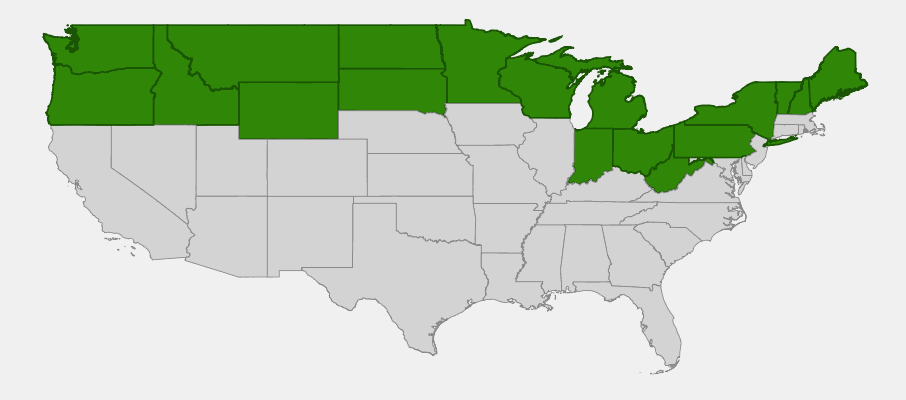
Labrador Tea is native to a broad expanse of northern North America, from Greenland and Labrador westward across Canada to Alaska and south into the northern contiguous United States. In New England, it is distributed throughout Maine, New Hampshire, and Vermont, with its abundance increasing northward. It is a characteristic species of the boreal and sub-boreal zones, occurring wherever cool, moist, acidic bog and wetland habitats exist.
In its US range, Labrador Tea occurs primarily in the northeastern states (Maine, New Hampshire, Vermont, New York, Pennsylvania), the Great Lakes states (Michigan, Wisconsin, Minnesota), the northern Rockies (Idaho, Montana, Wyoming), and the Pacific Northwest (Washington, Oregon). In all of these regions it is associated with the same ecological conditions: cool temperatures, high moisture, acidic soils, and open or partially shaded conditions in bogs, fens, and wet forests. The species reaches its southernmost limits in sphagnum bogs and high-elevation wetlands where local conditions mimic the cool, moist climate of the boreal zone.
Labrador Tea is an indicator species for boreal and sub-boreal peat-forming ecosystems. Where you find Labrador Tea, you typically find an associated suite of species characteristic of northern peatlands: Black Spruce, Tamarack, Bog Rosemary, Sundews, pitcher plants, and various sedges and sphagnum mosses. The plant is adapted to the nutrient-poor, waterlogged, strongly acidic conditions of sphagnum bogs in ways that most vascular plants cannot match.
📋 Regional plant lists featuring Labrador Tea: New England
Growing & Care Guide
Labrador Tea is one of the most rewarding native shrubs for gardeners dealing with wet, boggy, or chronically moist sites. Rather than viewing these challenging conditions as a problem, Labrador Tea users embrace them — the plant is at its best exactly where other plants struggle most.
Light
Labrador Tea grows best in full sun to partial shade. In its natural bog habitat, it often grows in open, exposed conditions with full sun. It tolerates partial shade well — in fact, partial shade in warmer, southern portions of its range helps protect it from heat stress. In deep shade, flowering is reduced and the plant becomes more open and leggy. For best flowering and most compact form, provide at least 4–6 hours of direct sun per day.
Soil & Water
This is where Labrador Tea stands apart from most garden shrubs: it requires consistently moist to wet, strongly acidic, peaty or humusy soil (pH 3.5–5.5). It is an ideal candidate for bog gardens, rain gardens, wetland edges, and any chronically wet site in the garden. It tolerates standing water for extended periods and thrives in sphagnum moss-based growing media. Standard garden soils — even with amendments — are usually too alkaline and too dry for this plant. Successful cultivation almost always requires either a naturally boggy site or an artificially created bog garden with appropriate acidic substrate.
Planting Tips
The batch notes that Labrador Tea “transplants well” — which is encouraging, as many Ericaceous plants can be finicky about transplanting. Container-grown specimens with established root systems do best. Plant in spring or fall in a permanently moist to wet site. Amend planting areas with peat moss, composted bark, and acidifying agents if natural soil pH is too high. Mulch heavily with pine bark, shredded pine needles, or sphagnum moss to maintain moisture and soil acidity. Space plants 2–3 feet apart for a naturalistic bog planting.
Pruning & Maintenance
Labrador Tea requires minimal pruning. Remove dead or winter-damaged stems in early spring. Light shaping can be done after flowering to maintain compact form, but avoid heavy pruning — the plant does not regenerate vigorously from old wood. The plant is generally pest and disease resistant, though it can be affected by leaf spots in very poorly ventilated conditions. Maintain consistent soil moisture; the plant is not drought tolerant and will show stress quickly when soil dries out.
Landscape Uses
- Bog gardens — a classic and ideal bog garden plant
- Rain gardens — thrives in wet zones that collect runoff
- Wetland restoration — characteristic species of northern peatland restoration
- Pond and stream edges — excellent for moist to wet margins
- Native plant gardens in cool northern climates
- Foundation plantings in consistently moist, shaded areas
- Pollinator gardens — white flower clusters attract native bees
Note: Labrador Tea has mild toxicity — the leaves contain ledol, a diterpene that can cause headache or dizziness if ingested in quantity. Use as a tea only in moderation and after proper preparation. Not recommended for internal use by pregnant women.
Wildlife & Ecological Value
Labrador Tea is a key component of northern peatland ecosystems, providing food and habitat for a specialized community of boreal wildlife adapted to bog conditions.
For Birds
The flowers attract a variety of native pollinators including native bees, flies, and small wasps. Ruffed Grouse and Spruce Grouse eat the leaves and twigs, particularly in winter when other food is scarce. Yellow Warblers, Common Yellowthroats, and other wetland-associated warblers nest in and around shrubby bog edges dominated by Labrador Tea. The dense evergreen growth provides excellent year-round cover for small birds seeking protection from predators and harsh weather.
For Mammals
Snowshoe Hares browse the stems and foliage, particularly in winter. Moose occasionally graze on the shrubs in their bog habitats. Deer generally avoid Labrador Tea — the aromatic compounds in the foliage appear to make it unpalatable to most deer, which is an unusual and valuable characteristic in regions with heavy deer browsing pressure. This deer resistance is one practical reason to consider Labrador Tea for landscapes in areas with deer pressure.
For Pollinators
Labrador Tea is a valuable early-season nectar and pollen source in bog and wetland habitats. The flowers attract specialist native bees that forage in bog environments, including species of Andrena and Osmia, as well as various bumblebee species. In northern peatlands where few other flowering plants bloom in May and June, Labrador Tea can be the dominant floral resource available during early pollinator season.
Ecosystem Role
As a characteristic species of boreal peatlands, Labrador Tea contributes to the complex ecology of these globally significant ecosystems. Northern peatlands store enormous quantities of carbon — more per unit area than any other terrestrial ecosystem — and the plant community in which Labrador Tea participates is essential to maintaining this carbon storage function. Labrador Tea also provides structural diversity in bog habitats, creating a shrub layer that supports species requiring more than the low-growing sphagnum mat layer.
Cultural & Historical Uses
Labrador Tea holds a significant place in the ethnobotany of northern North American Indigenous peoples. The Cree, Ojibwe, Inuit, and many other northern nations prepared a tea from the dried leaves, using it as a medicinal beverage for treating colds, coughs, sore throats, headaches, and skin conditions. The Cree name for the plant translates roughly as “the plant that makes tea,” reflecting its long cultural importance. The Dene people of the subarctic used it as a general tonic and cold remedy, and the leaves were also burned as a smudge to repel insects — the volatile aromatic oils that give the plant its smell serve double duty as insect repellents.
European explorers and early settlers in northern Canada and New England adopted Labrador Tea as a tea substitute during the colonial period, particularly in Labrador (from which the plant takes its common name) and throughout the subarctic frontier. The beverage was valued both for its flavor and for its medicinal properties — the volatile oils in the leaves have antiseptic and expectorant properties that made it useful against respiratory infections. However, scientists and physicians eventually recognized that the leaves contain ledol, a diterpene with potentially toxic properties in large doses, and use of the plant as a regular tea beverage fell out of favor among non-Indigenous populations in the 20th century.
Today, Labrador Tea is experiencing renewed interest among foragers, herbalists, and Indigenous food sovereignty practitioners. The leaves are used in small quantities to flavor ice cream, baked goods, and teas by modern chefs and foragers in northern Canada and New England. Commercially, the essential oil derived from Labrador Tea is used in aromatherapy products and natural insect repellents. The plant is also used in northern peatland restoration projects, where its re-establishment is considered a marker of successful bog recovery.
Frequently Asked Questions
Can you actually make tea from Labrador Tea?
Yes, but with caution. Indigenous peoples have prepared leaf tea safely for centuries by using properly dried leaves in small amounts and not consuming it in large quantities daily. The plant contains ledol, which in high doses can cause headaches, dizziness, and gastrointestinal upset. Moderate, occasional use of properly prepared dried-leaf tea is generally considered safe for healthy adults, but daily heavy use is not recommended. Pregnant women and people with kidney problems should avoid it entirely.
Why does Labrador Tea grow in bogs?
Labrador Tea is highly specialized for the extreme conditions of northern bogs: strongly acidic, nutrient-poor, oxygen-depleted, waterlogged soils dominated by sphagnum moss. Its adaptations for this environment include thick, leathery leaves with rolled margins and woolly undersides that reduce water loss in the exposed, wind-swept bog environment, and a mycorrhizal root system specialized for nutrient uptake in acidic, nutrient-poor substrates. Few competitors can grow in these conditions, giving Labrador Tea a competitive advantage.
How is Labrador Tea related to rhododendrons?
Modern botanical classification places Labrador Tea within the genus Rhododendron (as R. groenlandicum), based on molecular phylogenetic studies showing that Ledum is nested within Rhododendron. The older name Ledum groenlandicum is still widely used in horticulture and field guides. Either name is acceptable; many botanists prefer Rhododendron groenlandicum for consistency with current taxonomy.
Is Labrador Tea deer resistant?
Yes — Labrador Tea is generally avoided by deer, which find the aromatic foliage unpalatable. This makes it more valuable than many native shrubs in areas with high deer populations. However, no plant is completely deer-proof when deer are very hungry, so some browsing may occur in extreme conditions.
Where can I buy Labrador Tea plants?
Labrador Tea is available from specialty native plant nurseries focusing on wetland and bog plants, and from nurseries specializing in northern New England natives. It is not as commonly available as more mainstream native shrubs, but its demand is growing. Look for it at native plant sales organized by conservation organizations and botanic gardens in Maine, New Hampshire, and Vermont.

Looking for a nursery that carries Labrador Tea?
Browse our native plant nursery directory: Maine · New Hampshire · Vermont · Connecticut