Sweetgale (Myrica gale)
Myrica gale, commonly known as Sweetgale, Bog Myrtle, or Sweet Gale, is a native deciduous to semi-evergreen shrub of remarkable aromatic quality and ecological importance throughout the wetlands and boggy shores of the northern United States, Canada, and beyond. A circumpolar species with a long history of human use, Sweetgale has been prized for millennia for the intense, sweet-resinous fragrance of its crushed leaves — a scent that has been compared to bay laurel, myrrh, and incense. The aromatic compounds that give Sweetgale its distinctive scent are also potent insect repellents, making it one of the few native plants with practical utility in the battle against mosquitoes and other biting insects.
Sweetgale grows in the acidic, wet-soil communities of New England and the northern United States — in bogs, fens, lake shores, stream banks, and the edges of wet heaths — often forming extensive, dense thickets that define the character of these landscapes. It grows in intimate association with sphagnum mosses, Leatherleaf, Labrador Tea, and other bog shrubs, as well as in more open lakeside habitats with Pitcher Plants and various sedges. The shrub has an unusual ability to fix atmospheric nitrogen through symbiotic bacteria in its root nodules — a trait more commonly associated with legumes — allowing it to thrive in the nutrient-poor peat soils where most other shrubs would struggle.
For native plant gardeners working with wet, acidic sites in northern New England, Sweetgale is a versatile and highly aromatic shrub that brings multiple seasons of interest: catkins in early spring, lush dark green aromatic foliage through summer, warm golden fall color, and attractive brown fruiting spikes that persist through winter. Its insect-repelling properties make it a pleasant companion plant near outdoor seating areas, and its deep ecological connections to wetland communities make it an outstanding choice for naturalistic wetland restorations.
Identification
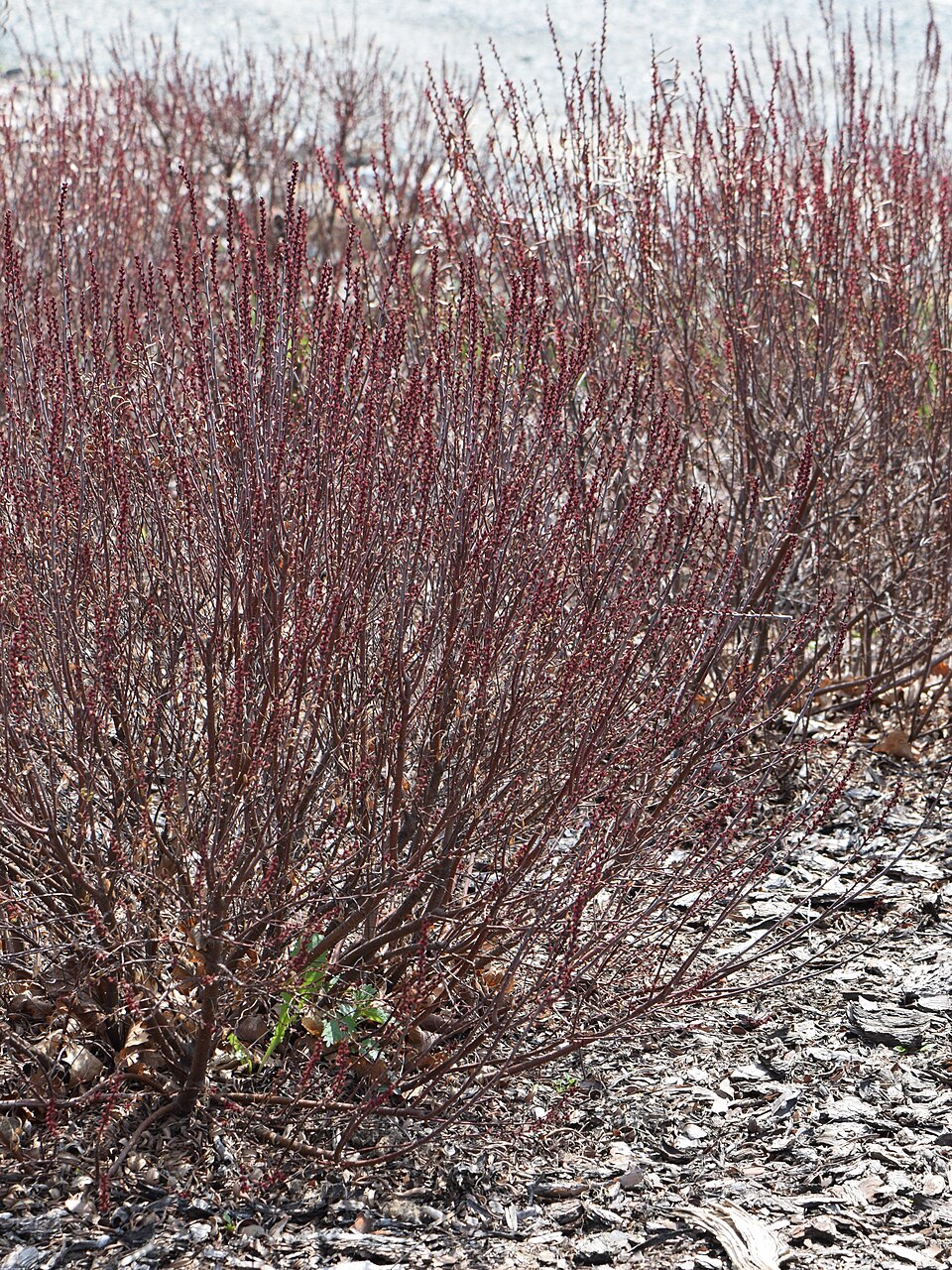
Sweetgale is a bushy, multi-stemmed deciduous to semi-evergreen shrub, typically growing 2 to 4 feet (60–120 cm) tall, occasionally reaching 5 feet in ideal conditions. The plant spreads both by suckering from the root system and by layering where branches touch moist substrate, forming dense thickets over time. The overall form is dense, rounded, and highly uniform — creating a compact, tidy appearance even without pruning. The shrub is immediately recognizable by its strong, sweet-resinous fragrance, which is released whenever the foliage is disturbed or crushed.
Stems & Structure
The stems are upright, reddish-brown to gray, covered with small yellowish resin glands that are visible with a hand lens and contribute to the plant’s fragrance. Young stems are slender and flexible; older stems are woody and gray-brown. The branching is dense and somewhat upright, creating the characteristic bushy habit. The bark is smooth and thin, with a pleasant scent. The plant forms a spreading root system from which root suckers arise, gradually expanding the colony. Root nodules contain the nitrogen-fixing Frankia bacteria that allow the plant to grow in nutrient-poor peat.
Leaves
The leaves are simple, alternate, and deciduous (or semi-evergreen in milder climates), 1 to 2 inches (2.5–5 cm) long and ½ to 1 inch wide, narrowly oblanceolate to spatula-shaped, with a rounded or notched tip and toothed margins in the upper half. The leaf surface is dark green and somewhat lustrous above; paler beneath. Both surfaces are covered with small, yellowish resin glands that make the leaves slightly sticky and intensely aromatic — the sweet, spicy, somewhat medicinal fragrance is one of the most distinctive scents in the northeastern flora. The fragrance is strongest on warm days and when leaves are crushed. In autumn the foliage turns warm golden-yellow before dropping.
Flowers & Fruit
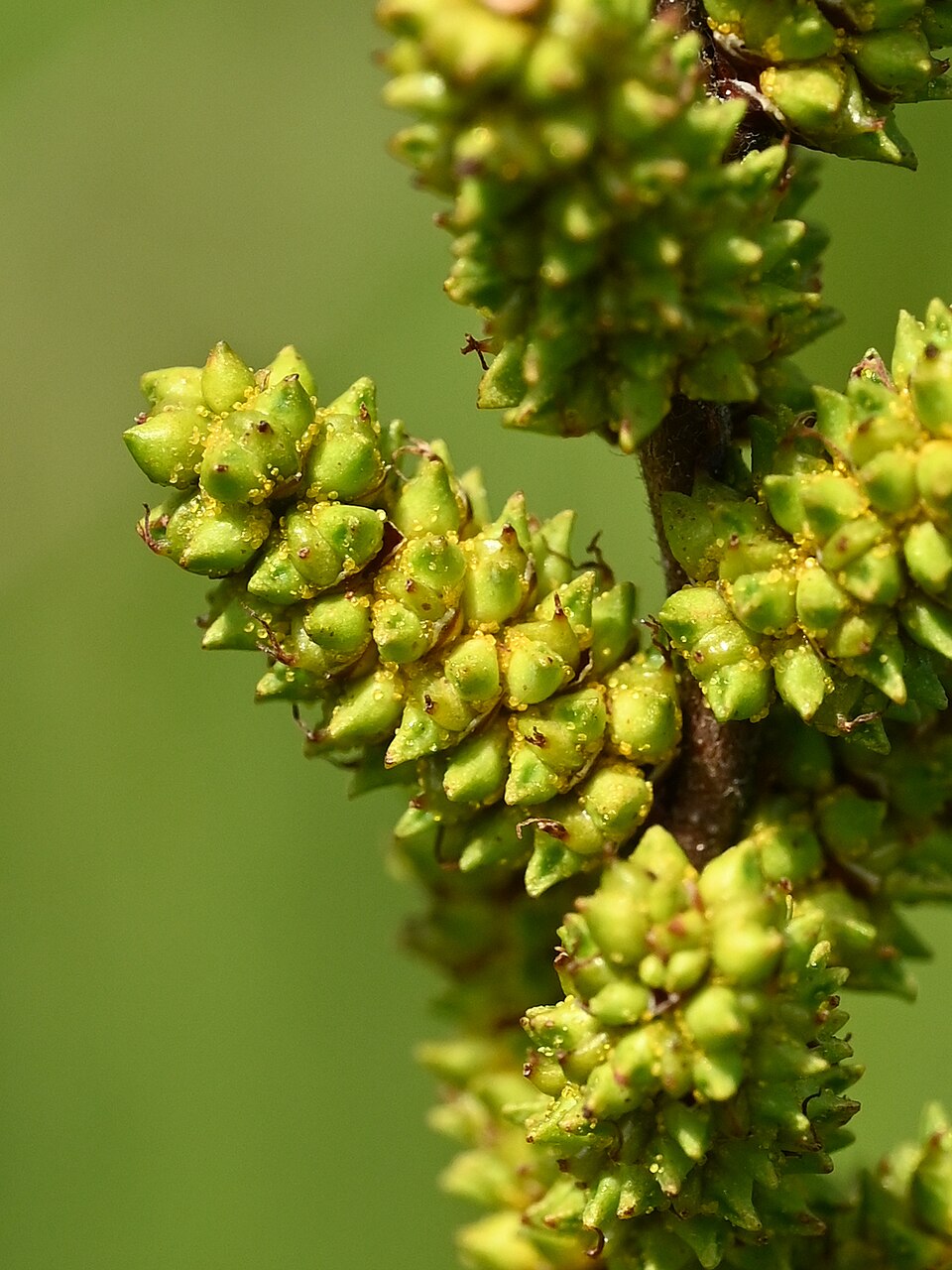
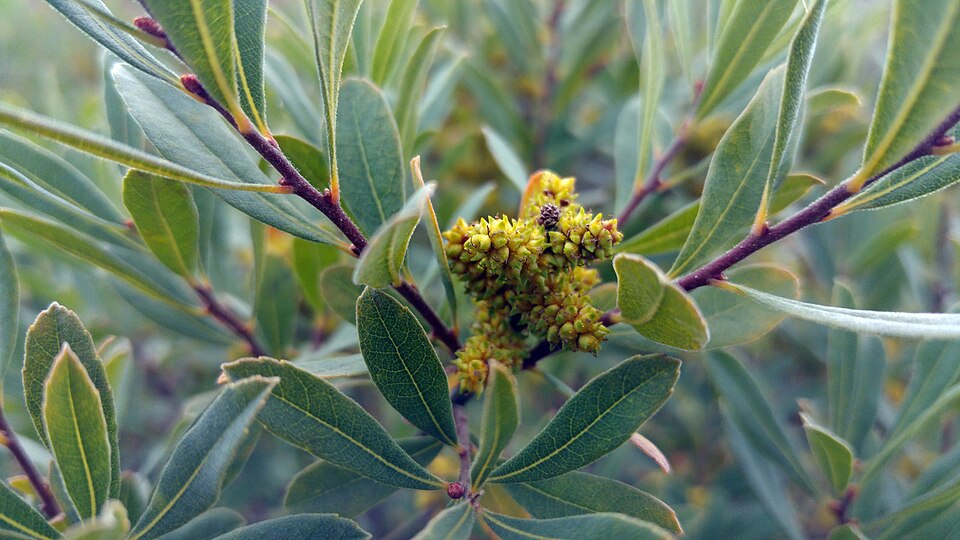
Sweetgale is typically dioecious (separate male and female plants), though some individuals bear both sexes. The flowers appear before or with the first leaves in early spring — March to May depending on location — as small, dense catkins. Male catkins are orange-brown, ¼ to ½ inch long, and release abundant wind-borne pollen; female catkins are greenish, shorter, and develop into small, waxy, aromatic cone-like fruit clusters after pollination. The fruit clusters — technically compound drupes covered in yellow resin glands — are ¼ inch long, waxy, and fragrant, arranged in dense, beadlike strings along the branches. They ripen in late summer and persist through winter, providing wildlife food and winter interest. The waxy fruit coating was historically used as a source of fragrant wax for candles.
Quick Facts
| Scientific Name | Myrica gale |
| Family | Myricaceae (Bayberry Family) |
| Plant Type | Deciduous Shrub (sometimes semi-evergreen) |
| Mature Height | 4 ft |
| Sun Exposure | Full Sun |
| Water Needs | Low to Moderate |
| Soil Requirements | Acidic, moist; pH 4.0–6.5; nitrogen-fixer |
| Bloom Time | March – May (before or with leaves) |
| Flower Type | Catkins (wind-pollinated; dioecious) |
| Fall Color | Golden yellow |
| Special Notes | Bushy plant; dark green, aromatic foliage; nitrogen fixer |
| USDA Hardiness Zones | 1–6 |
Native Range
Sweetgale is a circumpolar species with one of the widest ranges of any wetland shrub in the Northern Hemisphere, occurring naturally across North America, Europe, and Asia wherever cool, acidic wetlands persist. In North America, it ranges from Alaska east across the boreal and subarctic zones to Newfoundland and Labrador, and south into the northern and eastern United States. In New England, it is native to Maine, New Hampshire, and Vermont, where it grows in bogs, fens, bog-lake shores, and peaty wetlands.
In the United States, Sweetgale occurs in the Northeast (south through New England and into Pennsylvania, New Jersey, and Maryland), the Great Lakes states (Michigan, Wisconsin, Minnesota), and the Pacific Northwest (Oregon, Washington, and Alaska), where coastal bog habitats support it. It is absent from much of the interior United States and the South. The species reaches its southern limits in the eastern Appalachians of North Carolina and in the Pacific Coast ranges, where suitable acidic bog habitats exist at higher elevations.
Sweetgale’s circumpolar distribution reflects its ancient origin in the boreal wetland flora — a community that survived the last glaciation in refugia and then recolonized vast areas of northern North America as the ice sheets retreated. The species grows in habitats ranging from tundra pond margins in Alaska to coastal bogs in Maine and Ireland to mountain valley bogs in Scotland and Scandinavia, demonstrating remarkable ecological breadth within its preferred acidic, wet, cool growing conditions.
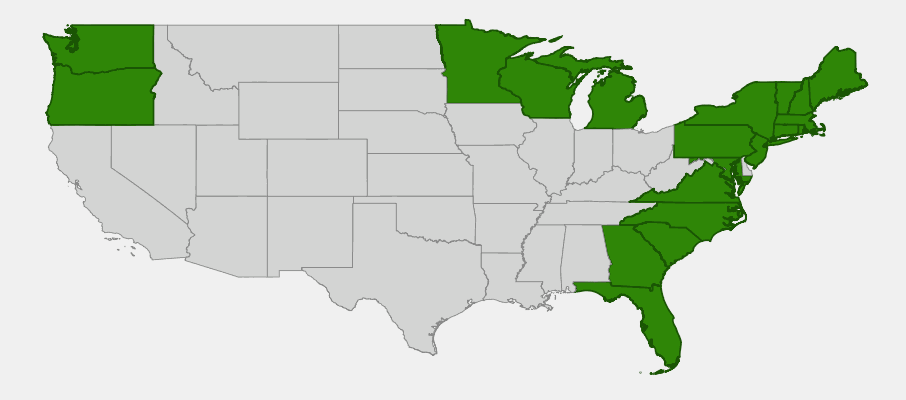
📋 Regional plant lists featuring Sweetgale: New England
Growing & Care Guide
Sweetgale is a remarkably adaptable native shrub within the range of conditions it tolerates. Once established in suitable acidic, moist soil, it is virtually self-maintaining, spreading steadily to fill available space. The key is providing the acidic conditions it requires — without those, the plant will struggle regardless of how much water and care it receives.
Light
Sweetgale grows best in full sun, where it develops the densest, most compact form and the most vibrant aromatic foliage. In its natural habitat it often grows in open bog conditions with abundant light. It will tolerate very light shade — such as the dappled light at the edge of a Black Spruce or Tamarack canopy — but becomes more open and less aromatic in shadier conditions. For gardens, full sun to very light shade is ideal.
Soil & Water
Sweetgale requires moist, acidic soil with pH between 4.0 and 6.5. It grows naturally in waterlogged peat bogs — conditions that would kill most shrubs — but also in somewhat drier, simply moist, acidic soils along bog margins and stream banks. The critical factor is soil acidity; adequate moisture is also important, especially during establishment. Unlike the most extreme bog specialists (Bog Rosemary, Bog Laurel), Sweetgale can tolerate a somewhat wider range of moisture conditions, from saturated peat to simply moist, acidic, humus-rich soil. This makes it more adaptable to garden situations. Amending soil with sphagnum peat to lower pH is often the most practical approach in standard garden settings.
Planting Tips
Plant Sweetgale in spring or early fall. Container-grown stock is the most widely available form. Prepare the site with a generous amendment of sphagnum peat moss worked into the planting area to lower pH and improve moisture retention. Space plants 3–4 feet apart to allow for their spreading, colony-forming growth habit. For a naturalistic bog garden or wet margin planting, group Sweetgale with Leatherleaf, Labrador Tea, wild cranberry, and sedges for an authentic New England bog community. Plant both male and female individuals for fruit production — they are visually identical; buy plants that are already fruiting (female) or from a nursery that identifies sex.
Pruning & Maintenance
Sweetgale requires almost no maintenance. Its naturally dense, rounded form rarely needs pruning. If the plant spreads more than desired, cut back individual stems to the ground in late winter. The dense root system and suckering habit make it difficult to completely remove once established, so site it thoughtfully. The plant is highly resistant to pests and diseases. Its nitrogen-fixing ability means that fertilization is rarely needed and can actually be harmful by altering the soil chemistry and encouraging weed competition.
Landscape Uses
- Bog garden shrub layer — defining plant of northern bog landscapes
- Wet margin planting — excellent along acidic pond shores and stream banks
- Aromatic border planting near outdoor seating — natural insect repellent
- Rain garden feature — in consistently moist, acidic zones
- Wetland restoration — native bog and fen community restoration
- Natural windbreak — dense growth provides wind protection in wet settings
- Winter interest — persistent aromatic fruit clusters
Wildlife & Ecological Value
Sweetgale provides important ecological services in the northern wetland ecosystems where it grows. While its aromatic compounds deter some insects, it supports a specialized community of wildlife adapted to the bog environment.
For Birds
The waxy fruit of Sweetgale is consumed by several bird species, particularly during fall and winter migration when other food sources may be limited. Tree Swallows, Yellow-rumped Warblers, and American Robins have been documented consuming Sweetgale fruit. In its bog habitat, Sweetgale provides nesting cover and foraging habitat for Palm Warblers, Common Yellowthroats, Wilson’s Warblers, and other bog-specialist birds. The dense, multi-stemmed thickets are particularly valuable as cover for secretive marsh birds and small perching birds during poor weather. The early spring catkins attract insects that in turn attract early-migrating warblers.
For Mammals
White-tailed Deer, Moose, and Snowshoe Hares browse Sweetgale foliage and twigs, particularly in winter. Beaver occasionally harvest Sweetgale stems for dam construction and food. The plant’s dense thickets provide excellent cover for small mammals including Meadow Voles, Bog Lemmings, and shrews that inhabit wet, grassy bog margins. Muskrats and Beaver use the thickets for shelter. While the aromatic compounds in the leaves are a mild deterrent to some browsers, most northern mammals have adapted to consume Sweetgale without ill effect.
For Pollinators
Sweetgale is wind-pollinated and does not produce nectar, but its catkins release large quantities of pollen in early spring that is gathered by early-season native bees including bumblebee queens emerging from winter dormancy. Mining bees (Andrena species) that specialize in wet habitats are among the early pollinators that visit Sweetgale catkins. The plant’s role in the bog ecosystem extends beyond direct pollinator interactions — by fixing nitrogen and enriching the peat, it helps support the broader plant community that sustains the bog’s diverse insect fauna.
Ecosystem Role
Sweetgale plays a unique and important role in northern bog and wetland ecosystems through its ability to fix atmospheric nitrogen via root nodules containing the actinobacterium Frankia alni. In the nitrogen-limited environment of a sphagnum bog — where most other shrubs survive on the meager nutrients that arrive through rainfall — Sweetgale’s nitrogen-fixing ability gives it a significant competitive advantage and allows it to contribute fixed nitrogen to the surrounding ecosystem through leaf litter decomposition. This nitrogen subsidy is important for neighboring plants and for the invertebrate decomposer community in the bog. The dense thickets Sweetgale forms also provide important physical structure — thermal cover, nest sites, and hiding places — in what would otherwise be a relatively open, exposed bog surface.
Cultural & Historical Uses
Sweetgale has one of the richest ethnobotanical histories of any bog plant, reflecting its ancient and intimate relationship with northern peoples on both sides of the Atlantic. In Britain, where it is known as Bog Myrtle or Sweet Gale, it has been used for over 1,000 years as a flavoring for ale — before hops became the standard bittering agent for beer in the 16th century, a mixture called “gruit” that included Sweetgale, Yarrow, and Wild Rosemary was the principal bittering and flavoring agent for northern European ale. This tradition is documented from early medieval brewing records in Scotland, Ireland, Scandinavia, and the Netherlands, and has experienced a modern revival among craft brewers creating historic “gruit ales.”
Indigenous peoples of northeastern North America, including various Algonquian nations, used Sweetgale extensively. The aromatic leaves were burned as insect repellent in dwellings and camps — a use that was immediately adopted by European settlers, who discovered that bundles of Sweetgale branches kept in sleeping areas and clothing chests repelled mosquitoes, fleas, and moths. This insect-repelling use was particularly valued in northern regions where biting insects were a significant seasonal problem. The aromatic compounds responsible — primarily myrcene, caryophyllene, and other terpenoids — have been confirmed in modern phytochemical studies to have insect-repellent properties.
The waxy coating on Sweetgale’s fruit was historically collected and rendered into a fragrant wax used for candle-making, in the same manner as the more widely known Bayberry (Morella caroliniensis, also in the Myricaceae family). Sweetgale candles burn with a pleasant, spicy fragrance. The leaves were also used to make a refreshing tea (in moderation), as a condiment in cooking (the flavor is somewhat like bay leaf with a resinous note), and in folk medicine as a treatment for skin conditions and digestive complaints. In northern Scotland and Norway, Sweetgale was used in tanning leather and as a natural yellow dye for wool.
The genus name Myrica derives from the Greek word for a fragrant shrub; the species name gale comes from the Old English gagel, one of the plant’s common names in Britain. The plant is one of the only members of the Myricaceae family with a circumpolar distribution — most of its relatives are tropical or warm-temperate — which reflects its specialization in the cold bog habitats that form a circumpolar belt around the top of the world.
Frequently Asked Questions
Does Sweetgale actually repel mosquitoes?
Yes — to a meaningful degree. The aromatic compounds in Sweetgale leaves (primarily myrcene, limonene, and other terpenoids) have been shown in scientific studies to have measurable insect-repellent properties, particularly against mosquitoes, midges, and flies. Rubbing crushed leaves on exposed skin provides temporary protection against biting insects. The effect is shorter-lived than DEET-based repellents, but Sweetgale is a genuinely natural alternative for minor outdoor activities. Growing it near outdoor seating or patios may help reduce the number of mosquitoes in the immediate vicinity.
Can I use Sweetgale in cooking?
Yes, in moderation. Sweetgale leaves can be used as a flavoring similar to bay leaf — they add a resinous, slightly spicy flavor to soups, stews, and roasted meats. The dried leaves and small amounts of the dried fruit are also used in craft brewing to make traditional “gruit ale.” Do not consume large quantities, as the aromatic compounds can cause headaches and mild gastrointestinal upset in some individuals. The plant has been used safely as a culinary flavoring for centuries, but moderation is advisable.
What is the difference between Sweetgale and Bayberry?
Sweetgale (Myrica gale) and Bayberry (Morella caroliniensis, formerly Myrica pennsylvanica) are both members of the Myricaceae family and share aromatic, waxy properties, but they are different species. Sweetgale is a smaller (2–4 ft), deciduous shrub of acidic bog habitats with small, narrow leaves. Bayberry is a larger (5–8 ft), semi-evergreen shrub of coastal dunes and sandy soils with broader leaves and larger fruit clusters. Both fix nitrogen, both produce waxy aromatic fruit, and both have been used for candle-making — but Bayberry is more widely known in horticulture and is better adapted to drier conditions.
Is Sweetgale invasive?
No — Sweetgale is a native species and is not invasive. It does spread by root suckers and layering to form expanding colonies, which can be vigorous in ideal conditions, but it does not spread outside of suitable acidic, wet habitats. It is often described as a “colony-forming” native shrub — normal and desirable ecological behavior that contributes to its value for wildlife habitat.
Can I grow Sweetgale in a typical garden bed?
Sweetgale will not thrive in average garden soil. It requires acidic conditions (pH 4.0–6.5) and consistent moisture. In typical neutral or alkaline garden soil, the plant will grow poorly and eventually decline. However, if you have naturally acidic soil (common in much of New England) and a moist site — such as a rain garden, bog feature, or low-lying area that stays wet — Sweetgale can be successfully grown outside its native bog habitat. Amending soil with generous quantities of sphagnum peat and maintaining moisture are the keys to success in garden settings.

Looking for a nursery that carries Sweetgale?
Browse our native plant nursery directory: Maine · New Hampshire · Vermont · Connecticut