New York Aster (Aster novi-belgii)
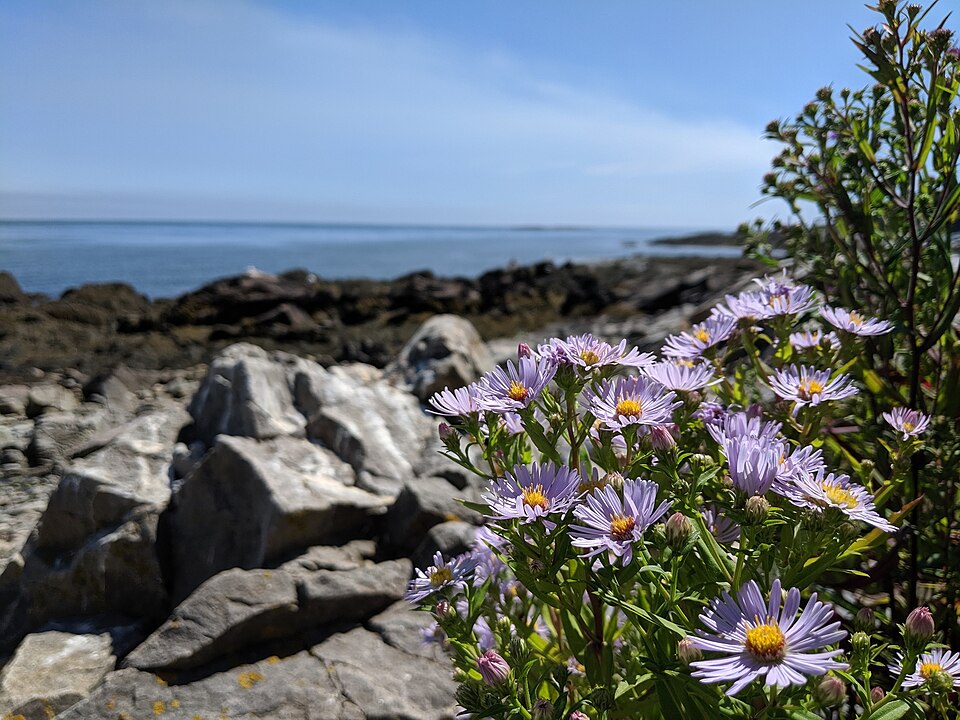
Symphyotrichum novi-belgii (formerly Aster novi-belgii), commonly known as New York Aster or New York Michaelmas Daisy, is a spectacular native perennial wildflower that lights up coastal meadows, marshes, and streambanks throughout the northeastern United States and Canada with its brilliant violet-purple blossoms each autumn. A member of the Asteraceae (daisy) family, this robust aster has been beloved by gardeners and naturalists for centuries — and its natural populations, concentrated along the Atlantic Coast and Chesapeake Bay region, are among the most important late-season nectar sources for migrating pollinators in the Mid-Atlantic states.
The scientific name recalls the Dutch colonial settlement of New Amsterdam (modern New York) — novi-belgii means “of New Belgium” in Latin, reflecting the European name for the New Netherlands territory where this plant was first documented for European science. Despite its historical association with the coastal Northeast, New York Aster grows naturally in moist meadows, marsh edges, and coastal plain wetlands throughout much of the northeastern United States, extending south through Maryland and Virginia in appropriate coastal and tidal habitats. In the Mid-Atlantic region, it is found primarily in coastal and tidal areas — a designation reflected by the “C” (coastal) comment in the plant list data.
For the native plant garden, New York Aster is an outstanding fall bloomer — flowering September through October when most perennials have finished for the season — and is one of the most important late-season nectar sources for monarch butterflies, migrating bees, and other pollinators building resources for their fall journeys. Its tall, branching stems clad with dozens of violet-purple flowers create a stunning late-season display that bridges the gap between summer’s exuberance and the quiet of winter.
Identification
New York Aster is an upright to somewhat spreading perennial herb, growing 3 to 4 feet (90–120 cm) tall at maturity, though vigorous plants in rich moist soils can reach 5 feet. The stems are smooth (hairless or nearly so) — a key feature distinguishing it from many other aster species — branching in the upper portion to create a broad, multi-flowered crown. The plant spreads by rhizomes to form clumping colonies over time.
Leaves
The leaves are alternate, simple, lance-shaped to narrowly oblong, 2 to 5 inches (5–13 cm) long, with clasping bases that wrap partially around the stem — another key identification feature. Stem leaves are smooth, slightly bluish-green to dark green, with entire or finely toothed margins. The clasping leaf bases distinguish New York Aster from many similar species. Basal leaves (often absent at flowering time) are larger and may have short petioles.
Flowers
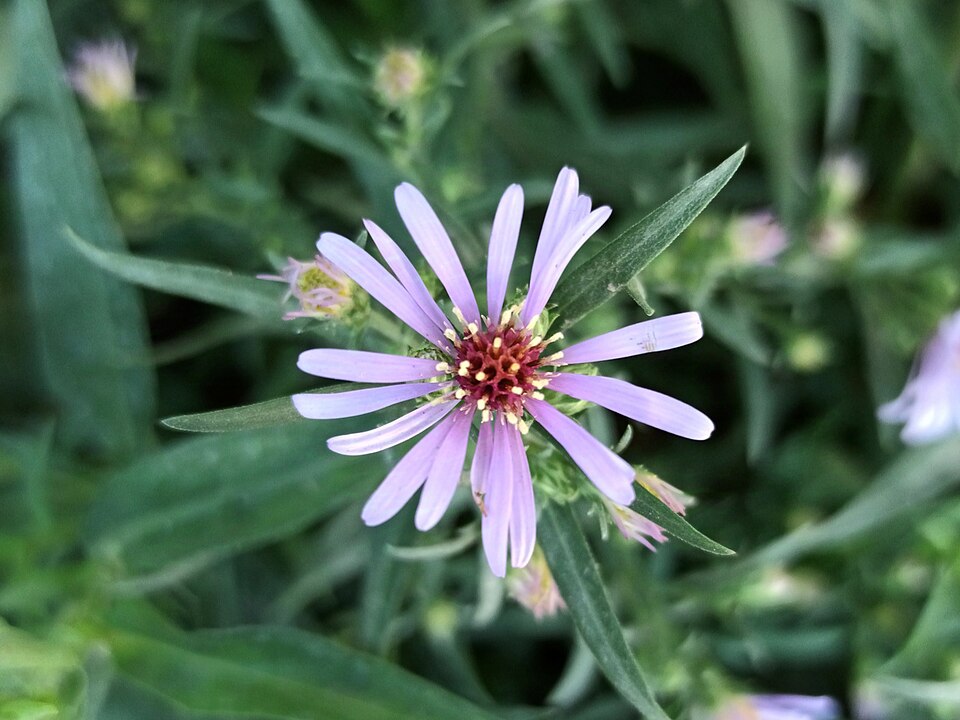
The flowerheads are classic aster form: a central disc of tiny yellow tubular flowers (disc florets) surrounded by 20 to 50 ray florets that are violet-purple to blue-violet in color, occasionally white or pink in cultivated forms. Each flowerhead is 1 to 1.5 inches (2.5–4 cm) in diameter. The involucre (the green cups beneath the flower) has narrow, linear bracts with grass-green tips that tend to spread outward or recurve — another useful identification detail. Flowering occurs September through October, occasionally into November.
Quick Facts
| Scientific Name | Symphyotrichum novi-belgii (syn. Aster novi-belgii) |
| Family | Asteraceae (Daisy) |
| Plant Type | Perennial Wildflower |
| Mature Height | 3–4 ft |
| Sun Exposure | Full Sun to Part Shade |
| Water Needs | Moderate |
| Bloom Time | September – October |
| Flower Color | Violet-purple to blue-violet |
| Fragrance | None notable |
| USDA Hardiness Zones | 4–8 |
Native Range
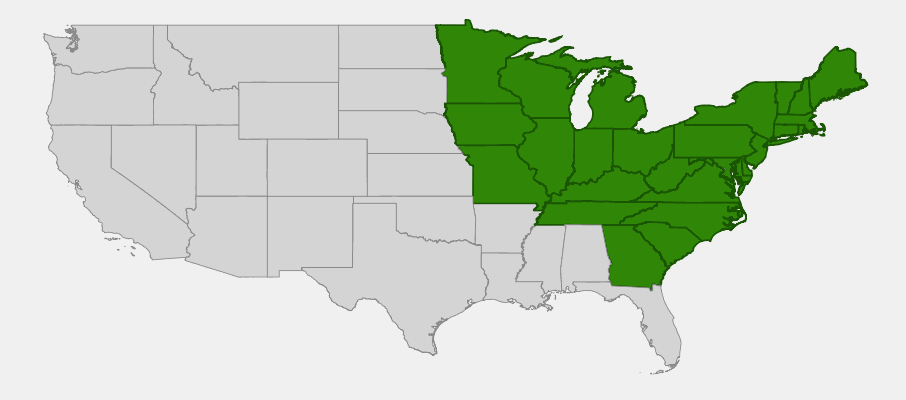
New York Aster is native primarily to the Atlantic Coast region of northeastern North America, ranging from Newfoundland south through New England, the Mid-Atlantic states, and into the coastal Carolinas. Its natural range is closely tied to coastal and near-coastal habitats — freshwater tidal marshes, coastal meadows, brackish marsh edges, and moist coastal plain soils — reflecting the “C” (coastal) designation in the Mid-Atlantic native plant list.
In Maryland and Virginia, New York Aster occurs naturally in tidal freshwater and brackish marsh margins along Chesapeake Bay tributaries and coastal plain streams. It also naturalized extensively inland in moist meadows and disturbed areas throughout the Northeast, making its precise native range somewhat difficult to delimit. The species is rare or absent in the mountains and interior uplands of the Mid-Atlantic, being primarily a coastal and piedmont plant in this region.
New York Aster has been extensively hybridized in horticulture — the “Michaelmas Daisy” garden cultivars popular in British and European gardens are largely derived from this species and its relatives. These cultivated forms have escaped into naturalized populations throughout the northeastern US and western Europe, further complicating documentation of truly wild native populations. When seeking plants for native garden use, it is important to source seed-grown or wild-type plants from local ecotypes rather than cultivated selections.
📋 Regional plant lists featuring New York Aster: Maryland, Virginia & West Virginia
Growing & Care Guide
New York Aster is a vigorous, adaptable perennial that rewards minimal care with spectacular late-season displays. In the garden, it is one of the most important plants for supporting fall pollinators — particularly monarch butterflies, bumble bees, and specialist aster bees — when flower resources are otherwise scarce.
Light
New York Aster performs best in full sun (6+ hours per day), producing the densest growth and most prolific flowering. It tolerates partial shade (4–6 hours sun) but may produce fewer flowers and develop a more open, leaning habit in shadier conditions. In the Mid-Atlantic, providing full sun ensures the best fall display and most robust plant health, reducing the risk of powdery mildew that can affect asters in shaded, poorly ventilated spots.
Soil & Water
New York Aster prefers moist, fertile soils and naturally grows in the moist meadows and marsh edges of the coastal plain. It tolerates occasional flooding and brief waterlogging but performs best in well-drained but consistently moist soil. In the garden, it can be grown in average garden soil with supplemental watering during dry periods, or planted in the moist zones of rain gardens and bioswales. It tolerates a range of soil pH from slightly acidic to neutral (5.5–7.0).
Planting Tips
Plant New York Aster in spring from container-grown stock or divisions, spacing plants 18 to 24 inches apart. For bushier plants with more flowers and less leaning, pinch back the growing tips once in early June (before July 4th) to encourage branching — a technique called “Chelsea chop” among gardeners. This reduces the plant’s final height slightly and produces a denser, more floriferous specimen. Divide clumps every 3–4 years in spring to maintain vigor.
Pruning & Maintenance
Leave spent flower heads in place through winter — the seeds provide food for goldfinches and other seed-eating birds, and the dried stems add winter structure to the garden. Cut back to 4 to 6 inches in late winter or early spring before new growth begins. The plant spreads gradually by rhizome and may need annual editing at the edges of its clump to prevent overcrowding of neighboring plants. Powdery mildew can be a cosmetic issue in humid summers — improve air circulation by planting in open areas and avoiding overhead watering.
Landscape Uses
- Fall pollinator garden — one of the most important native fall nectar plants in the Mid-Atlantic
- Coastal and tidal garden — natural fit in coastal plain gardens and rain gardens
- Meadow planting — tall, showy addition to native meadow seed mixes and plugs
- Rain garden — tolerates periodic inundation in rain garden low zones
- Butterfly garden — major fall nectar source for monarchs and other migrating butterflies
- Bird garden — seeds attract goldfinches and other finches in fall and winter
Wildlife & Ecological Value
New York Aster is one of the most ecologically productive native fall-blooming perennials in eastern North America, providing critical late-season resources for pollinators and birds at a time when most other native flowers have finished blooming.
For Birds
The seeds of New York Aster are consumed by American Goldfinch, Pine Siskin, and other small seed-eating birds through fall and winter. The dense, shrubby structure provides cover for Song Sparrow, Lincoln’s Sparrow, and other sparrow species during fall migration. The insect activity around the blooming flowers attracts warblers and other insectivorous migrants in September and October.
For Mammals
White-tailed Deer browse New York Aster foliage and flowers — it is considered moderately susceptible to deer browsing where deer pressure is high. Rabbits may browse young growth in spring. The seeds are occasionally consumed by small mammals including mice and voles. The clumping habit creates some ground-level cover for small mammals in natural settings.
For Pollinators
New York Aster is an extraordinarily important late-season pollinator plant. Monarch butterflies use asters as a critical fuel stop during their fall migration south — studies have documented monarchs nectaring on asters for multiple days in the Mid-Atlantic during the peak fall migration (September–October). Specialist native bees in the genus Andrena (aster mining bees) and Colletes (polyester bees) are oligolectic on asters, meaning aster pollen is their exclusive food source — these bees are entirely dependent on wild asters for survival. Bumblebee queens in late fall rely on asters as a final nectar source before winter dormancy.
Ecosystem Role
In coastal plain wetland margins and meadow ecosystems, New York Aster is a foundational late-successional perennial that stabilizes disturbed soils and provides long-season structural habitat. Its fall bloom fills a critical phenological gap — the period after goldenrods peak and before the first hard frosts — when pollinator food resources are otherwise extremely limited. By supporting late-season pollinators, asters indirectly benefit the entire pollinator community that depends on Mid-Atlantic ecosystems.
Cultural & Historical Uses
Native asters, including New York Aster, have been used medicinally by Indigenous peoples throughout eastern North America. The Cherokee used root infusions of asters for fever and headache; the Iroquois used aster preparations for fevers and sore throats. The Menominee smoked the dried leaves of native asters as part of medicinal ceremonies. While specific ethnobotanical records for Symphyotrichum novi-belgii in particular are limited, asters as a group were widely recognized as medicinal plants throughout the eastern woodland cultural tradition.
In European and American garden history, New York Aster holds a remarkable distinction: it was one of the first North American wildflowers to be brought to European gardens, arriving in Britain in the mid-17th century. It became extremely popular as an autumn-blooming garden plant and inspired the development of the “Michaelmas Daisy” tradition — the practice of having tall, profusely blooming asters flower around Michaelmas (September 29), the feast day of St. Michael in the Anglican calendar. Hundreds of named cultivars were developed from New York Aster and its relatives in British and continental European gardens by the 19th century, and these Michaelmas Daisies became a staple of Victorian and Edwardian garden design.
Today, there is growing recognition that the wild-type native forms of New York Aster are ecologically superior to the garden cultivars for supporting specialist native bees and other wildlife. Conservation-minded gardeners and restoration practitioners increasingly seek out locally sourced seed-grown plants of this and other aster species, understanding that the ecological relationships these plants support were built over millions of years of co-evolution with native insects and wildlife — not just a few centuries of horticultural selection.
Frequently Asked Questions
Is New York Aster the same as Symphyotrichum novi-belgii?
Yes — the plant is known by both names. Aster novi-belgii is the older name, now superseded by Symphyotrichum novi-belgii in modern taxonomy. Both names refer to the same plant. The reclassification of North American asters from Aster to Symphyotrichum (and other genera) occurred in the 1990s and reflects molecular phylogenetic evidence that the true asters (Aster sensu stricto) are primarily Eurasian.
Is New York Aster good for monarchs?
Absolutely — it is one of the most important fall nectar sources for monarch butterflies during their autumn migration. Planting New York Aster and other native asters is one of the most effective things a gardener can do to support monarch migration. Plant alongside native goldenrods for the most powerful combination of fall pollinator support.
Does New York Aster need to be divided?
Yes — dividing every 3 to 4 years in early spring (when new growth is just emerging) maintains plant vigor and controls the spread of the clump. Plants that are not divided may become crowded and die out in the center. Division also provides free plants for expanding plantings or sharing with other gardeners.
Why is my New York Aster falling over?
Flopping or leaning is common in asters, especially in partial shade or rich, moist soils. To prevent this, pinch back growing tips once or twice before mid-July to encourage bushier, sturdier growth. Staking with ring supports is another option. Planting in full sun also produces more compact, upright growth.
Is New York Aster deer resistant?
No — it is moderately susceptible to deer browsing. Where deer pressure is significant, consider protecting young plants with cages or applying deer repellent early in the season. Established plants often recover from deer browsing, but repeated heavy browsing can weaken them over time.

Looking for a nursery that carries New York Aster?
Browse our native plant nursery directory: Maryland · Virginia · West Virginia