Arrow Alum (Peltandra virginica)
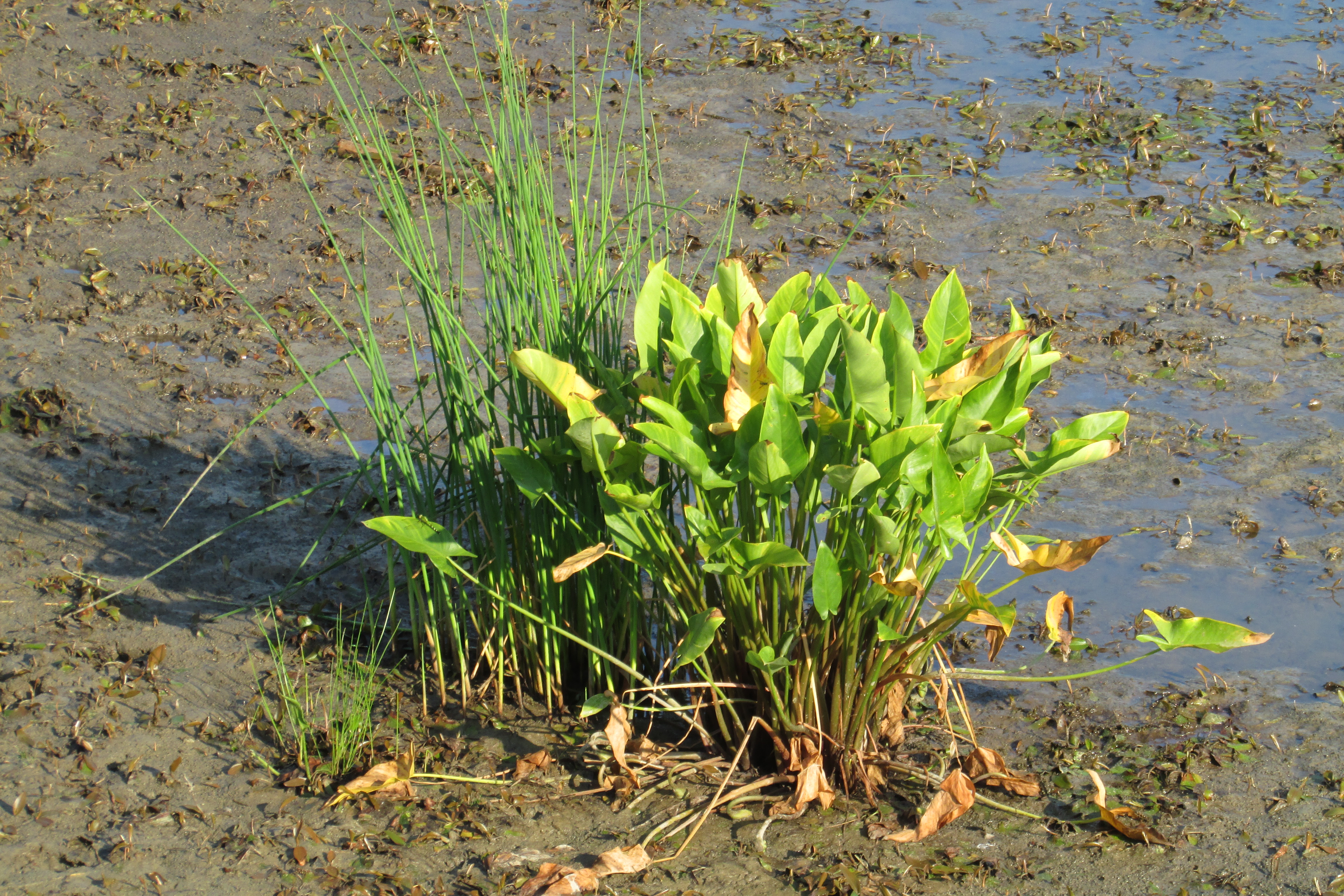
Peltandra virginica, commonly known as Arrow Alum, Green Arrow Arum, or Virginia Tuckahoe, is one of the most visually striking emergent aquatic plants of the eastern United States. A member of the Araceae (Arum) family, this robust perennial rises from the muddy bottoms of marshes, swamps, ponds, and slow-moving streams, sending up large, dramatically arrow-shaped leaves that can reach two feet in length. Its common name “Arrow Alum” is a tribute to the plant’s strikingly arrow-shaped leaf form, a classic silhouette instantly recognizable to wetland ecologists and naturalists throughout its native range.
Unlike many of its exotic relatives in the Araceae family, Arrow Alum is a purely native plant of eastern North America, occurring naturally from southern Ontario and Quebec south to Florida, and west to Michigan and Texas. It is an important component of freshwater marsh ecosystems, providing food and shelter for a wide variety of wetland wildlife. Waterfowl, particularly wood ducks and mallards, consume the large greenish berries enthusiastically in late summer and fall. Meanwhile, its dense leafy growth creates vital spawning cover for frogs, turtles, and fish in shallow water environments.
Arrow Alum is increasingly valued in ecological restoration and rain garden design, where its bold architectural form makes it as much a landscaping statement as a conservation tool. Unlike many aquatic plants, Arrow Alum is non-invasive within its native range and rarely becomes a nuisance. Its ability to tolerate a range of water depths — from boggy wet soils to standing water 6 inches deep — makes it one of the most versatile native emergent plants available for pond edges, rain garden overflow zones, and wetland buffer plantings along stream corridors.
Identification
Arrow Alum is an emergent perennial that grows from a thick, starchy rhizome or corm buried in the substrate. The plant typically reaches 1 to 2 feet in height above the water surface, with leaves often arching outward dramatically. Its bold, arrowhead shape makes Arrow Alum one of the easiest native wetland plants to identify — once seen, it is rarely forgotten.
Leaves
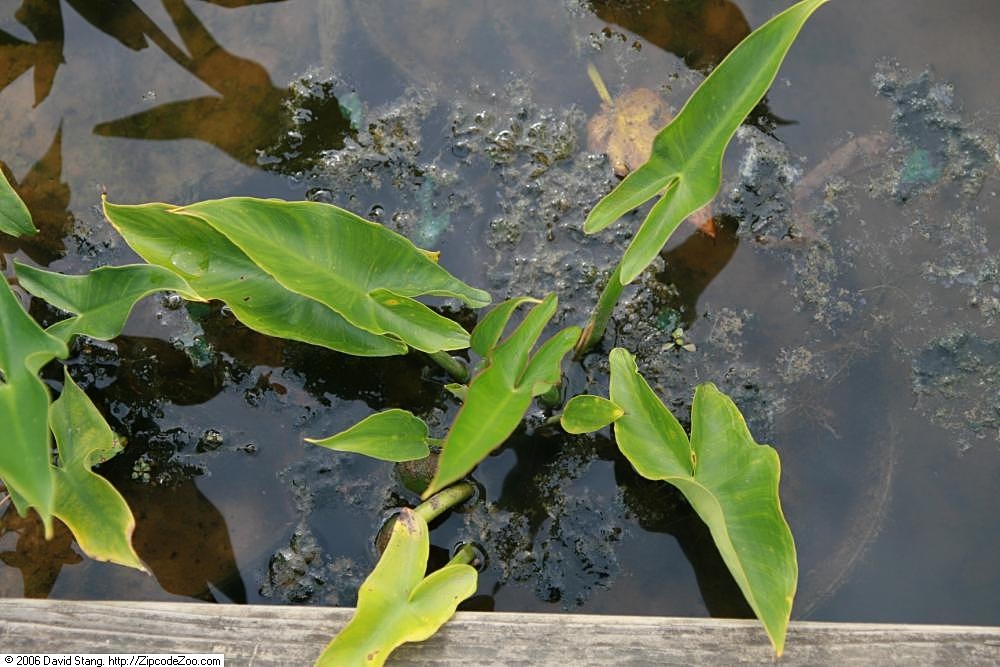
The leaves are the most distinctive feature of Arrow Alum. They are large — typically 8 to 24 inches long — and deeply sagittate (arrow-shaped), with two prominent downward-pointing basal lobes flanking the leaf base. The leaf surface is a deep, lustrous green and leathery in texture, with prominent parallel venation. Leaf petioles (stalks) are long, sheathing, and spongy, allowing the plant to maintain buoyancy in shallow water. New leaves emerge in spring from the central rosette, unfurling in an elegant coiled spiral before expanding to full size.
Flowers & Fruit
Arrow Alum flowers from April through June. The inflorescence is a typical arum-type structure: a pale green, tubular spathe 4 to 7 inches long that encloses a spadix bearing minute, densely packed flowers. The spathe is pale green to whitish-green, and tightly furled around the bottom where the female flowers are located, with male flowers clustered above. Pollination is achieved by small insects attracted to the spadix. After pollination, the spathe withers and the female portion of the spadix develops into a cluster of dark, olive-green to reddish-brown berries, each about ¼ to ½ inch in diameter, enclosed within a fleshy green sheath. The berries ripen by late summer and are eagerly consumed by waterfowl and other wildlife.
Quick Facts
| Scientific Name | Peltandra virginica |
| Family | Araceae (Arum) |
| Plant Type | Emergent Aquatic Perennial |
| Mature Height | 1–2 ft |
| Sun Exposure | Full Sun to Part Shade |
| Water Needs | Low (Drought Tolerant) |
| Bloom Time | April – June |
| Flower Color | Greenish-white (spathe) |
| Fruit | Dark olive-green to reddish-brown berries |
| Soil Type | Wet, muddy, or mucky; tolerates standing water |
| USDA Hardiness Zones | 4–9 |
Native Range
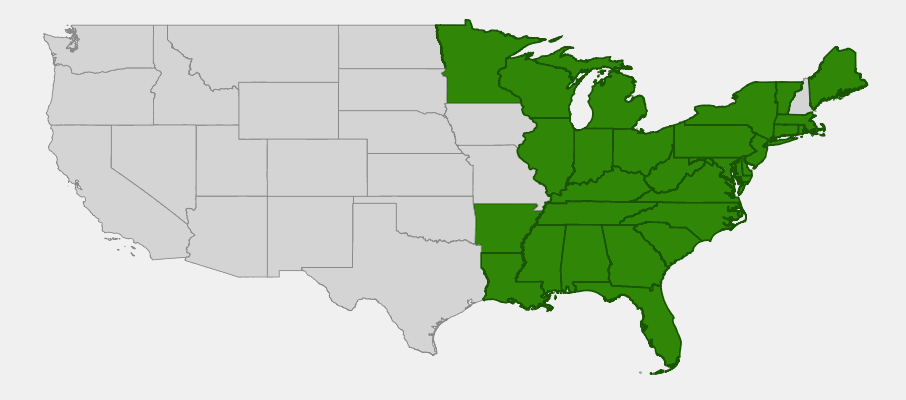
Arrow Alum is native to a broad swath of eastern North America, ranging from southern Ontario and Quebec in the north south through New England, the Mid-Atlantic states, the Southeast Coastal Plain, and the Gulf Coast to Florida and Louisiana. The western edge of its range reaches into the Midwest states including Michigan, Indiana, Illinois, and Missouri. Populations also occur in Arkansas and Texas, making it one of the more widespread native aquatic plants in eastern North America.
Throughout its range, Arrow Alum is intimately associated with freshwater wetland systems — marshes, swamps, ponds, lake shores, and the quiet margins of slow-moving streams and rivers. It is especially common in Coastal Plain wetlands from New Jersey south through the Carolinas and Florida, where extensive lowland marsh systems provide ideal habitat. Inland populations are frequently associated with floodplain swamps, beaver ponds, and forested wetlands in the Piedmont and Appalachian foothills.
In the Mid-Atlantic region — including Maryland, Virginia, and West Virginia — Arrow Alum is a characteristic species of freshwater tidal marshes, non-tidal marshes, beaver meadows, and sluggish stream margins. It often forms dense stands in shallow water zones along the edges of waterbodies, particularly where water depth remains relatively stable through the growing season. Its presence is a reliable indicator of high-quality, undisturbed freshwater wetland habitat.
📋 Regional plant lists featuring Arrow Alum: Maryland, Virginia & West Virginia
Growing & Care Guide
Arrow Alum is a rewarding native plant for anyone with a pond, rain garden, or consistently wet area to fill. Its tolerance for variable water depth and its bold, architectural foliage make it both functional and ornamental. Once established, it requires essentially no care and will persist indefinitely in appropriate wetland conditions.
Light
Arrow Alum thrives in full sun to part shade, making it adaptable to a range of pond-edge and rain garden situations. In full sun, plants develop the most robust growth and the largest leaves. In part shade — such as the edge of a forested wetland or the north side of a building — plants grow somewhat more slowly but remain healthy and produce their characteristic inflorescences reliably each spring. Deep shade should be avoided, as it reduces flowering and overall vigor.
Soil & Water
In nature, Arrow Alum grows in wet to saturated, muddy soils and can tolerate standing water up to 6 to 10 inches deep. For pond-edge planting, set plants at the water margin where water depth ranges from 0 to 6 inches. It grows equally well in heavy clay soils, peaty muck, and silty loam typical of floodplain settings. The plant is not suitable for dry, well-drained garden conditions — it requires consistently wet to wet-saturated soil throughout the growing season. Despite this, established plants can sometimes tolerate brief dry periods in mid-summer without significant damage.
Planting Tips
Plant Arrow Alum rhizomes or containerized plants in spring or early summer, when water temperatures are warming and growth is active. Set the rhizome just below the soil surface at the pond edge or in shallow water. Space plants 18 to 24 inches apart for a naturalistic stand effect; they will slowly spread by rhizome to fill gaps. Arrow Alum can also be grown in submerged containers filled with heavy topsoil or clay — a useful strategy for decorative pond plantings where soil depth is limited.
Pruning & Maintenance
Arrow Alum is essentially maintenance-free once established. The leaves die back to the rhizome each winter and emerge again in spring. In naturalistic plantings, leave the dead foliage in place — it provides winter cover for wildlife and the nutrient cycle returns organic matter to the soil. In formal pond settings, dead foliage can be cut back to the soil level in late fall or early spring before new growth emerges. Division of crowded clumps every 5 to 7 years helps maintain vigor; this is best done in early spring.
Landscape Uses
Arrow Alum’s bold form and ease of care make it valuable in multiple landscape settings:
- Pond and lake edges — the classic use; creates a naturalistic shoreline buffer
- Rain gardens — excellent in overflow zones that remain wet for extended periods
- Freshwater wetland restoration — a native alternative to invasive cattails in marsh restoration
- Stormwater management — planted in bioswales, retention basins, and wet ditches
- Tidal freshwater gardens — tolerates the fluctuating water levels of freshwater tidal zones
- Wildlife gardens — exceptional value for waterfowl, frogs, and turtles
Wildlife & Ecological Value
Arrow Alum plays an outsized role in freshwater wetland food webs, particularly in the Mid-Atlantic region. Its dense foliage, berries, and rhizomes are all important food sources, and the plant’s growth form provides critical shelter and nesting structure for wetland wildlife throughout the year.
For Birds
The olive-green to reddish-brown berries of Arrow Alum are an important late-season food source for dabbling ducks, particularly Wood Ducks and Mallards, which consume the large fruits directly from the plant or pick them up from the water surface after they fall. Wading birds, including Great Blue Herons, frequently forage for frogs and fish in the shallow-water zones where Arrow Alum grows. The dense emergent stands also provide loafing and roosting cover for rails, bitterns, and other secretive marsh birds.
For Mammals
Muskrats and beaver regularly feed on the starchy rhizomes and lower stems of Arrow Alum, which are rich in carbohydrates. White-tailed deer occasionally browse the foliage along wetland margins, though the plant’s mucilaginous, slightly irritating sap generally discourages heavy deer browsing. River otters use the dense stands as resting and hiding cover when traveling along stream corridors.
For Pollinators
The inflorescence of Arrow Alum attracts small specialized pollinators — primarily small bees, flies, and beetles — that are drawn to the spadix by subtle odor cues. The bloom structure provides thermal warmth to visiting pollinators on cool spring days through heat-generating chemistry (thermogenesis), a fascinating trait shared with other arums. The plant supports niche early-season pollinator diversity in wetland ecosystems.
Ecosystem Role
Arrow Alum is a structural cornerstone of freshwater marsh ecosystems. Its dense stands stabilize muddy shorelines, reducing erosion and filtering nutrients from runoff before they reach open water. The leaf litter and rhizome decomposition contribute organic matter to the wetland substrate, supporting the invertebrate communities (midges, mayflies, caddisflies) that are the base of the aquatic food web. The dense stand structure creates the complex habitat mosaic that supports high levels of aquatic biodiversity.
Cultural & Historical Uses
Arrow Alum has a long history of use by Indigenous peoples of eastern North America, who recognized both its utility and its hazards. The rhizomes and berries of the plant contain calcium oxalate crystals — the same compound responsible for the burning sensation of raw taro root — which must be removed by thorough cooking before the plant is edible. Despite this preparation requirement, Arrow Alum rhizomes, known as “tuckahoe” in the Algonquian languages, were an important emergency food source for many Eastern Woodland tribes, particularly during winter and early spring when other foods were scarce.
The name “Tuckahoe” appears in the historical records of early Virginia colonists, including the journals of Captain John Smith (1612), who described watching Indigenous people harvest the roots from swamps. The Powhatan Confederacy and other Tidewater peoples processed the roots by prolonged drying and roasting to neutralize the calcium oxalate, then ground them into a coarse flour used to make a nutritious bread. Early European colonists in dire straits sometimes resorted to eating tuckahoe as well, though accounts suggest the preparation methods were not always fully mastered.
In traditional medicine, various parts of Arrow Alum were used by some Native American groups to treat skin ailments and as a topical antiseptic. The astringent properties of the root were used to treat sore throats and as a mouth rinse. Modern ethnobotanical research has confirmed the presence of several biologically active compounds in the plant’s tissues, though it is not used therapeutically in contemporary herbal medicine. Today, Arrow Alum is valued primarily as an ecological plant for wetland restoration and native habitat gardening.
Frequently Asked Questions
Is Arrow Alum the same as Taro?
No, though they are relatives in the Araceae family. Arrow Alum (Peltandra virginica) is native to eastern North America, while Taro (Colocasia esculenta) is a tropical Asian plant grown as a food crop. Both contain calcium oxalate and require thorough cooking before the roots are edible. Arrow Alum is much smaller and better adapted to cold-winter climates.
Can I grow Arrow Alum in a container pond?
Yes — Arrow Alum grows very well in containers submerged in decorative ponds and water features. Plant it in a wide container filled with heavy topsoil or aquatic planting mix and set the container so the soil surface is at or just below the water surface. Container planting also makes it easy to control its spread in formal water gardens.
Is Arrow Alum invasive?
No. Arrow Alum is a well-behaved native plant within its natural range. It spreads slowly by rhizome but does not become aggressively weedy or displace other native wetland species the way non-native invasives like Phragmites or Purple Loosestrife do. In fact, in some areas, Arrow Alum is planted specifically to help displace invasive plants in wetland restoration projects.
How deep can Arrow Alum grow in water?
Arrow Alum grows best in water depths of 0 to 6 inches, but can tolerate depths up to about 10 to 12 inches under optimal growing conditions. It grows most robustly at water margins where the soil is always wet but water depth is relatively shallow. Very deep water limits its growth and flowering.
Will deer eat Arrow Alum?
Arrow Alum is generally considered deer-resistant because the calcium oxalate crystals in its tissues cause an immediate burning sensation in the mouth. Deer occasionally nibble the foliage but typically move on quickly. It is a better choice than many non-native aquatic plants for gardens in high deer-pressure areas near wetlands.

Looking for a nursery that carries Arrow Alum?
Browse our native plant nursery directory: Maryland · Virginia · West Virginia