Eastern Gamagrass (Tripsacum dactyloides)

Tripsacum dactyloides, commonly known as Eastern Gamagrass, is one of the most ecologically significant and visually impressive native grasses of North America. A close relative of corn (Zea mays), this massive warm-season bunchgrass forms bold, fountain-like clumps of arching blue-green foliage reaching 4 to 8 feet in height, making it one of the most dramatic native grasses available for the landscape. Its name “gamagrass” is believed to be a corruption of “gama grass,” a Spanish term for a forage grass, reflecting its historical importance as a high-quality livestock forage in the tallgrass prairies and savannas of the eastern United States.
Once a dominant component of vast tallgrass prairie and savanna ecosystems that stretched from the Atlantic Coast to the Great Plains, Eastern Gamagrass has been dramatically reduced in its natural range by the conversion of prairie and wetland meadow habitat to agriculture and urban development. Like many native prairie grasses, it thrives with fire and recovers rapidly after burning — a trait that sustained its dominance in pre-settlement landscapes managed with fire by Indigenous peoples for millennia. Today, Eastern Gamagrass is recognized as an outstanding native ornamental grass for large-scale landscapes, rain gardens, streambank stabilization, and prairie restoration, as well as a superior forage grass for conservation grazing systems.
Eastern Gamagrass is also notable for its deep, extensive root system — described by some researchers as reaching 6 to 12 feet deep or more — which makes it exceptionally effective for carbon sequestration, soil building, and erosion control. The plant’s thick rhizomes form dense, erosion-resistant mats that can anchor stream banks and stabilize steep slopes, while simultaneously filtering runoff and building organic matter in the soil. These qualities, combined with its outstanding wildlife value for birds and small mammals, make Eastern Gamagrass one of the most ecologically productive native plants available for landscape use.
Identification
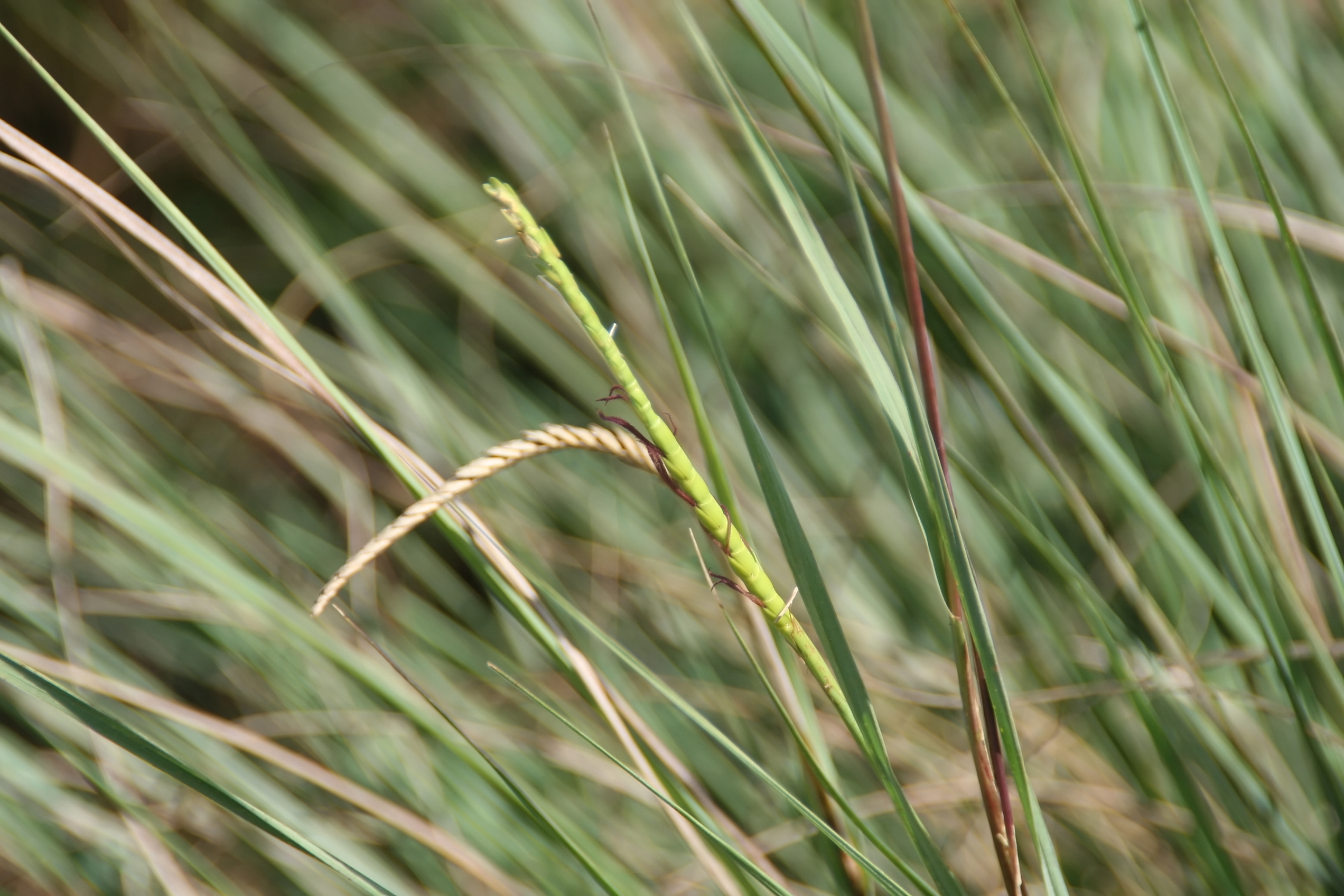
Eastern Gamagrass is unmistakable in the landscape due to its sheer size and distinctive growth habit. It forms large, dense clumps or colonies from a system of thick, knotty rhizomes, with arching, strap-like leaves and distinctive rope-like flowering stalks. Its closest relative, corn, is immediately evident in the structure of its reproductive parts — the inflorescence shows the same corn-like separation of male and female flowers.
Leaves & Stem
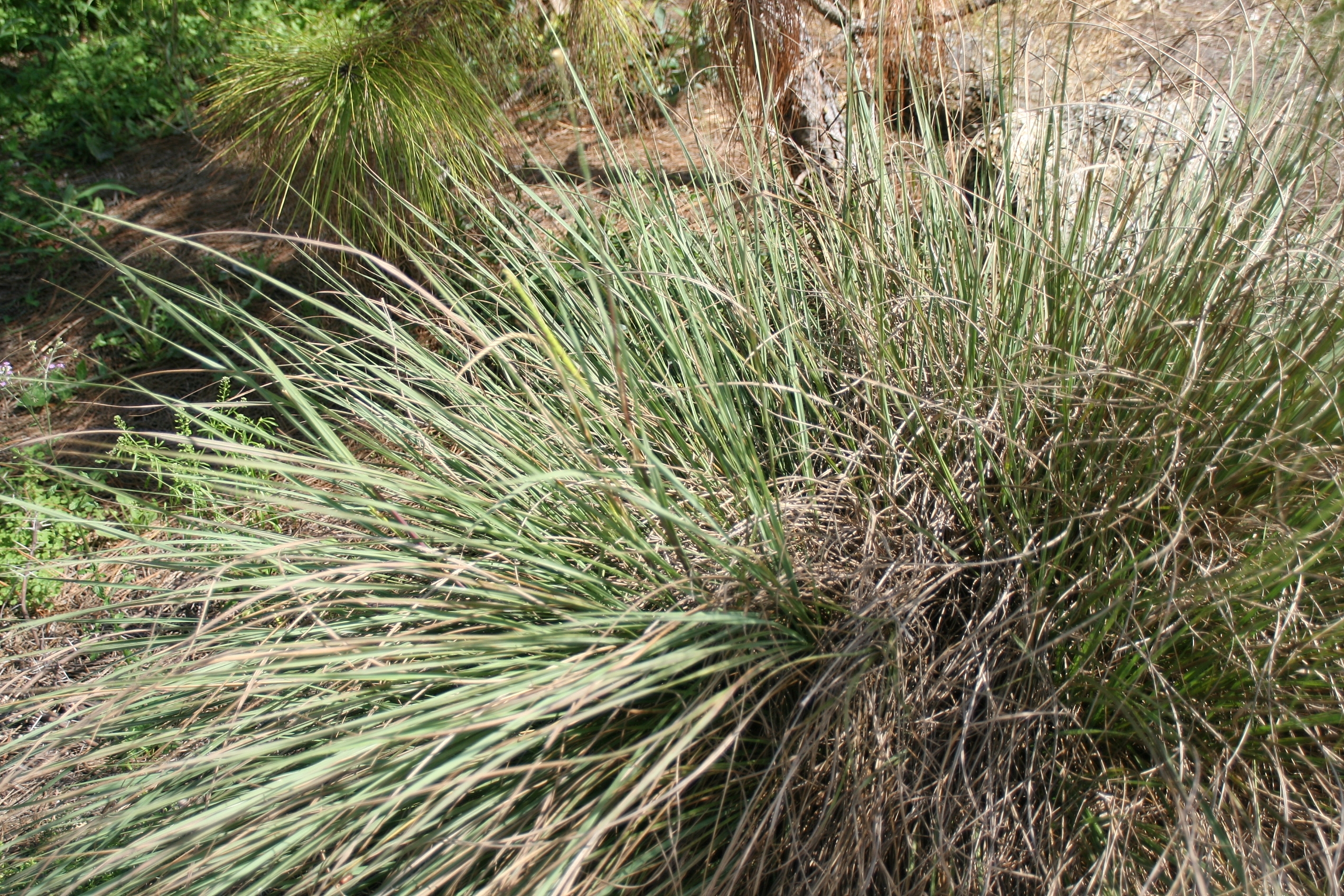
The leaves are broad, flat, and strap-like — 12 to 24 inches long and ½ to 1 inch wide — with a prominent midrib and rough-textured margins. The leaf surfaces are a distinctive blue-green to deep green color, and the midrib is often pale or whitish on the upper surface. The lower leaf sheaths are often reddish-purple at the base, a distinctive feature. Individual leaf blades are smooth to slightly rough-textured. The overall growth form is a large, arching fountain clump that can reach 4 to 8 feet in height and spread 3 to 5 feet wide at maturity.
Flowers & Seeds
Eastern Gamagrass flowers from June through August, producing distinctive rope-like flowering stalks (racemes) that extend above the foliage. Each raceme is composed of segmented, jointed sections — female flowers (pistillate spikelets) are borne in the lower, hard-cased sections, while male flowers (staminate spikelets) are borne in softer, pollen-producing sections at the top. This separation of male and female structures on the same stalk is similar to the arrangement in corn. The seed units — hard, bony, and olive-green to brownish — mature in late summer and are an important food source for birds and rodents. The plant is wind-pollinated.
Quick Facts
| Scientific Name | Tripsacum dactyloides |
| Family | Poaceae (Grass) |
| Plant Type | Warm-Season Perennial Bunchgrass |
| Mature Height | 4–8 ft (in flower) |
| Sun Exposure | Full Sun (easy to grow; evergreen in frost-free areas) |
| Water Needs | Moderate to High (once established, tolerates drought) |
| Bloom Time | June – August |
| Flower Color | Greenish-brown (wind-pollinated) |
| Foliage Color | Blue-green to deep green; often reddish-purple at base |
| Soil Type | Moist to wet; clay, loam, or sandy loam; adaptable |
| USDA Hardiness Zones | 5–9 |
Native Range
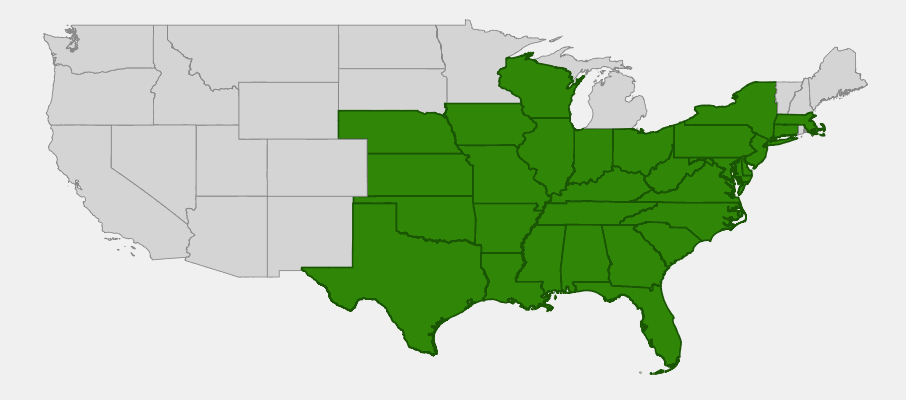
Eastern Gamagrass has one of the widest native ranges of any North American grass, occurring naturally from the Atlantic Coast westward through the Midwest and south to the Gulf Coast and into Mexico. In the eastern United States, it ranges from Connecticut, New York, and New Jersey south through the Coastal Plain and Piedmont to Florida and along the Gulf Coast to Texas. Inland populations occur throughout the Ohio Valley, Mississippi River valley, and across the prairie and savanna states of Kansas, Nebraska, Iowa, Missouri, Illinois, Indiana, and Ohio.
Originally, Eastern Gamagrass was a characteristic dominant or co-dominant species in tallgrass prairies, wet prairies, and savanna openings across an enormous area of North America. In the Mid-Atlantic region, it occurred naturally in both Coastal Plain wetland meadows and in river floodplain prairies and openings. Today, most natural populations occur in scattered remnant prairies, river floodplains, and protected natural areas, as the vast majority of its former prairie habitat has been converted to agriculture. In the Mid-Atlantic region including Maryland, Virginia, and West Virginia, it grows in moist low areas, stream margins, and open meadow settings.
Eastern Gamagrass is one of the few large native grasses that thrives in both dry upland conditions and moist lowland habitats, making it adaptable across a wide range of landscape situations. In frost-free areas of the deep South (Zone 9 and warmer), it may remain partially evergreen year-round, while in the Mid-Atlantic region it is reliably deciduous, dying back to the ground each winter and re-emerging vigorously in spring.
📋 Regional plant lists featuring Eastern Gamagrass: Maryland, Virginia & West Virginia
Growing & Care Guide
Eastern Gamagrass is a bold, architectural grass that brings drama and ecological value to large-scale landscape plantings. It is relatively easy to grow once the soil conditions are right, and its deep root system makes it exceptionally drought-tolerant after the first two establishment years. The key challenge is providing adequate moisture during establishment and managing its large, assertive growth in smaller garden spaces.
Light
Eastern Gamagrass performs best in full sun — 6 or more hours of direct sunlight per day. It can tolerate light shade but becomes increasingly open and floppy in shadier conditions, losing much of its dramatic clumping form. For best ornamental effect and maximum ecological value (seed production, pollinator support), plant in the sunniest spot available.
Soil & Water
Eastern Gamagrass is highly adaptable to soil type, growing in everything from heavy clay to sandy loam. It is most vigorous in moist to wet soils but, once established, can tolerate prolonged drought thanks to its extraordinary deep root system. During establishment (the first 2 growing seasons), consistent moisture is important — newly planted specimens require weekly watering during dry spells. Avoid extremely dry, droughty soils for the first two years. In moist to wet areas (rain gardens, pond margins, stream banks), Eastern Gamagrass thrives with minimal supplemental watering.
Planting Tips
Eastern Gamagrass can be challenging to establish from seed, which requires cold stratification. Container-grown plants from nurseries are more reliable and faster to establish. Plant in spring when soil temperatures are warming, spacing clumps 4 to 6 feet apart to allow for their large mature size. In restoration or meadow plantings, spacing can be closer (3 feet) for faster coverage. Eastern Gamagrass is an excellent choice for streambank and detention basin planting — its tough, flexible stems and deep roots resist flooding and erosion.
Pruning & Maintenance
Cut Eastern Gamagrass back to 4 to 6 inches above the ground in late winter or early spring, before new growth emerges. This removes the dead foliage and stimulates vigorous new growth from the base. Like many prairie grasses, Eastern Gamagrass benefits from periodic burning (if locally permitted) or hard cutting to mimic the fire disturbance regime it evolved with. This prevents the build-up of dead matter in the clump center and maintains vigor. Divide large, mature clumps every 5 to 8 years using a sharp spade or saw to cut through the tough rhizome mass.
Landscape Uses
- Rain garden and stormwater management — excellent for detention basins and bioswales
- Streambank stabilization — the deep, tough root system anchors eroding banks
- Prairie and meadow restoration — a dominant species in tallgrass prairie plantings
- Specimen accent grass — bold architectural statement in large landscape beds
- Wildlife garden — exceptional seed production for birds and small mammals
- Carbon sequestration — among the best native plants for deep soil carbon storage
Wildlife & Ecological Value
Eastern Gamagrass is a keystone species in tallgrass prairie and savanna ecosystems, providing critical food and habitat resources for an extraordinary diversity of wildlife. Its ecological contributions span birds, mammals, insects, and a host of soil organisms.
For Birds
The hard, bony seed units of Eastern Gamagrass are consumed by numerous granivorous birds including Dickcissel, Bobolink, Eastern Meadowlark, native sparrows (Field, Grasshopper, Savannah), and Northern Bobwhite Quail. The dense base of the clumps provides nesting cover for ground-nesting birds like Meadowlarks and Dickcissels. In winter, the persistent dead seed stalks provide food for seed-eating birds long after other food sources have been depleted.
For Mammals
Eastern Gamagrass seeds and young shoots are consumed by a variety of small mammals including meadow voles, white-footed mice, and prairie voles. The dense clumps provide cover and nesting habitat for these small mammals, which in turn support populations of hawks, owls, foxes, and other predators. White-tailed deer graze the tender new shoots in spring.
For Pollinators
While Eastern Gamagrass is wind-pollinated and not a direct nectar source, the plant supports significant insect diversity. The thick clump bases provide overwintering habitat for ground-nesting native bees and beneficial insects. Caterpillars of several grass-feeding moth and skipper butterfly species feed on the foliage, including species in the genus Poanes (Grass Skippers) that are important prairie specialist butterflies. The dense grass stands also support high populations of insects that are in turn consumed by insectivorous birds and bats.
Ecosystem Role
Few native plants can match Eastern Gamagrass for its capacity to build and protect soil. Its root system — which can extend 8 to 12 feet into the soil — pumps enormous quantities of organic matter deep into the soil profile through root turnover and exudation, building long-term soil carbon stores at a rate that exceeds most other non-woody plants. In streambank settings, the flexible stems absorb flood energy and the tough rhizome system binds soil against erosion. In restored prairies, Eastern Gamagrass is often a keystone species whose establishment enables the gradual recolonization of other prairie species.
Cultural & Historical Uses
Eastern Gamagrass holds a profound place in the agricultural and cultural history of North America. As a close relative of corn (Zea mays), it has attracted significant attention from plant breeders and agricultural scientists as a potential source of genes for improving domesticated corn — particularly for drought tolerance, perenniality, and disease resistance. Research on crossing corn with Eastern Gamagrass has been ongoing since the 1930s, and several experimental perennial grain crops based on this hybridization have been developed, though none have reached commercial scale.
For Indigenous peoples of the tallgrass prairie and Southeastern regions, Eastern Gamagrass was an important forage plant for horses and a resource in the broader prairie ecosystem that sustained bison herds — which in turn were central to the subsistence economies of many Plains and Southeastern tribes. The plant’s deep, starchy rhizomes were occasionally used as emergency food by some groups, though it was not a primary food plant. The dense grass clumps were also used for thatching and basket weaving in some cultural traditions.
During the era of European settlement and early American agriculture, Eastern Gamagrass was extensively used as livestock forage on natural pastures throughout the South and Midwest. Early agricultural reports uniformly praised it as the finest native hay and pasture grass in North America — nutritious, palatable to cattle and horses, and highly productive on moist soils. Unfortunately, its slow establishment from seed, its inability to tolerate repeated heavy grazing (unlike introduced grasses), and the conversion of prairies to cropland resulted in its near elimination from agricultural use during the 20th century. It is now experiencing a revival of interest as a conservation forage grass in sustainable livestock operations and as an ornamental native grass in ecological landscaping.
Frequently Asked Questions
Is Eastern Gamagrass related to corn?
Yes — Eastern Gamagrass (Tripsacum dactyloides) is one of corn’s closest wild relatives and belongs to the tribe Andropogoneae, the same tribal grouping that includes corn (Zea mays), Sugarcane (Saccharum), and Sorghum. The similarity of the inflorescence structure (with separate male and female sections) makes the relationship immediately apparent to anyone familiar with corn tassels and ears. Plant geneticists have studied Eastern Gamagrass extensively as a potential source of genes to improve domesticated corn.
How big does Eastern Gamagrass get?
Eastern Gamagrass is one of the largest native bunchgrasses. The foliage clump typically reaches 3 to 5 feet in height and similar width, while the flowering stems rise to 5 to 8 feet or more above the ground. In optimal conditions with rich, moist soil, exceptional specimens can approach 10 feet in height. Plan for ample space when siting this grass in the landscape.
Is Eastern Gamagrass invasive?
No — Eastern Gamagrass is a non-invasive native species within its natural range. It spreads slowly by rhizome and forms clumps rather than aggressive runners. It does not self-seed aggressively in typical garden conditions. In fact, establishing new plants from seed is challenging due to hard seed dormancy. Eastern Gamagrass is listed on several conservation priority lists due to habitat loss.
Can Eastern Gamagrass grow in wet soil?
Yes — it is one of the most water-tolerant large native grasses and thrives in moist to seasonally wet soils. This makes it ideal for rain gardens, pond margins, and stormwater areas. However, it is also drought-tolerant once established due to its deep root system, giving it an unusually wide moisture tolerance range for a single species.
When does Eastern Gamagrass emerge in spring?
Eastern Gamagrass is a warm-season grass that emerges later in spring than cool-season grasses. In the Mid-Atlantic region, expect new growth to appear in April to early May when soil temperatures consistently reach 60°F. Growth accelerates rapidly through June and July, with flowering occurring from June through August.

Looking for a nursery that carries Eastern Gamagrass?
Browse our native plant nursery directory: Maryland · Virginia · West Virginia