Maidenhair Fern (Adiantum pedatum)
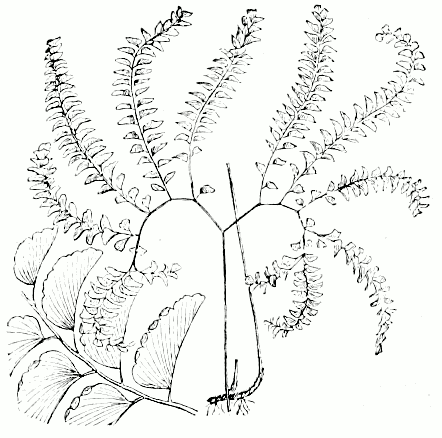
Adiantum pedatum, the Northern Maidenhair Fern, is one of the most beautiful and distinctive native ferns of North America. Its unusual architecture — dark, wiry, almost black stems that branch into a graceful, fan-like arrangement of delicate, horseshoe-shaped fronds — sets it apart from virtually every other fern in eastern forests. The name “Adiantum” comes from the Greek for “not wetting” (adiantos), referring to the leaves’ remarkable ability to repel water — raindrops bead and roll off the glossy leaflets, leaving them completely dry while surrounding vegetation drips.
A member of the maidenhair fern family (Pteridaceae), Northern Maidenhair Fern grows 1–3 feet tall in the moist, shaded understory of rich deciduous forests throughout the eastern and western United States. The fronds are arranged in a unique, two-dimensional fan or crescent shape at the top of a slender, polished, dark stem — completely unlike the typical “feather” form of most ferns. The individual leaflets (pinnules) are fan-shaped, bright green, and delicately textured, with a light, airy quality that moves beautifully in gentle breezes. The dark, shiny stems remain attractive through winter, adding a subtle ornamental quality even after the fronds die back.
Maidenhair Fern is widely considered one of the finest native ferns for woodland garden use. Its exceptional grace and architectural distinctiveness make it a standout plant in any shaded setting. It thrives in moist, rich, well-drained soils with consistent shade — conditions found in many home garden settings with mature trees. For gardeners in Delaware, New Jersey, and New York who want to add elegance and natural beauty to shade gardens, woodland paths, or the north side of buildings, Maidenhair Fern is an outstanding native choice.
Identification
Maidenhair Fern is immediately recognizable and unlike any other common fern. The most distinctive feature is its growth form: each frond has a long, smooth, dark reddish-black or purplish-black stipe (stalk) that forks at the top into two curving branches, which in turn divide into finger-like rachis branches bearing the leaflets. The overall shape is like an outstretched hand or a circular fan, with the leaflets (pinnules) arranged along the upper, outer edge of each branch.
Fronds & Pinnules
The frond is divided into 5–8 radiating rachis branches, each bearing a single row of 15–25 pinnules (leaflets) along its outer (upper) edge. The pinnules are small — about ½–¾ inch wide — fan-shaped, and distinctly asymmetrical, with smooth or slightly toothed outer margins. The color is a fresh, bright light green above. The leaf surface is distinctly water-repellent, causing water to bead into spherical droplets that roll off — this gives the plant a jewel-like appearance after rain.
Stipe & Rachis
The stipe (leaf stalk) is one of the most distinctive features: it is smooth, polished, and very dark — deep reddish-brown to nearly black — with a wiry, resilient quality. The dark stipes remain attractive through winter after the leaflets have dropped. The rhizome is slender, creeping, and covered with fine, brown scales.
Sori (Spore Cases)
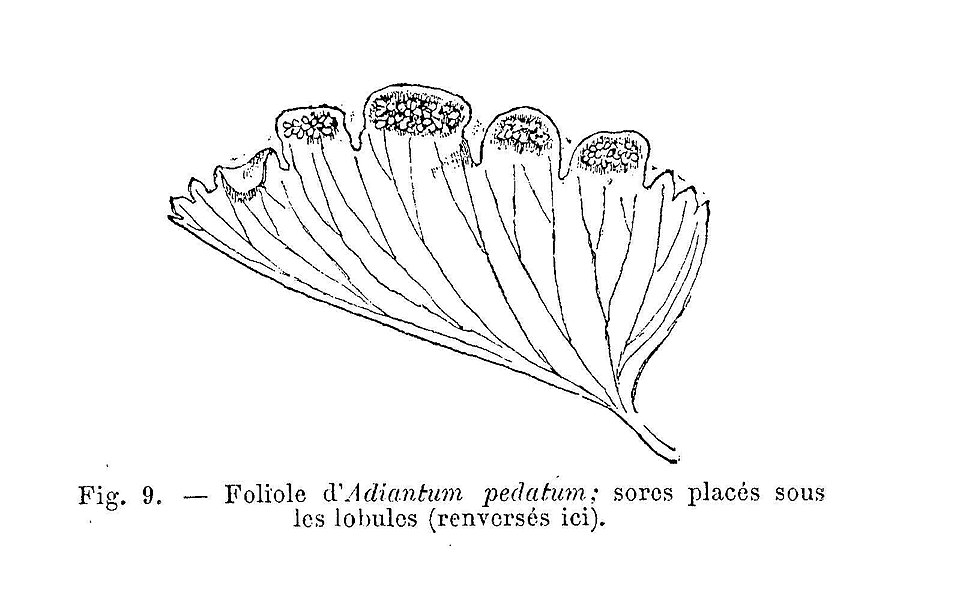
The sori (spore-bearing structures) are located at the tips of the pinnule veins, protected by false indusia formed by the folded-back margins of the leaflets — a distinctive arrangement called “marginal sori with reflexed false indusia.” This characteristic, unique among common garden ferns, helps confirm identification.
Quick Facts
| Scientific Name | Adiantum pedatum |
| Family | Pteridaceae (Maidenhair Fern) |
| Plant Type | Deciduous Fern (Perennial) |
| Mature Height | 1–3 ft |
| Sun Exposure | Full Shade |
| Water Needs | Moderate |
| Bloom Time | None (spore-bearing fern) |
| Spore Maturity | July – September |
| USDA Hardiness Zones | 3–8 |
Native Range
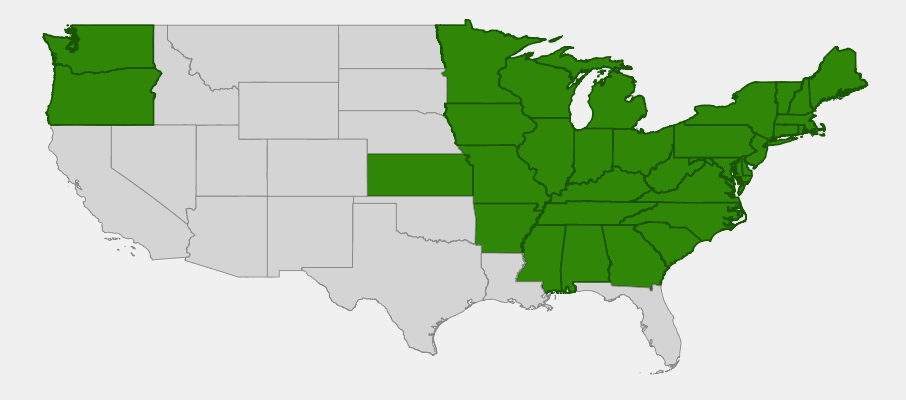
Northern Maidenhair Fern has a broad native range across North America, occurring in two main areas: the eastern United States and Canada (from Nova Scotia south to Georgia and Alabama, west to the Great Plains), and the Pacific Northwest (from British Columbia south through Washington, Oregon, and into northern California and Alaska). This disjunct distribution reflects the fern’s adaptation to moist, rich deciduous or mixed forest habitats wherever they occur across the continent.
In Delaware, New Jersey, and New York, Maidenhair Fern is found in rich, moist deciduous forests — particularly in shaded ravines, north-facing slopes, and sheltered valleys where moisture is consistent and soils are deep and fertile. It is most common in the New York Highlands and Hudson Valley, the Catskills, and similar topographically complex regions where north-facing slopes create consistently moist, cool conditions.
The fern’s presence is a reliable indicator of rich, undisturbed forest soil. It grows in association with other indicators of forest quality including Wild Ginger, Solomon’s Seal, Bloodroot, and Trillium. Finding Maidenhair Fern in a woodland suggests that the soil is deep, well-drained, rich in organic matter, and has not been severely disturbed for many decades.
📋 Regional plant lists featuring Maidenhair Fern: Delaware, New Jersey & New York
Growing & Care Guide
Maidenhair Fern is best grown in conditions that replicate its natural habitat: shade, consistently moist soil rich in organic matter, and protection from drying winds. With these conditions met, it is surprisingly durable and long-lived.
Light
Maidenhair Fern is a shade specialist. It thrives in full shade to deep shade — beneath deciduous or evergreen tree canopies, on north-facing slopes, or along shaded building foundations. Direct sun causes the delicate leaflets to scorch and the plants to wilt. Morning light with afternoon shade is acceptable in cool climates, but consistent shade is safest.
Soil & Water
The fern requires consistently moist, well-drained, humus-rich soil with a slightly acidic to neutral pH (5.5–7.0). It is more sensitive to drought than Christmas Fern and will wilt and die back in dry conditions. Amend planting areas generously with compost or leaf mold. Mulch with a 2–3 inch layer of shredded leaves to retain moisture and feed the soil as it decomposes. Do not let the soil dry out — this is the most common cause of failure with Maidenhair Fern.
Planting Tips
Plant in spring or fall into well-prepared, organically rich soil. The crown should be planted just at soil level — planting too deep is a common error. Water thoroughly after planting and maintain moisture throughout the first growing season. Once established in appropriate conditions, Maidenhair Fern requires minimal care. Propagate by careful division of established clumps in early spring before new fronds emerge.
Pruning & Maintenance
Cut old fronds to the ground in late fall or early spring — they die back naturally with the first hard frost and don’t persist through winter like Christmas Fern. The dark, polished stipes remain attractive through winter even after fronds have dropped. No serious pest or disease issues. Slugs occasionally graze on new fronds; use diatomaceous earth or copper barriers if necessary.
Landscape Uses
- Woodland garden — an elegant centerpiece beneath deciduous trees
- Shade garden — superb accent plant in shaded borders
- Stream bank planting — beautiful at moist, shaded water’s edge
- Companion planting — pairs beautifully with spring wildflowers
- Container gardening — stunning in large pots in shaded courtyards
- Cut foliage — delicate fronds are prized by florists and decorators
Wildlife & Ecological Value
Maidenhair Fern contributes to the ecological richness of the woodland understory through its structural role and its support of invertebrate communities.
For Birds
The dense colonies of Maidenhair Fern fronds provide low-level cover for ground-foraging birds like Hermit Thrush, Veery, and Wood Thrush. The moist, leaf-litter-rich soil beneath colonies supports populations of earthworms, snails, and beetles that are important food sources for thrushes, robins, and woodpeckers.
For Mammals
Like other forest ferns, Maidenhair Fern creates microhabitat for small mammals and amphibians at the forest floor. Salamanders, toads, and shrews shelter beneath the frond canopy. The rich soil environment supports the invertebrate diversity that the broader food web depends upon.
For Pollinators
Maidenhair Fern does not produce flowers but contributes to fungal diversity and soil health in the forest understory. Some Adiantum species are host plants for specialized fern-feeding moths and other invertebrates.
Ecosystem Role
Maidenhair Fern is an indicator and component of high-quality mesic forest communities. Its presence signals rich, undisturbed soils with deep organic horizons. The plant contributes to soil building through its leaf litter, provides microhabitat structure, and participates in the mycorrhizal networks of the forest floor.
Cultural & Historical Uses
Maidenhair Fern has one of the richest histories of cultural use of any native North American fern. Indigenous peoples across the continent valued the plant for medicinal, ceremonial, and practical purposes. The Ojibwe used infusions of the plant to treat coughs, chest congestion, and as a hair wash — the name “maidenhair” may refer to the tradition of using Adiantum preparations to treat hair conditions, as the delicate leaves were thought to resemble fine, silky hair. The Cherokee used the plant as a treatment for rheumatism and for “weak back.”
Many western nations — including the Quinault, Makah, and Coast Salish peoples of the Pacific Northwest — used Maidenhair Fern stems extensively in basket weaving. The dark, polished stipes were woven into decorative patterns in basketry, prized for their natural luster and durability. These distinctive dark elements created beautiful geometric designs in coiled and twined baskets that remain culturally significant art forms today. The association of the plant with weaving and feminine work contributed to its common name in some traditions.
In classical European herbal medicine, related Adiantum species (particularly European Maidenhair, A. capillus-veneris) were used to prepare “capillaire” — a sweet syrup flavored with maidenhair fern that was popular as a cough remedy and a flavoring for drinks and confections well into the 19th century. The North American species was used similarly by early colonists who recognized its relationship to the European medicinal plant.
Frequently Asked Questions
Why does water bead on Maidenhair Fern fronds?
The surface of Maidenhair Fern leaflets has a unique microstructure that makes it hydrophobic (water-repellent). This is the characteristic that gives the genus its Greek name “Adiantum” — meaning “unwetted.” The effect is visible and beautiful: after rain, water droplets form perfect spheres and roll off the leaves without wetting them.
Is Maidenhair Fern difficult to grow?
It requires specific conditions — shade, consistent moisture, and rich soil — but is not difficult to grow when those conditions are provided. The most common failures come from dry soils and too much sun.
come from dry soils and too much sun.
Can Maidenhair Fern survive winter?
Yes — it is a hardy perennial that dies back to the rhizome each fall and re-emerges in spring. The rhizome is cold-hardy to Zone 3. In mild winters, some fronds may persist longer than usual.
How do I propagate Maidenhair Fern?
The easiest method is division of established clumps in early spring before new fronds emerge. Carefully separate sections of the rhizome and replant immediately at the same depth. Water well. Division is best done every few years to rejuvenate older colonies.
What plants pair well with Maidenhair Fern?
Excellent companions include Wild Ginger (Asarum canadense), Bloodroot (Sanguinaria canadensis), Jack-in-the-Pulpit (Arisaema triphyllum), Solomon’s Seal (Polygonatum spp.), and Trillium species. These all share a preference for moist, shaded, rich forest soils.

Looking for a nursery that carries Maidenhair Fern?
Browse our native plant nursery directory: Delaware · New Jersey