Hairy Grama (Bouteloua hirsuta)
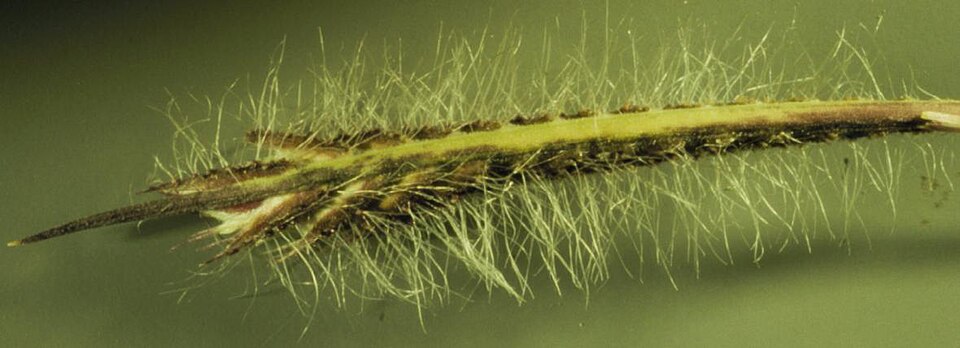
Bouteloua hirsuta, commonly known as Hairy Grama, is a compact, warm-season bunchgrass native to the grasslands, prairies, and desert scrub of central and southwestern North America. A member of the Poaceae (grass family), it is closely related to Blue Grama (Bouteloua gracilis) and shares that species’ characteristic horizontal, comb-like seed heads — which have been compared to eyebrows, flags, or toothbrushes depending on the viewer’s imagination. “Hairy” refers to the prominent white hairs on the florets and glumes that give the plant a distinctively fuzzy appearance when examined closely.
Hairy Grama is a warm-season grass that thrives in hot, dry conditions and poor soils. Growing 1 to 2 feet tall in dense tufts, it is exceptionally well-adapted to the short-grass prairie and desert grassland environments of the Southwest, where summer drought, intense heat, and shallow, rocky soils create conditions that challenge most other plants. Its deep fibrous root system — which can extend to 5 feet — anchors topsoil against erosion and accesses deeper soil moisture that allows the plant to persist through prolonged dry periods.
For ranchers and grassland managers, Hairy Grama is a valuable forage grass — palatable and nutritious for cattle, horses, and wildlife throughout the growing season. For gardeners and restorationists, it is a durable, low-maintenance native grass that provides year-round interest in dry landscapes. Its distinctive seed heads, appearing in summer and persisting through winter, create a unique visual texture and attract seed-eating wildlife throughout the cold months. The batch note that it “does well at lower elevations” underscores its value for desert and foothill gardens below the 5,000-foot elevation zone in Arizona and New Mexico.
Identification
Hairy Grama forms compact tufts or bunches of basal foliage typically 6 to 18 inches tall, with flowering culms (stems) rising to 2 feet. The plants spread slowly by short rhizomes and tillers, gradually forming small clumps or patches rather than large spreading colonies. The color is gray-green to blue-green in the growing season, turning tan to straw-colored in dormancy.
Leaves
The leaf blades are narrow (1–2 mm wide), flat to folded, and covered with stiff white hairs — the “hirsuta” feature that names the species. The leaf surfaces feel rough and slightly scratchy. Leaves are 2 to 6 inches long, emerging from a compressed basal sheath. The leaf sheaths are also hairy at the edges. In drought, the leaves roll inward to reduce moisture loss, giving the plant a finer, wiry texture.
Flowers & Seed Heads
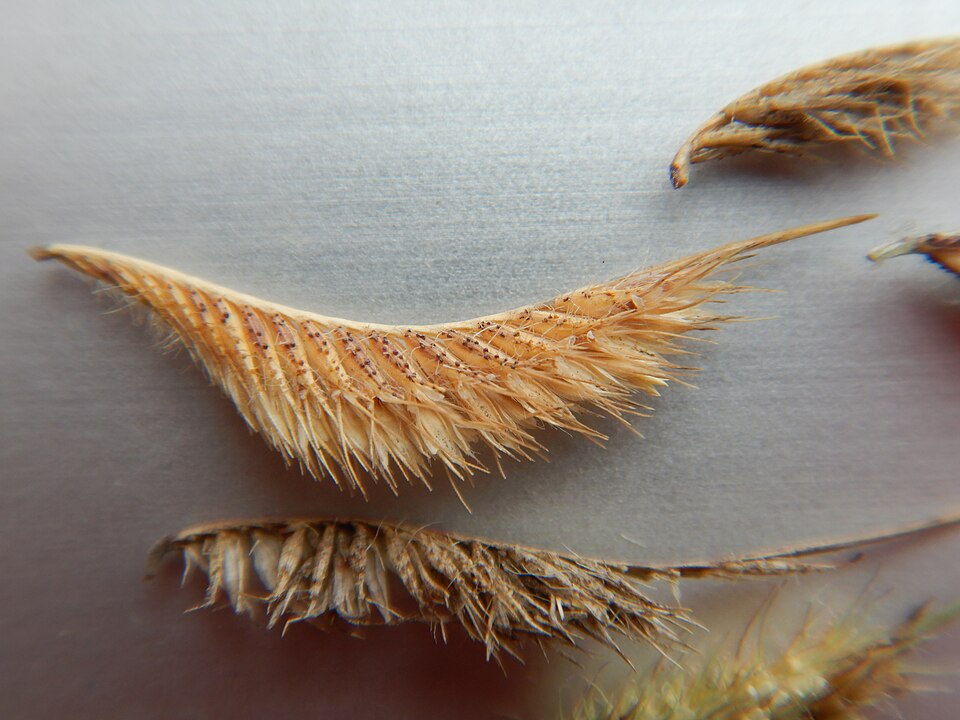
The seed heads are Hairy Grama’s most distinctive and attractive feature. Each flowering culm bears 1 to 3 horizontal, flag-like spikes (racemes) arranged along the side of the culm tip — never terminal. Each spike is 1 to 2 inches long, comb-shaped, with the florets arranged along one side of the curved rachis. The florets are hairy with long awns, giving a distinctly fuzzy appearance. The seed heads appear in summer (July–September in Arizona) and persist through winter as attractive tan straw-colored structures, maintaining ornamental interest long after the growing season. A distinguishing feature from Blue Grama is the presence of sterile floret awns that extend well beyond the fertile florets, giving a bristlier appearance than its close relative.
Quick Facts
| Scientific Name | Bouteloua hirsuta |
| Family | Poaceae (Grass Family) |
| Plant Type | Warm-Season Perennial Bunchgrass |
| Mature Height | 2 ft |
| Sun Exposure | Full Sun to Part Shade |
| Water Needs | Low (Drought Tolerant) |
| Bloom Time | July – September |
| Flower Color | Tan to reddish-brown (seed heads) |
| USDA Hardiness Zones | 3–9 |
Native Range
Hairy Grama is one of the most widespread native grasses in North America, ranging from the desert grasslands of Arizona and New Mexico north through the Great Plains all the way to Manitoba and Ontario in Canada. In the Southwest, it is characteristic of desert grasslands, Rocky Mountain foothills, and open ponderosa pine forests at lower elevations. Eastward, it is a common component of mixed-grass and short-grass prairies across the Great Plains states.
The species is particularly abundant in the transition zone between the Chihuahuan Desert and the Colorado Plateau, where rocky, shallow soils and hot summers favor the warm-season grama grasses. In Arizona and New Mexico, it is most common between 2,000 and 5,000 feet elevation — the “lower elevation” range noted in its batch description. Here it co-dominates with Blue Grama, Sideoats Grama (Bouteloua curtipendula), and Black Grama (Bouteloua eriopoda) in native grassland communities.
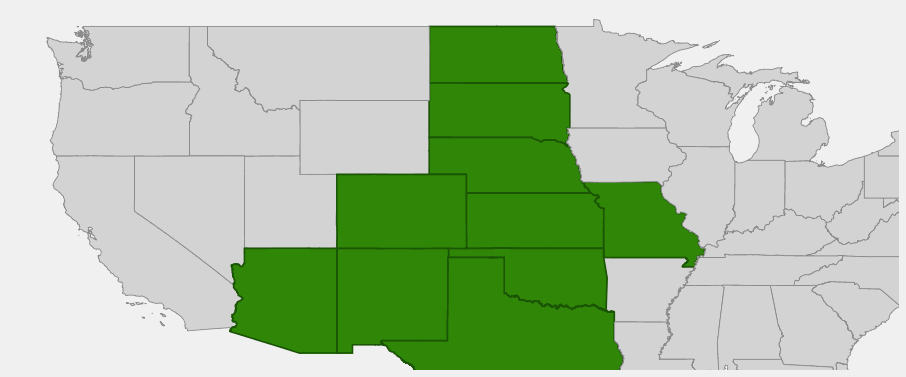
In the Great Plains, Hairy Grama extends across Kansas, Nebraska, South Dakota, North Dakota, Oklahoma, Missouri, and neighboring states, where it is a minor but consistent component of the short-grass and mixed-grass prairie. Its drought tolerance and adaptability to shallow, rocky soils make it particularly important on the drier, western edge of the plains region where other grass species struggle.
📋 Regional plant lists featuring Hairy Grama: Arizona
Growing & Care Guide
Hairy Grama is one of the toughest and most versatile native grasses for dry-climate gardens. Its combination of drought tolerance, adaptability to poor soils, and low maintenance requirements make it an excellent choice for xeriscape lawns, prairie restorations, erosion control, and naturalized areas throughout the Southwest and Great Plains.
Light
Hairy Grama thrives in full sun and tolerates partial shade. Full sun (6+ hours daily) produces the most vigorous plants with the best seed head display. In partial shade, growth continues but seed production decreases. In deep shade, the plant struggles and may thin out over time. For desert garden settings, full sun is preferred.
Soil & Water
Hairy Grama is remarkably tolerant of poor, shallow, rocky, and sandy soils — precisely the conditions where many other grasses fail. It does not tolerate heavy clay or persistently wet soils, which cause root rot. In xeriscape settings, supplemental irrigation is only needed during establishment (the first growing season). Once established, Hairy Grama typically survives on natural rainfall alone in most of Arizona and New Mexico. In the Great Plains, it is equally drought tolerant once its deep root system is established.
Planting Tips
Plant in spring or early summer (May–June) to take advantage of warm-season germination. Hairy Grama can be seeded directly at a rate of 1–2 lbs of pure live seed per 1,000 square feet for erosion control or prairie restoration. For garden accent use, container plants spaced 12–18 inches apart provide faster results. The grass germinates best when seeds have good soil contact — rake lightly after broadcasting seed and tamp lightly or use a roller to press seeds into soil.
Pruning & Maintenance
Hairy Grama is essentially self-maintaining. In late winter, cut or burn back the dead foliage to 3–4 inches to stimulate fresh new growth. This is optional — the plant naturally pushes new growth through old dead foliage — but burning or cutting gives a cleaner appearance and reduces competition from accumulated litter. The attractive seed heads can be left through winter to provide visual interest and wildlife food before cutting back in late winter.
Landscape Uses
- Native lawn substitute — mow to 3–4 inches for a low-maintenance buffalo-grass-style lawn
- Prairie and meadow restoration — key component of short-grass and mixed-grass prairie mixes
- Erosion control — dense fibrous roots stabilize slopes and disturbed soils
- Desert grassland borders — attractive naturalistic drifts among desert shrubs
- Wildlife habitat — essential component of native grassland bird and small mammal habitat
- Revegetation — reliable and economical for large-scale native seeding projects
Wildlife & Ecological Value
Hairy Grama is a keystone grass in southwestern and Great Plains grassland ecosystems, supporting an extensive food web from insects to large mammals through its seeds, foliage, and structural habitat.
For Birds
The seeds of Hairy Grama and other grama grasses are consumed by Horned Larks, Western Meadowlarks, Scaled Quail, Gambel’s Quail, Cassin’s Sparrows, and various other seed-eating grassland birds. The dense grass tufts provide nesting cover for ground-nesting birds. Hairy Grama grasslands are important habitat for the Chihuahuan Desert specialty species Botteri’s Sparrow and Cassin’s Sparrow, both of which depend on intact desert grasslands for breeding.
For Mammals
Hairy Grama is an important forage grass for Pronghorn, Mule Deer, Black-tailed Prairie Dogs, and Richardson’s Ground Squirrels. It is considered a desirable forage species for cattle and horses, being both palatable and nutritious throughout the growing season. Small mammals including Merriam’s Kangaroo Rats and various mice consume the seeds and use the dense clumps for shelter and runways.
For Pollinators
Like most grasses, Hairy Grama is wind-pollinated and offers limited direct value to nectar-seeking pollinators. However, the dense grassland communities it creates support a rich invertebrate fauna — including grasshoppers, beetles, moth larvae, and other insects — that are critical food sources for insectivorous birds, lizards, and other wildlife.
Ecosystem Role
Hairy Grama plays a critical role in maintaining the structure and function of southwestern grasslands. Its deep, fibrous root system builds soil organic matter, prevents erosion, and cycles nutrients efficiently. In overgrazed or disturbed areas, Hairy Grama is often one of the first native grasses to decline — its presence in good abundance is considered an indicator of healthy grassland condition. Restoration of Hairy Grama-dominated grasslands is a priority for land managers throughout the Southwest.
Cultural & Historical Uses
Grama grasses, including Hairy Grama, were central to the grassland economies of Plains and Southwest Indigenous peoples. The dense grasslands they supported were the ecological foundation for the vast bison herds that sustained Plains Indian cultures for thousands of years. While individual grama grass species were not always distinguished in historical accounts, they were collectively recognized as the “grama” grasses — the primary forage basis of the southwestern and Great Plains range.
The Navajo and other Southwestern peoples recognized the grama grasses as among the most reliable and drought-resistant pasture plants on their rangelands. The grass’s ability to cure on the standing plant — maintaining nutritional value through fall and winter even after drying — made it equivalent to naturally cured hay, a characteristic that allowed the great bison herds and native ungulate populations to survive harsh winters on the open range. This property, called “standing hay,” was also recognized by early Anglo ranchers who built the southwestern cattle industry on the foundation of grama grass rangelands.
Today, Hairy Grama continues to be used in ecological restoration and native seeding projects throughout the Southwest. It is a component of many commercial native grass seed mixes for the region. Its value for revegetating disturbed desert grasslands, road cuts, and post-fire areas makes it an important tool for land managers and restorationists working to restore southwestern grassland ecosystems.
Frequently Asked Questions
What is the difference between Hairy Grama and Blue Grama?
Both are Bouteloua species with characteristic horizontal, comb-like seed heads. Hairy Grama (B. hirsuta) has prominent hairs on the florets and glumes (hence “hairy”), and its sterile floret awns extend well beyond the fertile florets — giving a bristlier, fuzzier appearance. Blue Grama (B. gracilis) has glumes with fewer hairs and its seed heads have a more uniform, smooth-edged appearance. Both grow at similar elevations but Blue Grama tends to be more abundant at higher elevations and on finer-textured soils.
Can I use Hairy Grama as a lawn grass?
Yes — Hairy Grama can be mowed to 3–4 inches to create a low-maintenance native lawn in the Southwest and Great Plains. It is best mixed with Blue Grama and Buffalo Grass for a more complete, dense lawn coverage. It tolerates moderate foot traffic and requires far less water and no fertilizer compared to conventional turf grasses. It goes dormant (brown) in winter.
Does Hairy Grama tolerate fire?
Yes — Hairy Grama is highly fire-tolerant. It is adapted to the periodic grassland fires that characterize its native range and typically regrows vigorously from its root crown within weeks after a fire. Periodic burning is actually beneficial for Hairy Grama, removing accumulated dead matter and stimulating fresh, nutritious new growth.
What is the best season to plant Hairy Grama?
Plant or seed in late spring to early summer (May–June) when soil temperatures are warm enough to trigger germination of this warm-season grass. Fall seeding can work in mild-winter areas, but cold-weather seeding results in poor germination. Container plants can be installed in spring or early fall.
How do I identify Hairy Grama from other grama grasses?
Look for the distinctive horizontal, comb-shaped seed heads (1–3 per stem) and the conspicuous white hairs on the florets that give the heads a fuzzy appearance. The hairy leaves are also distinctive. Compared to Blue Grama, Hairy Grama’s awns (bristles) on the seed head extend more visibly beyond the florets, creating a slightly scruffier look.

Looking for a nursery that carries Hairy Grama?
Browse our native plant nursery directory: Arizona