Rock Hibiscus (Hibiscus denudatus)
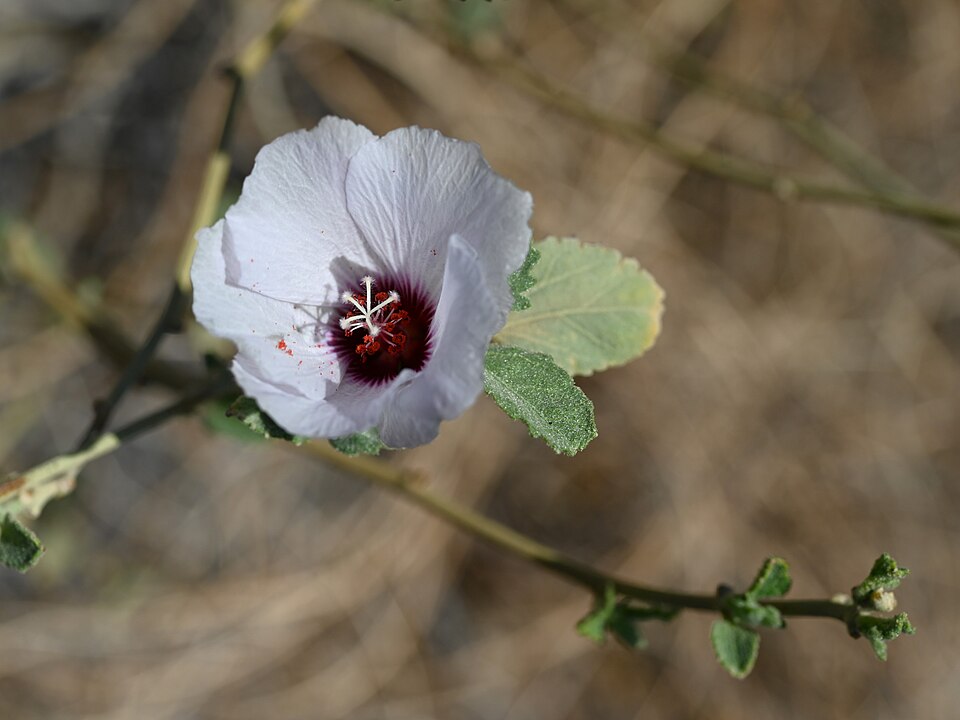
Hibiscus denudatus, commonly known as Rock Hibiscus, Paleface Rose-Mallow, or Desert Hibiscus, is a compact, low-growing native shrub of the Sonoran and Chihuahuan Deserts. This delicate-appearing but remarkably tough member of the Malvaceae (mallow family) produces beautiful pale lavender to pinkish-white flowers with dark red to maroon veins at the base — a display that belies the harsh desert conditions it endures on rocky slopes and canyon walls from sea level to 4,500 feet elevation. The batch notes its “Lavender flowers” as a key characteristic, which is indeed one of the most charming features of this often-overlooked desert native.
Rock Hibiscus grows 1 to 3 feet tall and wide as a loosely branched, somewhat herbaceous subshrub. The stems are covered with a characteristic soft, grayish-white pubescence (fine hairs), and the leaves are small, gray-green, and similarly hairy — adaptations that reflect sunlight and reduce water loss in the intense desert sun. Unlike its showy tropical relatives, Rock Hibiscus blooms are relatively small (1–2 inches across), but what they lack in size they make up in color and charm: the cool lavender tones are a striking contrast against the pale desert background and the warm amber tones of the rocky terrain.
Though less commonly cultivated than some other desert natives, Rock Hibiscus deserves wider use in xeriscape gardens throughout the low-desert Southwest. Its exceptionally long bloom season (nearly year-round in frost-free areas), near-zero water requirements once established, and unique lavender-flowered form distinguish it from most other desert shrubs. The flowers attract hummingbirds, native bees, and butterflies, and the seeds are consumed by small birds and mammals. For gardeners seeking a drought-tolerant flowering shrub for rocky, exposed sites where few other plants thrive, Rock Hibiscus offers a compelling combination of beauty and toughness.
Identification
Rock Hibiscus is a loosely branched subshrub or herbaceous perennial growing 1 to 3 feet tall and equally wide. The stems are slender, somewhat woody at the base, and densely covered with star-shaped (stellate) hairs that give the plant an overall soft, grayish appearance. The plant spreads slowly by basal stems and may form small clumps over time. It often dies back partially in winter but resproutes from the woody base in spring.
Leaves
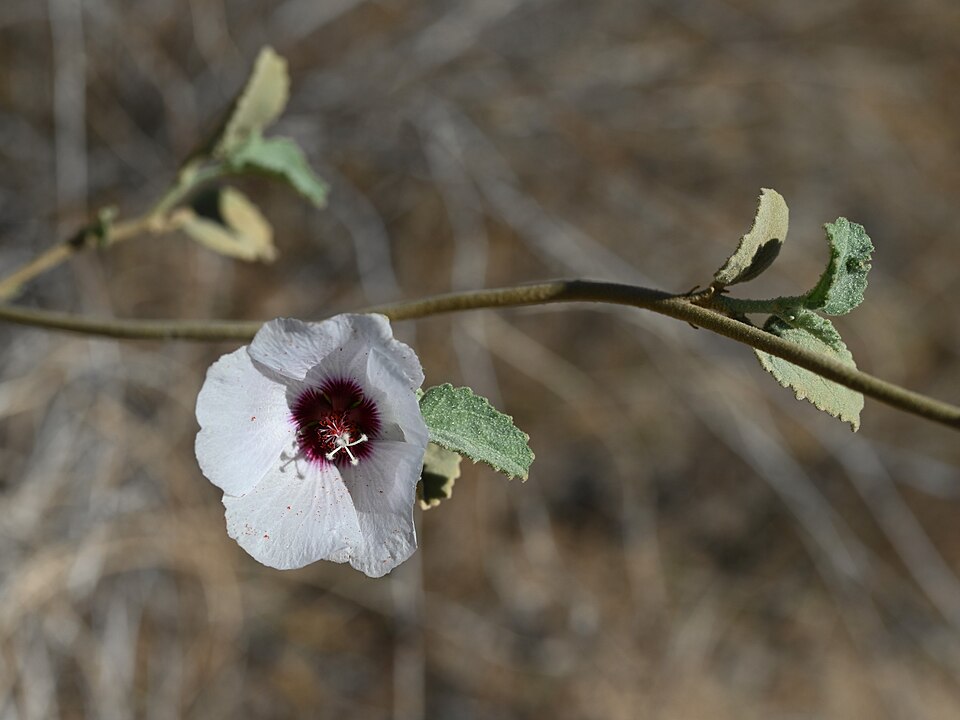
The leaves are distinctively small (½ to 2 inches long), gray-green, and densely covered with soft stellate hairs on both surfaces — giving them a felt-like or sage-like texture. Leaf shape varies from ovate to deeply 3-lobed, with toothed or scalloped margins. The small, gray, velvety leaves are an immediate identification clue that distinguishes Rock Hibiscus from other desert hibiscus species. In drought, the leaves may be shed to reduce moisture loss; the plant refoliates quickly after rain.
Flowers
The flowers are the plant’s most celebrated feature. Each bloom is 1 to 2 inches across, with 5 broad, overlapping petals that are pale lavender to pinkish-white in color, often with dark reddish-purple veins radiating from a dark center. The staminal column (a central tube of fused stamens, characteristic of the mallow family) is prominent. Flowers open in the morning and typically close by afternoon, lasting only one day — but each plant produces a continuous succession of blooms across an exceptionally long season: essentially year-round in warmer desert locations, or from spring through fall where frost occurs. The combination of cool lavender color and dark veining is unlike any other common desert shrub.
Quick Facts
| Scientific Name | Hibiscus denudatus |
| Family | Malvaceae (Mallow Family) |
| Plant Type | Deciduous Subshrub / Perennial |
| Mature Height | 2 ft |
| Sun Exposure | Full Sun |
| Water Needs | Low (Drought Tolerant) |
| Bloom Time | Nearly year-round (peak February – November) |
| Flower Color | Pale lavender to pinkish-white with dark veining |
| USDA Hardiness Zones | 8–11 |
Native Range
Rock Hibiscus is native to the lower Sonoran Desert of the American Southwest and northwestern Mexico, ranging from southern California and southern Nevada east through Arizona and southern New Mexico to the Trans-Pecos region of western Texas. It is one of the characteristic flowering shrubs of the rocky desert terrain below 4,500 feet elevation in the Sonoran Desert bioregion — particularly common on rocky hillsides, canyon walls, and desert washes where shallow, fast-draining substrates prevail.
In Arizona, Rock Hibiscus is most abundant in the rocky desert terrain of the Sonoran Desert, particularly in Pima, Pinal, Maricopa, and Yavapai Counties. It grows alongside Brittlebush, Triangle-leaf Bursage, Desert Marigold, and various cacti on south- and west-facing rocky slopes. The species extends into the lower Sky Islands foothills and along desert canyon systems where rocky substrates and good drainage are present.
In Baja California and Sonora, Mexico, Rock Hibiscus is common throughout the Baja California Peninsula and mainland Sonora, where it is a characteristic element of coastal desert scrub and rocky inland desert terrain. The species is tolerant of coastal salt spray and sandy soils as well as inland rocky desert conditions, reflecting its adaptability across a range of desert microhabitats.
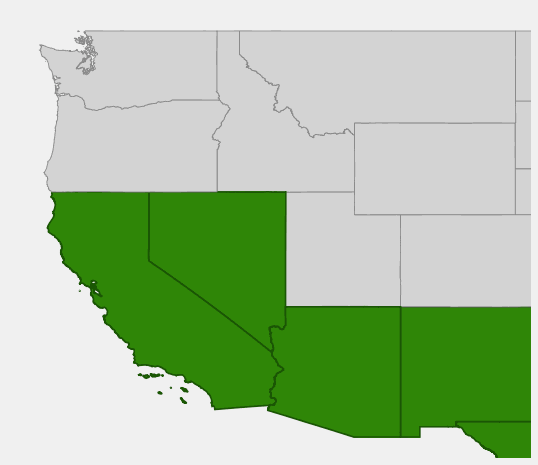
📋 Regional plant lists featuring Rock Hibiscus: Arizona
Growing & Care Guide
Rock Hibiscus is an excellent xeriscape plant for the low-desert Southwest, suited to the extremely harsh conditions — shallow, rocky soils, intense heat, and low rainfall — that challenge many ornamental plants. Once established, it is highly self-sufficient, requiring little more than good drainage and full sun to thrive.
Light
Rock Hibiscus requires full sun — at least 6 to 8 hours of direct sunlight daily. It evolved on south- and west-facing rocky slopes in some of the most intensely lit desert environments in North America. In partial shade, the plant becomes leggy, blooms less prolifically, and is more susceptible to pest problems. Plant in the most open, unobstructed sun exposure available.
Soil & Water
The most critical requirement is sharp drainage. Rock Hibiscus grows in rocky, gravelly, sandy desert soils with minimal organic content and fast drainage. Heavy clay soils cause root and crown rot, often within a single wet season. In garden settings, plant in native desert soil, decomposed granite, or a mix heavily amended with coarse gravel. Once established, Rock Hibiscus survives on natural desert rainfall in most Arizona locations. In hotter, drier desert locations, supplemental watering every 2–4 weeks during summer may extend the bloom season and keep the plant looking its best.
Planting Tips
Plant in fall (October–November) or spring (March–April) for best establishment. Fall planting allows root development during the mild winter before summer heat arrives. Container stock from native plant nurseries establishes most reliably. Plant at the same depth as in the container; mounding the planting area slightly to ensure the crown stays dry is beneficial. A top dressing of gravel mulch around (but not touching) the base is beneficial.
Pruning & Maintenance
Light pruning in early spring removes winter-killed stem tips and encourages bushier growth. Cut back to healthy green tissue. Rock Hibiscus can be pruned to 6–12 inches in late winter to rejuvenate the plant and encourage a fresh flush of growth and flowers. Deadheading spent flowers is optional — the small seed capsules left on the plant are not unattractive and provide food for wildlife. The plant is essentially pest- and disease-free in appropriate desert conditions.
Landscape Uses
- Rocky slope or hillside planting — excels on steep, dry, rocky terrain
- Desert rock garden — attractive among boulders and in rock crevices
- Hummingbird garden — long bloom season provides consistent nectar
- Xeriscape foundation plant — low water, long bloom, compact form
- Desert wash planting — tolerates occasional flooding in desert washes
- Container gardening — suitable for large containers in warmer climates
Wildlife & Ecological Value
Rock Hibiscus is a valuable wildlife plant for the low-desert Southwest, offering nectar, seeds, and habitat across its nearly year-round bloom season.
For Birds
Hummingbirds — particularly Costa’s Hummingbird, the Sonoran Desert specialist — are frequent visitors to Rock Hibiscus flowers. Anna’s Hummingbirds and Black-chinned Hummingbirds also visit regularly. The small seed capsules provide food for Verdins, House Finches, and other seed-eating desert birds. The dense, somewhat twiggy structure of the plant provides shelter and nesting sites for small birds.
For Mammals
Small desert rodents including Cactus Mice and Desert Pocket Mice collect the seeds. The plant’s dense growth provides refuge from predators for small desert mammals. The flowers and young foliage are occasionally browsed by Jackrabbits and Desert Cottontails, though the hairy leaves are generally less palatable than many other desert plants.
For Pollinators
Rock Hibiscus’s long bloom season — spanning much of the year in frost-free desert locations — makes it an exceptionally valuable resource for desert pollinators. Native bees, particularly Diadasia (chimney bees) that specialize on mallow family flowers, are frequent visitors. Painted Lady Butterflies, Queen Butterflies, and various hawk moths also visit. The consistent supply of pollen and nectar from this single species across multiple seasons helps support desert pollinator populations through seasonally lean periods.
Ecosystem Role
Rock Hibiscus occupies a specialized ecological niche on the rocky desert slopes and canyon walls where few other shrubs thrive. Its ability to establish on shallow, skeletal desert soils makes it a pioneer plant on rocky terrain, contributing organic matter and creating microhabitats that facilitate the establishment of other species. Its nearly year-round bloom makes it a particularly important resource in the winter months when desert flowering plants are scarce.
Cultural & Historical Uses
Rock Hibiscus, like many members of the mallow family, was known to Indigenous peoples of the Sonoran Desert region for its practical and medicinal properties. The Tohono O’odham and Seri peoples used various parts of the plant medicinally. The soft, mucilaginous properties of mallow family plants — present in the leaves, flowers, and stems — were used as demulcent (soothing) agents for sore throats, coughs, and inflammatory conditions. The roots of Rock Hibiscus, like those of other mallows, contain mucilaginous compounds useful for topical applications.
The fiber from the stems and leaves, while not as strong as that from larger hibiscus species, was occasionally used by desert peoples for lightweight cordage and basket-making materials. The flowers are edible and sweet (they can be eaten raw in salads or as a garnish), and the young leaves and seed pods of mallow family plants have a long history of use as pot herbs throughout the Mediterranean and Southwest. While Rock Hibiscus was not a primary food plant, its flowers and young growth would have supplemented desert diets during periods when it was abundant and flowering.
In modern ethnobotany, Rock Hibiscus is recognized as an important component of traditional desert plant knowledge. Its role as a nearly year-round nectar source for hummingbirds — particularly the Costa’s Hummingbird, which is resident in the Sonoran Desert through the winter — connects it to the broader web of ecological relationships that support desert biodiversity. Today it is increasingly recognized by native plant gardeners and horticulturalists as an underutilized desert native with outstanding ornamental and ecological value.
Frequently Asked Questions
How long does Rock Hibiscus bloom?
Rock Hibiscus has one of the longest bloom seasons of any Sonoran Desert native shrub. In frost-free desert locations, it blooms nearly year-round, with peak bloom from February through November. Even in areas with light frosts, it resproutes quickly from the woody base in spring and blooms continuously from March through fall. The individual flowers last only one day, but new blooms open continuously throughout the season.
Is Rock Hibiscus related to tropical hibiscus and Rose of Sharon?
Yes — Rock Hibiscus (Hibiscus denudatus) is in the same genus as tropical hibiscus (H. rosa-sinensis), Rose of Sharon (H. syriacus), and Swamp Rose Mallow (H. moscheutos). All are members of the Malvaceae family. Rock Hibiscus differs in being adapted to extreme desert conditions and having much smaller flowers, but shares the characteristic 5-petaled flower with the central staminal column typical of the genus.
Why are my Rock Hibiscus flowers only open in the morning?
Like most hibiscus species, Rock Hibiscus flowers are ephemeral — each individual flower opens in the morning and typically closes or falls by afternoon. This is normal behavior. The plant compensates by producing new flowers continuously throughout the growing season, creating an impression of nearly constant bloom even though each flower lasts only one day.
How do I get more blooms from Rock Hibiscus?
Maximum blooming requires full sun — this is the single most important factor. Supplemental water every 2–3 weeks during the hot summer months can extend and intensify bloom. A light pruning in late winter to remove dead stem tips encourages fresh, vigorous growth and abundant flowers. Avoid heavy fertilization, which promotes vegetative growth at the expense of flowers.
Is Rock Hibiscus frost-tolerant?
Rock Hibiscus tolerates light frosts but is damaged by temperatures below about 25°F (-4°C). In areas with hard freezes, the above-ground stems may die back, but the plant typically resproutes from the woody base in spring. In USDA Zone 8 and above, it is essentially root-hardy. In Zones 9–11, it may remain evergreen through mild winters.

Looking for a nursery that carries Rock Hibiscus?
Browse our native plant nursery directory: Arizona