Desert Honeysuckle (Anisacanthus thurberi)
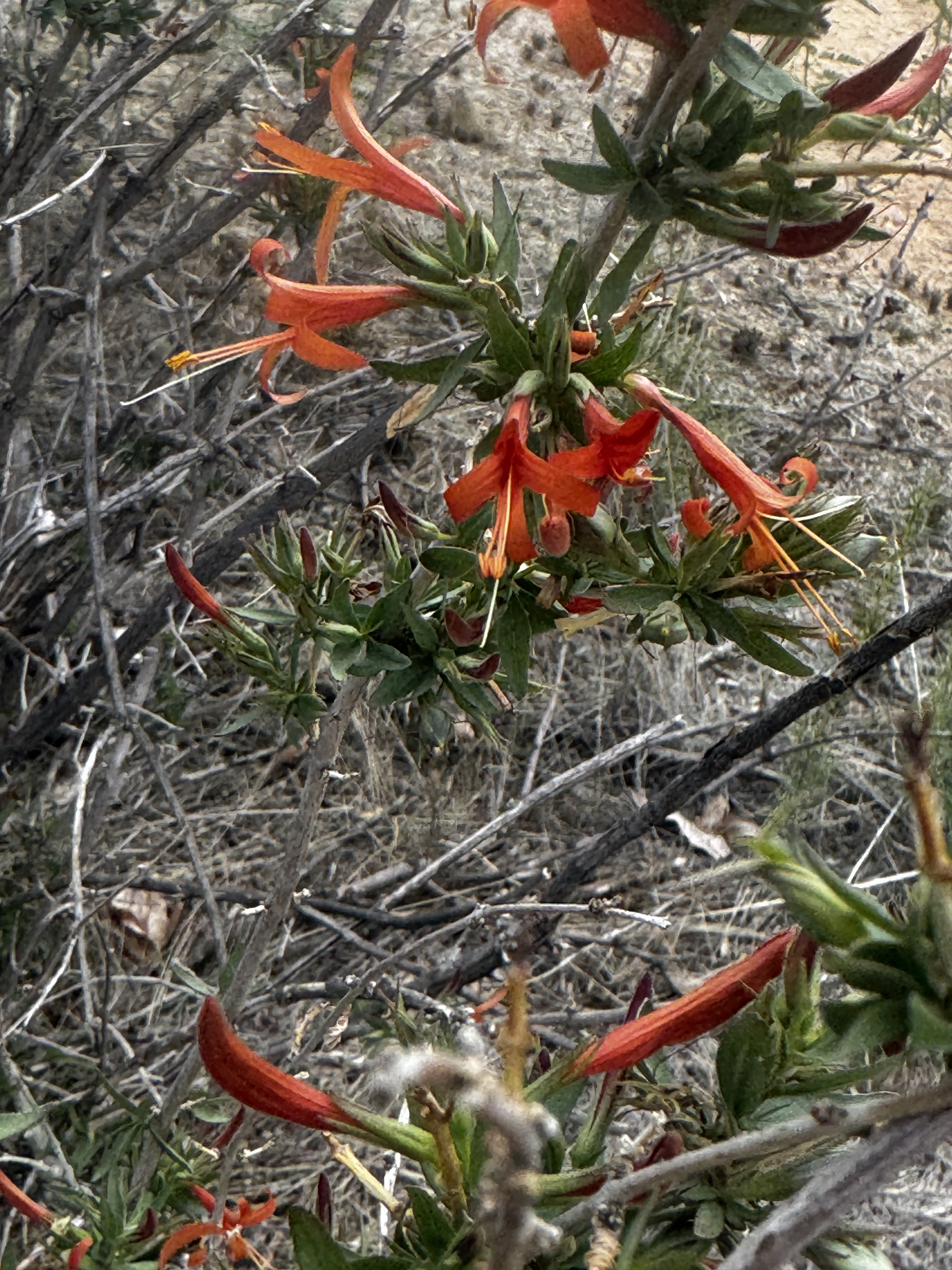
Anisacanthus thurberi, commonly known as Desert Honeysuckle or Thurber’s Desert Honeysuckle, is a stunning drought-tolerant shrub native to the desert Southwest. Despite its common name, it is not a true honeysuckle (Lonicera) but belongs to the Acanthaceae family. This spreading, semi-evergreen to deciduous shrub produces one of the most brilliant floral displays of any native Sonoran Desert plant: masses of tubular, orange-red to scarlet flowers that blaze against the dusty desert landscape from late summer through fall and again in spring. These vivid blossoms are extraordinarily attractive to hummingbirds — particularly migrating rufous and broad-tailed hummingbirds passing through Arizona — making Desert Honeysuckle one of the most valuable hummingbird plants in the native Southwestern garden palette.
Growing 3 to 5 feet tall and wide, Desert Honeysuckle forms an attractively rounded shrub with arching branches covered by narrow, lance-shaped leaves. The brown seed capsules that develop after flowering split explosively when ripe, ejecting the seeds some distance from the parent plant — an effective dispersal strategy in the open desert. The plant’s combination of drought tolerance, long bloom season, wildlife value, and natural beauty make it a standout choice for water-wise Southwestern gardens from the low desert to the Chihuahuan Desert grassland zone.
Desert Honeysuckle was named for George Thurber (1821–1890), an American botanist who participated in the U.S.-Mexico Boundary Survey from 1850 to 1854 and documented many new-to-science plant species of the Sonoran borderlands. The USDA plant symbol ANTH6 identifies this species in the national plant database. In Arizona and New Mexico, it is increasingly popular in xeriscape and native plant gardens for its spectacular fall blooming that draws migrating hummingbirds just when most garden plants have finished flowering.
Identification
Desert Honeysuckle is most readily identified by its vivid orange-red tubular flowers that appear in clusters at the tips of branches. The shrub has a somewhat open, irregular form with arching stems bearing narrow, pale green leaves. It can be evergreen to semi-deciduous depending on winter temperatures and moisture availability.
Leaves
The leaves are opposite, lance-shaped to narrowly elliptic, 1 to 3 inches long and about ½ inch wide, with a slightly rough texture and entire or slightly wavy margins. The color is pale to medium green, often with a grayish cast. In cold winters, the shrub may drop most of its leaves; in mild winters or sheltered locations, it may remain semi-evergreen. New growth emerges in spring with particularly fresh, bright green leaves.
Flowers
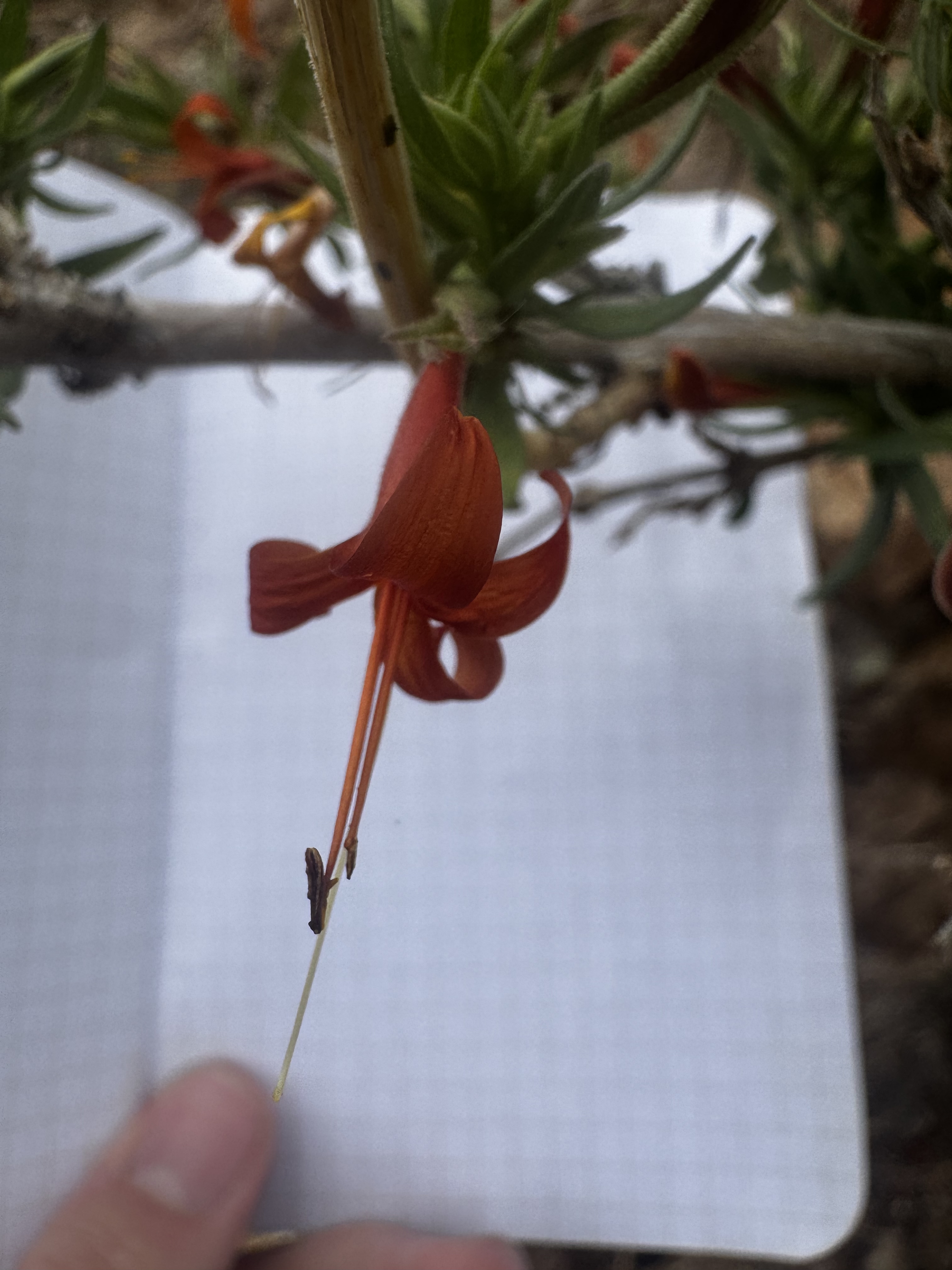
The flowers are the defining feature of Desert Honeysuckle. They are tubular, about 1 to 1.5 inches long, and brilliantly colored in shades of orange-red to scarlet — the perfect hummingbird flower. They are borne in clusters (cymes) at the tips of branches and axils of upper leaves. The two primary bloom periods are summer through fall (August–November) and a spring flush (March–May). In mild winters with occasional irrigation, plants may bloom nearly continuously. The flower tube is slightly curved and the mouth opens into two lips.
Fruit
The fruit is a narrow, club-shaped capsule about ¾ inch long that ripens to brown. When fully mature, the capsule splits explosively into two valves, ejecting the flat, rounded brown seeds with considerable force. The seeds have a distinctive “retinacula” — hook-like structures that help attach and remove the seeds from the capsule during the explosive dispersal event. After seeding, the empty brown capsules persist on the plant for many months.
Quick Facts
| Scientific Name | Anisacanthus thurberi |
| Family | Acanthaceae (Acanthus) |
| Plant Type | Perennial Shrub (semi-evergreen) |
| Mature Height | 4 ft |
| Sun Exposure | Full Sun |
| Water Needs | Low (Drought Tolerant) |
| Bloom Time | March–May and August–November |
| Flower Color | Orange-red to scarlet |
| USDA Hardiness Zones | 8–11 |
Native Range
Desert Honeysuckle is native to the Sonoran and Chihuahuan Desert regions of the American Southwest and adjacent Mexico. In the United States, it occurs in southern Arizona and southwestern New Mexico and just enters western Texas. The plant is most common and abundant in Arizona, particularly in the Sonoran Desert transition zone from sea level to about 5,000 feet elevation, where it inhabits rocky canyon slopes, desert washes, and the edges of desert grasslands.
The species is well-represented in the sky island mountain ranges of southeastern Arizona — the Santa Catalina, Rincon, Huachuca, and Chiricahua ranges — where it grows on rocky canyon walls and slopes from the desert floor up into the oak woodland zone. It is frequently encountered along streams and washes where roots can access deeper soil moisture, though it tolerates surprisingly dry rocky sites once established.
In its native habitat, Desert Honeysuckle grows in association with saguaro cactus, brittlebush, ocotillo, desert marigold, fairy duster, and various native shrubs. It is a characteristic species of the Arizona Upland subdivision of the Sonoran Desert — the richest and most diverse desert community in North America — and is closely associated with the annual monsoon rainfall that drives its main late-summer bloom period.
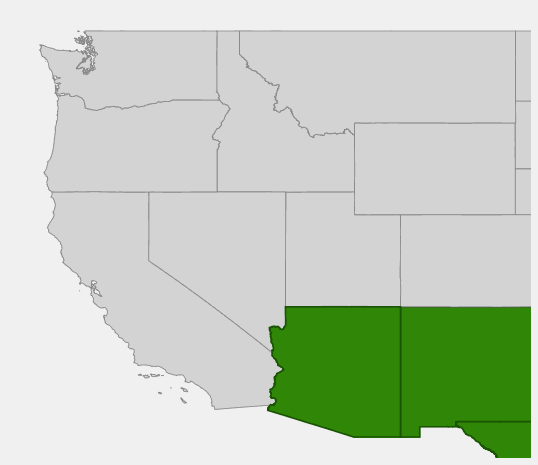
📋 Regional plant lists featuring Desert Honeysuckle: Arizona
Growing & Care Guide
Desert Honeysuckle is one of the most rewarding native shrubs for Arizona gardens. Easy to grow, dramatically beautiful in bloom, and magnetically attractive to hummingbirds and butterflies, it earns its place in any water-conscious Southwestern landscape.
Light
Desert Honeysuckle thrives in full sun, which promotes the densest growth and most abundant flowering. It tolerates partial shade — especially afternoon shade in the hottest desert zones — but may produce fewer flowers and a more open, leggy form in heavily shaded conditions. In the low desert (Phoenix and below), full sun combined with reflected heat from walls can be intense; ensure the plant has adequate soil moisture in these conditions.
Soil & Water
This shrub is highly adaptable to the range of alkaline, rocky, and gravelly desert soils typical of Arizona gardens. It does not tolerate poorly-drained clay but grows well in native desert soil, decomposed granite, and amended loam. Water deeply but infrequently — established plants need supplemental irrigation only through the pre-monsoon “foresummer” period (May–July). During monsoon season, natural rainfall is usually sufficient. In winter, reduce or eliminate irrigation entirely. Overwatering is the most common cause of failure.
Planting Tips
Plant in early fall or early spring when temperatures are moderate. Dig a hole no deeper than the root ball and two to three times as wide. Set the plant at grade or very slightly above to ensure good drainage. Mulch with gravel or decomposed granite to conserve moisture and reflect heat. In the first summer, water deeply once a week during dry periods; after the first monsoon season, the plant should be established. Desert Honeysuckle transplants easily from containers and grows relatively quickly — expect significant growth in the first two years.
Pruning & Maintenance
Prune in late winter or early spring before new growth begins. Remove dead stems, shape to maintain a tidy form, and cut back any frost-damaged branches to healthy wood. Light tip-pruning after the spring flush promotes bushier growth and more flower buds for the fall season. Avoid heavy pruning in fall, which can reduce the important late-season bloom that benefits migrating hummingbirds. Desert Honeysuckle can be cut back hard (to 6–12 inches) if it becomes overgrown; it will regenerate vigorously.
Landscape Uses
- Hummingbird garden — one of the premier native shrubs for attracting migrating hummingbirds
- Xeriscape border — excellent drought tolerance once established
- Mixed native shrub border — pairs beautifully with brittlebush, fairy duster, and desert willow
- Slope planting and erosion control on desert banks and rocky slopes
- Wildlife corridor planting — provides food and shelter for birds and insects
- Foundation planting in desert-style home landscapes
Wildlife & Ecological Value
Desert Honeysuckle is one of the most valuable native shrubs for desert wildlife, providing food, shelter, and nesting resources across multiple seasons.
For Birds
The long, tubular flowers of Desert Honeysuckle are perfectly shaped for hummingbirds, and this plant is a magnet for migrating Costa’s, Black-chinned, Broad-tailed, and Rufous Hummingbirds passing through Arizona. The dense, twiggy structure also provides excellent nesting habitat and escape cover for small songbirds including Lucy’s Warbler, Verdin, and Cactus Wren. The seed capsules, though small, are consumed by finches and sparrows.
For Mammals
Desert Honeysuckle provides browse for mule deer and javelina, and its dense shrubby form offers thermal cover for rabbits, pack rats, and small desert mammals. The extensive root system supports mycorrhizal fungal communities that benefit other nearby plants.
For Pollinators
In addition to hummingbirds, Desert Honeysuckle flowers attract carpenter bees and other large native bees that can access the long flower tube. Butterflies, including various sulfurs and skippers, also visit the flowers. The plant is an important late-season nectar source in desert gardens at a time when many other plants have finished flowering.
Ecosystem Role
Desert Honeysuckle contributes to the structural diversity of desert scrub communities, creating mid-height cover between ground-level cacti and taller saguaro and palo verde. Its role as a hummingbird resource is ecologically significant during the fall migration corridor through southeastern Arizona, one of the most important raptor and songbird migration routes in North America. The plant’s value as a pollinator resource during the post-monsoon period, when many desert plants pause flowering, makes it an important ecological bridge.
Cultural & Historical Uses
The Tohono O’odham, Akimel O’odham, and other Indigenous peoples of the Sonoran Desert region recognized Desert Honeysuckle as a medicinal and practical plant. Various parts of the plant were used in traditional medicines for skin conditions and as a wash for sores and wounds. The strong, flexible stems were used in basketry and for making small tools and implements.
Spanish missionaries and settlers in the Sonoran Desert region encountered Desert Honeysuckle and noted its ornamental qualities, though systematic documentation of its uses was limited. The plant was formally described by American botanist George Thurber during the U.S.-Mexico Boundary Survey in the early 1850s — one of many botanical discoveries made during that scientifically productive expedition that traversed some of the most biologically rich desert terrain on the continent.
In modern horticulture, Desert Honeysuckle has gained considerable popularity as awareness of the importance of native plants for supporting wildlife has grown. Arizona’s booming native plant nursery industry has embraced this species as a reliable, beautiful, and ecologically important addition to water-wise landscapes. It is now commonly available at native plant nurseries throughout southern Arizona and New Mexico, and is featured in numerous public demonstration gardens at the Arizona-Sonora Desert Museum, Tohono Chul, and the Desert Botanical Garden in Phoenix.
Frequently Asked Questions
Is Desert Honeysuckle the same as Flame Anisacanthus?
They are closely related but different species. Flame Anisacanthus (Anisacanthus quadrifidus var. wrightii) is native to Texas and the Chihuahuan Desert. Desert Honeysuckle (Anisacanthus thurberi) is the Sonoran Desert species. Both have similar orange-red tubular flowers, but Desert Honeysuckle is more appropriate for Arizona gardens as the locally native species.
How often should I water Desert Honeysuckle?
Once established (after the first monsoon season), Desert Honeysuckle needs very little supplemental water. During the hottest pre-monsoon period (May–July), a deep watering every 2–3 weeks is sufficient. After monsoon rains begin, natural rainfall is usually adequate. In winter, water monthly at most. Overwatering is more harmful than underwatering for this desert-adapted shrub.
Why is my Desert Honeysuckle dropping its leaves?
Leaf drop is normal — Desert Honeysuckle is semi-evergreen to deciduous. It may drop most of its leaves in response to hard frost, prolonged drought, or extended heat before monsoon season. This is a natural drought and cold tolerance mechanism, not a sign of plant death. New leaves will emerge when conditions improve.
Will Desert Honeysuckle attract hummingbirds year-round?
The plant blooms twice — in spring (March–May) and again in late summer through fall (August–November). Both bloom periods attract hummingbirds, but the fall bloom is especially valuable for migrating hummingbirds moving through Arizona on their southward journey. The Costa’s Hummingbird, which overwinters in the Sonoran Desert, also visits the spring flowers.
How large will Desert Honeysuckle get?
In well-drained soil with full sun, Desert Honeysuckle typically reaches 3–5 feet tall and about as wide. With supplemental irrigation it may grow larger — up to 6 feet in very favorable conditions. Annual or biennial pruning helps maintain a tidy, compact form and promotes abundant flowering.

Looking for a nursery that carries Desert Honeysuckle?
Browse our native plant nursery directory: Arizona