Mariola (Parthenium incanum)
Parthenium incanum, commonly known as Mariola or Mariola Rubber Plant, is a tough, evergreen native shrub of the Chihuahuan and Sonoran Deserts known for its distinctive silvery-white foliage and remarkable durability in extreme desert conditions. The name “mariola” comes from Spanish and has been applied to this plant by desert residents for generations. The plant is a member of the large Asteraceae family — the same family as sunflowers and daisies — and produces small, white composite flower heads that attract pollinators throughout the growing season.
Growing 1 to 2 feet tall with an equal or greater spread, Mariola forms a rounded, dense shrub with strongly aromatic foliage covered in dense white hairs that give the plant its characteristic silvery-white appearance. This reflective coloration is a water-conservation adaptation, reflecting intense desert sunlight and reducing leaf temperature. The aromatic oils in the foliage are both insect-repellent and potentially medicinal, and have been used by desert peoples for centuries. The plant’s near-total tolerance of drought, intense heat, alkaline soils, and freezing temperatures makes it remarkably “tough” — as noted by the native plant list comment — and suitable for some of the most challenging landscape conditions in the Sonoran and Chihuahuan Desert regions.
Mariola is closely related to guayule (Parthenium argentatum), which was a significant rubber-producing plant commercially cultivated during World War II as an alternative to Hevea rubber. Mariola itself contains small amounts of rubber in its stems and roots, but not enough for commercial extraction. However, this shared chemistry has made Mariola a subject of botanical interest and has contributed to research on desert plant products. Today, the plant is valued primarily for its role in native plant landscapes and its ecological importance as evergreen cover and food source in the harsh Chihuahuan Desert ecosystem.
Identification
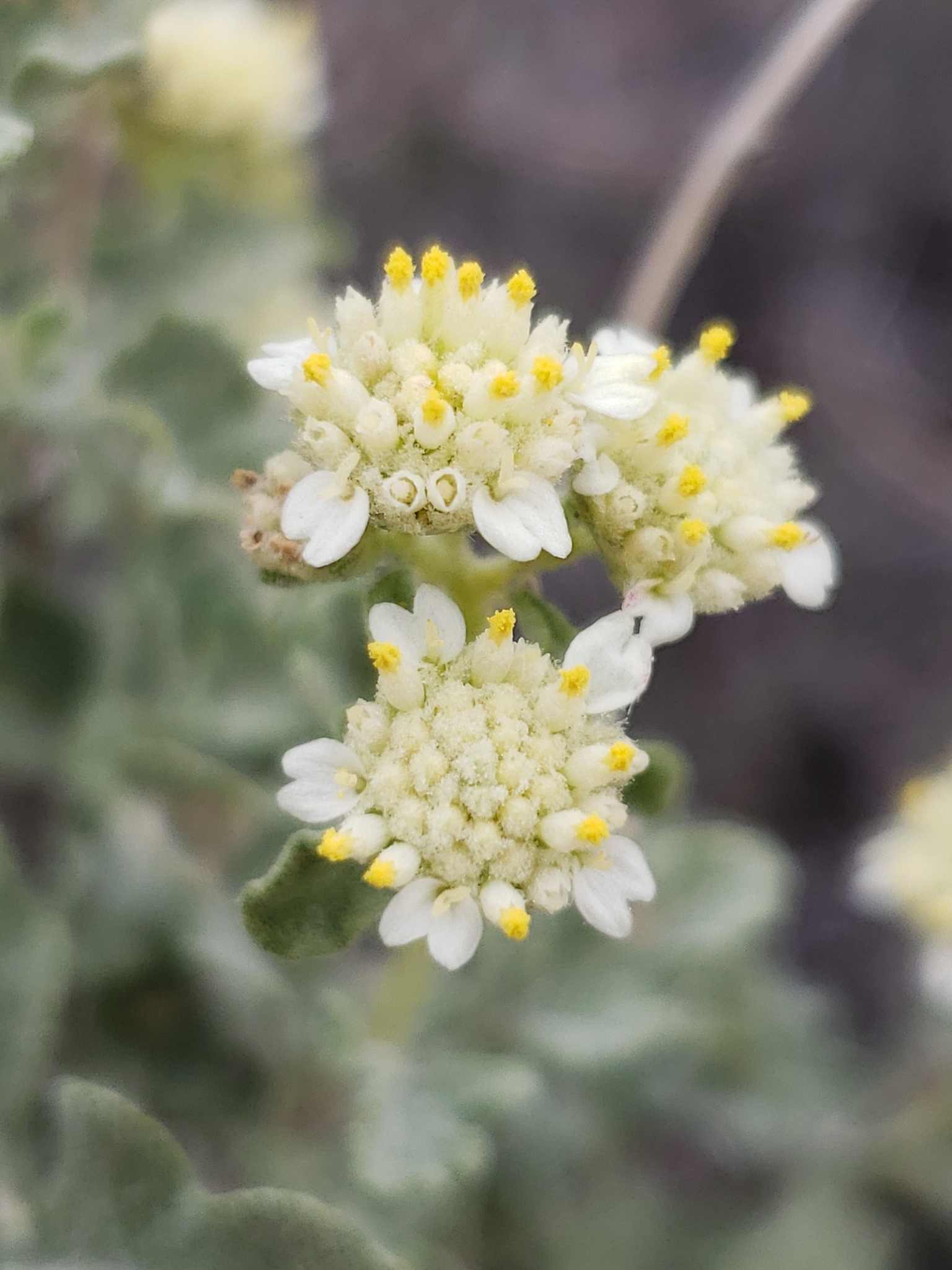
Mariola is most readily identified by its silver-white, densely hairy foliage that gives the entire plant a whitish or grayish appearance — unlike almost anything else in the desert flora of similar size. Combined with its rounded, compact form and small white flower heads, it is distinctive and unmistakable in its native habitat.
Leaves
The leaves are the most distinctive feature of Mariola: they are deeply lobed or pinnatifid (cut almost to the midrib), 1 to 3 inches long, and densely covered on both surfaces with white, woolly hairs (tomentum). This dense pubescence gives the foliage its characteristic silvery-white color and is the plant’s primary adaptation for reducing water loss and reflecting solar radiation. The leaves are aromatic, with a distinctive camphor-like or sage-like scent, especially when crushed. Unlike most desert shrubs, Mariola retains its leaves through winter, making it a true evergreen in all but the coldest winters.
Flowers
The flower heads are small and numerous, borne in branched clusters (corymbs) at the tips of the stems. Each head is about ¼ inch across with 5 small white ray florets surrounding a small yellow disc. While individually inconspicuous, the massed effect of hundreds of flower heads can create a misty white cloud above the silvery foliage. Flowering is most abundant in spring (March–May) and again in fall, but plants may flower intermittently throughout the growing season. The flowers attract a wide variety of small native bees, wasps, and flies.
Stems & Bark
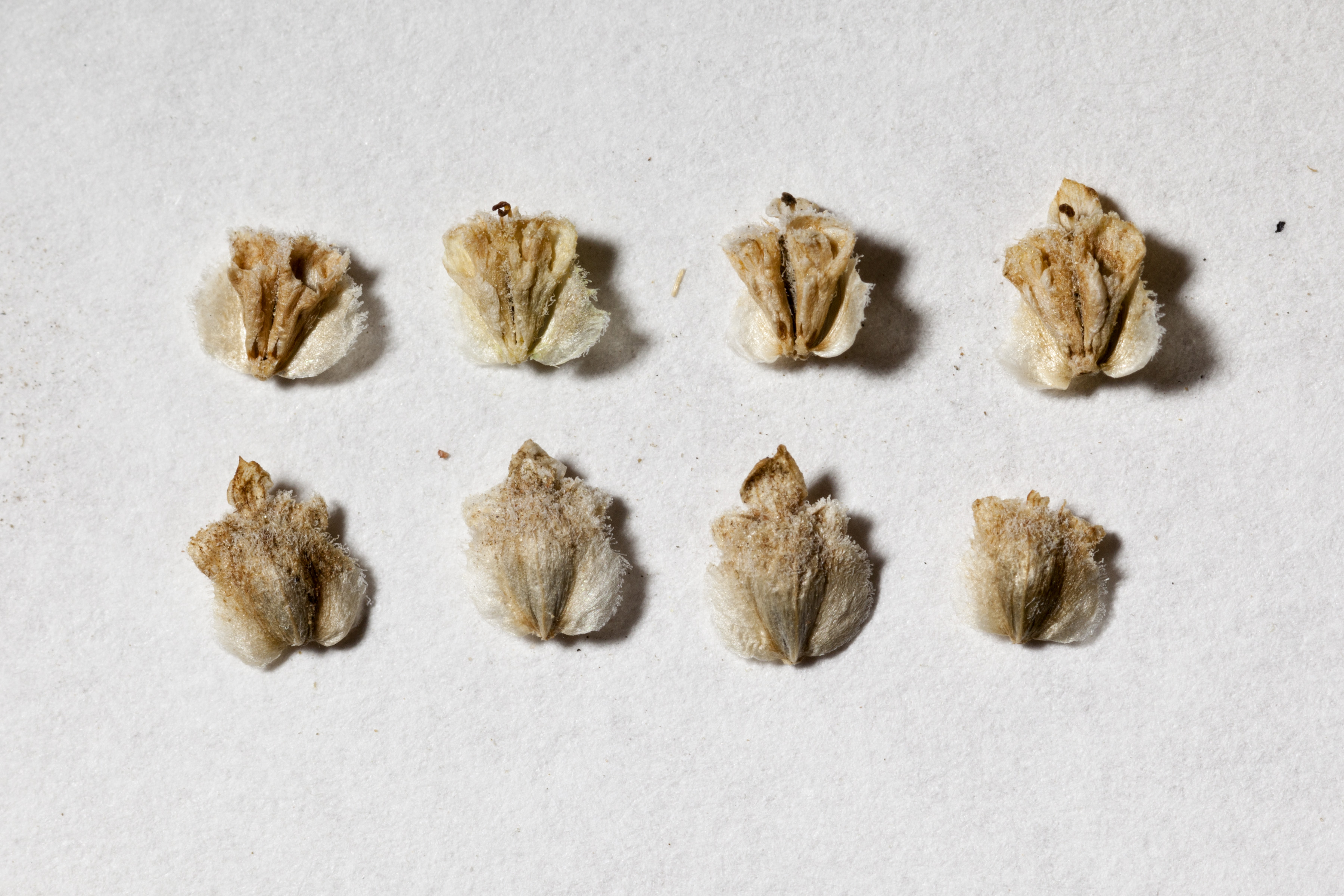
Mariola has a woody base with numerous erect to somewhat spreading stems that branch freely. Young stems are white and densely hairy like the leaves; older stems develop a grayish, somewhat shredded bark. The stems contain a small amount of rubber-like latex, which is related to the plant’s connection to commercial rubber-producing relatives. The overall growth habit is dense and shrubby, maintaining its form even in the absence of pruning.
Quick Facts
| Scientific Name | Parthenium incanum |
| Family | Asteraceae (Daisy/Composite) |
| Plant Type | Evergreen Perennial Shrub |
| Mature Height | 2 ft |
| Sun Exposure | Full Sun |
| Water Needs | Low (Drought Tolerant) |
| Bloom Time | March–May and August–October |
| Flower Color | White |
| USDA Hardiness Zones | 7–10 |
Native Range
Mariola is native to the Chihuahuan Desert and adjacent desert grassland regions of the American Southwest and northern Mexico. In the United States, it occurs in southern Arizona, southern New Mexico, and western Texas, extending south through Chihuahua, Sonora, Coahuila, Durango, and Zacatecas in Mexico. The species reaches its greatest abundance in the central and northern Chihuahuan Desert province, where it is one of the dominant low shrubs on wide plains and gentle slopes.
Within its U.S. range, Mariola is a characteristic species of limestone and caliche flats, rocky desert plains, and the lower slopes of Chihuahuan Desert mountain ranges. It is particularly common on the Jornada del Muerto Plain of south-central New Mexico, in the Tularosa Basin, along the Rio Grande Valley, and in the desert grassland zone of southeastern Arizona. Elevation range is typically 3,500 to 5,500 feet, though it occurs slightly higher and lower at the margins of its range.
Mariola is considered an increaser species in desert grassland — it expands its territory when overgrazing reduces competing native grasses. In heavily grazed areas, Mariola can become dominant. However, in well-managed or ungrazed desert grassland, it occurs as one component of a diverse shrub-grass community alongside creosote bush, tarbush, snakeweed, and native grama grasses. The plant’s evergreen character makes it particularly prominent in winter when deciduous plants have dropped their leaves.
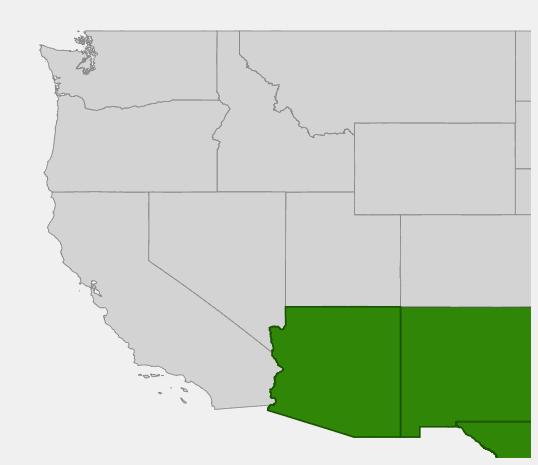
📋 Regional plant lists featuring Mariola: Arizona
Growing & Care Guide
Mariola is one of the toughest evergreen shrubs available to desert gardeners. It tolerates conditions that challenge most plants — extreme drought, alkaline soils, freezing temperatures, reflected heat, and poor fertility — while maintaining year-round interest with its distinctive silvery foliage and periodic white flower displays.
Light
Mariola requires full sun. Its reflective, silvery-white foliage is an adaptation to intense desert sunlight, and in shaded conditions the plant loses much of its compact form and distinctive appearance. Plant in the sunniest location available for best results.
Soil & Water
Mariola is adapted to the calcareous, rocky, and nutrient-poor soils of the Chihuahuan Desert. It performs well in alkaline soils (pH 7.5–8.5) where many other plants struggle. Drainage must be excellent — the plant will not tolerate wet feet. Once established, supplemental irrigation is rarely needed; Mariola survives on natural rainfall alone in most of the Chihuahuan Desert zone. In the Sonoran Desert (lower elevations, hotter summers), occasional deep watering during the pre-monsoon period helps maintain vigor. Do not fertilize — poor soil is preferred.
Planting Tips
Plant in fall or spring when temperatures are moderate. In native soils, prepare a shallow planting hole at grade; in clay-modified soils, create a raised, gravelly planting area. Mulch with pea gravel or decomposed granite rather than organic mulch, which can hold too much moisture around the crown. Containerized plants establish quickly. Give the plant room — the mature spread can be 2–3 feet. In landscape beds, Mariola combines beautifully with other low desert shrubs for a cohesive, water-wise planting.
Pruning & Maintenance
Mariola requires minimal maintenance. In early spring, light shaping to remove any winter-damaged tips maintains a tidy appearance. Avoid heavy pruning — the plant’s natural form is attractive and should be respected. Occasionally remove older, woody stems from the base to rejuvenate the plant. Mariola is evergreen and does not benefit from the dramatic cutting-back appropriate for deciduous shrubs.
Landscape Uses
- Silver accent — the bright silvery-white foliage contrasts dramatically with green or dark-leaved plants
- Low border or groundcover — compact size and dense form create excellent low coverage
- Hellstrip and parking lot planting — extreme toughness makes it suitable for the most challenging landscape locations
- Erosion control — dense roots and persistent foliage protect desert soils
- Wildlife garden — provides year-round cover and seasonal flowers for pollinators
- Restoration planting — appropriate for Chihuahuan Desert restoration projects
Wildlife & Ecological Value
While not the most dramatic wildlife plant in the Southwestern palette, Mariola provides important ecological services — particularly as year-round cover and a pollinator resource in the challenging Chihuahuan Desert ecosystem.
For Birds
The dense, low structure of Mariola provides year-round ground-level cover for small birds including sparrows, wrens, and thrashers. The small seeds in the dried flower heads provide food for finches and sparrows in fall and winter. In winter, the evergreen foliage provides thermal cover and windbreaks for small birds roosting near the ground in the open desert.
For Mammals
Mariola is generally avoided by most browsers due to its aromatic, resinous foliage. This resistance to browsing makes it valuable in heavily grazed areas where it provides persistent cover for jackrabbits, cottontails, and small rodents that take shelter beneath its skirt of foliage. The plant’s deep roots and persistent structure also support soil moisture and microhabitat diversity.
For Pollinators
The small white flower heads of Mariola attract a wide variety of small native bees, wasps, flies, and beetles that feed on the accessible pollen and nectar. As a nearly year-round bloomer in its native range, it provides resources during periods when other desert plants are not flowering. The white daisy-type flowers are particularly attractive to small halictid bees (sweat bees) and specialist Parthenium-visiting bees.
Ecosystem Role
As an evergreen shrub in the often seasonally bare Chihuahuan Desert, Mariola provides critical year-round cover and soil stabilization. Its dense root system protects fragile desert soils from wind erosion — a significant ecological service in a region prone to dust storms. In disturbed desert areas, Mariola often colonizes quickly and provides the first woody cover that allows more sensitive native species to establish. Its resinous chemistry may also have allelopathic effects (chemical inhibition of competing plants), which could contribute to the open spacing characteristic of Chihuahuan Desert vegetation.
Cultural & Historical Uses
Mariola has a long history of use by Indigenous peoples of the Chihuahuan Desert region, particularly the various Apache groups and the Rarámuri (Tarahumara) of northern Mexico. Medicinally, infusions of the leaves were applied as washes for skin infections, rashes, and wounds. The plant’s strong aromatic oils, which contain camphor, thymol, and other compounds with documented antimicrobial properties, lend some credibility to its traditional medicinal uses.
The Rarámuri used Mariola branches as a structural material and as fuel, and the plant’s resinous stems burn readily even when fresh. The aromatic smoke was used in some traditional ceremonies. Various desert cultures also used Mariola as an insect repellent, placing bundles of the aromatic foliage in stored food areas or near sleeping areas to discourage insects.
The plant’s connection to the rubber industry of the 20th century represents a fascinating chapter in its modern history. During World War II, when natural rubber from Southeast Asia was cut off by Japanese military actions, the U.S. government launched a major program to identify alternative rubber-producing plants. Mariola and its close relative guayule (Parthenium argentatum) were both studied, though guayule — with its higher rubber content — received the majority of research attention. Today, guayule remains an area of active agricultural research as a potential sustainable rubber crop, and Mariola’s rubber chemistry continues to inform this work.
Frequently Asked Questions
Is Mariola the same as guayule?
No — Mariola (Parthenium incanum) and guayule (Parthenium argentatum) are closely related but distinct species. Guayule has higher rubber content and was commercially cultivated for latex. Mariola has lower rubber content and has not been used commercially, but they share similar aromatic chemistry and ecological roles in the Chihuahuan Desert.
Is Mariola toxic to livestock?
Mariola is not generally considered toxic to livestock, but most animals avoid it due to its strong aromatic scent and bitter taste. In heavily overgrazed areas where preferred grasses have been eliminated, cattle may be forced to consume Mariola along with other less-palatable plants. In these conditions, heavy consumption can cause digestive issues, but the plant is not acutely toxic at typical grazing levels.
How do I tell Mariola from other silver-leaved desert shrubs?
Mariola’s deeply lobed (pinnatifid) leaves and small white daisy-type flowers distinguish it from most other silver-leaved desert shrubs. Brittlebush (Encelia farinosa) has similar silver foliage but oval leaves and large yellow flowers. White salvia (Salvia apiana) has sage-like leaves and lavender flowers. Mariola’s specific combination of deeply lobed silvery leaves, camphor scent, and small white flower heads makes it distinctive once learned.
Does Mariola stay evergreen in Arizona winters?
Yes — Mariola is reliably evergreen in most of Arizona, retaining its silvery leaves through all but the hardest winters. At temperatures below about 10–15°F, it may experience some leaf damage or dieback, but the woody base is hardy and will regenerate in spring. The evergreen character is one of its most valuable landscape traits in winter-dormant desert gardens.
Where can I find Mariola for purchase?
Mariola is available from native plant nurseries specializing in Chihuahuan Desert and upper Sonoran Desert species, particularly those in southern New Mexico and southeastern Arizona. Check our Arizona native plant nursery directory for regional sources.

Looking for a nursery that carries Mariola?
Browse our native plant nursery directory: Arizona