Elliott’s Blueberry (Vaccinium elliottii)
Vaccinium elliottii, commonly known as Elliott’s Blueberry or Mayberry, is a native deciduous shrub of the southeastern United States that combines outstanding wildlife value, edible fruit, brilliant fall color, and year-round ecological contributions in a compact, adaptable package. Named for the South Carolina botanist Stephen Elliott (1771–1830), who first formally described it, Elliott’s Blueberry is one of several native blueberry species thriving in the warm coastal plain and Piedmont woodlands of the Deep South — and arguably one of the most underutilized in cultivation despite its many outstanding qualities.
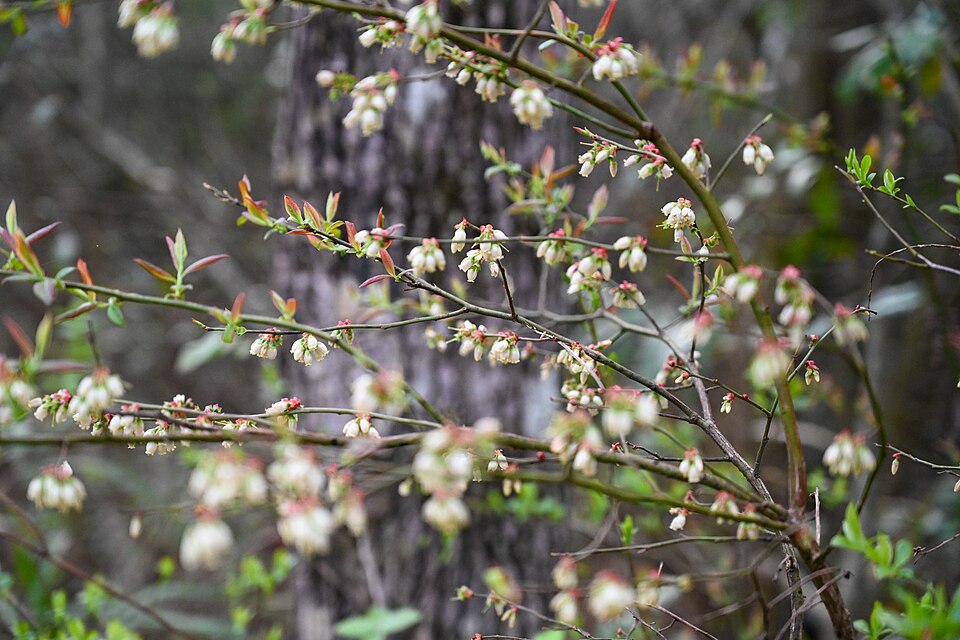
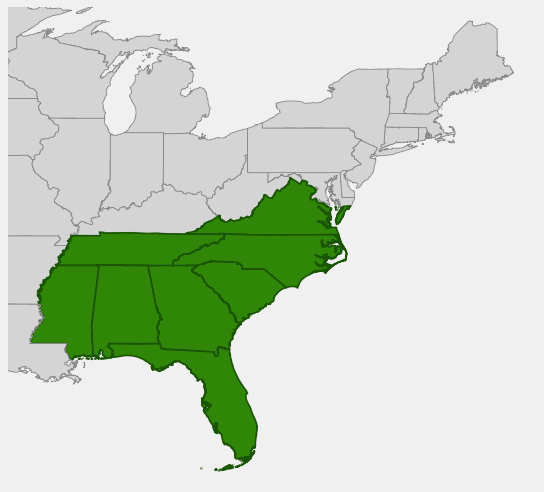
Growing naturally in pine flatwoods, open sandy-loam woodlands, bay forest edges, and upland hardwood margins from Virginia south through the Carolinas, Georgia, Florida, Alabama, Mississippi, and into Tennessee, Elliott’s Blueberry is an understory specialist adapted to the acidic, well-drained to seasonally moist soils of the southeastern coastal plain. It produces abundant clusters of small, sweet-tart black blueberries in summer — delicious for both humans and wildlife — preceded in March through May by drooping clusters of classic blueberry urn-shaped white flowers that are among the earliest and most reliable sources of spring nectar for native bees. The flowers are critical for buzz-pollinating bumblebees that emerge in late winter.
As a landscape plant, Elliott’s Blueberry offers genuine four-season interest: spring flowers, summer fruit, spectacular red to orange-red fall color (among the most vivid of any native southeastern shrub), and attractive winter twig structure. It is a top choice for edible native plant gardens, wildlife habitat plantings, and naturalistic woodland gardens throughout USDA Hardiness Zones 6–9 in the Southeast.
Identification
Elliott’s Blueberry is a multi-stemmed deciduous shrub typically growing 4 to 12 feet tall, with arching, somewhat wiry branches and a dense, rounded to irregular form. It spreads slowly by underground rhizomes, gradually forming open colonies in woodland settings. The plant’s overall appearance is elegant and fine-textured, with small leaves, delicate pendant flower clusters, and colorful seasonally changing fruit.
Stems & Twigs
Young twigs are slender, green to reddish-green, with a slight waxy coating. Older stems develop grayish-brown bark that exfoliates in thin, papery strips on larger specimens. The stems are strongly upright to arching, often developing a layered, somewhat open canopy structure with age. The plant spreads gradually by stolons and rhizomes, forming loose colonies over time without becoming aggressively invasive or difficult to manage in garden settings.
Leaves
The leaves are simple, alternate, elliptic to ovate, and relatively small — typically 1 to 2 inches long and ½ to ¾ inch wide. They are thin, bright to medium green on the upper surface, paler beneath, with a finely serrulate (very finely toothed) margin. The leaf texture is thin and somewhat membranous compared to other blueberry species. In autumn, the foliage transforms into a spectacular display of red, scarlet, and orange — one of the most vivid fall color shows of any native southeastern shrub, rivaling the reds of sourwood and black gum in intensity and reliability.
Flowers & Fruit
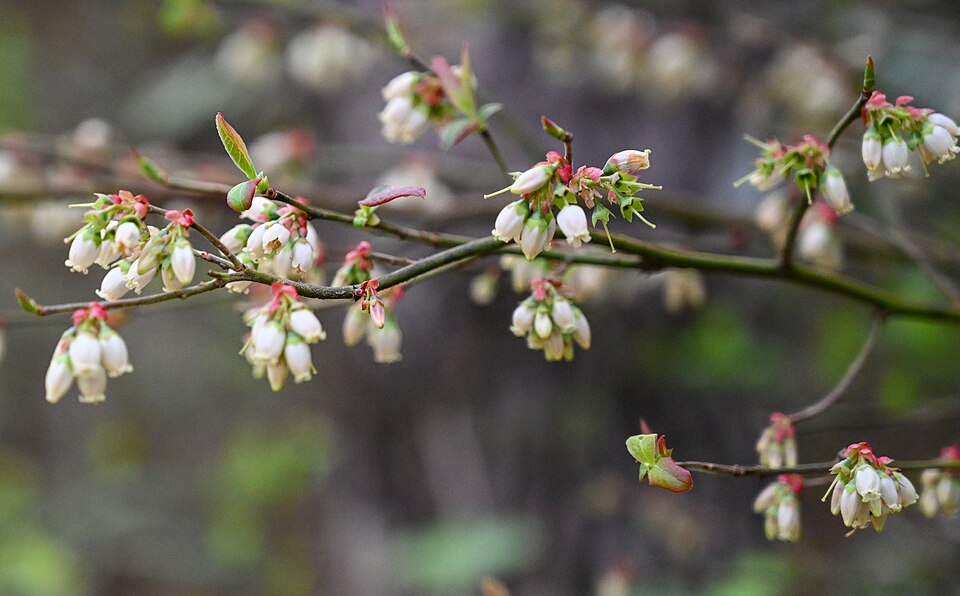
The flowers appear before or with the emerging leaves in March through May — providing important early-season nectar when few other shrubs are in bloom. They are produced in dense, drooping clusters (racemes) of 4–10 urn-shaped (urceolate) flowers, each about ¼ inch long, white to very pale pink, with a faint sweet scent. The flowers are adapted to pollination by bumblebees that “buzz pollinate” (sonicate) the anthers to release pollen — a process that only bumblebees and a few other native bee genera can perform effectively. This makes Elliott’s Blueberry directly dependent on native bumblebees for optimal fruit set.
The fruit is a small round berry, 3/16 to ¼ inch in diameter, ripening from green to red to glossy black from June through August. The berries are sweet and flavorful with a concentrated, complex flavor that many gardeners and foragers consider superior to commercial blueberries despite their smaller size. On established shrubs with adequate pollination, fruit production can be truly abundant.
Quick Facts
| Scientific Name | Vaccinium elliottii |
| Family | Ericaceae (Heath) |
| Plant Type | Deciduous Shrub |
| Mature Height | 12 ft |
| Sun Exposure | Full Sun to Part Shade |
| Water Needs | Moderate to High |
| Bloom Time | March – May |
| Flower Color | White to pale pink |
| Fruit | Black blueberries (edible; Jun–Aug) |
| Fall Color | Brilliant red to orange-red |
| USDA Hardiness Zones | 6–9 |
Native Range
Elliott’s Blueberry is native to the southeastern United States, ranging from southeastern Virginia south through the Carolinas, Georgia, and Florida, and westward through Alabama, Mississippi, and into Tennessee. Its range closely mirrors the distribution of the Coastal Plain and lower Piedmont environments — acidic, sandy, seasonally moist soils beneath open pine-dominated or mixed pine-hardwood forest canopies that are characteristic of the Gulf and South Atlantic Coastal Plain.
Within this range, Elliott’s Blueberry is most commonly found in longleaf pine flatwoods, pine-scrub oak sandhill communities, bay forest edges, and upland hardwood woodlands with acidic, well-drained to moderately moist soils. It frequently grows alongside other native blueberries, including Highbush Blueberry (Vaccinium corymbosum), Deerberry (Vaccinium stamineum), and Sparkleberry (Vaccinium arboreum), forming diverse understory blueberry communities that are extraordinarily valuable for wildlife.
This species is closely associated with fire-maintained ecosystems — particularly the longleaf pine flatwoods and pine-wiregrass communities of the Gulf and South Atlantic Coastal Plain. Regular prescribed fire historically kept the canopy open and prevented hardwood encroachment, maintaining the light conditions that favor Elliott’s Blueberry and other ericaceous understory shrubs. Conservation lands that reintroduce prescribed fire have shown dramatically improved health and abundance of blueberry communities and the full suite of associated wildlife.
📋 Regional plant lists featuring Elliott’s Blueberry: Alabama, Georgia & Mississippi
Growing & Care Guide
Elliott’s Blueberry is an excellent native shrub for southeastern gardens with acidic, well-drained to moderately moist soils. Like all blueberries, it requires acidic conditions (pH 4.5–5.5) to thrive — outside this range, it will decline due to nutrient deficiencies and root stress. When sited appropriately with the right pH, adequate moisture, and sufficient sunlight, it is reliable, productive, and highly rewarding.
Light
Elliott’s Blueberry grows best in full sun to part shade. Full sun maximizes flower and fruit production and enhances the vividness of fall color. Part shade (3–5 hours of direct sun) produces a more open, graceful plant with slightly reduced fruiting. Deep shade is not suitable — the plant becomes weak and sparsely fruiting without adequate light, and fall color will be muted.
Soil & Water
Acidic soil is absolutely essential. Elliott’s Blueberry thrives in sandy loam to loamy soils with pH 4.5–5.5. In heavy clay soils, raised beds or amended planting areas with composted pine bark help create suitable conditions. The plant prefers moderate to high moisture — it grows naturally in seasonally moist lowlands and bay forest edges. Consistent mulching with pine bark, wood chips, or pine needles maintains the cool, moist, acidic root environment this species evolved in.
Planting Tips
Plant in fall or spring. Space plants 4–6 feet apart for a massed planting or edible native hedge. For cross-pollination and maximum fruiting, plant at least 2–3 specimens. Mulch generously with acidic organic mulch. Avoid limestone-based amendments or fertilizers high in phosphorus, which can harm the mycorrhizal root associations blueberries depend on. Test soil pH before planting and amend with elemental sulfur if needed to lower pH below 5.5.
Pruning & Maintenance
Prune lightly after fruiting in late summer, removing the oldest, least productive canes at the base to stimulate vigorous new growth from the crown. Avoid heavy pruning in late fall or winter that removes flower buds. The plant is generally pest-resistant, though blueberry stem blight can occasionally affect stressed plants — adequate drainage and proper watering practices are the best prevention.
Landscape Uses
- Edible native garden — delicious blueberries for humans and wildlife alike
- Four-season interest — spring flowers, summer fruit, spectacular fall color, winter structure
- Pollinator garden — critical early spring buzz-pollination resource for bumblebees
- Wildlife habitat anchor — among the most wildlife-productive shrubs for SE gardens
- Woodland edge planting — perfect beneath open pine canopy or at forest margins
- Mass planting and native hedge — forms attractive colonies in appropriate conditions
Wildlife & Ecological Value
Elliott’s Blueberry is one of the most ecologically productive native shrubs for wildlife in the Southeast. Few plants combine such abundant early-season nectar, nutritious summer fruit, and excellent structural cover in a single species — making it a genuine wildlife garden powerhouse.
For Birds
The blueberries attract a remarkable diversity of fruit-eating birds including Eastern Bluebirds, American Robins, Gray Catbirds, Brown Thrashers, Cedar Waxwings, Eastern Towhees, Scarlet Tanagers, and many warblers during their summer residency. The dense, twiggy structure provides excellent nesting habitat for thicket-nesting species such as Yellow-breasted Chat, Common Yellowthroat, and Prairie Warbler. In fall, migrating thrushes and waxwing flocks depend heavily on blueberry thickets as critical fueling stations before continuing their journeys southward.
For Mammals
Black bears consume blueberries voraciously where ranges overlap across the Southeast. White-tailed deer browse the foliage, and raccoons, opossums, and foxes eat the fruit. Eastern box turtles are major consumers of fallen ripe blueberries on the woodland floor. Gray and Fox Squirrels also harvest the fruit for immediate consumption and caching.
For Pollinators
Blueberries are among the most important native bee plants in North America. The urn-shaped flowers require buzz pollination — vibration at a specific frequency — which only bumblebees and a few other native bee genera can provide effectively. This makes Elliott’s Blueberry specifically dependent on native bumblebees for optimal fruit set. Planting Elliott’s Blueberry directly supports declining bumblebee populations, including the imperiled Rusty-patched Bumblebee in northern parts of its range and several Southern species currently facing population pressures.
Ecosystem Role
In longleaf pine flatwoods and other fire-maintained ecosystems, blueberry shrubs like Vaccinium elliottii form a critical structural layer between the ground cover and canopy. The rhizomatous root system stabilizes sandy soils and contributes to organic matter cycling. The abundant summer fruit crop supports a broad food web from insects to bears, making these shrubs a fundamental food-web component in southeastern coastal plain ecosystems.
Cultural & Historical Uses
Blueberries hold deep cultural significance for Indigenous peoples throughout the eastern United States. Native nations of the Southeast — including the Muscogee (Creek), Cherokee, Choctaw, and others — harvested wild blueberries extensively for fresh eating, drying, and preserving. Dried blueberries were an important travel food and winter food reserve, mixed with cornmeal and dried meat in traditional preparations. Several nations used blueberry preparations medicinally, including infusions of the roots and leaves for urinary tract ailments, as a blood purifier, and for various digestive complaints.
Early European settlers in the Southeast quickly adopted wild blueberry harvesting from Indigenous peoples, and blueberries became an important seasonal food throughout the region. The small, intensely flavored wild berries were made into preserves, pies, and wines. The development of commercial highbush blueberry cultivation in the early 20th century drew directly on observations of wild southeastern species including Vaccinium elliottii, which contributed genetic material and botanical knowledge to early breeding programs aimed at developing commercially viable blueberry cultivars for the warm Southeast.
Today, Elliott’s Blueberry is gaining attention as a desirable native alternative or complement to cultivated highbush blueberries in home fruit gardens throughout the Southeast. While the fruit is smaller than commercial varieties, its superior flavor concentration, exceptional wildlife value, adaptability to naturalistic conditions, and stunning fall color make it increasingly popular with native plant gardeners and permaculture practitioners who want an edible plant that also performs important ecological functions.
Frequently Asked Questions
Are the berries of Elliott’s Blueberry edible?
Yes — the berries are genuinely delicious. Smaller than commercial blueberries, they have a concentrated, sweet-tart flavor that many consider superior to cultivated varieties. Harvest them when fully ripe (deep glossy black and slightly soft) from June through August. They can be eaten fresh, used in baking, made into preserves, or frozen for later use.
Do I need multiple plants for good fruit production?
Elliott’s Blueberry produces significantly better fruit with cross-pollination from nearby plants of the same or a related species. Plant at least 2–3 plants within 10–15 feet of each other for optimal fruit set. Highbush Blueberry and other native Vaccinium species in the garden can also serve as effective cross-pollinators.
Why does my Elliott’s Blueberry have yellow leaves?
Yellowing (chlorosis) is almost always caused by soil pH that is too high (alkaline or neutral). Elliott’s Blueberry requires acidic soil (pH 4.5–5.5). Test your soil pH, and if it’s above 6.0, amend with elemental sulfur to lower it. Consistent mulching with pine bark or pine straw will help maintain the appropriate acidic root environment over time.
How does it differ from Highbush Blueberry?
Elliott’s Blueberry is generally similar in height to Highbush but with smaller leaves and smaller fruit. It is better adapted to the warmer, sometimes drier conditions of the Coastal Plain compared to Highbush, which prefers consistently moist, more northerly habitats. Both are excellent native species. Elliott’s tends to show better heat tolerance and more vivid fall color in the Deep South.
What is the fall color like?
Spectacular and reliable. Elliott’s Blueberry is one of the finest native shrubs for autumn foliage in the Southeast, producing vivid shades of red, scarlet, and orange-red from October through November. Even in warm Southern autumns, the color display is intense and long-lasting — making this species genuinely worth growing for its fall display alone, independent of its fruit and wildlife value.

Looking for a nursery that carries Elliott’s Blueberry?
Browse our native plant nursery directory: Alabama · Georgia · Mississippi