Southern Magnolia (Magnolia grandiflora)
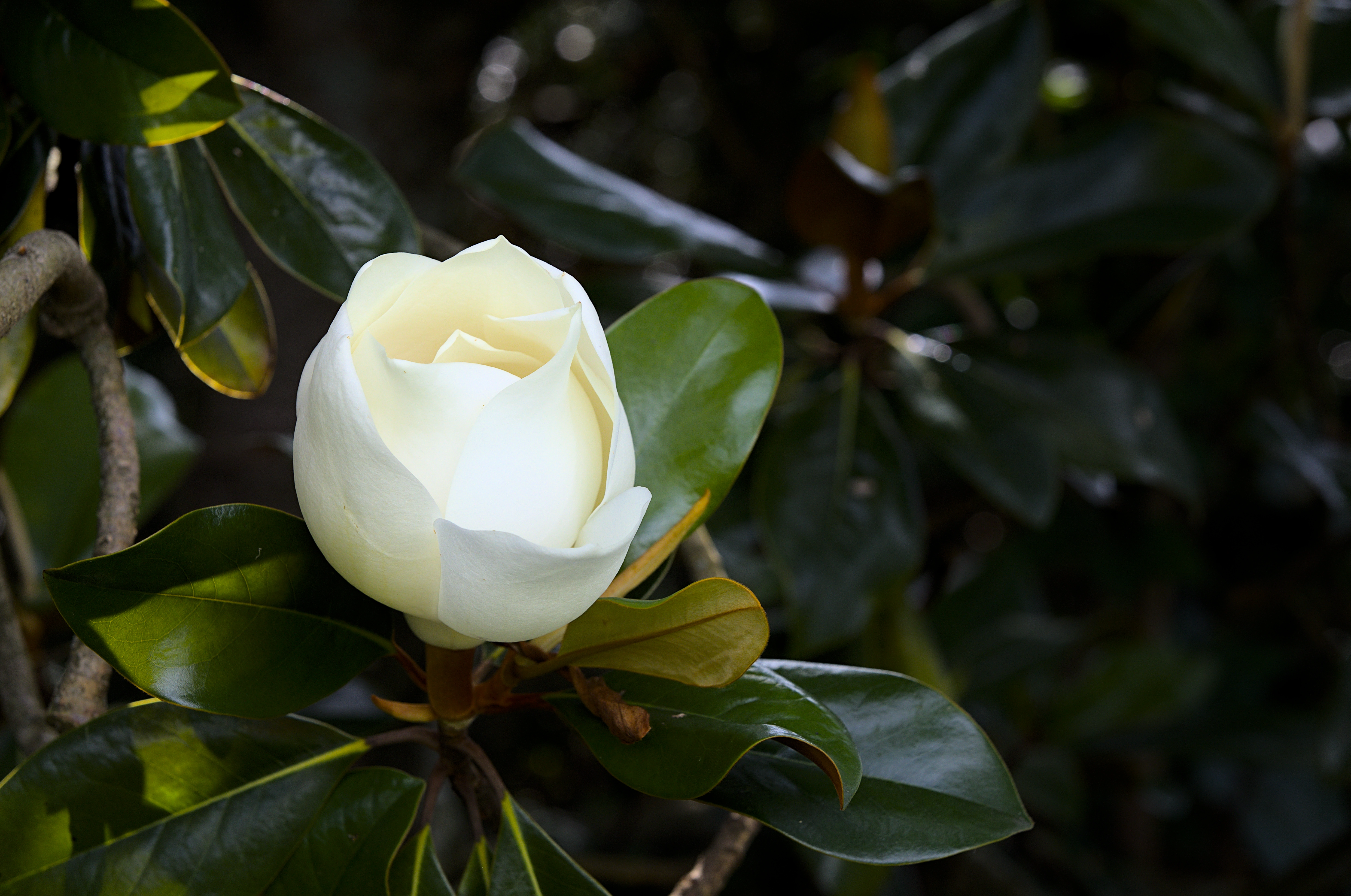
Magnolia grandiflora, the Southern Magnolia, is one of the most iconic trees in American horticulture — a magnificent broadleaf evergreen that has defined the landscapes and culture of the American South for centuries. Its enormous, fragrant white flowers, up to 12 inches across, are among the largest blooms of any hardy tree in the world, and its glossy, dark green leaves with rusty-brown undersides are as striking as its flowers. Southern Magnolia is the state flower of both Mississippi and Louisiana, and its image has been central to the identity of the Deep South from antebellum plantation gardens to contemporary streetscapes across the region.
In its natural habitat, Southern Magnolia is a large forest tree growing to 60–100 feet tall along the moist bottomlands, bluff forests, and maritime hammocks of the southeastern Coastal Plain. Unlike many ornamental trees introduced to horticulture from other continents, Southern Magnolia is a true native — one that evolved in the ancient forests of the southeastern United States and has played an ecological role in these landscapes for millions of years. Its large, seed-filled cones — which split open in late summer to reveal vivid scarlet seeds suspended on silky threads — are an important food source for migratory birds and other wildlife, and its massive, dense canopy provides structural habitat of a kind that few other trees can match.
Southern Magnolia is a highly versatile landscape tree, performing well in full sun to considerable shade, tolerating a range of soil conditions from moist bottomlands to well-drained upland soils, and thriving across a wide geographic range that now extends well beyond its native Southeast through cultivation. For native plant enthusiasts in the South, it is an essential tree — combining unmatched aesthetic impact with genuine ecological value and an extraordinary connection to the natural and cultural heritage of the region.
Identification
Southern Magnolia is a large, densely crowned broadleaf evergreen tree typically reaching 60 to 100 feet tall in landscape settings, with a broadly pyramidal to oval crown that can spread 30 to 50 feet wide. Young trees have a naturally pyramidal shape; older trees develop a broader, more irregular crown. The tree holds its leaves year-round, creating a dense, impenetrable shade beneath the canopy. The massive, trunk can reach 3 to 4 feet in diameter on old specimens, with a rounded profile and a fibrous, dark brown to gray-brown bark.
Bark
The bark of Southern Magnolia is thin, smooth, and gray on young trees, developing shallow, scaly ridges and a darker gray-brown color with age. Old specimens may have a slightly shaggy or plated appearance. The bark is easily damaged by mechanical injury from lawn mowers and weed trimmers, and mulching out to the drip line is strongly recommended to protect the shallow surface roots. Unlike many trees, the magnolia’s surface roots are extensive and close to the surface, making it unsuitable for planting in areas where lawn grasses and ground covers are maintained aggressively.
Leaves
The leaves are the tree’s most instantly recognizable feature: large, simple, alternate, and persistently evergreen, each leaf 5 to 8 inches long and 2 to 3 inches wide, with a thick, leathery texture and a strongly elliptic to oblong-ovate shape. The upper surface is intensely glossy, dark green, and almost lacquered in appearance; the underside is covered in a dense, felt-like mat of rusty-brown to golden-brown hairs (tomentum) that is one of the most distinctive identification features of the species. Leaf margins are smooth, and the tip is pointed to short-acuminate. Leaves are held for 2 years before dropping, so there is always a layer of fallen leaves beneath the tree — one of the reasons Southern Magnolia creates dense shade that inhibits most understory vegetation.
Flowers & Fruit
The flowers of Southern Magnolia are among the most spectacular of any hardy tree. Each flower is 6 to 12 inches across, with 6 to 12 creamy white, waxy, cup-shaped tepals arranged in a broad, flattened bowl. The center of the flower contains a cone-like structure bearing numerous yellow stamens and pistils. The flowers are intensely, sweetly fragrant — a rich, lemony scent that can be detected from a considerable distance on warm, humid spring evenings. Flowering begins in April and continues through June, with occasional scattered blooms possible through summer and into early fall on mature trees.
After pollination, the cone-like structures develop into aggregate fruits — cylindrical, textured, rose-pink to brown cones 3 to 5 inches long that split open in late summer and early fall to reveal vivid, brilliant scarlet seeds suspended on white, silky threads. These seeds are high in fat and are eagerly consumed by migratory and resident birds, particularly those fattening up for fall migration. The fruit display — pink cone against dark green leaves with scarlet seeds dangling on threads — is one of the most visually striking of any native tree in fall.
Quick Facts
| Scientific Name | Magnolia grandiflora |
| Family | Magnoliaceae (Magnolia) |
| Plant Type | Broadleaf Evergreen Tree |
| Mature Height | 100 ft |
| Sun Exposure | Full Sun to Full Shade |
| Water Needs | Moderate |
| Bloom Time | April – June |
| Flower Color | White |
| USDA Hardiness Zones | 6–10 |
Native Range
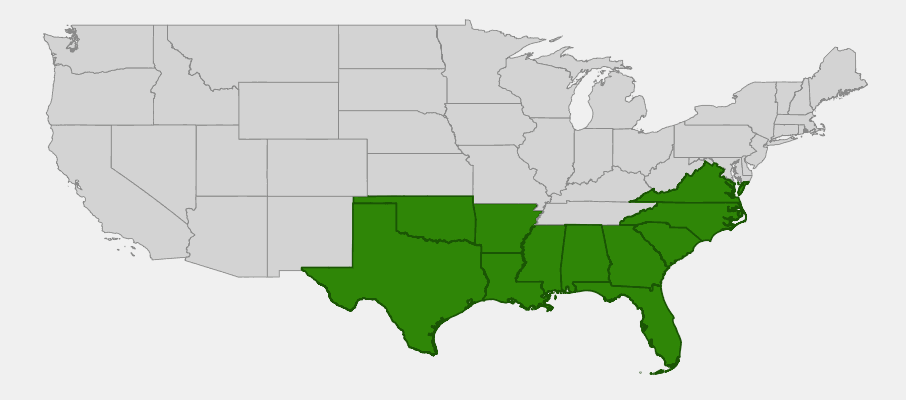
Southern Magnolia is native to the Coastal Plain of the southeastern United States, ranging from coastal North Carolina south through South Carolina, Georgia, and all of Florida, then west along the Gulf Coast through Alabama, Mississippi, Louisiana, and into eastern and central Texas. It also extends northward into Arkansas and portions of southeastern Virginia along river bottoms and sheltered bluff forests where the maritime climate moderates winter temperatures. In its native range, Southern Magnolia is primarily a tree of moist, well-drained bottomland forests, bluff forests, and maritime hammocks — habitats where deep, moist, well-drained soils and a long frost-free season favor its growth.
Within the Atlantic and Gulf Coastal Plain, Southern Magnolia is most common in the mixed pine-hardwood forests of the middle and outer Coastal Plain, where it grows as a canopy and subcanopy tree alongside Loblolly Pine, Swamp Chestnut Oak, American Beech, and Sweetgum. In Florida, it occurs in hammocks and bottomland forests across the northern and central parts of the state. Along the Gulf Coast, it is a dominant tree of the maritime forests and bottomland hardwood communities that line the margins of the coastal plain from Texas to Georgia. Its presence in the landscape is often a reliable indicator of deep, moist, fertile soils.
Beyond its native range, Southern Magnolia has been widely planted as an ornamental throughout the eastern United States, the Pacific Coast, and in mild-winter regions worldwide. It has naturalized in some areas outside its native range where conditions are suitable. In horticulture, numerous cultivars have been selected for specific traits including compact size (such as ‘Little Gem’), cold hardiness, flower size, and foliage characteristics. However, for ecological and conservation purposes, locally sourced native-origin trees are always preferred over cultivars, which may not support the full suite of wildlife interactions characteristic of the species in its natural range.
📋 Regional plant lists featuring Southern Magnolia: Alabama, Georgia & Mississippi
Growing & Care Guide
Southern Magnolia is a surprisingly adaptable tree that, while best suited to the moist, fertile soils of its native range, performs well in a wide variety of landscape conditions. Its combination of massive size, year-round beauty, and minimal maintenance requirements makes it one of the most impactful trees available for southeastern landscapes.
Light
Southern Magnolia thrives in full sun to moderate shade. In full sun, it develops the densest, most symmetrical crown, the largest flower production, and the most vigorous growth. It also tolerates considerable shade — young trees in its natural forest habitat grow up through the canopy from the shaded understory, and established trees in half-shade can perform well. The best landscape specimens are usually those with morning sun and some afternoon shade in the hottest parts of the range, where afternoon heat can stress trees during establishment.
Soil & Water
Southern Magnolia prefers moist, well-drained, acidic soils (pH 5.0–6.5) rich in organic matter. In its native habitat it grows on the deep, loamy soils of bottomland forests and bluff forests where moisture is reliable but drainage is good. It does not tolerate prolonged flooding but can handle brief periods of wet conditions. Established trees are moderately drought-tolerant but perform best with consistent moisture, especially during their first 2–3 years of establishment. The tree does not perform well in highly alkaline soils, heavy clay without drainage, or excessively dry, compacted urban soils without supplemental water.
Planting Tips
Plant Southern Magnolia in fall or early spring. Allow ample space for the tree’s ultimate size — a minimum of 20–30 feet from structures and 15–20 feet from other large trees. Plant at the same depth as the nursery container, never deeper. Mulch with 3–4 inches of organic mulch (shredded bark or wood chips) out to the drip line to retain moisture and protect surface roots — this is particularly important as Southern Magnolia has extensive, shallow surface roots that are easily damaged by mowing and soil compaction. Water deeply and regularly during the first growing season.
Pruning & Maintenance
Southern Magnolia requires very little pruning. The tree naturally develops an attractive form without intervention. Remove dead, damaged, or crossing branches in late winter or early spring before growth begins. Lower branches can be removed gradually to raise the crown if needed, though the low, sweeping branching of a magnolia left to develop naturally is one of its great aesthetic features. Avoid heavy pruning, which can create large wounds susceptible to decay. The fallen leaves beneath the tree are acidic and leathery, decomposing slowly and sometimes inhibiting turf growth beneath the canopy — this is best managed by accepting a mulched or planted area under the tree rather than fighting it with lawn maintenance.
Landscape Uses
Southern Magnolia is one of the most impactful specimen trees available for southeastern landscapes:
- Specimen/accent tree — unmatched aesthetic impact in flower and in fruit
- Screen and privacy planting — year-round dense evergreen canopy
- Shade tree — deep, dense shade under mature specimens
- Wildlife habitat — fruit feeds migratory birds; canopy harbors nesting species
- Street tree — widely used in southern cities, tolerates urban conditions
- Historical and heritage gardens — the definitive tree of traditional southern landscapes
- Windbreak — dense evergreen canopy provides year-round wind protection
Wildlife & Ecological Value
Southern Magnolia provides year-round wildlife habitat — from its spring flowers to its fall fruit and its dense, year-round evergreen canopy. As one of the largest native trees of the southeastern Coastal Plain, it supports an impressive range of wildlife interactions.
For Birds
The scarlet seeds of Southern Magnolia are consumed by a wide range of birds, including Eastern Towhee, Hermit Thrush, American Robin, Eastern Bluebird, Red-eyed Vireo, Pileated Woodpecker, Wild Turkey, and various warblers and flycatchers during fall migration. The large, dense canopy of mature Southern Magnolias provides year-round nesting and roosting habitat for Great Horned Owls, Barred Owls, and many songbirds. The structural complexity of the canopy — with its thick, persistent leaves, strong horizontal branches, and cone-like fruit structures — creates exceptional nesting site diversity that few other trees match.
For Mammals
White-tailed Deer, Eastern Gray Squirrels, and Fox Squirrels consume the seeds of Southern Magnolia. The dense, low-branching canopy of mature specimens provides thermal cover for deer bedding in winter. Raccoons and opossums forage in magnolia canopies for seeds and invertebrates. In the coastal plain, Black Bears consume the seeds as part of their diverse fall diet.
For Pollinators
The flowers of Southern Magnolia are an ancient pollination story: magnolias evolved before bees, and the large, bowl-shaped flowers were originally adapted for pollination by beetles. Today, the Southern Magnolia’s large white flowers are still primarily pollinated by beetles (particularly members of the genus Cerambycidae and Nitidulidae) that are attracted to the flowers’ heat, fragrance, and pollen. The flowers also attract native bees and bumblebees. The magnolia’s beetle-pollination relationship is one of the most ancient plant-pollinator interactions in North America, connecting modern gardens to the primeval forests of the Cretaceous era.
Ecosystem Role
Southern Magnolia is a canopy dominant in the moist bottomland and bluff forests of the southeastern Coastal Plain. Its large, leathery leaves decompose slowly, creating a persistent leaf layer that moderates soil temperature and retains moisture beneath the canopy. The dense shade cast by the evergreen canopy shapes the understory plant community, favoring shade-tolerant species and creating habitat structure that supports a diverse community of forest-floor invertebrates, reptiles, and amphibians. The persistent cone structures and old tree cavities support cavity-nesting birds and mammals throughout the year.
Cultural & Historical Uses
Southern Magnolia occupies a singular place in the cultural identity of the American South. Its large white flowers have symbolized the grace, beauty, and strength of the region in literature, music, and art since the 18th century. The magnolia blossom is the official state flower of both Mississippi (adopted 1900) and Louisiana (adopted 1900), and it appears on the state seal of Mississippi. The tree itself is the state tree of Mississippi (adopted 1938). No other native plant has been as thoroughly woven into the cultural fabric of the Deep South as Magnolia grandiflora.
Indigenous peoples of the southeastern United States had numerous uses for Southern Magnolia. The bark and cones were used medicinally by the Cherokee and other southeastern nations as a treatment for rheumatism, fever, and as a general tonic. The aromatic bark was dried and used as a tobacco substitute or additive by some groups, and the leaves were used in wound treatment preparations. Early European colonizers quickly adopted the plant as both a medicinal and ornamental species, and it was introduced to European botanical gardens in the early 18th century, where it became one of the most celebrated exotic plants from the New World. French and English botanists competed to be the first to successfully flower the tree in European cultivation.
In antebellum southern culture, the magnolia-lined avenue leading to a plantation house became an iconic symbol of wealth, permanence, and connection to the land. These avenues — many of which survive today as heritage trees of great historical and ecological significance — represent some of the oldest documented native tree plantings in North America. In the post-Civil War South, the magnolia took on complex layers of meaning as both a symbol of the lost antebellum world and a resilient, enduring symbol of the South’s natural heritage. Today, Southern Magnolia is equally celebrated as a native plant of genuine ecological value and as one of the most beautiful trees in the world — a combination that few other species can claim.
In modern horticulture, Southern Magnolia has spawned dozens of named cultivars selected for smaller size, greater cold hardiness, and various foliage and flower characteristics. The dwarf cultivar ‘Little Gem’, selected in North Carolina in the 1950s, brought the beauty of Southern Magnolia to smaller gardens and has been one of the most widely sold native trees in American horticulture for decades. However, gardeners and ecologists increasingly emphasize the value of straight-species, locally sourced Southern Magnolia for genuine ecological restoration and habitat value, as cultivars may not provide the same quality of wildlife habitat as wild-type trees.
Frequently Asked Questions
Is Southern Magnolia a messy tree?
Southern Magnolia does drop leaves year-round (it is evergreen but replaces leaves continuously), as well as large cones and spent flowers. The leaves are large, leathery, and decompose slowly, and the fallen flowers can be slippery underfoot. Under the tree, a thick layer of leaves and debris tends to accumulate, which can inhibit lawn grass. The best approach is to mulch under the tree’s canopy and accept (or even appreciate) the natural leaf litter, which is ecologically beneficial and aesthetically fitting for a natural garden aesthetic.
How large does Southern Magnolia get?
In its natural habitat, Southern Magnolia regularly reaches 60–100 feet tall with a spread of 30–50 feet. Landscape trees are often somewhat smaller. The compact cultivar ‘Little Gem’ tops out at 15–20 feet and is suitable for smaller gardens. Always allow ample space for the tree’s ultimate size — a minimum of 20–30 feet from any structure is recommended for the full-sized species.
Do Southern Magnolias smell?
Yes — intensely and wonderfully. The large white flowers produce a rich, sweet, lemon-tinged fragrance that can fill a garden and be detected from considerable distances. The scent is strongest in warm, humid weather. Some people find it overwhelming in quantity; others consider it one of the finest natural fragrances in the botanical world. The leaves and bark also have a subtle aromatic quality when crushed.
When does Southern Magnolia bloom?
The main bloom period is April through June across most of its range, with the largest concentration of flowers in May. Individual flowers last only 3–4 days before dropping their petals, but a mature tree produces dozens to hundreds of flowers over the course of the bloom season. Occasional flowers may appear throughout summer and even into early fall on mature specimens, providing a longer bloom period than many other trees.
Is Southern Magnolia native to my area?
Southern Magnolia is native to the southeastern United States, from coastal North Carolina to Texas and north to Arkansas and parts of Virginia. If you live within this range, you are planting a true native. If you are outside this range (for example, in Tennessee, Kentucky, or the Midwest), Southern Magnolia is a cultivated ornamental, not a native planting. For ecological gardening purposes, using locally sourced seed-grown trees from your region of the native range is always preferable to cultivars.

Looking for a nursery that carries Southern Magnolia?
Browse our native plant nursery directory: Alabama · Georgia · Mississippi