
Pink Lady’s Slipper (Cypripedium acaule)
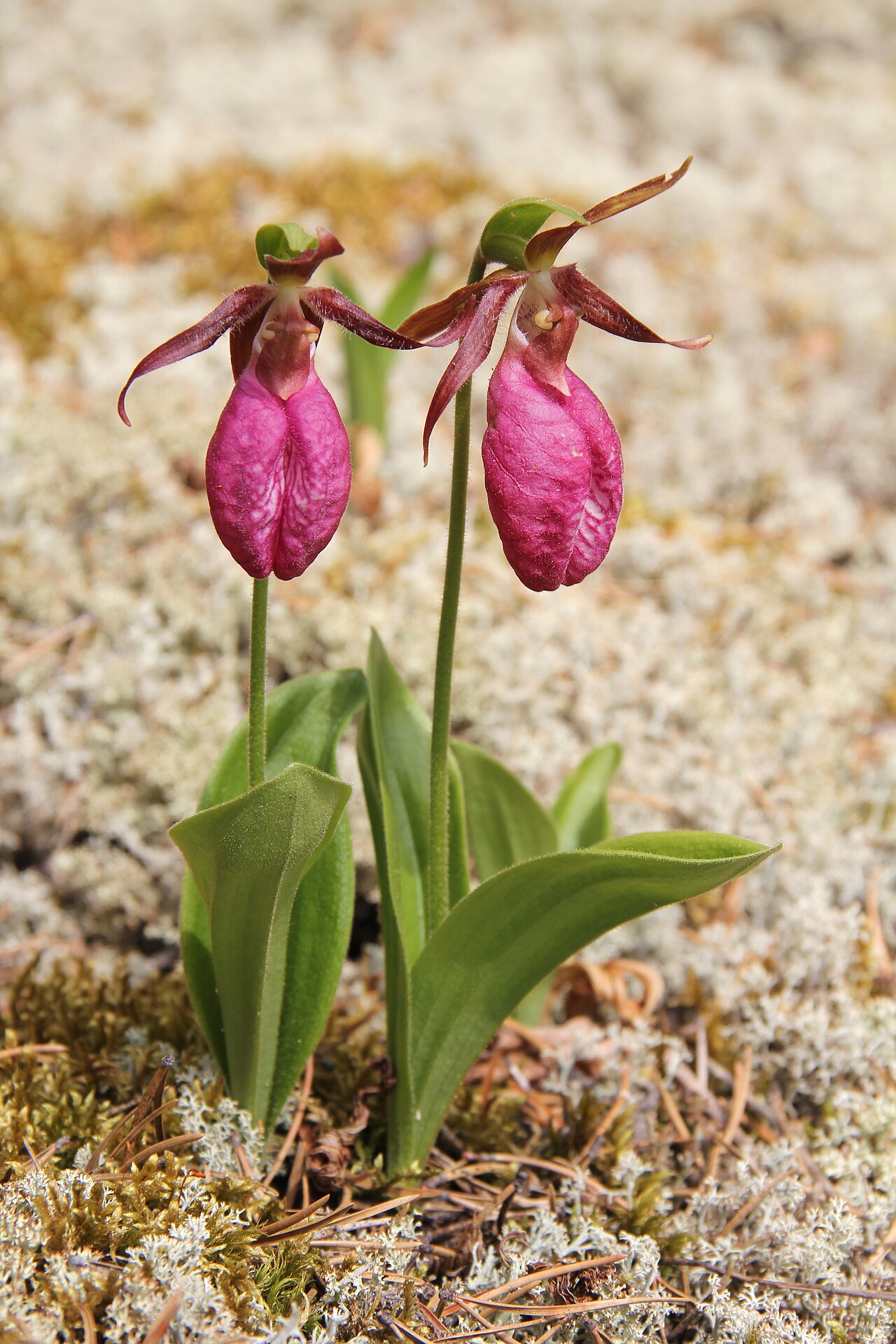
Pink lady’s slipper (Cypripedium acaule) is one of the most recognizable orchids of eastern North American woods. A single pink pouch rises above two broad leaves at ground level, creating a striking flower without a tall leafy stem. It is a plant to appreciate carefully in place, not an ordinary bedding perennial to lift from the woods and move around a garden.
Its growing requirements are unusually specific. Very acidic soil, suitable drainage, a compatible woodland setting, and fungal relationships all matter. A garden that supports common shade flowers may still be entirely unsuitable for this orchid. NC State and the Wildflower Center both emphasize the difficulty of transplanting and cultivating it.
For most gardeners, the best approach is to protect an existing population or obtain genuinely propagated plants from a specialist who can explain their needs. Never buy stock whose origin is unclear. The regional list includes this species as a native woodland plant, not as a promise that it will thrive in every Alabama, Georgia, or Mississippi yard.
Identification
Growth & Flowering Stem
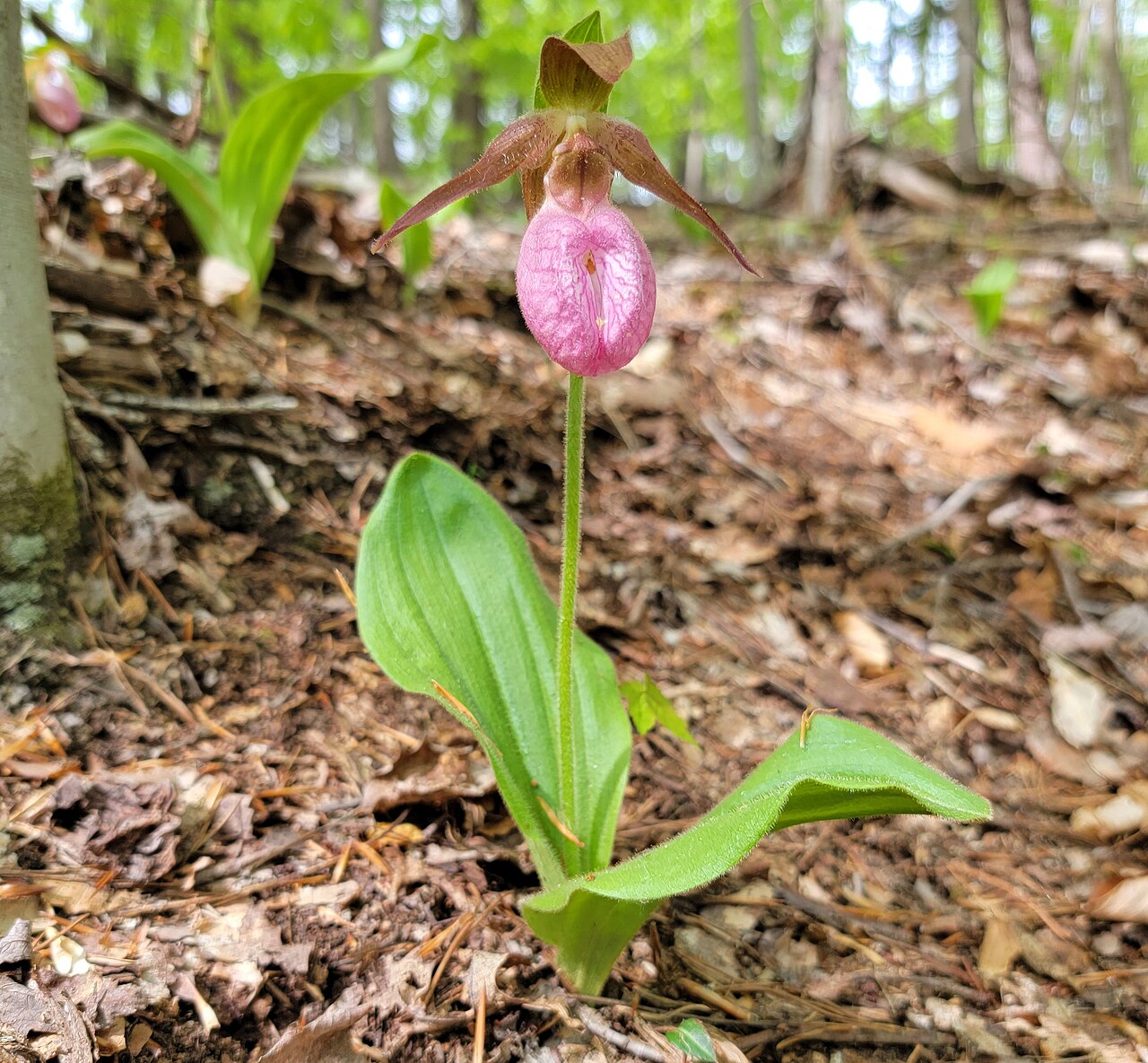
Two basal leaves emerge from the underground plant, and a bristly, essentially leafless stalk rises between them. The regional table gives an 8–12-inch flowering height; larger plants can reach roughly two feet in published accounts. A smaller plant is not necessarily a different species, and a nonflowering pair of leaves should not be disturbed to check the roots.
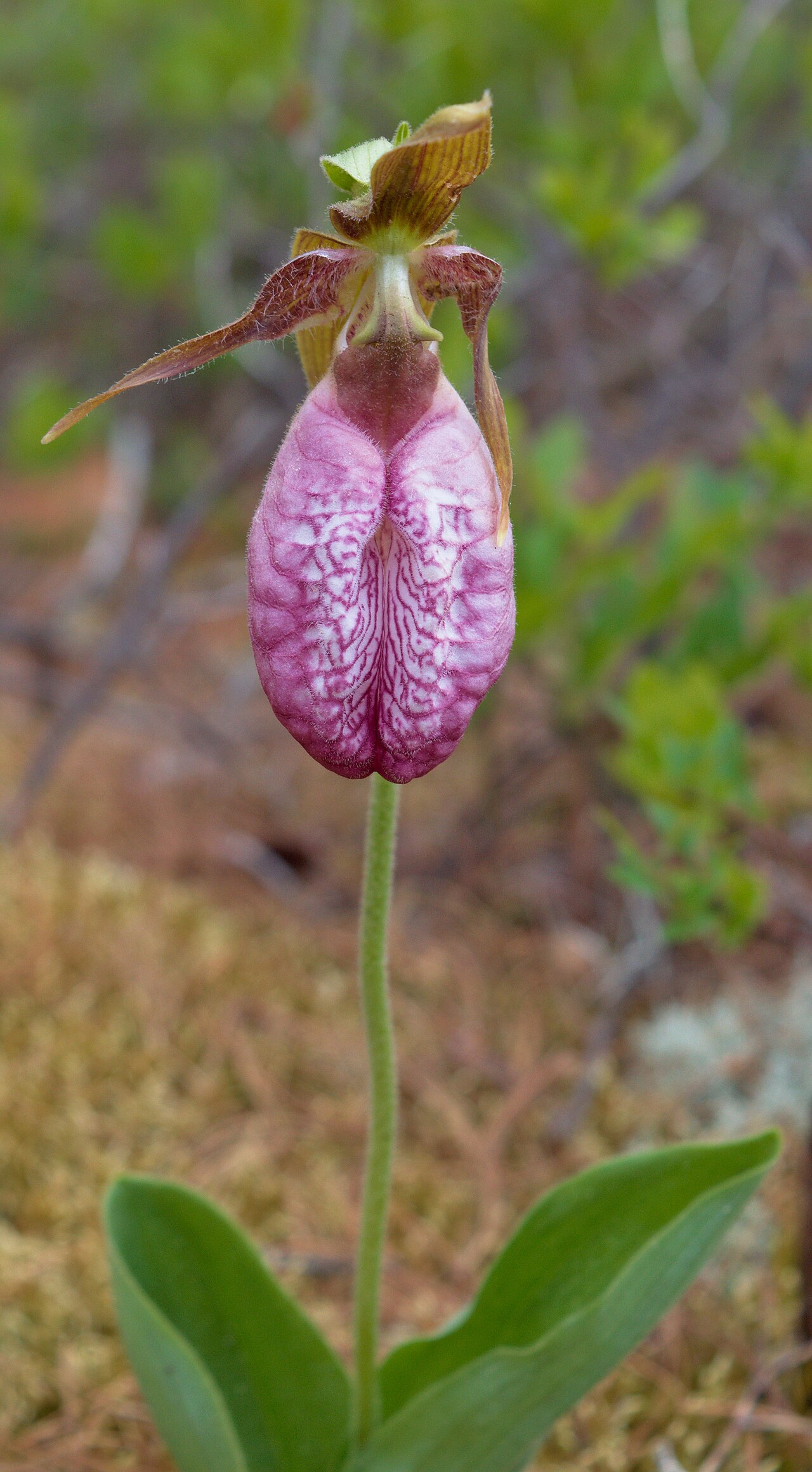
The lack of a leafy aerial stem helps separate this species from several other lady’s slippers. Observe the whole plant, not only the pink color of the pouch. The important combination is the basal leaf pair, single prominent flower, and distinctive slit along the front of the inflated lip.
Leaves
The broad leaves have strong parallel veins and a somewhat pleated appearance. They spread close to the ground, where they can be hidden by surrounding woodland plants. Their surface and margins can bear hairs. Avoid handling them unnecessarily: contact with lady’s slippers can irritate the skin of susceptible people.
Healthy foliage is important after flowering because the plant is still supporting its underground system. Do not cut the leaves to tidy a display that has finished blooming. A woodland orchid is not a cut-flower crop, and removing its visible parts may compromise more than the appearance of one season.
Flowers
The pink inflated lip has darker veins and a vertical opening down the front. The other floral segments are much narrower and usually greenish brown to brown. The pouch is a modified petal, not a fruit or an insect nest. Flowers are normally solitary on the stalk, though unusual plants can carry more than one.
Blooming falls in spring to early summer, varying with latitude and elevation. Southern woodland plants may flower well before northern populations. A photograph taken in Canada is useful for identifying the structure, but its calendar should not be transferred directly to a Georgia mountain site.
Fruit & Seeds
After successful pollination, an upright capsule develops and eventually releases numerous tiny seeds. A large seed count does not mean easy garden reproduction. Orchid seeds are small and depend on biological conditions that are absent from an ordinary packet-seed sowing routine.
A flowering plant may not produce a capsule every year. That alone is not evidence that it needs fertilizer or hand intervention. Pollination is a separate stage from flower production, and this species has an unusual relationship with its bee visitors.
Quick Facts
| Scientific Name | Cypripedium acaule |
| Family | Orchidaceae (orchid family) |
| Plant Type | Herbaceous perennial woodland orchid |
| Mature Height | 8–12 inches in the regional list; larger plants can reach about 2 ft |
| Mature Spread | Small individual plant; not a rapid groundcover |
| Growth Rate | Slow; specialist cultivation |
| Sun Exposure | Partial shade to shade |
| Water Needs | Dry-mesic to moist woodland conditions with drainage |
| Soil Type | Very acidic woodland soil, often sandy or humus over rock |
| Soil pH | Very acidic; do not lime existing colonies |
| Bloom Time | Spring to early summer; timing varies with latitude |
| Flower Color | Pink pouch with darker veins; greenish-brown other segments |
| Fall Color | Deciduous seasonal foliage |
| Fruit | Capsule with numerous minute seeds |
| Deer Resistant | No dependable resistance claim; protect from browsing where needed |
| USDA Hardiness Zones | 3–8 in the NC State account; hardiness alone does not assure garden success |
Native Range
Pink lady’s slipper is native across a broad central and eastern Canadian and eastern U.S. range. The U.S. map follows the state list shared by NC State and the Wildflower Center, extending from Minnesota and the Great Lakes through New England and south into the Appalachians and parts of the Southeast.
The sources name Alabama and Georgia but do not establish Mississippi as part of the mapped range. Its presence in a combined three-state gardening list must not be read as proof of nativity in all three states. Within its actual range, suitable populations occupy particular woodland conditions rather than every shaded acre.
Habitats include acidic pine woods, other conifer and oak woodland, sandy sites, and humus over rocky ground. Some sites are relatively dry at the surface and others more mesic. That variability does not erase the importance of acidity and the intact below-ground environment. A state map cannot identify a suitable transplant destination.
Native Range at a Glance
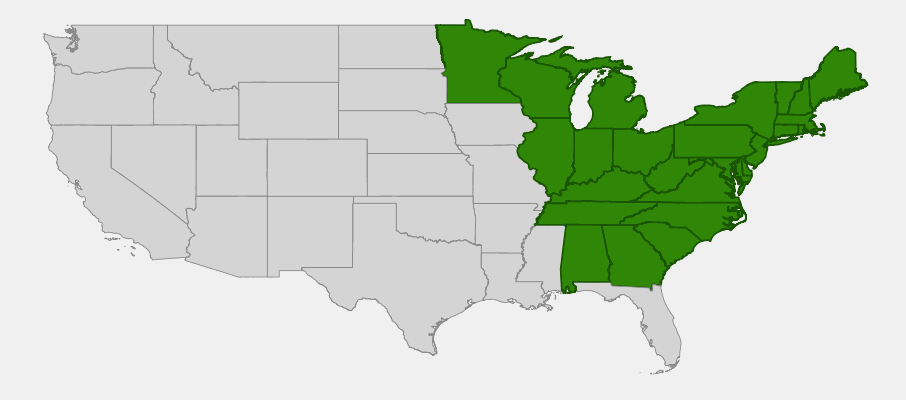
| U.S. States | AL, CT, DC, DE, GA, IL, IN, KY, MA, MD, ME, MI, MN, NC, NH, NJ, NY, OH, PA, RI, SC, TN, VA, VT, WI, WV |
| Canadian Provinces | Broad central and eastern Canadian range; cited lists include NB, NL, NS, ON, PE and SK |
| Ecoregion | Eastern woodland and conifer-forest communities |
| Elevation Range | Low sandy woodland to mountain forest; no precise numerical range adopted here |
| Habitat | Very acidic pine, conifer and oak woods; humus over rock, dry-mesic forest |
| Common Associates | Pines, other conifers, oaks and local woodland groundlayer vegetation |
| Range Source | Lady Bird Johnson Wildflower Center; USDA (County-Level Data) |
📋 Explore the Alabama, Georgia & Mississippi native plant list.
Growing & Care Guide
Light
Partial shade and dappled woodland light are the best-supported recommendations. The previous table’s full-sun option has been removed because it could encourage planting this specialist orchid in an exposed garden. An opening in a pine woodland is not equivalent to a hot, bare flower bed with reflected afternoon heat.
Soil & Water
Very acidic conditions are central to this species. Do not add lime, general lawn amendments, or a rich standard potting mix to an existing colony. A soil test can describe chemistry, but it cannot by itself reproduce the biological setting that supports the orchid.
Provide drainage and avoid both prolonged waterlogging and severe disturbance. ‘Average moisture’ in a regional table is only a shorthand; it does not capture the difference between an intact acidic woodland floor and a newly dug irrigated hole. Follow the specialist nursery’s instructions for genuinely propagated material rather than applying a generic perennial-watering schedule.
Do not collect woodland soil to inoculate an unrelated garden. Moving soil can damage the donor site and does not guarantee the necessary fungi or conditions will establish. The fungal association is a reason to respect the habitat, not a simple ingredient that can be harvested and sprinkled into a pot.
Planting Tips
If the plant already grows on your property, protect it from digging, grading, compaction, and changes in runoff. Keep a path outside the colony and mark its location without driving stakes through the root zone. Preserve the canopy and litter conditions that already support it.
For purchased plants, ask specifically whether they were propagated rather than wild-dug, how long they have been grown in cultivation, and what substrate and water regime the nursery used. A healthy-looking flower at the point of sale does not demonstrate that the plant will survive the next year.
Do not plan a large replacement groundcover or mass planting around this species. A small specialist planting with documented provenance and careful observation is a more realistic horticultural project. Where dependable seasonal color is the main goal, choose easier native woodland perennials instead.
Pruning & Maintenance
There is no routine pruning requirement. Leave living leaves intact and avoid clearing all surrounding litter simply to display the flowers. An orchid can be photographed attractively without exposing its crown or rearranging the forest floor.
Observe from the same nearby position over time and record emergence, flowering, and disturbance. Do not repeatedly dig to check whether a nonflowering or dormant plant is alive. A stable observation record is more useful than a series of interventions based on a single disappointing season.
Where browsing or trampling threatens an established plant, use a carefully positioned protective measure that does not damage roots or alter the local environment. Do not assume that a conspicuous orchid is immune to animal damage merely because it is native.
Propagation
NC State explains that germinating seeds depend on a compatible fungus and that the mature plant continues a symbiotic relationship. This makes propagation fundamentally different from sowing a common annual. Specialist orchid laboratories and nurseries are better sources of propagated stock than instructions promising easy results from dry seed.
Division is not recommended here as a casual way to multiply a wild colony. Removing part of a slowly established plant can damage the remainder, and transplant success is uncertain. Conservation projects should use qualified orchid specialists and a documented plan rather than improvised rescue digging.
Landscape Uses
- Protection and interpretation of an existing acidic woodland orchid population.
- A specialist native-orchid collection using documented propagated stock.
- A woodland observation garden where soil and canopy conditions remain undisturbed.
- Educational photography from a path, showing flowers and fungal dependence without collecting plants.
Wildlife & Ecological Value
For Pollinators
Bees enter the pouch and can transfer pollen as they leave, but NC State describes the flower as offering no reward to the visitors. Bees can learn to avoid it, contributing to low pollination rates. It would therefore be misleading to sell pink lady’s slipper as a high-output nectar plant. Its pollination biology is interesting precisely because it differs from a conventional nectar garden.
For Birds
The orchid’s contribution is as one component of an intact woodland community, not a major berry crop or structural nesting shrub. Protecting its habitat also retains the surrounding plants and litter used by many other organisms. Avoid attaching broad bird-food claims to this species without evidence.
For Mammals
Garden protection should focus on preventing disturbance and browsing where these occur. The plant is not presented as forage or food for people or animals. Skin irritation from contact is documented, so handling should be limited and gloves used when necessary around cultivated material.
Ecosystem Role
The relationship between orchid and fungus is a reminder that a native plant is part of a biological community below ground as well as above it. Protecting the soil structure and hydrology can matter more than adding new plants. A flowering stalk moved to another place is not equivalent to conserving the original population.
Cultural & Historical Uses
The slipper-shaped lip accounts for the common name. The scientific name also carries the long-standing slipper imagery associated with the genus. These names describe the flower’s form, but a full identification still requires the basal leaves and other structural details.
Historical accounts record medicinal uses of lady’s slipper roots. Those records do not establish safety or effectiveness, and this guide provides no recipes or doses. Harvesting roots also destroys or seriously damages the very plant being admired.
The strongest modern garden lesson is restraint: enjoy and document established colonies, support responsible propagation, and reject wild-dug stock. A native orchid’s beauty does not make collection an act of conservation. Protecting an intact woodland site is a more durable contribution.
Frequently Asked Questions
Can I transplant one from the woods?
Do not dig wild plants. Both cited horticultural sources emphasize poor transplant performance, and removal damages the source population. Seek documented propagated stock from a specialist or enjoy the plant where it grows.
Is ordinary acidic garden soil enough?
Not necessarily. Soil chemistry, drainage, fungal relationships, and the woodland environment all matter. A low pH reading alone does not guarantee a suitable site.
Does it feed bees with nectar?
The extension account describes a deceptive flower that attracts bees without rewarding them. It can be pollinated by bees but should not be advertised as a nectar-rich pollinator crop.
Should I cut off the leaves after flowering?
No. Leave healthy foliage intact. Flowering is only part of the annual cycle, and the plant still needs its leaves after the bloom fades.
Is it native throughout Alabama, Georgia, and Mississippi?
No such claim is supported here. Alabama and Georgia are in the cited state lists; Mississippi is not. Even in native states, the orchid occupies particular suitable habitats rather than every woodland.
Sources & Further Reading
- NC State Extension Plant Toolbox — Pink Lady’s Slipper
- Lady Bird Johnson Wildflower Center — Cypripedium acaule
Find Native Plants Near You
Ask for nursery-propagated species stock. Browse native plant nurseries for Alabama, Georgia, and Mississippi.