
Uhiuhi (Mezoneuron kavaiense)
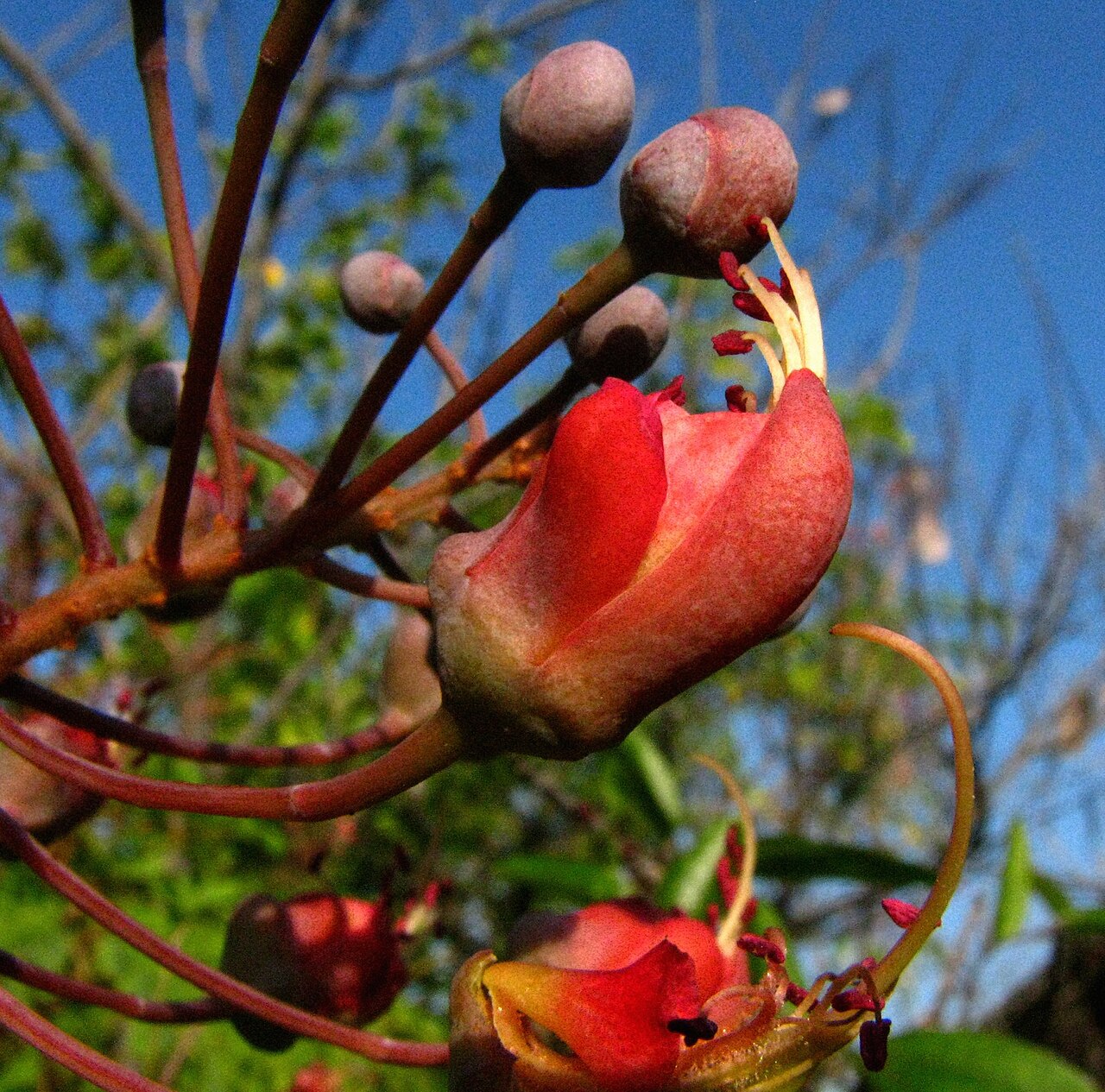
Uhiuhi (Mezoneuron kavaiense) is a rare Hawaiian dry-forest tree with finely divided leaves, small pink to reddish flowers, and distinctive flattened, winged pods. Its open branching and delicate foliage can be attractive in a suitable sunny landscape, but its horticultural needs are more particular than those of a generic drought-tolerant tree. Careful root handling and excellent drainage are central to successful establishment.
The species is endemic to Hawaiʻi and federally listed as endangered. Older sources and the USDA profile may use Caesalpinia kavaiensis, a verified synonym. The change of genus does not represent a different tree. Keep both names in records when tracing nursery stock, conservation literature, or historical accounts.
The University of Hawaiʻi growing guidance emphasizes young planting stock, avoidance of root coiling, minimal disturbance during transplanting, and sharply reduced irrigation once established. It also identifies black twig borer as a serious threat. Uhiuhi rewards a gardener who chooses the site and nursery plant deliberately and continues to inspect the tree after planting.
Quick Facts
| Scientific Name | Mezoneuron kavaiense |
| Family | Fabaceae |
| Plant Type | Native tree or large shrub |
| Mature Height | 15–35 ft; varies with form and conditions |
| Mature Spread | Variable; allow room for an open branching crown |
| Growth Rate | Site dependent; young roots require careful handling |
| Sun Exposure | Full sun |
| Water Needs | Dry after establishment; highly sensitive to excessive root-zone water |
| Soil Type | Well-drained soil matched to native habitat and nursery provenance |
| Soil pH | Assess local soil and nursery performance before amending |
| Bloom Time | Variable with source and conditions; observe local seasonality |
| Flower Color | Pink to rose-red, with source-dependent variation |
| Fall Color | Evergreen; seasonal new growth may contrast with older foliage |
| Fruit | Flattened winged pods |
| Deer Resistant | Not a browse-proof planting; protect young trees where needed |
| USDA Hardiness Zones | Use Hawaiian island, elevation, and exposure guidance for site selection |
Identification and Form
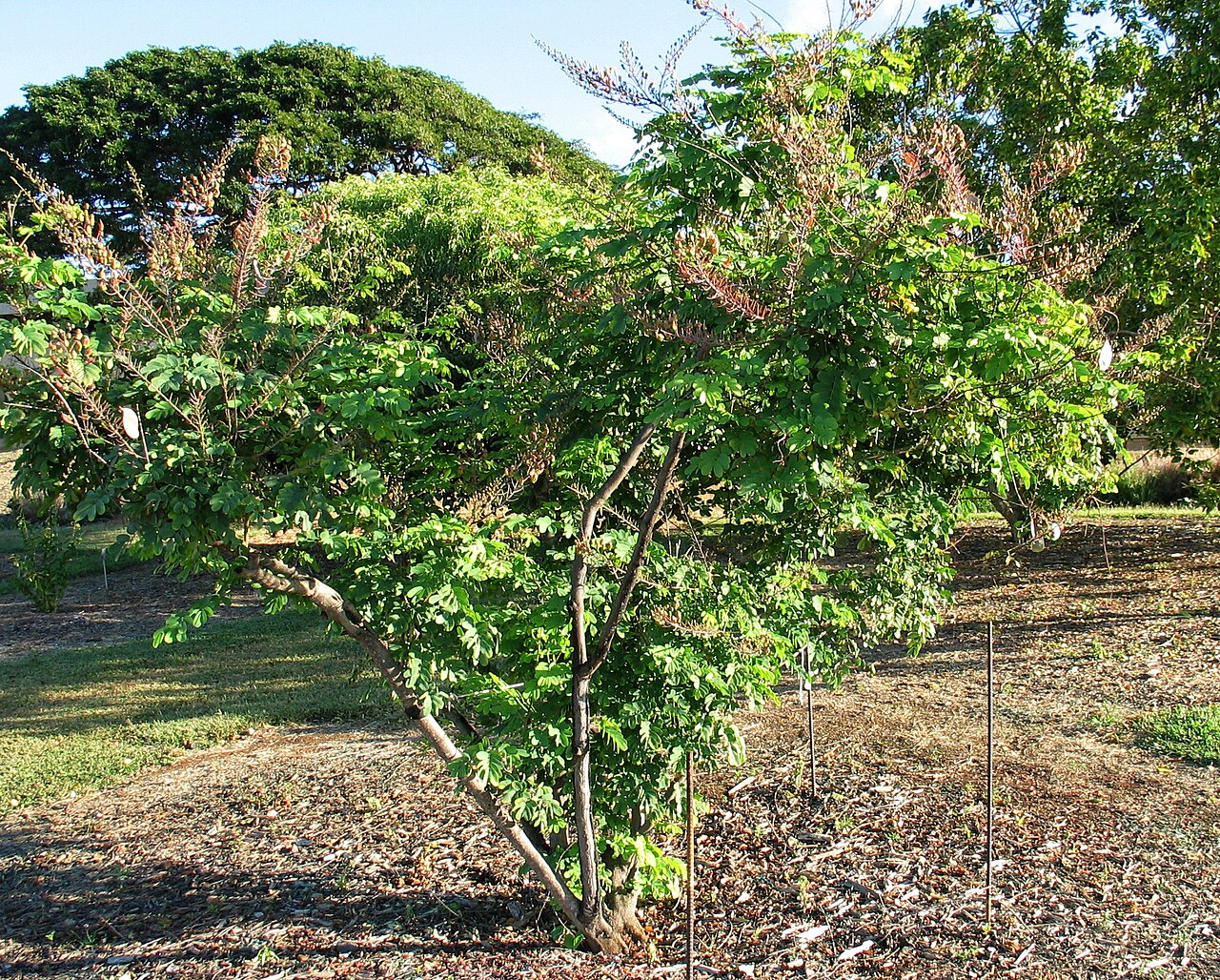
Uhiuhi belongs to Fabaceae, the pea family. Its divided leaves create a finer texture than the broad foliage of many Hawaiian trees. The plant may develop as a large shrub, an open small tree, or a somewhat sprawling form depending on source and conditions. A young specimen’s appearance does not necessarily predict a compact mature crown.
The regional list gives a planning range of roughly 15–35 feet. The University of Hawaiʻi account includes tall shrubs and small trees, so allow flexibility in the landscape design. Ask about the habit of the nursery’s source plants rather than assuming every individual will become an upright, symmetrical shade tree.
Flowers and Winged Pods
Flower color varies with source. The University of Hawaiʻi profile describes pink and orange-to-greenish tones in Oʻahu material and rose to reddish flowers in Hawaiʻi Island material. The photographs here preserve their cultivated context and should not be read as a claim that one color represents every population.
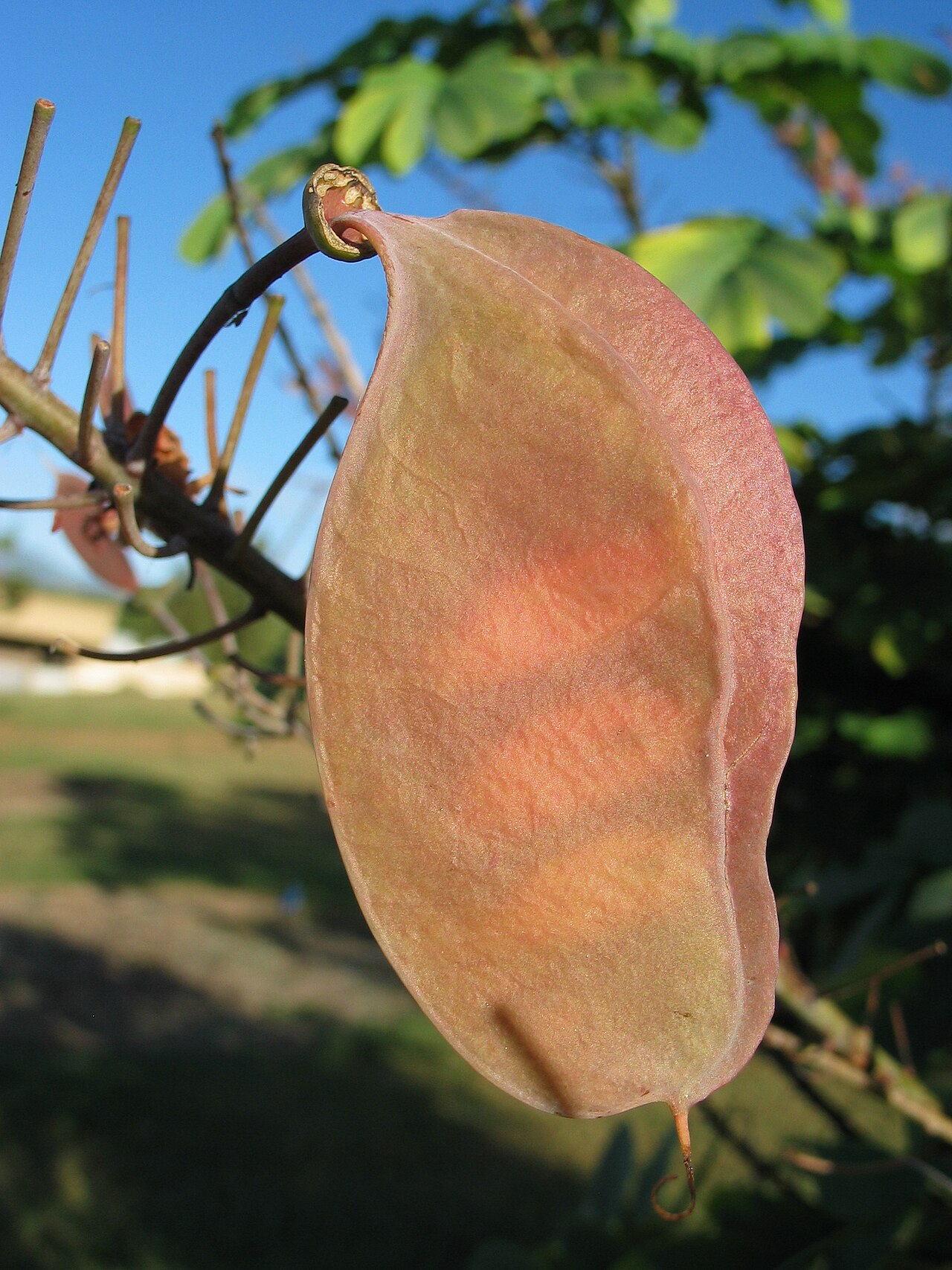
The flattened pods have a conspicuous wing, a feature reflected in the genus name. Pods and divided leaves together are useful identification clues. A flowering close-up alone can overlook the overall structure that distinguishes uhiuhi from unrelated red- or pink-flowered garden plants.
Flowering may be sporadic or recur frequently under cultivation. Observe the actual plant’s pattern rather than assigning a fixed season from a different site. Excessive water can reduce flowering according to the horticultural account, so a sparse display is not automatically a reason to irrigate or fertilize more.
Native Range and Conservation Context
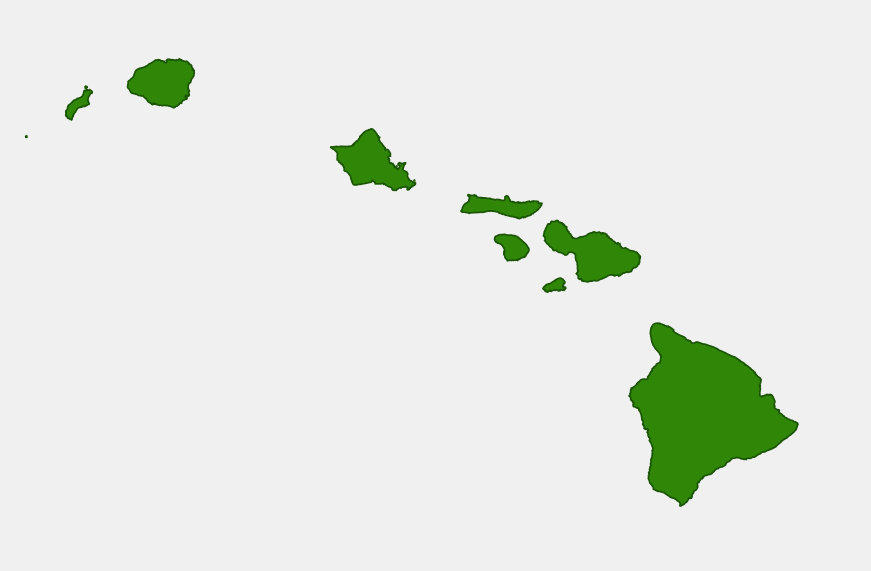
Uhiuhi is a Hawaiian endemic associated with dry forest. The University of Hawaiʻi account describes a historical range including Kauaʻi, Oʻahu, Lānaʻi, Maui, and Hawaiʻi and gives an elevation range of roughly 260–3,020 feet. Its surviving wild distribution is much more restricted than that historical island list.
Older locality summaries discuss loss from some islands and persistence in a small number of places. Those statements should not be treated as a current population census. Conservation records change as surveys, propagation, and restoration proceed, and the purpose of this planting guide is not to publish precise locations of rare surviving trees.
Native Range
| U.S. States | Hawaii |
| Hawaiian Islands | Historical range includes Kauaʻi, Oʻahu, Lānaʻi, Maui, Hawaiʻi; surviving wild range much reduced |
| Mexico / Canadian Provinces | Not included in the verified native range used here |
| Ecoregion | Hawaiian tropical forest and woodland |
| Elevation Range | About 260–3,020 ft in UH habitat account |
| Habitat | Rare Hawaiian dry forest |
| Common Associates | Site-appropriate native forest canopy and understory |
USDA PLANTS profile (CAKA5). Species identity verified; this link is not a guarantee of county-level distribution data.
The map shows Hawaiʻi as the native U.S. state. It does not imply that viable populations remain on every shaded island. For restoration, use current project guidance and appropriate provenance. A garden specimen can support appreciation and learning, but it does not replace protected habitat and coordinated recovery work.
Choose the Nursery Plant Carefully
Root Form Matters
The University of Hawaiʻi profile warns that uhiuhi roots can circle in conventional containers and that severe coiling can stunt or eventually kill a plant. It favors planting relatively young stock and using deeper, root-conscious nursery containers when plants must remain potted. A larger top is therefore not automatically a better purchase.
Ask how long the plant has been in its container, what container system was used, and whether the nursery has experience establishing the species. Seek a plant whose roots have been managed for planting out rather than one held indefinitely in a pot for visual size.
Do not assume that a tightly packed root ball is required for quality in this species. The University of Hawaiʻi account notes that young uhiuhi may not form the dense root mass seen in some nursery plants, and soil can fall away during removal. Handling needs to account for that vulnerability.
Provenance and Purpose
Retain island-source information and the complete botanical name. Different forms survive in cultivation, and those distinctions matter for conservation work as well as for interpreting flower color and habit. A plant chosen for an ornamental garden is not automatically suitable for a restoration site.
Obtain nursery-propagated material through an appropriate source. Do not collect wild seedlings, pods, or branches simply because the species is difficult to find commercially. Its rarity is a reason for coordinated sourcing, not an invitation to bypass it.
Site Selection
Full sun and excellent drainage are the main published recommendations. Uhiuhi tolerates heat, wind, and drought, but it is sensitive to excessive water around the roots. A dry-forest tree installed in a lawn irrigation zone may receive far more water than is appropriate after establishment.
Observe the site after rain. Compacted ground, a low planting basin, or runoff from roofs and paving can create wet conditions even in a generally dry neighborhood. Evaluate the whole root zone rather than adding a small amount of drainage material to an otherwise unsuitable hole.
Allow space for an open crown and access for twig inspection. Avoid crowding the tree among dense plants that hide dieback or make irrigation difficult to manage independently. A mixed dry native planting can work well when its members share similar water needs.
Planting Without Losing the Root Ball
Prepare the destination before removing the nursery container. Handle the plant gently and keep the root area protected from drying sun and wind. Follow the nursery’s instructions for its particular stock, especially if the root ball is loose and likely to break apart.
The University of Hawaiʻi account discusses specialized nursery techniques to help hold soil around young uhiuhi roots, including companion plants with fibrous roots. Those are propagation and handling methods to discuss with an experienced grower, not a reason to improvise by adding random plants to a purchased pot immediately before transplanting.
Set the tree at the appropriate original soil level and avoid burying the stem base. Backfill carefully and water to settle the soil without creating a permanently saturated basin. Keep the planting surface accessible so drainage and stem condition can be checked afterward.
Watering: Establish, Then Reduce
Young plants need enough water to establish, but excess is a significant concern. Check the nursery root ball and surrounding soil separately. Their different textures can make one appear dry while the other remains wet. Apply water slowly and allow drainage rather than relying on frequent shallow watering against the trunk.
Once established, the University of Hawaiʻi guidance calls for substantial reduction of supplemental irrigation, with watering mainly during drought. This is a more specific recommendation than simply labeling the plant “low water.” Its irrigation should not remain tied indefinitely to the needs of newly planted, moisture-loving companions.
Observe the plant during dry periods and adjust according to actual conditions. Drought tolerance does not mean a damaged or newly transplanted root system has the same resilience as a mature tree. At the same time, do not respond to every decline by increasing water; inspect drainage, roots, and twigs first.
Black Twig Borer and Other Problems
Black twig borer is a serious threat identified in the species profile. New twig dieback deserves prompt attention and accurate diagnosis. Look for a pattern of affected branches and seek guidance from a nursery or specialist familiar with the pest rather than waiting for major crown loss.
Mealybugs can also infest young growth. Inspect shoots and branch junctions during routine care. Identify the organism and the extent of damage before selecting a response, and consider whether the tree is simultaneously stressed by irrigation or root problems.
Maintain a record of symptoms, photographs, and any interventions. It helps distinguish a recurring pest problem from a site issue and gives a specialist better information. With a rare tree, early observation is a practical part of stewardship rather than an optional finishing touch.
Pruning and Nutrition
Prune with a clear structural or health purpose. Preserve the natural open form where space allows, and avoid repeated severe cutting to force the tree into a narrow location. Removing flowering shoots continually can reduce the very features that make uhiuhi attractive.
Do not assume that membership in the pea family supplies a complete fertilizer prescription. Root health, compatible soil conditions, and the nursery’s experience are more useful guides than a generic family-based rule. Where nutrient concerns arise, use local assessment before adding products.
The University of Hawaiʻi profile mentions improved performance associated with particular inoculation or nursery practices. That observation does not justify moving soil or debris from wild rare-tree populations into a garden. Discuss clean, appropriate nursery methods with the grower instead.
Conservation in a Garden Setting
The Hawaiʻi DLNR Rare Plant Program identifies uhiuhi as a conservation priority, and the University of Hawaiʻi account records its federal listing. A well-grown garden tree can make the species visible and support education, but conservation value depends on more than survival of a single ornamental specimen.
Documented identity, provenance, responsible propagation, and long-term care matter. For a recovery or restoration project, follow the project’s decisions about genetic material and planting sites. Avoid assuming that a tree from any available source should be planted near a wild population.
Maintain the surrounding landscape in a way that supports the tree’s dry-site needs. Overgrown competition, incompatible irrigation, and unobserved dieback can undermine a planting that began with good intentions. Long-term attention is particularly important for a species selected partly because it is rare.
Hawaiian Cultural History
Uhiuhi wood is known for great hardness, density, and durability. Historical Hawaiian uses recorded in the University of Hawaiʻi account include digging tools, kapa-working implements, fishing equipment, weapons, and structural elements. The wood also appears in accounts of sled runners and other specialized objects.
These records explain why the tree was valued, but they do not make rare living specimens an available source of timber. A planted tree can preserve a connection to that knowledge through observation and teaching without being harvested.
The Hawaiian name is ordinarily written uhiuhi as one word. Older references contain variant spellings and other local names, while the scientific name has also changed. Keeping a clear record of synonyms helps connect historical material to the correct living species.
Traditional medicinal references should be understood as cultural history rather than instructions for self-treatment. The purpose of this guide is to support accurate identification and appropriate cultivation, not to reconstruct specialized preparations from abbreviated accounts.
Common Questions
Is Caesalpinia kavaiensis the same tree? Yes. It is an older scientific name for the species treated here as Mezoneuron kavaiense.
Should I buy the largest potted specimen available? Not automatically. Root coiling and time in the container are important concerns. Healthy young, appropriately grown stock may establish better.
Does a dry garden mean no establishment water? No. The young plant still needs suitable moisture while roots establish. Irrigation should then be reduced to match the species and site.
Why are flower colors different in photographs? The University of Hawaiʻi account documents source-dependent variation, including differences between Oʻahu and Hawaiʻi Island forms.
What symptom should trigger quick inspection? Twig dieback, because black twig borer is a known serious threat. Confirm the cause before treatment.
A Dry-Forest Tree That Benefits From Precision
Uhiuhi can be a distinctive native specimen where full sun, drainage, careful planting, and attentive monitoring are available. Choose the nursery stock for its roots and provenance, not merely its height. Establish it thoughtfully, reduce unnecessary water as it matures, and keep watching the twigs and crown. Those practical choices give a rare Hawaiian tree the best chance of becoming a lasting part of the landscape.
Sources & Further Reading
- University of Hawaiʻi, Native Plants Hawaiʻi species profile
- Hawaiʻi DLNR Rare Plant Program: uhiuhi
Botanical range, identification, and cultural information are based on these sources. Garden-management advice should be adapted to local soil, exposure, and nursery provenance.
Find Native Plants Near You
Look for correctly identified, nursery-propagated plants with documented Hawaiian provenance. Visit our Hawaii native plant nursery directory and ask about stock suited to your island, elevation, and rainfall. Compare other trees in our Hawaii native plant list.