
Southern Maidenhair Fern (Adiantum capillus-veneris)
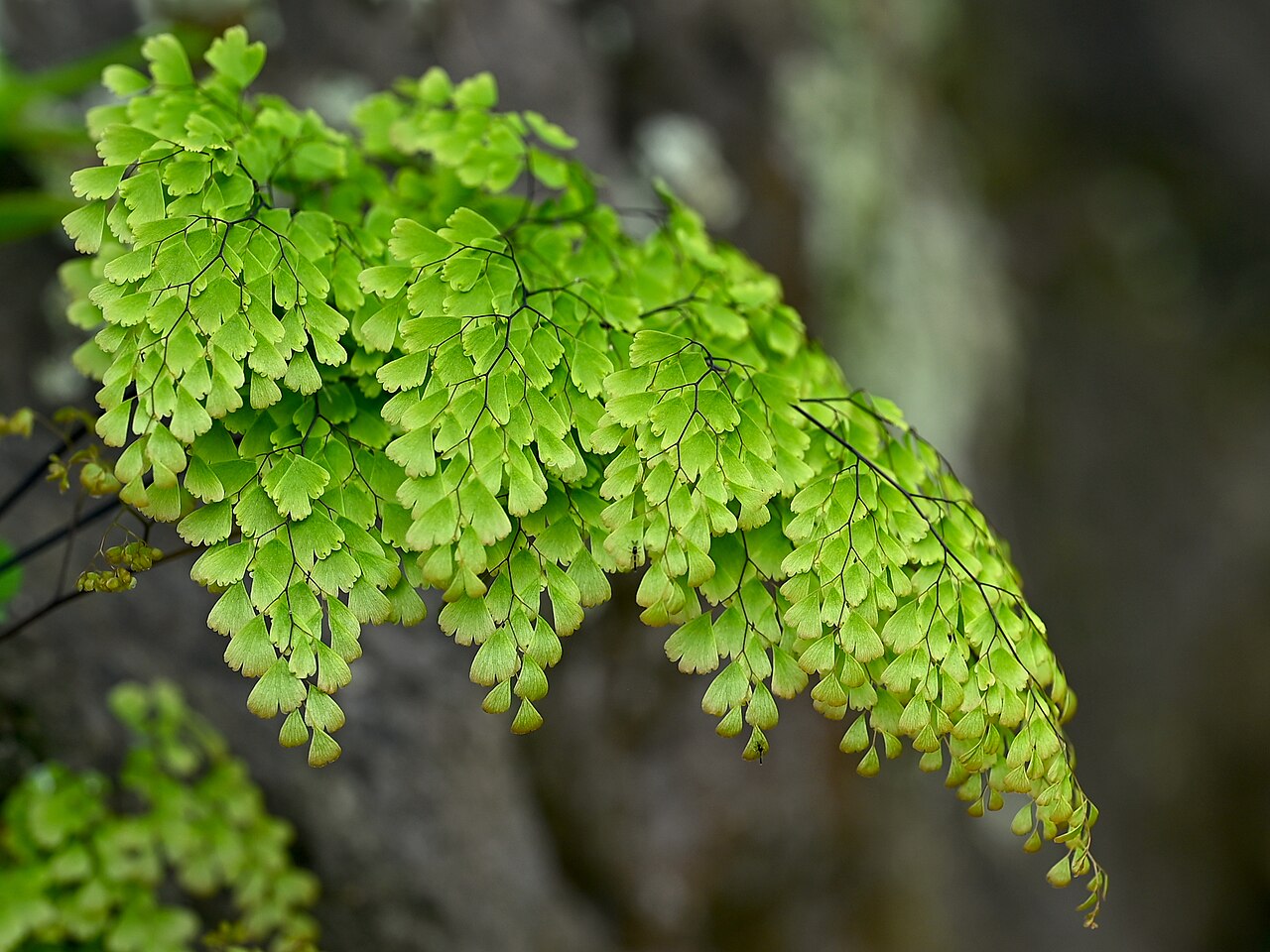
Southern maidenhair fern (Adiantum capillus-veneris) pairs slender dark stalks with delicate, fan-shaped green leaflets. It is particularly striking where fronds arch from a moist rock face or soften the edge of a shaded seep. The fine appearance is genuine, but its survival depends less on pampering the leaves than on providing a reliably moist, suitable root environment.
This is a fern, so it produces spores rather than flowers, fruit, or seeds. Its rolled leaflet margins shelter the spore-producing structures underneath. A garden label that promises blossoms or berries would be describing the wrong plant. The most useful features for recognition are the dark wiry axes, divided arching fronds, and individual wedge- to fan-shaped leaflets.
The species has a broad world distribution and a distinctive pattern within North America: extensive warm-region occurrences and a few remarkable northern disjunctions. Those isolated populations do not mean an ordinary cold, dry garden is suitable. Use local provenance and match the moist, sheltered habitat rather than interpreting a state-level map as a guarantee of easy cultivation.
Identification
Frond architecture
Fronds arise from a creeping rhizome and are usually arching or pendent rather than arranged in a rigid upright vase. Botanical descriptions allow fronds from about 15 to 75 centimeters long, although many garden plants occupy a more modest space. The finely divided blade carries small, separate leaflets along dark stalks. Look at the whole frond, not just one detached leaflet, when comparing maidenhair species.
Leaflets and dark stems
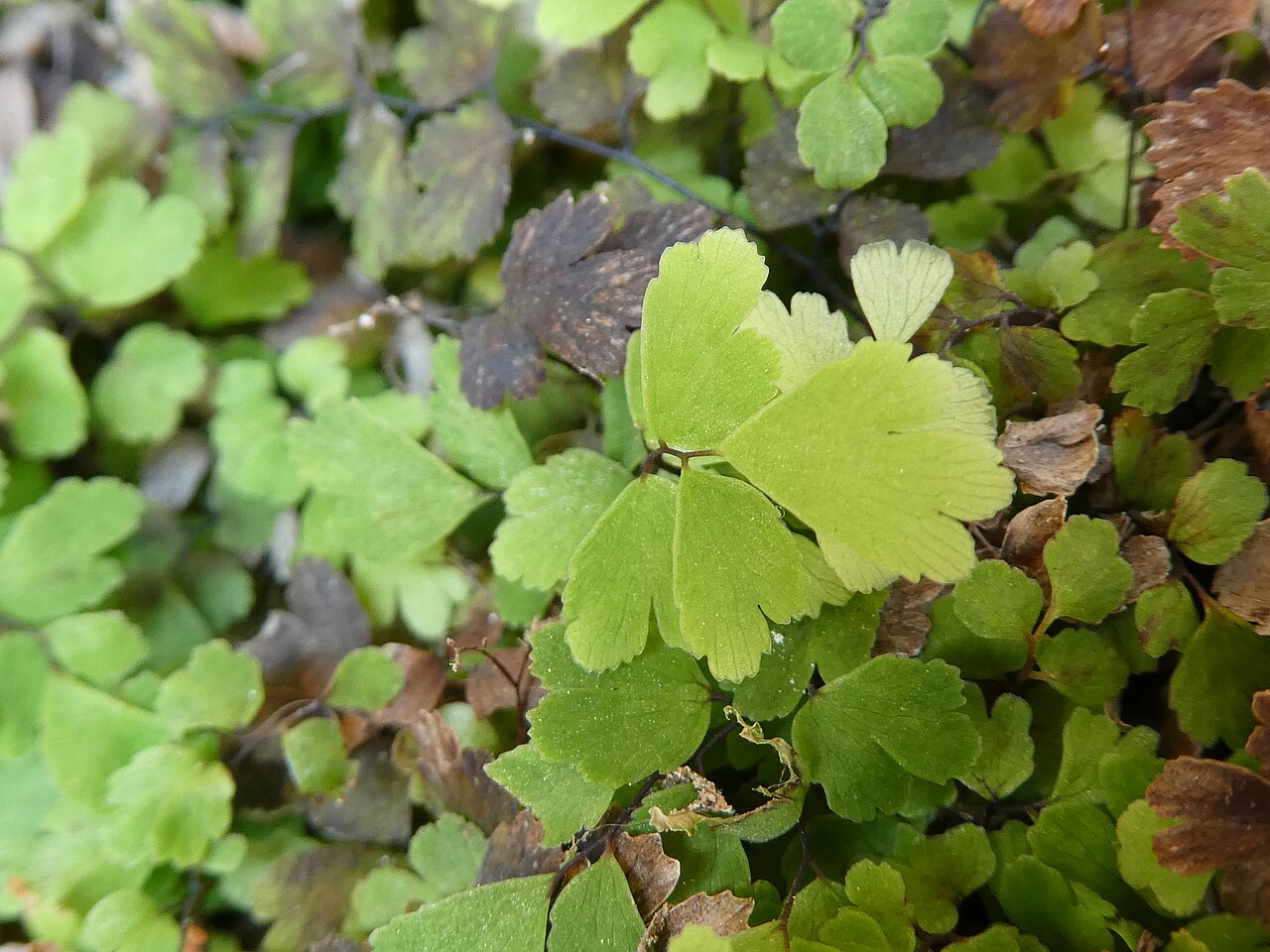
The green leaflets are commonly fan-shaped or wedge-shaped, with a narrowed attachment and an expanded outer margin. Their small size and thin texture give the plant its airy appearance. The slender black to dark brown axes contrast sharply with the foliage. Other maidenhairs also have dark stalks, so this combination should be checked against a regional key rather than treated as unique on its own.
Spores beneath the margins
On fertile leaflets, portions of the margin fold back over the spore-bearing areas. These structures differ from the round dots found on some other ferns. Turn over a mature leaflet carefully to inspect it without tearing the frond. Not every leaflet is fertile at every time of year, and the absence of visible spore structures on a young plant does not rule out the species.
Comparison with other maidenhairs
Northern maidenhair, Adiantum pedatum, and related western plants often have a more distinctive branching, fan-like arrangement of the entire frond. Southern maidenhair's overall outline and drooping habit are different. Cultivated maidenhairs sold as houseplants can add further confusion. Confirm the scientific name before planting material into a native garden, especially when a generic nursery label says only maidenhair fern.
Quick Facts
| Scientific Name | Adiantum capillus-veneris |
| Family | Pteridaceae — Maidenhair and brake fern family |
| Plant Type | Perennial fern; evergreen or seasonally reduced depending on climate |
| Mature Height | Commonly about 10 inches–2 feet; botanical frond lengths may be greater |
| Mature Spread | Often about 10 inches–2 feet, gradually spreading by rhizomes |
| Growth Rate | Moderate in suitable habitat |
| Sun Exposure | Partial to deep shade; avoid hot drying exposure |
| Water Needs | Consistently moist but not stagnant |
| Soil Type | Humus-rich, often neutral to alkaline; strongly associated with calcareous seep habitats |
| Flowers and Fruit | None — reproduces by spores, not seeds |
| USDA Hardiness Zones | Often listed for USDA zones 6–9; local microclimate is crucial |
| Landscape Caution | Cannot substitute for a drought-tolerant rock-garden fern |
| Foliage | Fine, fan-shaped green leaflets on dark arching stalks |
| Bloom Time | Not applicable — a nonflowering fern |
Native Range
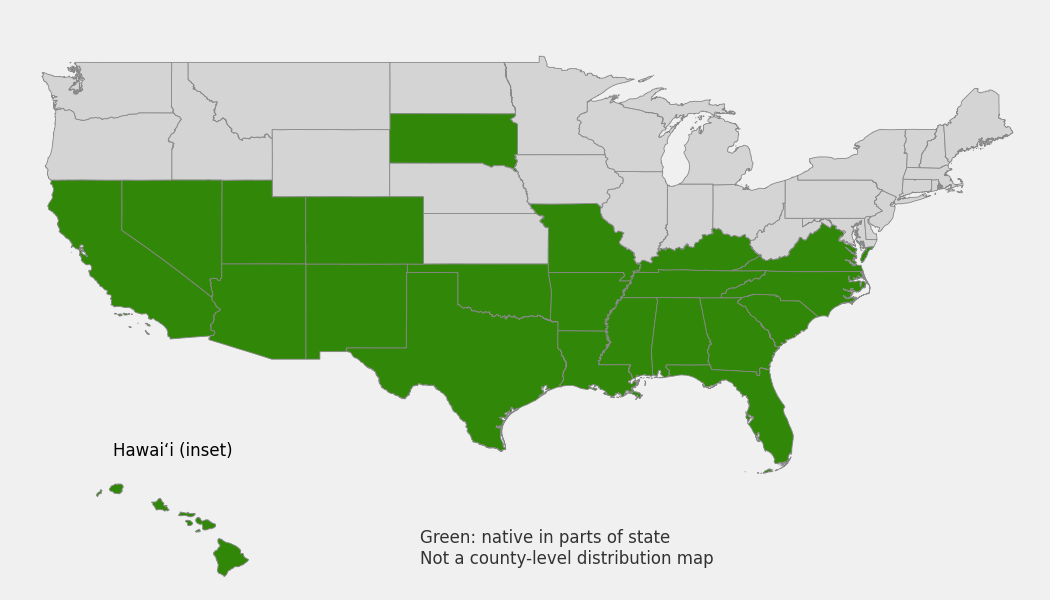
Flora of North America records southern maidenhair across much of the southern and southwestern United States, with scattered northern occurrences, and in a small disjunct area of British Columbia. The state-level map here follows its continental treatment and adds Hawaiʻi, recognized in the broader native distribution. Hawaiʻi appears in a separate inset so that this part of the range is not silently omitted.
The continental states shown are Alabama, Arizona, Arkansas, California, Colorado, Florida, Georgia, Kentucky, Louisiana, Mississippi, Missouri, Nevada, New Mexico, North Carolina, Oklahoma, South Carolina, South Dakota, Tennessee, Texas, Utah, and Virginia. Distribution databases differ in their treatment of scattered records; a report of a plant in cultivation or an isolated observation is not automatically proof of a native population. County-level records and local floras are the appropriate next step for a specific planting or restoration site.
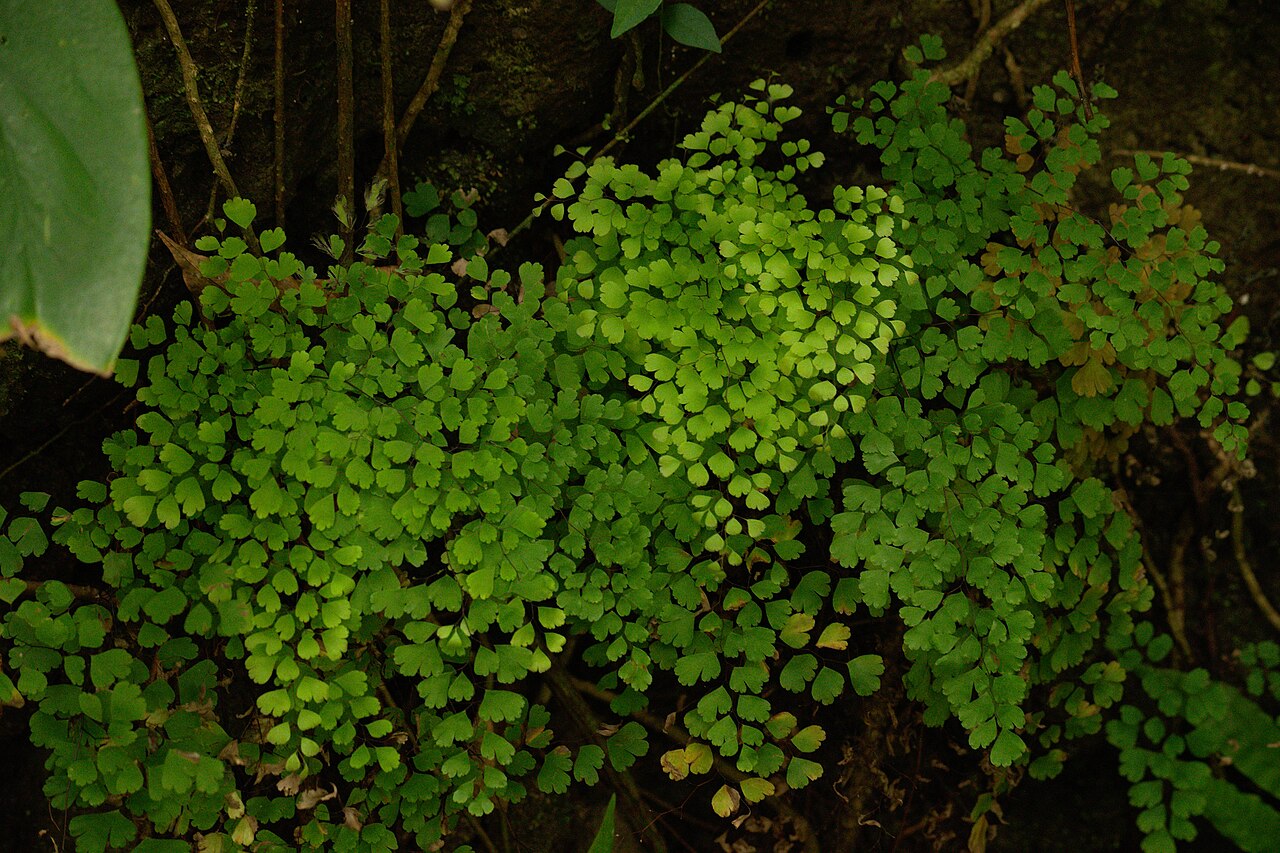
The natural habitat is highly informative: moist calcareous cliffs, streambanks, ledges, lime sinks, and canyon walls, from low elevations to about 2,500 meters in the Flora of North America account. Northern populations such as those associated with warm springs in British Columbia and South Dakota depend on unusual local conditions. The European photographs on this page illustrate a naturally widespread species, not a claim that European material is appropriate for a North American restoration project.
📋 Regional plant list: Arkansas, Louisiana, Eastern Oklahoma and Eastern Texas
Growing & Care Guide
Match the root habitat
A shaded, moisture-retentive setting is more important than a decorative rock placed beside the fern. Natural colonies often have a continuing supply of seepage and shelter from drying winds. In a garden, a reliably moist shaded bed or carefully managed rock crevice can approximate part of that environment. Do not install it on an exposed wall and assume the word rock in a habitat description means drought tolerance.
Shade and air movement
Partial to deep shade suits the fine fronds, especially where summers are hot. Gentle air movement is normal, but a hot wind can dry the foliage and root zone quickly. Morning light may be manageable in a moist setting, while intense afternoon sun is a less forgiving choice. Observe how a site behaves during the hottest part of the year, not only during cool planting weather.
Water consistently, not blindly
Keep the root environment moist without turning a container or planting hole into stagnant mud. Check below the surface and adjust watering for rainfall, drainage, and temperature. A fern on a natural seep may receive moving water with oxygen exchange; that is not the same as roots sealed in a pot with no outlet. If fronds collapse after drying, correct the moisture problem but do not assume every rhizome is necessarily dead.
Soil chemistry and organic matter
Unlike many acid-bog ferns, southern maidenhair is strongly associated with calcareous habitats. A humus-rich, neutral to alkaline substrate can suit it. Do not automatically add acidifying materials simply because the plant is a fern. Soil testing is useful when the existing chemistry is unknown. Changes should be based on the actual site rather than a universal recipe for all maidenhairs.
Planting and seasonal care
Use nursery-propagated stock and disturb the rhizome as little as practical. Set the plant at an appropriate depth without burying the growing points under heavy material. Remove damaged or dead fronds when needed, cutting rather than pulling through the rhizome. In colder portions of its garden range, seasonal foliage loss can occur; spring recovery depends on both winter conditions and the health of the root system.
Containers and indoor situations
A container allows close control of substrate but also dries faster and experiences wider temperature swings than an established seep. Provide drainage and monitor moisture frequently. Indoor plants need suitable light and protection from heating vents and other drying air. A plant grown successfully indoors is not automatically winter-hardy outdoors at the same address. Confirm identity as well, since several nonlocal maidenhairs are sold under similar common names.
Propagation without wild collection
Division of an established nursery-grown plant is a practical method when enough healthy rhizome and roots can be retained with each portion. Spore propagation is possible but requires a controlled, clean, moist setup and patience through the gametophyte stage. Ferns do not produce seed, so packets described as maidenhair fern seeds should raise questions. Never remove plants from rare seep or warm-spring populations to supply a garden.
Recognize site stress before treating pests
Brown frond edges or sudden loss of delicate foliage may reflect drying, excessive sun, salts, or root problems rather than an insect outbreak. Check the environment first and inspect the plant closely before selecting a treatment. Fertilizer cannot replace a dependable moisture supply. Use modest, evidence-based care rather than trying to force rapid growth from a fern adapted to a specific microsite.
Landscape Uses
- Softening shaded stonework where moisture can be maintained without stagnant roots.
- A fine-textured element beside a suitable seep or shaded water feature, outside damaging flood scour.
- A container specimen for gardeners able to monitor moisture and provide the correct light.
- A component of a locally appropriate moist native garden using propagated regional material.
- Not an exposed xeriscape plant, an edible herb, or a reason to disturb a rare natural colony.
Wildlife & Ecological Value
Habitat rather than blossoms
Southern maidenhair does not provide nectar, pollen, or fleshy fruits. Its ecological contribution is better understood through the moist microhabitat it occupies and helps structure. The fronds and surrounding vegetation add cover at a small scale, while the seep or stream margin supports organisms that depend on persistent moisture.
A living indicator of local conditions
A healthy natural colony can reflect a particular combination of moisture, shelter, and substrate. Protecting those conditions may matter more than simply counting plants. Changes in water flow, trampling, or disturbance to rock surfaces can harm the colony even when the fern itself is not deliberately removed.
Leaf litter and the surrounding planting
In gardens, combine the fern with other regionally appropriate plants that share its conditions. Allow a functional ground layer without smothering the delicate crown beneath heavy debris. A diverse, pesticide-conscious planting supports a broader community than an isolated fern in an otherwise sterile decorative feature.
Protect unusual northern populations
Warm-spring populations at the edge of the range are not interchangeable with widespread southern occurrences. Their limited habitat makes them vulnerable to changes in water supply and human disturbance. Observe such populations from permitted routes and follow site rules rather than collecting fronds, spores, or plants without authorization.
Cultural & Historical Uses
The name maidenhair reflects the fine, dark, hairlike stalks, while the scientific epithet capillus-veneris is traditionally associated with Venus's hair. The plant has long attracted attention because of the contrast between delicate foliage and the rocky settings where it can grow when water is available.
Its broad distribution has produced a long history of botanical observation and traditional references in different regions. Such history is not evidence that a home preparation is safe or effective. This page makes no recommendation to eat the fern or use it medicinally.
For native gardening, the important modern distinction is between a species' broad worldwide range and the provenance of an individual plant. A correctly identified European photograph can illustrate morphology, but a restoration project in Texas or Hawaiʻi should still seek locally appropriate propagated material and local ecological guidance.
Frequently Asked Questions
Does southern maidenhair bloom?
No. It is a fern and reproduces by spores. The structures beneath fertile leaflet margins are not flowers or seeds.
Can it handle dry shade?
Not reliably. Shade does not remove its need for consistent moisture, and dry roots beneath large trees can be unsuitable.
Why is South Dakota on the map?
The species has unusual northern disjunct occurrences associated with favorable local conditions, including warm-spring habitat. That does not imply statewide garden suitability.
Is it native to Hawaiʻi?
The broad botanical treatment used here recognizes Hawaiʻi within its native distribution. The map includes an explicit inset rather than hiding the islands outside a continental frame.
Should I acidify the soil?
Not automatically. This species is associated with calcareous sites and can favor neutral to alkaline conditions. Test the site and use species-specific guidance.
Can brown fronds recover?
A dead frond will not turn green again, but a living rhizome may produce new growth after conditions improve. Check moisture and exposure without assuming either certain recovery or total plant death.
Sources & Further Reading
- Flora of North America — Adiantum capillus-veneris
- NC State Extension — Southern Maidenhair Fern
- Kew Plants of the World Online — distribution
- NatureServe Explorer — species account
- Government of Canada — Southern Maidenhair Fern assessment
- Native Plant Society of Texas — species profile
Find Native Plants
Ask growers about nursery propagation and regional provenance. Browse our Arkansas native plant nurseries, Louisiana native plant nurseries, Oklahoma native plant nurseries, Texas native plant nurseries directory for suppliers.