
Saguaro (Carnegiea gigantea)
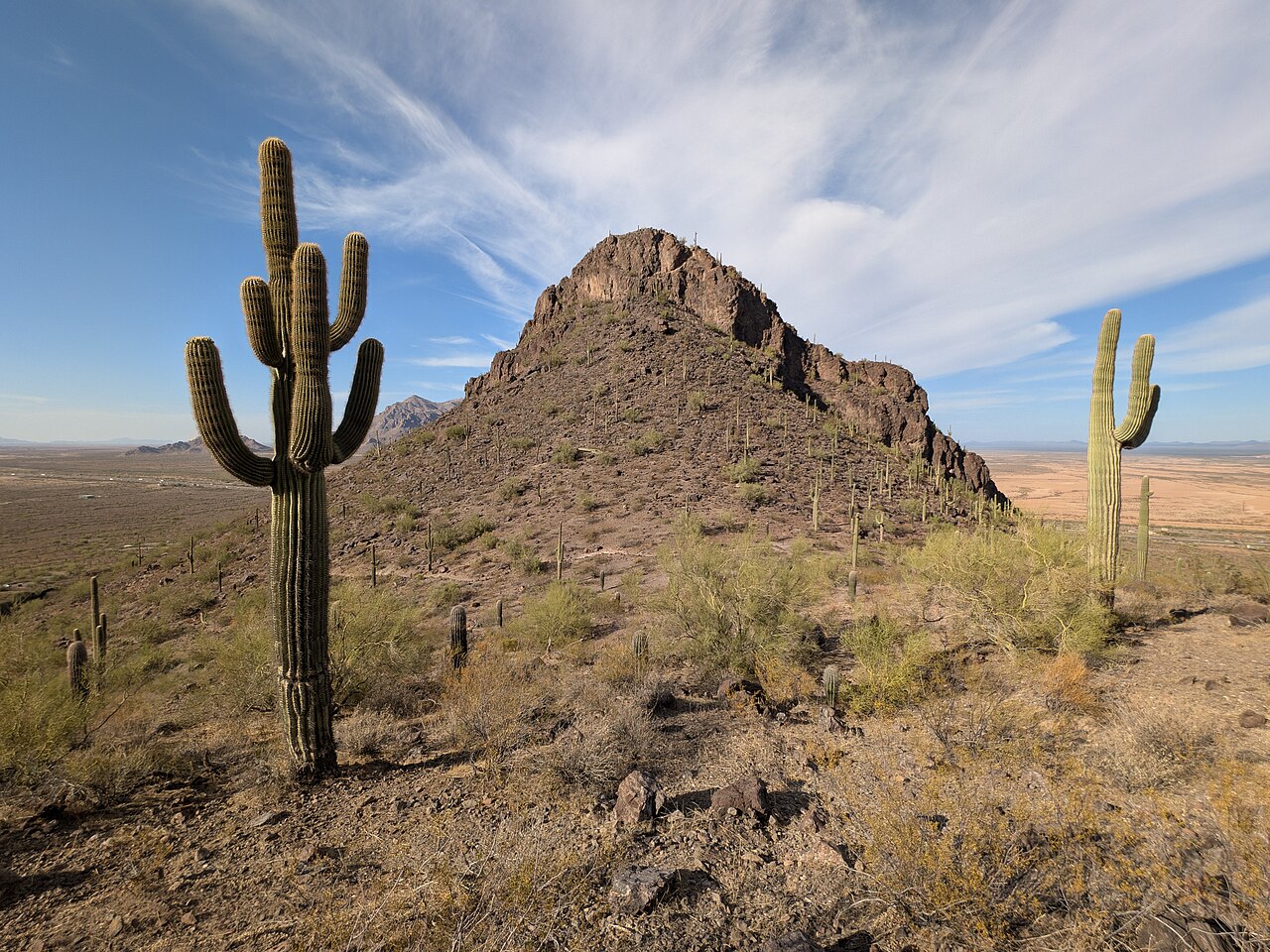
Carnegiea gigantea, the Saguaro (pronounced sah-WAH-roh), is the tallest cactus in the United States and the living symbol of the Sonoran Desert. A mature saguaro can stand 40 to 60 feet tall, live 150 to 200 years, and hold several thousand pounds of stored water in its pleated trunk. It is the only species in its genus, and its creamy white blossom has been the official state wildflower of Arizona since 1931.
Saguaros grow almost nowhere else on Earth: their range is essentially the Sonoran Desert of southern Arizona and the Mexican state of Sonora, plus a thin strip along the Colorado River in southeastern California. Within that range they are a keystone plant. Bats, doves and bees feed on the night-blooming flowers, birds and mammals feast on the red summer fruit, and woodpeckers carve nest holes into the trunks that later shelter owls, martins, flycatchers and lizards.
For gardeners in the low deserts of Arizona, a saguaro is a long-term investment in the landscape rather than a quick-growing accent. Seedlings grow only an inch or two in their first several years, and arms usually do not appear until the plant is 50 to 75 years old. Planted with a “nurse” shrub, given sharp drainage and left almost entirely alone, a young saguaro will outlive the person who planted it and feed desert wildlife for generations.
Identification
No other North American plant looks quite like a mature saguaro: a single, columnar green trunk up to about 2 feet thick, often with one or more upturned arms, standing far above the surrounding desert scrub. Young saguaros are simply spiny green columns, and many plants never branch at all. Arm number and shape vary enormously, which is part of what gives each old saguaro its individual “personality.”
Stems & Spines
The trunk and arms are pleated like an accordion, with roughly 12 to 30 vertical ribs. The pleats let the stem expand after summer monsoon rains, when a large saguaro can absorb hundreds of gallons of water, and contract again during drought. Inside the green flesh is a ring of woody ribs that act as the plant’s skeleton; after a saguaro dies, these ribs remain standing as the familiar weathered “saguaro skeleton” and were used by the Tohono O’odham and other peoples for building and harvesting tools. Clusters of stiff gray spines up to about 3 inches long grow from felty areoles along each rib, shading the skin and discouraging animals from chewing the moist interior.
Flowers
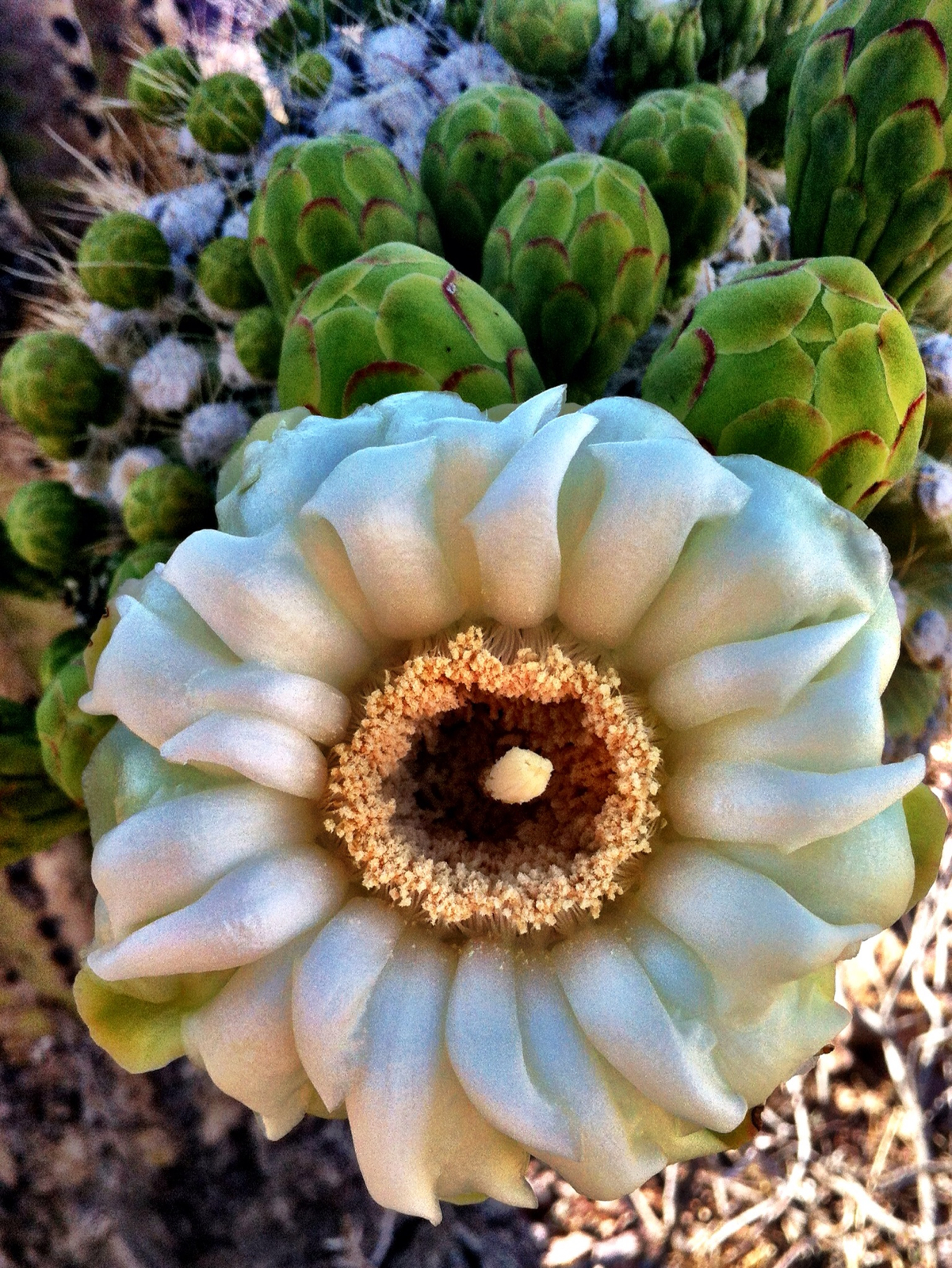
Saguaro flowers are waxy, creamy white, about 3 inches across, with a thick ring of golden stamens around a central stigma. They form in crowns near the tips of the trunk and arms, so most blooms are well above head height. Each flower opens after dark, stays open through the night and closes by the following afternoon, giving both nocturnal pollinators (lesser long-nosed bats) and daytime ones (white-winged doves, native bees, honeybees) a chance to visit. Flowering runs from about late April into June, with the peak in May and early June. A single plant can produce hundreds of flowers over the season, but only a few open on any given night.
Fruit & Seeds
Pollinated flowers develop into oval green fruits 2 to 3 inches long that ripen in June and July, just before the summer monsoon. When ripe, the fruit splits open to reveal bright red, sweet pulp packed with roughly 2,000 tiny black seeds, so from a distance a fruiting saguaro can look as if it is blooming red flowers. The fruit is an important summer food for desert wildlife and has been a staple harvest food for the Tohono O’odham people for centuries.
Quick Facts
| Scientific Name | Carnegiea gigantea |
| Family | Cactaceae (Cactus) |
| Plant Type | Tree-sized columnar cactus |
| Mature Height | 40–60 ft (12–18 m); exceptional plants taller |
| Mature Spread | 1–2 ft trunk; 10–15 ft across the arms on old plants |
| Growth Rate | Very slow (inches per year; arms after 50–75 years) |
| Sun Exposure | Full Sun (seedlings need light shade from a nurse plant) |
| Water Needs | Very low; dry, fast-draining soil |
| Soil Type | Rocky or gravelly, sharply drained desert soils |
| Soil pH | Neutral to alkaline (about 7.0–8.5) |
| Bloom Time | Late April – June (peak May to early June) |
| Flower Color | Creamy white with golden stamens |
| Fall Color | None (evergreen succulent stem) |
| Fruit | Green fruit splitting to red pulp, June–July |
| Deer Resistant | Yes as an adult; young plants need protection from javelina, packrats and rabbits |
| USDA Hardiness Zones | 9–11 (young plants damaged by long freezes) |
Native Range
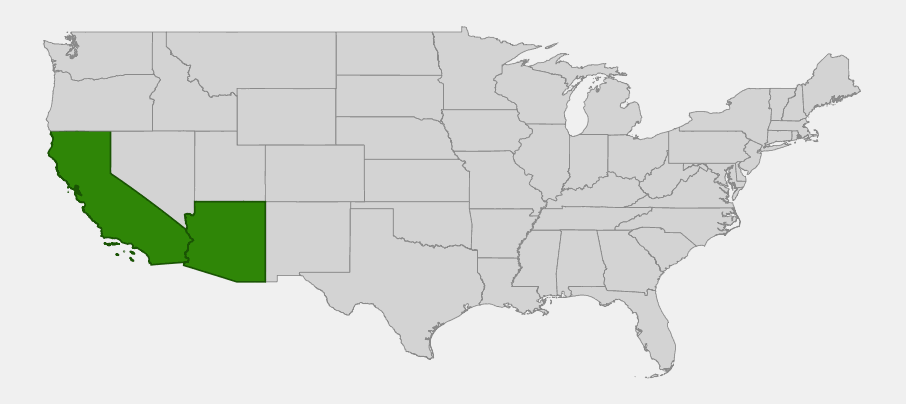
The saguaro is native to the Sonoran Desert. In the United States it grows across the southern half of Arizona, from the Tucson and Phoenix basins west toward the Colorado River and north into the lower canyons below the Mogollon Rim. In California it is found only in a small area along the Colorado River in the southeastern corner of the state, such as the Whipple Mountains area. South of the border it extends through much of the Mexican state of Sonora. It does not grow wild in New Mexico or Nevada.
Cold, not drought, sets the edge of the saguaro’s range. Extended hard freezes kill growing tips and young plants, so saguaros thin out at higher elevations and on north-facing slopes. They are most abundant on rocky slopes and bajadas (the gravelly outwash fans at the base of desert mountains), where soils drain quickly and warm air settles. Classic saguaro “forests” can be seen in Saguaro National Park on both sides of Tucson, in Organ Pipe Cactus National Monument, at Picacho Peak State Park, and in the Tonto National Forest east of Phoenix.
Saguaros rarely start life in the open. Seedlings depend on the shade of a “nurse plant” such as foothill palo verde, velvet mesquite, desert ironwood or creosotebush, which shields them from summer sun, winter frost and hungry animals. Over many decades the saguaro often outgrows and outlives its nurse. Today its biggest threats are invasive buffelgrass, which carries fire through desert that never evolved with it, and land clearing for development.
📋 Regional plant lists featuring Saguaro: Arizona & New Mexico
Growing & Care Guide
Saguaros are only a practical landscape plant in the low and middle deserts of Arizona and the Colorado River valley, roughly below 4,000 feet where hard freezes are short and rare. In that setting they are close to maintenance-free, as long as you respect three rules: full sun, fast drainage, and very little water.
Light
Established saguaros need full desert sun. Young plants are the exception: in nature they grow up in the dappled shade of a nurse tree, and nursery-grown seedlings can sunburn if moved straight into blazing afternoon sun. Plant small saguaros on the north or east side of a palo verde, mesquite or large shrub, or give them temporary shade cloth for their first summer.
Soil & Water
Good drainage matters more than anything else. Saguaros thrive in rocky, gravelly or sandy soils and rot quickly in heavy clay or anywhere water stands after a storm. If your yard has clay, plant on a raised mound of native gravelly soil rather than amending a planting hole, which can turn into a water-holding pit. Once established, a saguaro can live on natural rainfall alone in most of its range. During long, very hot dry spells, a deep soak once every few weeks in summer is plenty; never water in winter, and never set a saguaro on a lawn or drip line meant for thirsty plants. Overwatering causes rot and can make tall plants top-heavy and prone to toppling.
Planting Tips
Buy saguaros only from a reputable nursery that sells legally salvaged or nursery-grown plants with the Arizona Department of Agriculture tag; it is illegal to dig or move one from the wild without a permit under Arizona’s Native Plant Law. Plant in late spring or early summer, when soil is warm and roots grow actively. Before moving a plant, mark its south side and replant it facing the same direction, because the side that has never faced the sun burns easily. Set it at the same depth it grew before, firm the soil well, and stake larger specimens loosely until roots anchor them. Wait about a week before giving the first light watering so damaged roots can heal.
Pruning & Maintenance
Saguaros need no pruning, fertilizer or winter cover in warm locations. Leave woodpecker holes alone; the plant seals each cavity with a hard, scar-tissue “boot,” and the holes become wildlife homes. If an unusual freeze is forecast, cover the growing tips of young plants with a frost cloth or foam cup overnight. Watch for soft, dark, oozing spots, which can signal bacterial necrosis after injury or overwatering; call a certified arborist or cactus specialist for large plants rather than cutting into them yourself.
Propagation
Saguaros are grown from seed. Fresh seed from ripe summer fruit germinates readily in warm, moist conditions, but seedlings grow extremely slowly; a 10-year-old saguaro may be only a few inches tall. Most home gardeners are better off buying a nursery-grown plant or a properly tagged salvaged specimen.
Landscape Uses
- Signature specimen in low-desert yards in Arizona
- Wildlife garden centerpiece: flowers feed bats, doves and bees; fruit feeds birds and mammals
- Desert habitat restoration on rocky slopes and bajadas, planted under nurse shrubs
- Xeriscape and water-wise landscapes paired with brittlebush, ocotillo and palo verde
- Pollinator gardens as a late-spring nectar source; see our Arizona pollinator garden plants
Wildlife & Ecological Value
Few plants in North America support as much wildlife as a single old saguaro. It is food, water, nesting site and lookout tower for a long list of desert animals.
For Pollinators
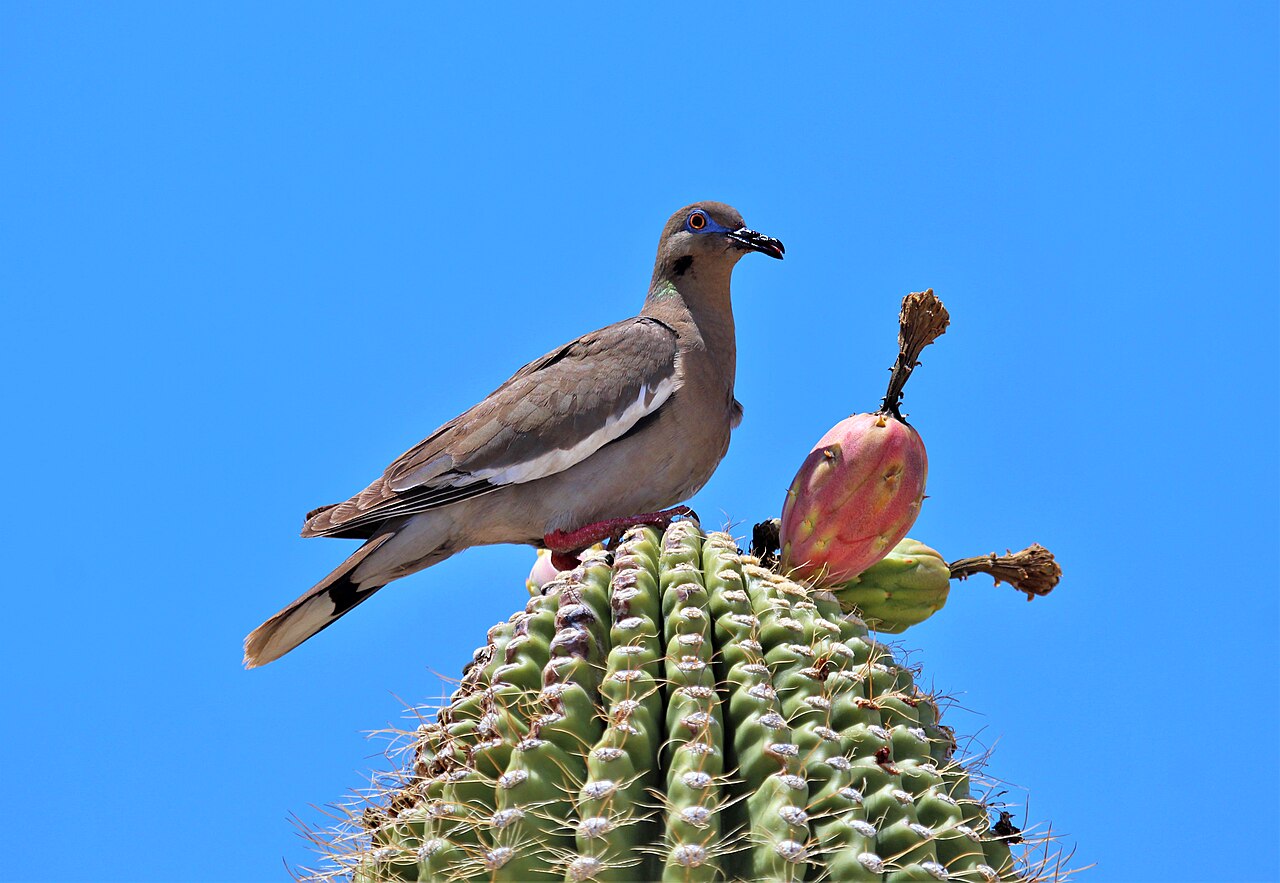
The night-opening flowers are pollinated by the migratory lesser long-nosed bat, which follows a “nectar corridor” of blooming cactus and agave north from Mexico each spring. When the flowers stay open into the next morning, white-winged doves, native bees, honeybees, hummingbirds and other birds take over, drinking nectar and moving pollen between plants.
For Birds
Gila woodpeckers and gilded flickers excavate nest cavities in the trunk and arms. Once abandoned, those cavities house elf owls, ferruginous pygmy-owls, purple martins, ash-throated and brown-crested flycatchers, cactus wrens and others. Red-tailed hawks and Harris’s hawks nest in the crooks of the arms, and white-winged doves time their summer nesting to the saguaro fruit harvest.
For Mammals
Ripe fruit and fallen seeds feed coyotes, javelinas, gray foxes, ground squirrels, packrats and harvester ants, which in turn spread the seeds across the desert floor. Bats rely on the nectar during migration, and the shade and cavities of large saguaros offer refuge from extreme heat.
Ecosystem Role
The saguaro is a keystone species of the Sonoran Desert. Its summer fruit arrives during the driest, hottest weeks of the year, when little else is available, and provides both food and moisture. Its cavities create nesting habitat in a landscape with few trees, and fallen skeletons slowly return nutrients to the soil. Protecting saguaro stands, and the nurse trees that young saguaros depend on, protects a whole community of desert life.
Cultural & Historical Uses
For the Tohono O’odham, the saguaro (haṣañ) is a relative rather than just a plant. Each June and July, families camp in the saguaro stands to harvest the fruit, called bahidaj, using long poles made from saguaro ribs to knock the fruit from the tops of the stems. The pulp is eaten fresh, dried, boiled into syrup and jam, and the seeds are ground into meal or used as chicken feed. The harvest marks the beginning of the O’odham new year.
Saguaro syrup is also fermented into a ceremonial wine for the summer rain ceremony, held to call the monsoon rains that the desert, its people and their crops depend on. The Akimel O’odham, Seri and other peoples of the region likewise harvested saguaro fruit, and the hard woody ribs of dead saguaros were used for building shades, fences, roofs and harvesting tools.
The saguaro has become an icon of the American Southwest, even though it grows naturally only in a small part of it. Saguaro National Monument was established in 1933 and became Saguaro National Park in 1994, protecting two large stands on either side of Tucson. The saguaro blossom was made Arizona’s state wildflower in 1931, and the plant is protected under state law.
Frequently Asked Questions
How long does it take a saguaro to grow arms?
Usually 50 to 75 years, and sometimes closer to 100 in dry or high-elevation sites. Growth depends heavily on rainfall, and some saguaros never grow arms at all.
How old is a 15-foot saguaro?
Probably close to a century. National Park Service estimates for the Tucson area put a saguaro at roughly 6½ feet tall around age 70 and 15 to 16 feet around age 95 to 100, though growth varies widely with rainfall and site. Height is only a rough guide to age.
Is it illegal to cut down or move a saguaro?
In Arizona, saguaros are protected under the Arizona Native Plant Law. Removing, moving or selling one requires permits and tags from the Arizona Department of Agriculture, and landowners must notify the state before removing protected plants. On public land, damaging a saguaro is a serious offense.
Can I grow a saguaro outside Arizona?
Saguaros grow outdoors only in hot, dry, low-elevation deserts with mild winters, such as the low deserts of Arizona and the Colorado River valley. Elsewhere they are best grown in large containers in a greenhouse or sunny window, where they will stay small for many years.
Is saguaro fruit edible?
Yes. The ripe red pulp is sweet and has been eaten for centuries by the Tohono O’odham and other peoples. On public land, check local rules before harvesting, and never damage the plant to reach the fruit.

Looking for a nursery that carries Saguaro?
Browse our native plant nursery directory: Arizona · California