Desert Ironwood (Olneya tesota)
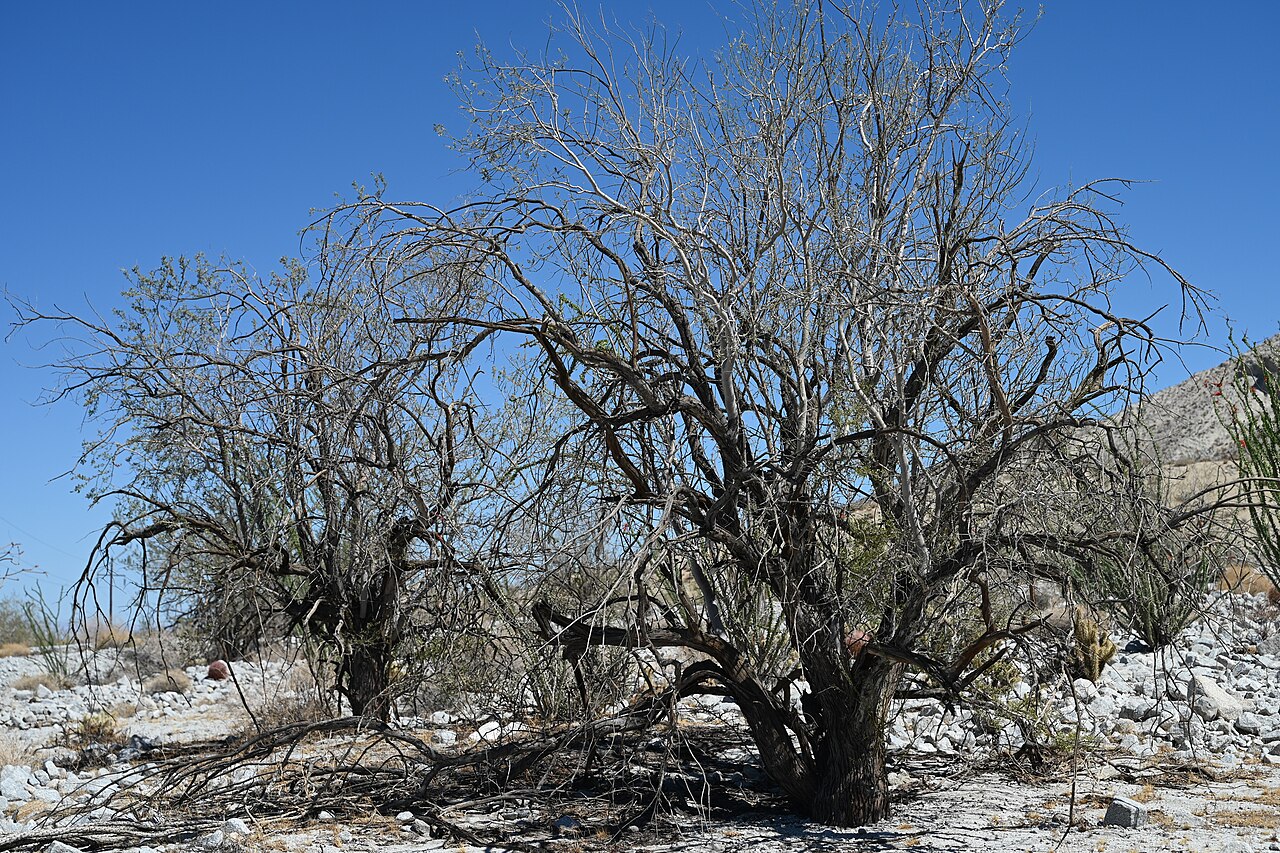
Desert ironwood is a broad-crowned Sonoran Desert tree with gray-green foliage, hard wood and a spring display of pink-lavender pea flowers. It can look spare on an exposed rocky slope and much fuller in a favorable wash or a carefully watered garden. That variation is part of its character, not a reason to confuse it with another tree.
The scientific name is Olneya tesota. Eastern trees called ironwood, including Carpinus and Ostrya, are unrelated choices with different climates and care requirements. This page concerns the warm-desert legume, and the Arizona table link leads here rather than to an eastern woodland tree.
For a suitable low-desert landscape, ironwood offers shade, structure and habitat over a long period. Give it a permanent position with room for its canopy and respect its spines. It is not a quick annual screen, and it should not be forced into a narrow passage where repeated heavy pruning would remove its natural shape.
Identification
Leaflets and spines
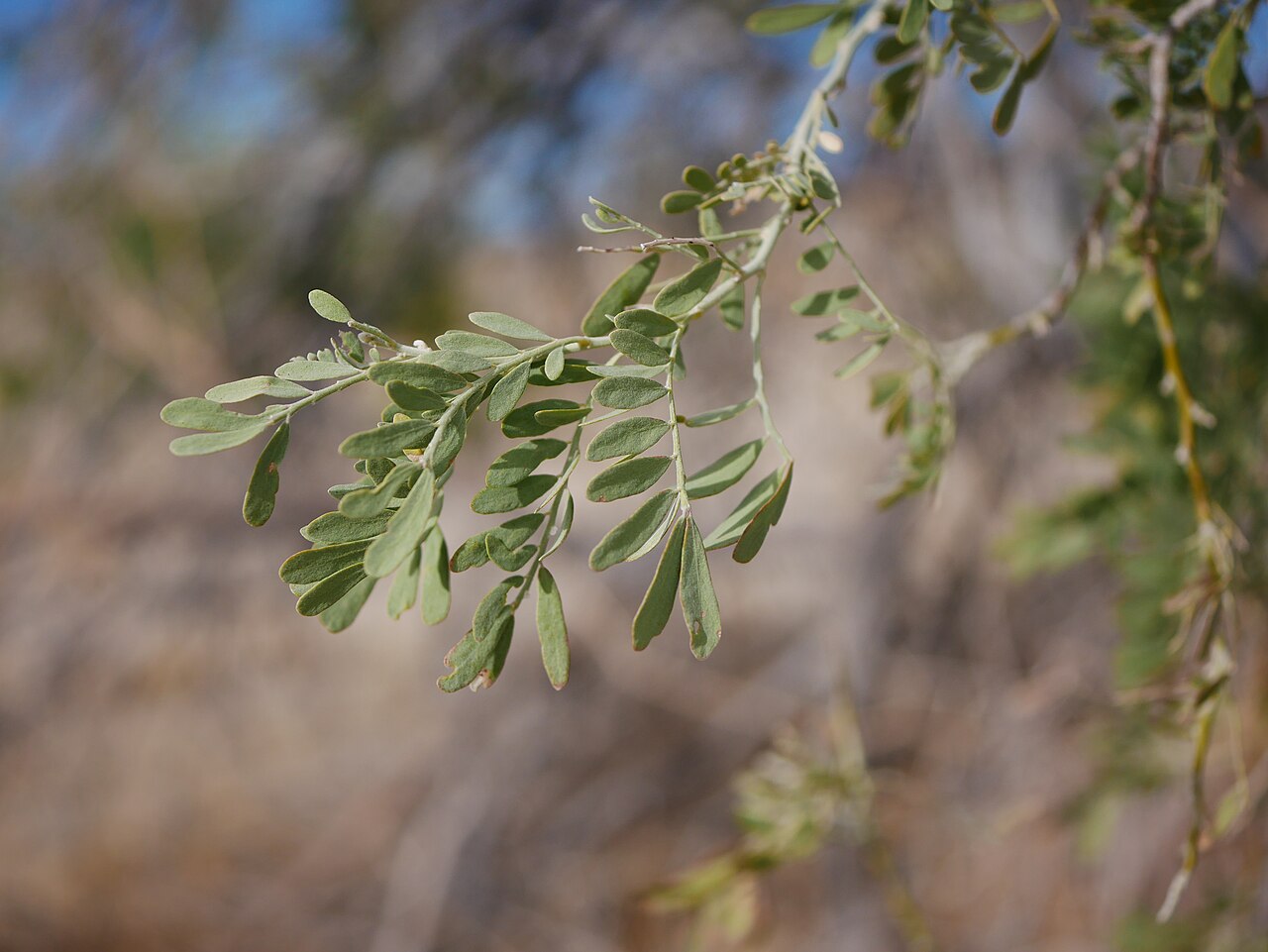
The leaves are compound, with several small gray-green leaflets along a central stalk. Pairs of sharp spines occur near leaf bases. Look closely from a safe distance before reaching into a branch. A leaflet is not the entire leaf; that distinction helps separate ironwood from desert trees with simple leaves.
Flowers
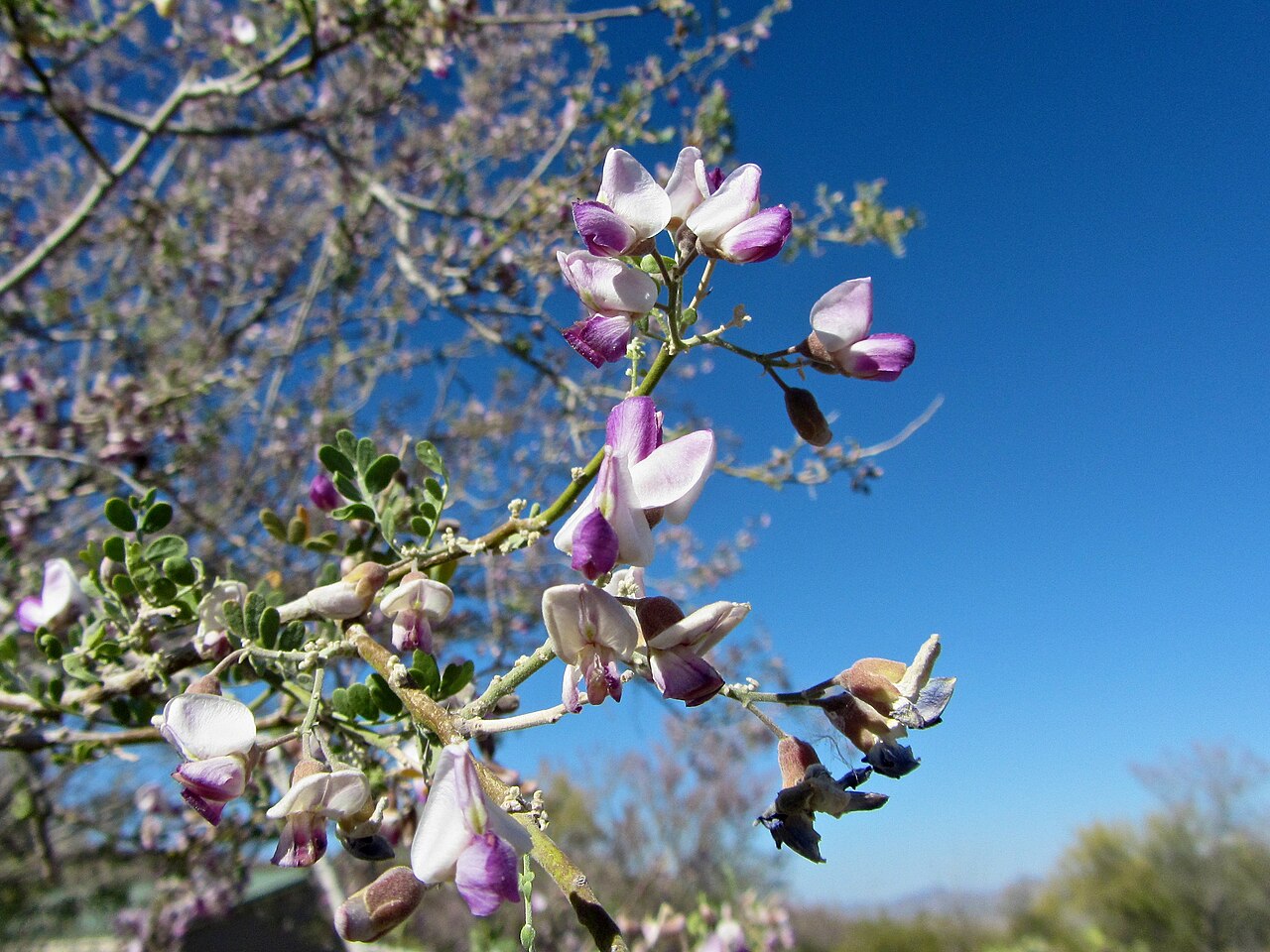
The blossoms have the unequal petals characteristic of a pea-family flower. Their pink, lavender and pale tones can be especially conspicuous when foliage is sparse. Flowering timing varies with the season, so the absence of blossoms is not evidence that a tree is incorrectly named. Use bark, leaves and branching as well.
Bark, crown and pods
Young bark is relatively smooth and gray; older trunks become darker and more fissured. The crown spreads broadly, and mature trees may have several substantial stems. Hairy pods develop after flowering. Do not judge age from trunk size alone, because growth depends strongly on the site.
What it is not
A tree labeled simply ironwood could refer to several unrelated genera. Desert ironwood is not eastern ironwood, and it is not a mesquite even though both are legumes of dry landscapes. Ask for Olneya tesota on a nursery label and compare several features, rather than making an identification from wood hardness or a common name.
Quick Facts
| Scientific Name | Olneya tesota |
| Family | Fabaceae |
| Plant Type | Spiny evergreen to drought-deciduous desert tree |
| Mature Height | Often 15–30 feet, depending on site and water |
| Mature Spread | A broad crown, often around 20–30 feet at maturity |
| Growth Rate | Slow to moderate; strongly site-dependent |
| Sun Exposure | Full sun |
| Water Needs | Low after establishment; supplemental deep watering can improve garden growth |
| Soil Type | Well-drained desert soil; avoid chronically saturated roots |
| Soil pH | Adapted to many desert soils; test before adding amendments |
| Bloom Time | Spring into early summer, often April–June |
| Flower Color | Pink, lavender and white pea-like flowers |
| Fall Color | No reliable autumn display; leaves may be shed during stress |
| Fruit | Hairy pods with hard seeds |
| Deer Resistant | Spines do not guarantee protection from browsing |
| USDA Hardiness Zones | Warm Sonoran Desert conditions; young trees can be injured by severe freezes |
Native Range
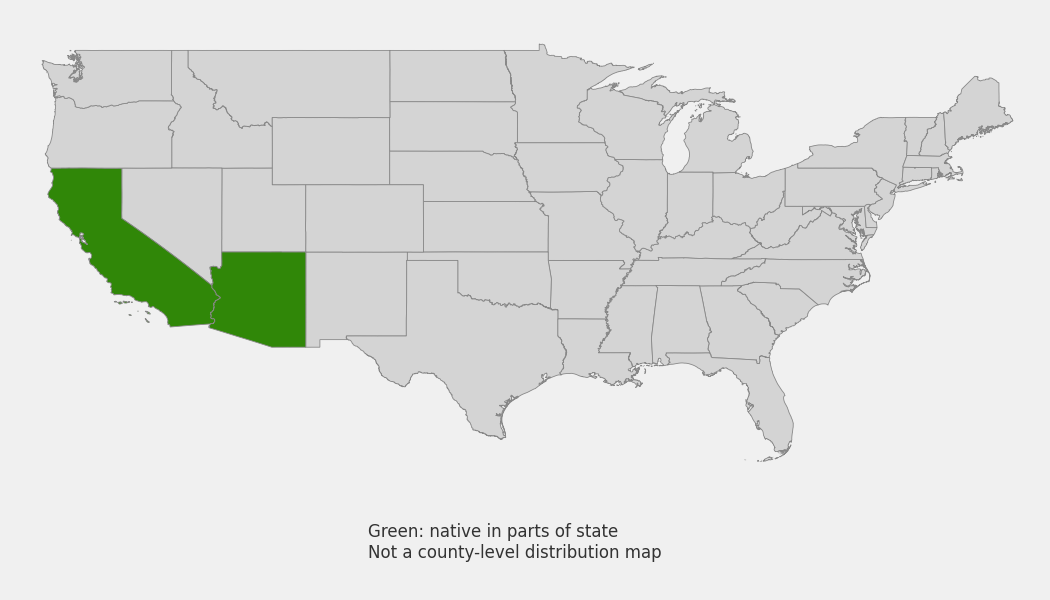
Desert ironwood is closely associated with the Sonoran Desert. Its United States native range is in Arizona and southeastern California, continuing into northwestern Mexico, including Sonora and parts of the Baja California peninsula. The map highlights the two U.S. states only; it does not imply nativity throughout either state.
Natural sites include washes, drainage areas and low desert hills. Water moving through a wash can support a large tree in a landscape that otherwise appears very dry. A garden on a shallow rocky slope may produce a smaller, slower tree than a deep-soiled site, even when both are in the same city.
This is a warm-desert species. The Arizona regional list includes many climates, so the state name alone is not a planting recommendation for a cold upland garden. Check local frost exposure, mature space and drainage before buying. A sheltered young tree can still be damaged during a severe freeze.
📋 Regional plant list: Arizona
Growing & Care Guide
Plan for a permanent tree
Choose a site with space for the canopy and a clear view of nearby buildings, utilities and paths. The tree should not need annual topping to fit. Keep spiny lower branches away from a narrow walkway, while allowing enough room to retain a natural canopy. Think about access for future pruning before planting a small container tree.
Use full sun
A sunny position supports the tree’s normal form. Do not place it in a small shaded courtyard and expect a full desert canopy. Where reflected heat is intense, pay particular attention to establishment watering and root-ball moisture; drought adaptation does not make a newly transplanted container immune to drying.
Planting and the root flare
Locate the root flare and plant at an appropriate depth rather than burying the trunk under extra soil. Open a planting area that allows roots to move into surrounding soil, and correct circling roots according to good nursery practice. Water thoroughly after planting. Avoid a tiny highly amended hole that holds water differently from the soil around it.
Establishment irrigation
Check the original root ball as well as nearby soil. Water should penetrate the root zone rather than run off a hard surface. Gradually adjust irrigation as roots expand, using local conditions and tree response rather than abruptly stopping water because the species is called drought tolerant. A desert tree can survive on little water yet grow poorly if establishment is neglected.
Long-term watering
The Arizona-Sonora Desert Museum notes that moderate growing-season water can improve landscape performance. Deep, spaced watering is generally more useful than constant shallow sprinkling. Allow the soil to drain, and avoid placing the trunk inside an irrigated lawn zone that stays wet. Review emitter positions as the canopy and roots expand.
Soil and feeding
Good drainage matters more than a rich planting mix. Do not fertilize automatically; many desert sites do not need routine feeding for this tree. If growth is weak, inspect water distribution, soil compaction and frost damage first. A soil test and local extension guidance are better than repeated applications intended to force fast growth.
Pruning and spines
Use minimal structural pruning rather than stripping the canopy or topping the tree. Remove a branch because it has a clear structural or clearance reason, not merely because it is low. Wear appropriate protection around spines. Larger cuts and mature-tree work are best assessed by a qualified arborist familiar with desert trees.
Frost and winter placement
Avoid a frost pocket when choosing a site, particularly for a young plant. Cold injury is not always immediately apparent, so wait for a clear picture of living growth before making extensive corrective cuts. Do not confuse a cold-damaged tree with a need for heavy fertilizer. Local low-desert nursery advice is more useful than a broad hardiness label alone.
Propagation and conservation
Buy nursery-propagated plants with a sound root system. If growing from seed, use a verified Olneya protocol and keep source records; hard-seeded legumes do not all receive identical treatment. Do not collect wood or dig trees from natural areas. A long-lived desert tree is not quickly replaced when removed from its habitat.
Monitoring problems
Watch irrigation patterns and trunk condition during establishment. Yellowing or leaf drop can have several causes, including drought, cold and root stress. Compare the timing with weather and watering before treating insects or disease. Avoid routinely spraying the flowering canopy, and ask for a diagnosis if dieback progresses.
Landscape Uses
- A shade or specimen tree in a warm, well-drained low-desert landscape.
- A structural element in a Sonoran Desert native planting.
- A nurse canopy for compatible plants selected for the filtered-light environment.
- Not an eastern woodland ironwood substitute or a tree for cold upland sites.
Wildlife & Ecological Value
A nurse-tree canopy
The Arizona-Sonora Desert Museum describes ironwood as a nurse plant whose canopy modifies the environment beneath it. Shade and shelter can help create establishment sites for other organisms. In a garden, retain some natural ground structure rather than assuming every fallen leaf beneath the canopy must be removed.
Food and shelter
Flowers, pods, branches and shaded ground contribute different resources to a desert community. The value is broader than one brief bloom. Avoid unsupported promises that a single tree will attract a particular animal on demand; habitat quality also depends on the surrounding landscape and the absence of harmful disturbances.
Respecting mature trees
Existing mature ironwoods can be more valuable than a newly planted replacement. Protect their root areas from excavation, compaction and major changes in drainage. Where construction is proposed, seek site-specific arboricultural advice before altering the ground around a long-established tree.
Cultural & Historical Uses
The name ironwood refers to exceptionally dense wood, but it is shared by many unrelated trees. The Spanish name palo fierro is also associated with this desert species. Using the botanical name prevents a nursery or restoration specification from accidentally selecting a plant from a different climate.
Ironwood has cultural and economic importance in the U.S.–Mexico borderlands, including woodworking traditions. That history should be considered alongside the ecological value of standing trees. Decorative uses are not a reason to remove living trees from natural habitat or to assume that any collected wood has a sustainable origin.
A native landscape can celebrate the tree by allowing its form to develop and explaining its role in the desert community. A label distinguishing Olneya from eastern ironwoods is a small but useful educational improvement. The goal is an accurately identified, well-placed tree, not a generic promise that all plants called ironwood have the same benefits.
Frequently Asked Questions
Is desert ironwood the same as eastern ironwood?
No. Olneya tesota is a Sonoran Desert legume. Eastern ironwoods belong to other genera and have different growing requirements.
Does it need water after planting?
Yes. Establishment requires careful watering. Even mature landscape trees may perform better with appropriate supplemental water than with abrupt neglect.
Can I grow it anywhere in Arizona?
No. Warm-desert conditions, frost exposure and drainage matter. A state-level native listing is not a recommendation for every elevation.
Should I prune it into a tight ball?
Retain its natural broad form and use minimal purposeful structural pruning. Repeated shearing or topping is not a good substitute for adequate space.
Why is my tree smaller than a specimen in a wash?
Soil depth, available water, age and exposure strongly affect growth. A rocky dry site can produce a much smaller tree.
Sources & Further Reading
- University of Arizona — Olneya tesota identification
- Arizona-Sonora Desert Museum — ironwood natural history
- Arizona-Sonora Desert Museum — plant care sheet
- USDA PLANTS — desert ironwood
Find Native Plants
Ask growers about nursery propagation and regional provenance. Browse our AZ native plant nurseries directory for suppliers. Explore the native nursery finder.