Venus Flytrap (Dionaea muscipula)
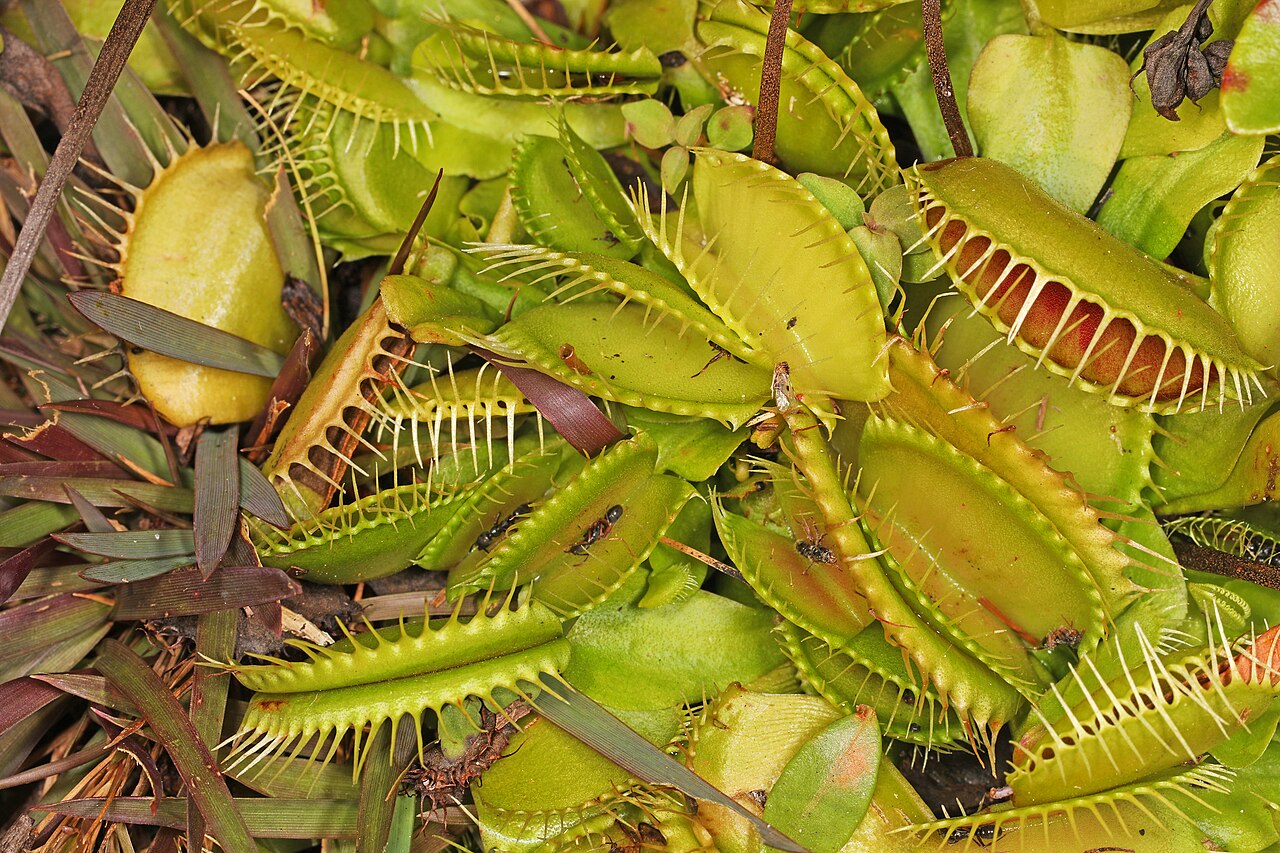
Dionaea muscipula, the Venus Flytrap, is one of the most famous plants on Earth and one of the rarest in the wild. This small carnivorous perennial catches insects and spiders with hinged, toothed traps that snap shut in a fraction of a second. Charles Darwin called it “one of the most wonderful plants in the world,” and it is the only species in its genus.
Despite being sold in garden centers worldwide, the Venus flytrap grows naturally in only one small part of the world: the coastal plain of southeastern North Carolina and northeastern South Carolina, roughly within 75 to 100 miles of Wilmington, North Carolina. There it lives in sunny, wet, sandy pine savannas and the edges of shrubby bogs, habitats that depend on regular fire. Much of that habitat has been lost to development, drainage and fire suppression, and wild plants are also stolen by poachers.
For native plant gardeners in the Carolinas, a Venus flytrap is a fascinating addition to a sunny bog garden or container, as long as it gets the right conditions: full sun, constantly wet acidic soil, pure water and a cool winter rest. Grown that way, it is long-lived and surprisingly tough. North Carolina adopted it as the official state carnivorous plant in 2005.
Identification
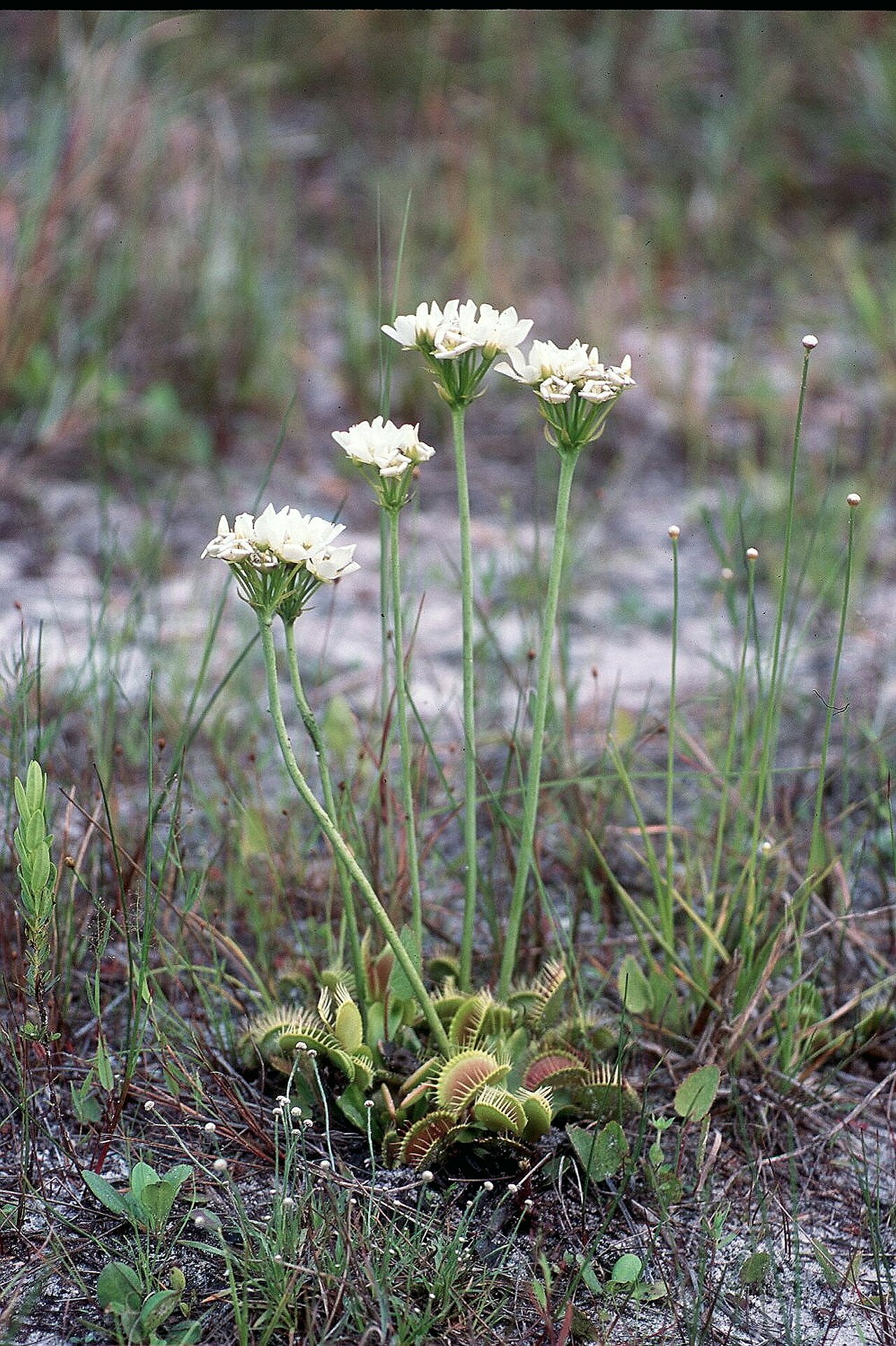
A Venus flytrap is a low rosette usually 2 to 5 inches across, made up of 4 to 8 leaves that radiate from an underground, bulb-like rhizome. Each leaf has two parts: a flattened, often heart-shaped leaf stalk (petiole) that does most of the photosynthesis, and the famous trap at its tip.
Leaves & Traps
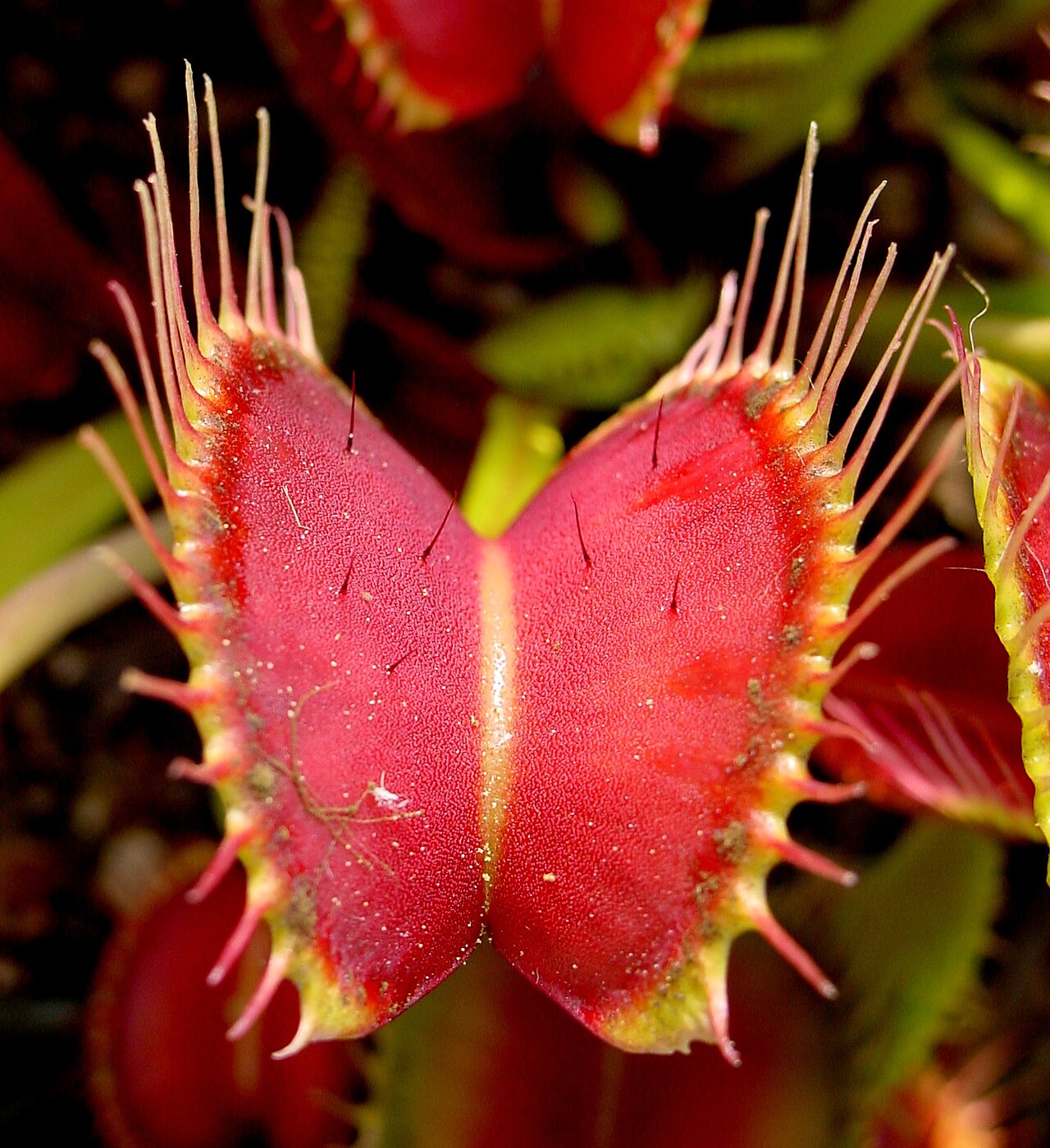
The trap is the modified leaf blade: two kidney-shaped lobes hinged along a midrib. The edges of each lobe carry 15 to 20 stiff, hair-like “teeth,” and the inner surface usually holds three tiny trigger hairs. When an insect touches trigger hairs twice within about 20 seconds, or one hair twice, the trap snaps shut in about a tenth of a second, and the teeth interlock like the bars of a cage. Struggling prey then seals the trap tightly and digestion begins, taking roughly 5 to 12 days. Trap interiors range from green to deep red, with the most color in strong sun. Each trap can close only a few times before it blackens and is replaced by new growth.
Flowers
In late spring, usually May and early June in the wild, mature plants send up a slender stalk 6 to 12 inches tall topped with a cluster of white, five-petaled flowers about an inch across with green veins. The tall stalk keeps pollinators well away from the traps below. The flowers are pollinated by sweat bees, checkered beetles, longhorn beetles and other small insects, which are rarely the same insects the traps catch.
Fruit & Seeds
Pollinated flowers form small capsules that ripen in early summer, each holding several tiny, shiny black, pear-shaped seeds. The seeds fall close to the parent plant. Plants also spread slowly by dividing their rhizomes, forming small clumps over time.
Quick Facts
| Scientific Name | Dionaea muscipula |
| Family | Droseraceae (Sundew) |
| Plant Type | Carnivorous herbaceous perennial |
| Mature Height | Rosette 2–4 in tall; flower stalks 6–12 in |
| Mature Spread | 2–5 in per rosette; slowly forms small clumps |
| Growth Rate | Slow to moderate |
| Sun Exposure | Full Sun |
| Water Needs | Wet; constantly moist with rain or distilled water |
| Soil Type | Nutrient-poor acidic sand and peat |
| Soil pH | Strongly acidic (about 4.0–5.0) |
| Bloom Time | May – June |
| Flower Color | White with green veins |
| Fall Color | Traps often redden in strong sun; plant goes dormant in winter |
| Fruit | Small capsule with shiny black seeds, early summer |
| Deer Resistant | Not usually browsed; too small to attract deer |
| USDA Hardiness Zones | 7–9 outdoors (needs a cool winter dormancy) |
Native Range
The Venus flytrap’s entire natural range lies in the outer coastal plain of the Carolinas, centered on southeastern North Carolina around Wilmington and extending into northeastern South Carolina near the coast. It is native to no other state or country. Plants found in the wild elsewhere, including small naturalized patches in Florida and New Jersey, came from planted or escaped stock.
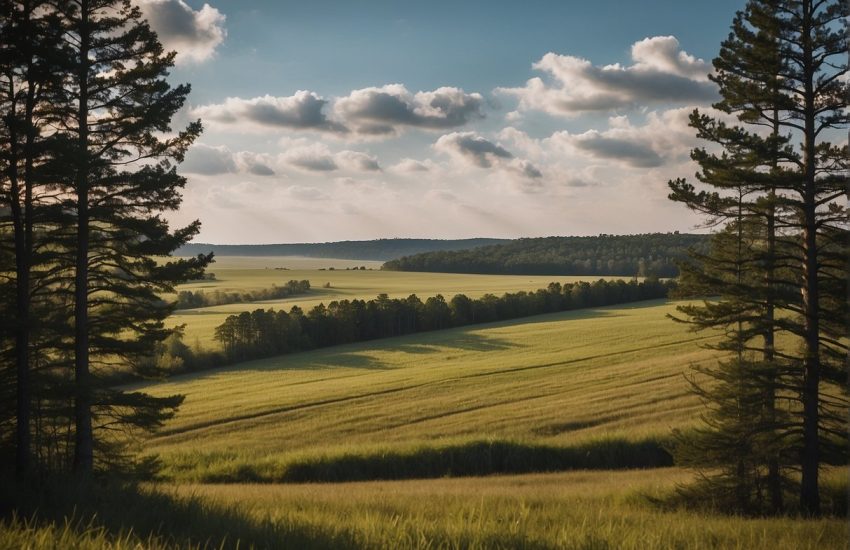
Within that small range, flytraps grow in wet pine savannas and flatwoods dominated by longleaf pine and wiregrass, and along the sunny, damp edges between savannas and shrubby pocosin bogs. The soils are acidic, sandy and peaty, and extremely low in nutrients, which is why the plant gets extra nitrogen and phosphorus from insects. They grow alongside pitcher plants, sundews, butterworts, orchids and other bog wildflowers.
Venus flytrap habitat depends on fire. Frequent, low-intensity fires, historically every few years, burn back competing shrubs and keep the savannas open and sunny. Where fire is suppressed, shrubs shade the flytraps out. Development, drainage, fire suppression and poaching have reduced wild populations dramatically, and some of the best remaining sites are protected in places like the Green Swamp Preserve and Carolina Beach State Park.
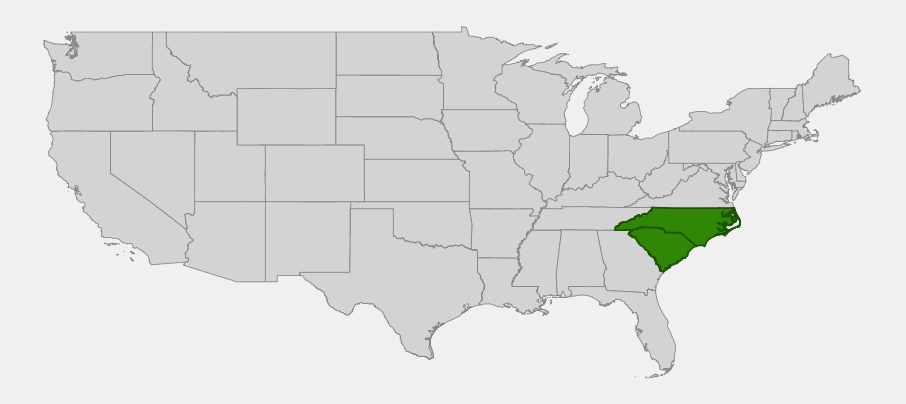
📋 Regional plant lists featuring Venus Flytrap: North Carolina & South Carolina
Growing & Care Guide
Most Venus flytraps that die in cultivation are killed with kindness: rich soil, tap water, fertilizer, shade or a warm windowsill all winter. Give a flytrap conditions like its native savanna and it is a durable, long-lived plant.
Light
Flytraps need full sun, ideally 6 or more hours of direct sun a day outdoors. Strong light produces sturdy leaves, quick traps and the red trap color many growers love; it is also why a flytrap turns red in a sunny spot. Plants kept in low light grow long, floppy, green leaves and weaken over time, a common reason a flytrap droops.
Soil & Water
Plant flytraps in a mix of sphagnum peat moss and clean silica sand or perlite, roughly half and half. Never use potting soil, compost or fertilizer, because added nutrients burn the roots. Keep the soil wet at all times during the growing season, ideally by standing the pot in a tray of water an inch or so deep. Use only rainwater, distilled water or reverse-osmosis water; the minerals in most tap water build up and slowly kill the plant.
Planting Tips
In the Carolina coastal plain and similar climates (about zones 7 to 9), flytraps can grow outdoors year-round in a sunny bog garden: a lined depression filled with peat and sand that stays wet. Elsewhere, grow them in plastic or glazed pots outdoors in summer. Buy only nursery-propagated plants (most are grown from tissue culture) and never dig plants from the wild, which is illegal in North Carolina.
Pruning & Maintenance
Snip off blackened traps and leaves as they die; this is normal, since each trap lasts only a few closures. Flytraps catch their own food outdoors and do not need feeding. If you grow one indoors, an occasional small live insect is enough; never feed it hamburger or other human food (see our notes on what not to feed a flytrap). Many growers cut off flower stalks early to save the plant’s energy, unless they want seed.
Winter Dormancy
Venus flytraps must have a winter rest of about 3 months, with temperatures roughly between 35 and 50°F. Growth slows, many leaves die back and the plant looks unimpressive; this is normal. Keep the soil damp but not flooded. Outdoors in its native zones, a flytrap handles light frosts on its own. In colder areas, move pots to an unheated garage, cold frame or sheltered porch. Plants kept warm all winter usually decline and die within a year or two.
Propagation
Flytraps can be grown from fresh seed sown on the surface of wet peat in bright light, though seedlings take 3 to 5 years to mature. Faster methods are dividing large clumps in spring and rooting leaf cuttings (a leaf with its white base, laid on wet peat in high humidity).
Landscape Uses
- Bog gardens with pitcher plants and sundews in full sun
- Container and patio displays set in a water tray
- Rain garden edges in the coastal Carolinas, where soil stays wet and acidic
- Educational and school gardens, where few plants spark more curiosity
- Savanna restoration plantings with longleaf pine, using nursery-propagated stock only
Wildlife & Ecological Value
The Venus flytrap is a predator, a nectar plant and a symbol of one of the most species-rich habitats in North America: the longleaf pine savanna.
For Pollinators
Field studies in North Carolina found that the flowers are visited and pollinated mainly by sweat bees, checkered beetles and longhorn beetles. Remarkably, these pollinators are almost never the insects the traps catch, because the flowers sit high on tall stalks well above the leaves.
As a Predator
The traps mostly capture crawling prey: ants, spiders, beetles and grasshoppers, along with some flying insects. Digesting this prey supplies the nitrogen and phosphorus missing from the poor savanna soil.
For Birds & Mammals
Flytraps are too small to be an important food for birds or mammals. Their value to larger wildlife comes through the habitat they share: open, fire-maintained longleaf savannas that support red-cockaded woodpeckers, Bachman’s sparrows, fox squirrels, gopher frogs and many rare plants.
Ecosystem Role
As a specialist of frequently burned, wet savannas, the Venus flytrap is an indicator of healthy, well-managed habitat. Where it thrives, the savanna is usually open, sunny and rich in other rare carnivorous plants and wildflowers. Protecting flytraps means protecting prescribed fire and wetland hydrology across the Carolina coastal plain.
Cultural & Historical Uses
The Venus flytrap was first described scientifically in the 1760s after Arthur Dobbs, the colonial governor of North Carolina, wrote about it in 1759 and called it the “fly trap sensitive.” Specimens sent to England caused a sensation, and the plant was given its name, which refers to Venus, the Roman goddess of love and beauty, and muscipula, Latin for “mousetrap.”
Charles Darwin studied the flytrap closely and described it in his 1875 book Insectivorous Plants, calling it “one of the most wonderful plants in the world.” Its fast trap closure, triggered by electrical signals much like those in animal nerves, is still studied by scientists today.
The plant’s fame has also made it a target. Wild flytraps have long been dug and sold illegally, so in 2014 North Carolina made poaching Venus flytraps from the wild a felony. The species is also regulated internationally under CITES. Today virtually all flytraps sold legally are propagated in nurseries and labs, so gardeners can enjoy them without harming wild populations.
Frequently Asked Questions
Where do Venus flytraps grow in the wild?
Only in the coastal plain of southeastern North Carolina and northeastern South Carolina, roughly within 75 to 100 miles of Wilmington, NC. They grow in wet, sunny, fire-maintained longleaf pine savannas and bog edges.
Is it illegal to collect Venus flytraps?
Yes. In North Carolina, taking Venus flytraps from the wild without permission is a felony. Buy only nursery-propagated plants, which are widely available.
Why do Venus flytrap traps turn black?
Each trap can only close and digest a few times before it naturally dies and turns black; new traps replace it. Many black traps at once usually point to a problem such as tap water, fertilizer, too little sun, or a plant that skipped its winter dormancy.
Do I need to feed my Venus flytrap?
Not outdoors, where it catches plenty of insects on its own. Indoor plants benefit from an occasional small live insect, but never feed them meat, cheese or other human food, and never fertilize the soil.
Can Venus flytraps grow indoors year-round?
They rarely thrive that way. Flytraps need much more light than a typical windowsill gives, plus a cool winter dormancy. They do best outdoors in full sun during the growing season and in a cool, sheltered spot in winter.

Looking for a nursery that carries Venus Flytrap?
Browse our native plant nursery directory: North Carolina · South Carolina