
Sugar Pine (Pinus lambertiana)
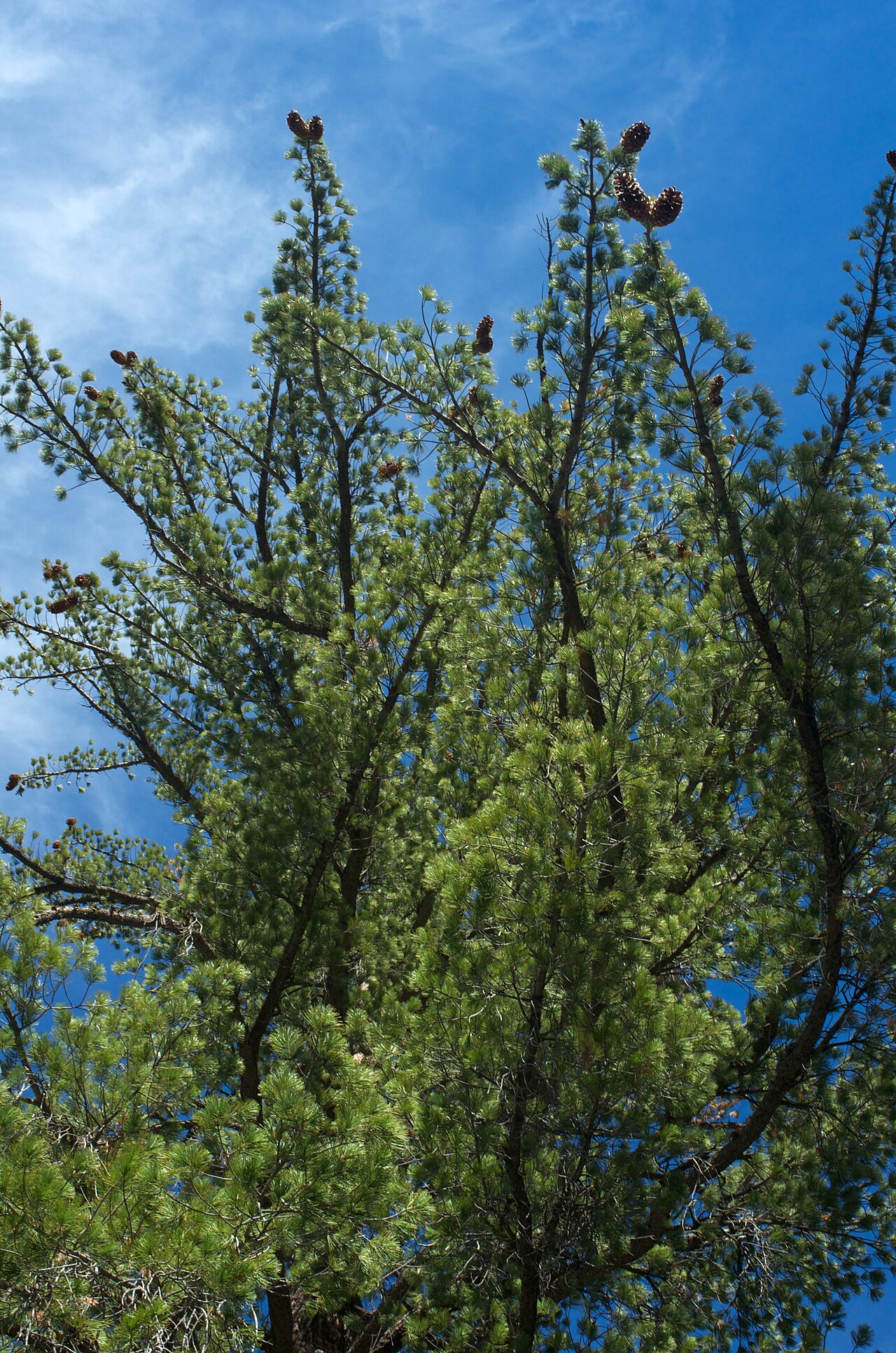
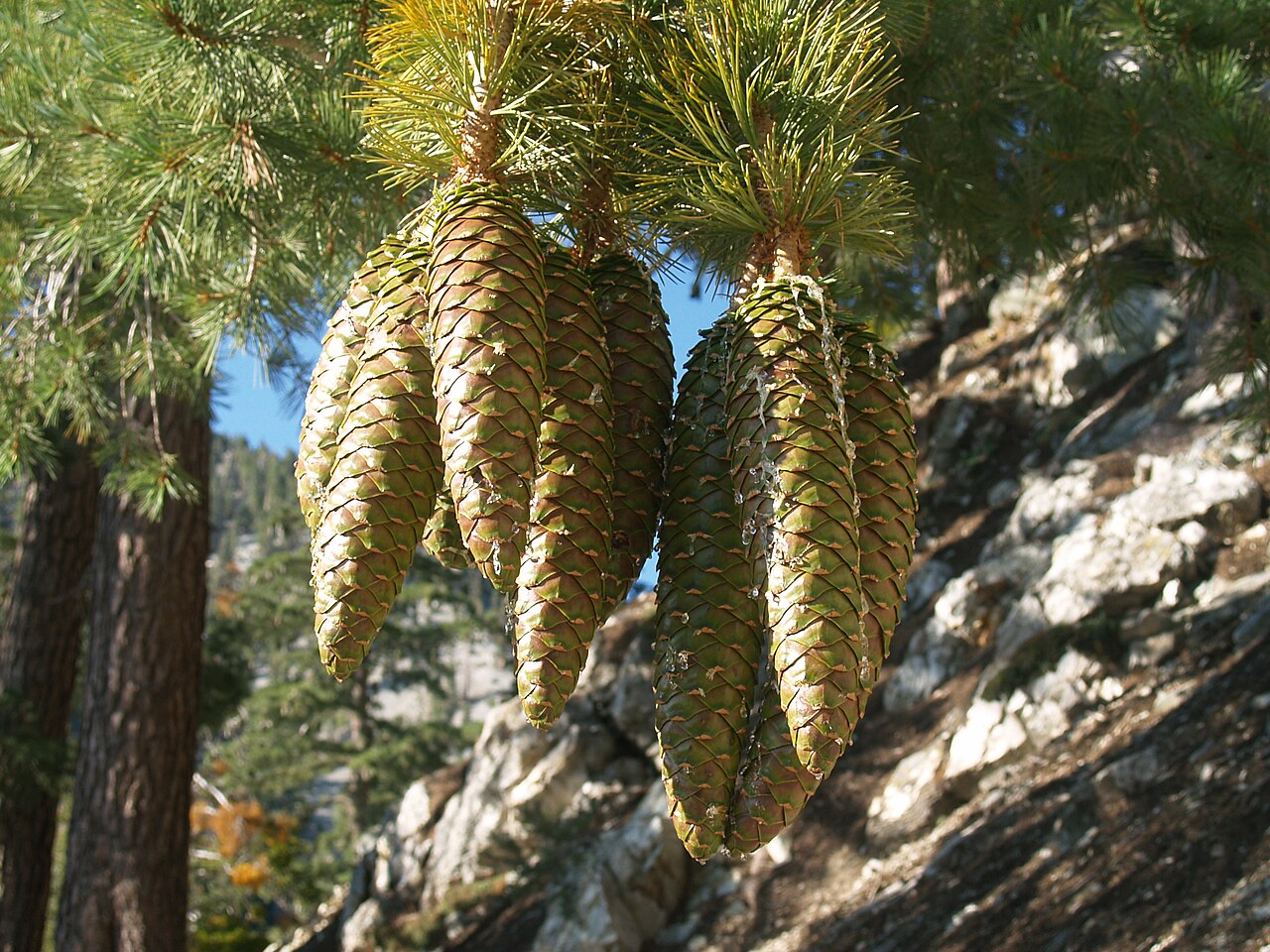
Pinus lambertiana, the Sugar Pine, is the tallest and most massive pine species in the world and a defining tree of California’s mixed-conifer forests. Mature trees commonly reach 130 to 200 feet, with the tallest documented individual — found in Yosemite National Park — standing over 273 feet tall. Sugar Pine is just as remarkable for its cones, which hang in long, resin-coated clusters from the outermost branch tips and are the longest of any conifer on earth, regularly 10 to 20 inches and occasionally over 22 inches from stem to tip.
John Muir, who considered it the “king of the conifers,” described Sugar Pine as combining the grandeur of its height with an almost architectural grace: a straight, clear trunk topped by widely spaced, nearly horizontal branches that give old trees a distinctive flat-topped or candelabra silhouette very different from the denser crowns of associated firs and pines. The common name comes from the sweet, slightly resinous sap that exudes from wounds in the bark, historically gathered and used much like maple sugar by both Indigenous peoples and early settlers.
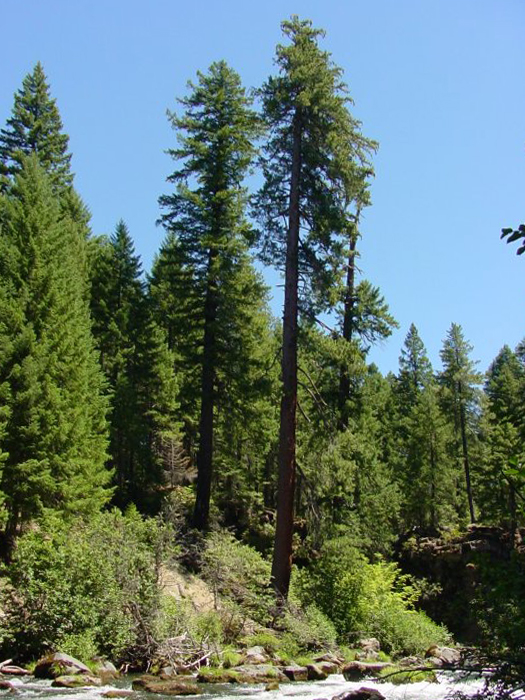
Sugar Pine never forms pure stands; it always grows scattered through mixed-conifer forest alongside Ponderosa Pine, Douglas-fir, white fir, and incense cedar, usually as scattered emergent giants rising above the surrounding canopy. It is shade-tolerant as a seedling and sapling, able to persist for decades in the understory before a canopy opening lets it shoot skyward — a trait that has helped the species regenerate even in actively logged and fire-managed landscapes, though it remains highly vulnerable to white pine blister rust, an introduced disease that has reshaped its management across much of its range.
Identification
Sugar Pine is best identified from a distance by its sheer height relative to neighboring trees and by its flat-topped, open crown of long, drooping branches — old trees often look like they’re holding out their limbs to display their enormous cones. Up close, the five-needle fascicles and the extraordinary cone length confirm the identification quickly, since no other pine in its range combines both traits at this scale.
Bark & Stems
Bark on young trees is smooth and gray-green, becoming thick, deeply furrowed, and purplish-brown to cinnamon-colored with age, broken into long, irregular plates. Branches are widely spaced and nearly horizontal on older trees, reaching out as much as 26 feet from the trunk, giving mature specimens an unmistakable open, asymmetrical crown.
Leaves
Needles grow in bundles (fascicles) of five, each needle 2 to 4.5 inches long, blue-green, and somewhat twisted, with a deciduous papery sheath at the base — a hallmark of the white pine group. Needles persist on the branch for two to three years before shedding.
Cones & Seeds
The cones are the tree’s signature feature: cylindrical, often slightly curved, typically 10 to 20 inches long and occasionally longer, hanging from the tips of the uppermost branches on long stalks. Unripe cones are green and heavy with resin, weighing 1 to 2 kilograms and capable of injuring anyone standing beneath a tree when squirrels chew them free — a real hazard in old-growth groves during cone season. Ripe cones turn cinnamon-brown and open to release seeds about half an inch long with a long wing that carries them on the wind, though much of the crop is harvested directly by squirrels and Clark’s nutcrackers before the cones fully open.
Quick Facts
| Scientific Name | Pinus lambertiana |
| Family | Pinaceae (Pine) |
| Plant Type | Evergreen Conifer Tree |
| Mature Height | 130–200 ft (exceptionally to 270+ ft) |
| Trunk Diameter | 4–8 ft (exceptionally to 11.5 ft) |
| Growth Rate | Slow to Moderate |
| Sun Exposure | Full Sun (tolerates part shade when young) |
| Water Needs | Low to Moderate once established |
| Soil Type | Well-drained, gravelly or sandy mountain soils |
| Soil pH | 5.5–6.5 (acidic to slightly acidic) |
| Bloom Time | Spring (wind-pollinated, inconspicuous) |
| Flower Color | Not showy — yellow male cones, reddish female cones |
| Fall Color | Evergreen (no fall color change) |
| Fruit | Long pendant cones, 10–20 in, the longest of any conifer |
| Deer Resistant | Good (mature trees rarely browsed) |
| USDA Hardiness Zones | 6–8 |
Native Range
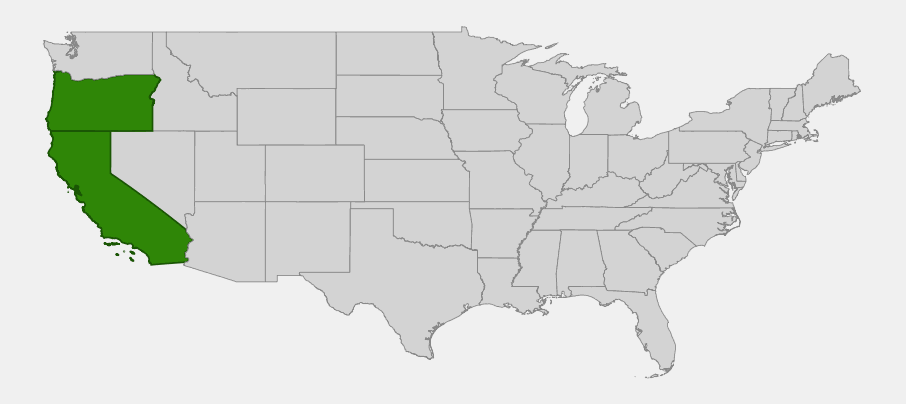
Sugar Pine is native to the Pacific coast mountains of California and southern Oregon, extending south into the Sierra San Pedro Mártir of northern Baja California, Mexico. Within the United States it is concentrated in the Sierra Nevada, the southern Cascade Range, the Klamath and Siskiyou Mountains straddling the Oregon-California border, and the Coast Ranges and Transverse Ranges of California, generally between 1,600 and 4,900 feet in elevation, though it reaches higher in the southern Sierra.
It occurs in mixed-conifer forest, always scattered among other species rather than in pure stands, typically alongside Ponderosa Pine, Douglas-fir, white fir, and incense cedar on well-drained mountain slopes and ridges. Sugar Pine is notably more abundant toward the southern part of its range, where it becomes a conspicuous emergent above the surrounding canopy in parks such as Yosemite, Sequoia, and Kings Canyon.
Sugar Pine populations have declined significantly over the past century due to white pine blister rust, an introduced fungal disease that kills susceptible trees, compounded by decades of fire suppression that let shade-tolerant competitors crowd out pine regeneration, and by selective historical logging that targeted the species for its clear, valuable wood. Restoration programs using blister-rust-resistant seed sources are now underway across much of its range, including at the USFS Dorena Genetic Resource Center in southern Oregon.
📋 Regional plant lists featuring Sugar Pine: Western Oregon & Western Washington
Growing & Care Guide
Sugar Pine is a tree for patient gardeners with room to spare — not a quick landscape fix, but a multi-generational planting that will eventually dwarf nearly everything else on the property. It suits large rural lots, parks, and restoration sites within or near its native elevation band far more than a typical suburban yard.
Light
Seedlings and young trees tolerate and often benefit from partial shade, mimicking their natural establishment beneath an open conifer canopy. As trees mature they need full sun to develop their characteristic form and produce cones; a Sugar Pine grown in deep, permanent shade will stay spindly and rarely thrive long-term.
Soil & Water
Plant in well-drained, gravelly or sandy mountain soil; Sugar Pine does not tolerate heavy, poorly drained clay or waterlogged sites. Once established it is fairly drought-tolerant, relying on winter and spring moisture typical of its montane range, though young trees need regular watering through their first several summers to establish a deep root system.
Planting Tips
Source only blister-rust-resistant nursery stock where available, since ordinary seedlings face high mortality from this introduced disease in much of the species’ range. Plant in fall or early spring at an elevation and climate reasonably similar to its native montane habitat — low-elevation, hot, humid sites are generally a poor match. Allow generous space; even a young tree will eventually need a 20- to 30-foot radius clear of structures.
Pruning & Maintenance
Established trees need little pruning beyond removing dead or diseased branches, ideally in dry weather to reduce the risk of spreading blister rust spores through pruning wounds. Watch for the orange pustules and branch dieback characteristic of blister rust infection, and remove nearby alternate hosts such as currant and gooseberry (Ribes species) where blister rust is a known regional problem, since the fungus requires both hosts to complete its life cycle.
Landscape Uses
Sugar Pine fits a narrow but important set of landscape roles:
- Specimen or legacy tree on large properties with room for its eventual scale
- Forest restoration plantings using blister-rust-resistant stock
- Windbreak or backdrop on rural acreage within its climate range
- Wildlife habitat planting — mature cone crops support a wide range of animals
Wildlife & Ecological Value
As one of the largest and longest-lived trees in its mixed-conifer forest community, Sugar Pine provides food and structural habitat that few associated species can match.
For Birds
Clark’s Nutcracker and several woodpecker species rely heavily on Sugar Pine seeds, prying open cones or caching seeds for winter use; nutcracker caching behavior also helps disperse and plant new seedlings across the landscape. Large raptors, including Northern Goshawks, favor the open, high branches of mature trees for nesting and hunting perches.
For Mammals
Douglas squirrels and chickarees cut green cones from high branches — a genuine hazard to anyone standing below during a heavy cone year — then cache and feed on the seeds. Black bears will chew into the resinous bark of mature trees to reach the sugary inner cambium, leaving distinctive scars that are sometimes mistaken for logging damage.
For Pollinators
Sugar Pine is wind-pollinated rather than insect-pollinated, so it does not directly support pollinators the way flowering trees do, though the deep, long-lived forest structure it helps create supports the broader insect communities associated with old-growth mixed-conifer forest.
Ecosystem Role
Mature Sugar Pines are keystone structural elements in Sierra Nevada and Klamath-Siskiyou forests, their emergent crowns and eventual standing snags providing cavity-nesting habitat unmatched by shorter associated conifers. Because the species is in decline from blister rust across much of its range, maintaining and restoring Sugar Pine populations is considered a conservation priority for the long-term structure of these forests.
Cultural & Historical Uses
Indigenous peoples throughout the Sierra Nevada and southern Cascades, including Sierra Miwok and Yokuts communities, gathered Sugar Pine seeds as a significant food source, roasting and grinding them much as other pine nuts were used, and also collected the sweet exuded sap for its sugar content — the origin of both the tree’s common name and an early use documented by 19th-century naturalists, including John Muir, who wrote admiringly of tasting the crystallized sap.
Euro-American settlers and the timber industry prized Sugar Pine for its soft, straight-grained, easily worked wood, and it became one of the most heavily logged conifers in California during the late 19th and early 20th centuries, used for everything from construction lumber to matchsticks and piano keys. This intensive historical harvest, combined with the arrival of white pine blister rust in the early 20th century, significantly reduced old-growth Sugar Pine stands across its range.
Today the species is the focus of active conservation and breeding programs aimed at restoring blister-rust resistance to the population, work carried out at facilities such as the USFS Dorena Genetic Resource Center in Oregon. Large remaining old-growth Sugar Pines are celebrated as landmark trees in parks including Yosemite, Sequoia, and Kings Canyon, where they remain a draw for visitors much as they were for Muir over a century ago.
Frequently Asked Questions
How is Sugar Pine different from Ponderosa Pine?
Sugar Pine has needles in bundles of five and the longest cones of any conifer, often well over a foot long. Ponderosa Pine has needles in bundles of three and much shorter, stouter cones typically 3 to 6 inches long. Sugar Pine’s open, flat-topped crown with widely spaced horizontal branches also looks distinctly different from Ponderosa’s denser, more rounded canopy.
Why are Sugar Pine cones so long?
The exact evolutionary advantage isn’t fully settled, but the long, pendant cones hang clear of the branch and dense needle clusters, likely improving wind dispersal of the winged seeds once the cone opens. The length is simply a defining trait of the species and one of the easiest ways to identify it at a distance.
Is Sugar Pine endangered?
It is not federally listed as endangered, but populations have declined significantly across much of its range due to white pine blister rust, an introduced disease, combined with historical logging and fire suppression. Active breeding programs are working to restore blister-rust-resistant stock to the wild population.
Can you grow Sugar Pine outside California and Oregon?
It can be grown in similar montane climates within USDA Zones 6 to 8, but it performs poorly in hot, humid, or low-elevation sites far from its native range, and blister rust pressure varies significantly by region. Gardeners outside its native range should consult local extension or forestry resources before planting.
How long does it take Sugar Pine to reach full size?
Sugar Pine is slow to moderate in growth and extremely long-lived, with some individuals living 400 to 500 years. A tree can take well over a century to approach its full mature height, which is part of why old-growth specimens are treated as landmark, irreplaceable trees.

Looking for a nursery that carries Sugar Pine?
Browse our native plant nursery directory: California · Oregon