Bigleaf Magnolia (Magnolia macrophylla)
Magnolia macrophylla, commonly called Bigleaf Magnolia, is a deciduous understory tree of the southern Appalachians and Gulf-South uplands that carries two superlatives at once: the largest simple leaf and the largest single flower of any tree native to North America. A mature leaf can stretch to 30 inches long, and the creamy nine-petaled flower that opens beneath it in late spring can span nearly a foot across — an improbable, almost tropical-looking bloom for a tree that tolerates winters well into USDA Zone 5. Despite its outsized parts, Bigleaf Magnolia is a modest-sized tree in the wild, usually 30 to 40 feet tall, growing as a scattered, rarely common understory specimen in rich coves and ravines.
In the forest, Bigleaf Magnolia is easy to overlook until you nearly walk into a fallen leaf the size of a placemat, or catch the heavy sweet fragrance of a flower hidden among the foliage. It favors moist, well-drained slopes and streamside coves with deep, humus-rich soil, often growing alongside beech, tulip tree, and other mesic hardwoods. Because its enormous leaves are brittle and easily shredded by wind, it does best in sites with some shelter — a north-facing cove, a forest edge, or a spot tucked behind taller trees.
Gardeners who have the right spot — part shade, rich soil, and protection from strong wind — find Bigleaf Magnolia to be one of the most striking native trees available, a genuine conversation piece whose scale and fragrance reward anyone willing to give it room and patience. It is less commonly offered than many native trees, so sourcing typically means seeking out a specialty native-plant nursery rather than a big-box garden center.
Identification
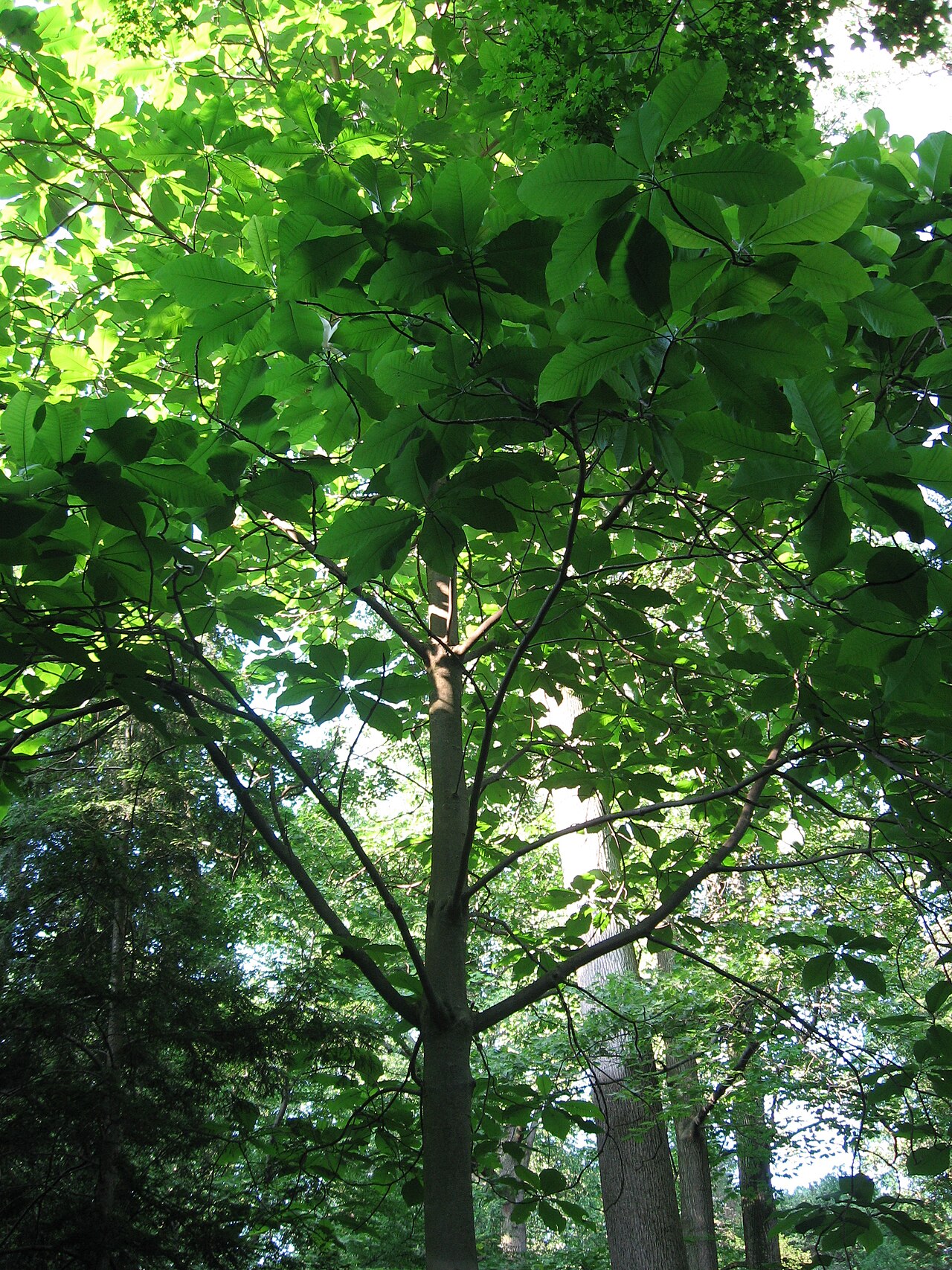
Bigleaf Magnolia is most often identified from a distance by its silhouette: widely spaced, upward-angled branches each tipped with a dense whorl of huge leaves, giving the crown a tiered, almost palm-like look very different from the dense twiggy canopy of most hardwoods. Young trees are usually single-trunked with a straight, slender stem; older trees broaden into a rounded, open crown.
Bark & Stems
Bark is thin, smooth, and pale gray on young stems, gradually developing shallow fissures and a slightly scaly texture with age, though it stays relatively smooth compared to many canopy trees. Twigs are stout, light brown to purplish, and often covered with fine hairs when young. Terminal buds are large, silky-hairy, and conspicuously flattened — a useful winter identification feature on a tree that otherwise reveals little once the leaves drop.
Leaves
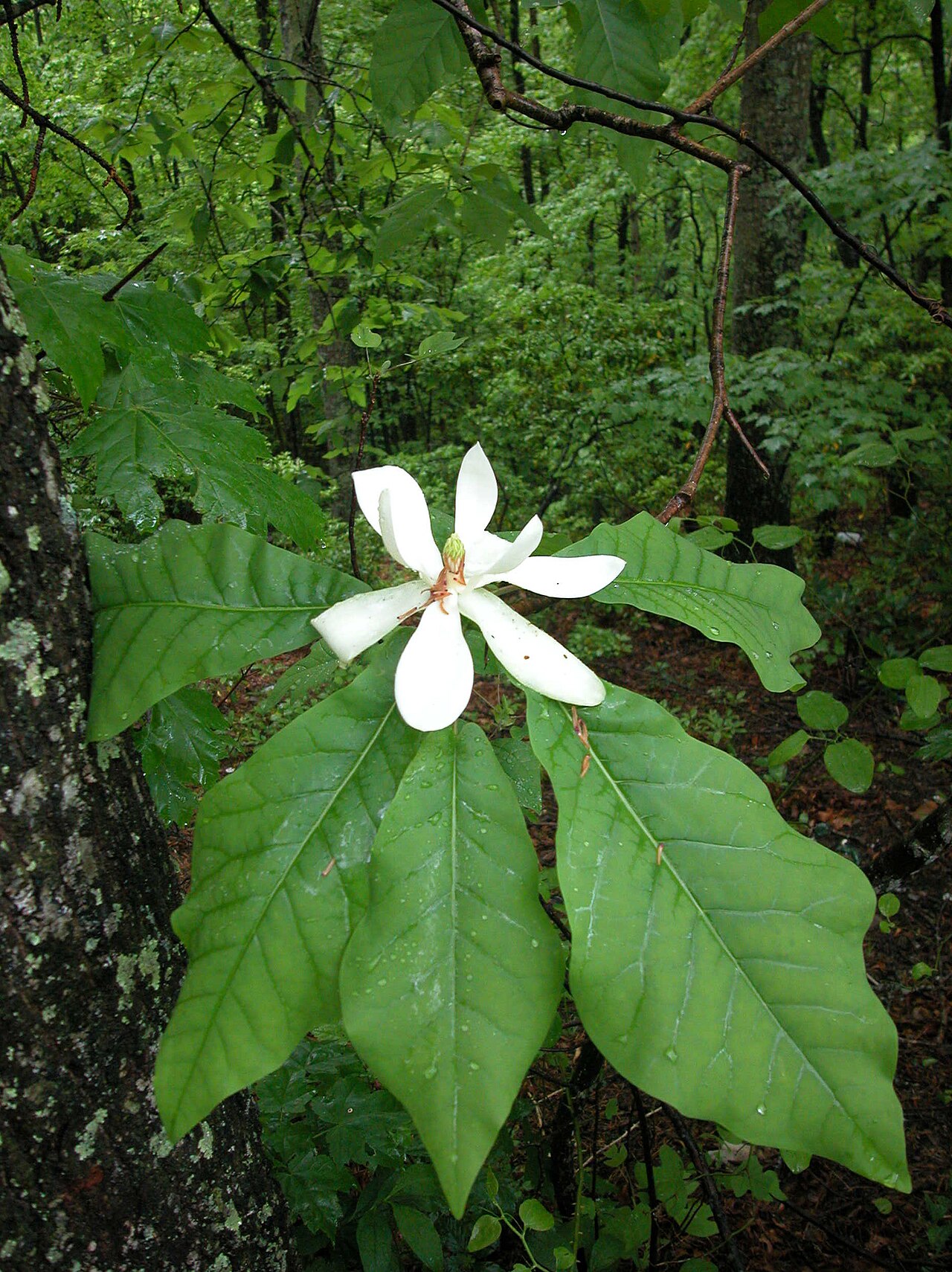
The leaves are the giveaway: simple, alternate, obovate, 12 to 30 inches long and 7 to 10 inches wide, with two small ear-like lobes (auricles) at the base where the blade meets the petiole. The upper surface is medium to dark green and smooth; the underside is covered in fine silvery-white hairs, giving the leaf a two-toned look when the wind flips it over. Leaves cluster near the branch tips in a loose, spoke-like whorl rather than spacing evenly along the stem. Fall color is an unremarkable yellow-brown, and the huge leaves drop quickly, often forming large, slow-to-decompose piles beneath the tree.
Flowers
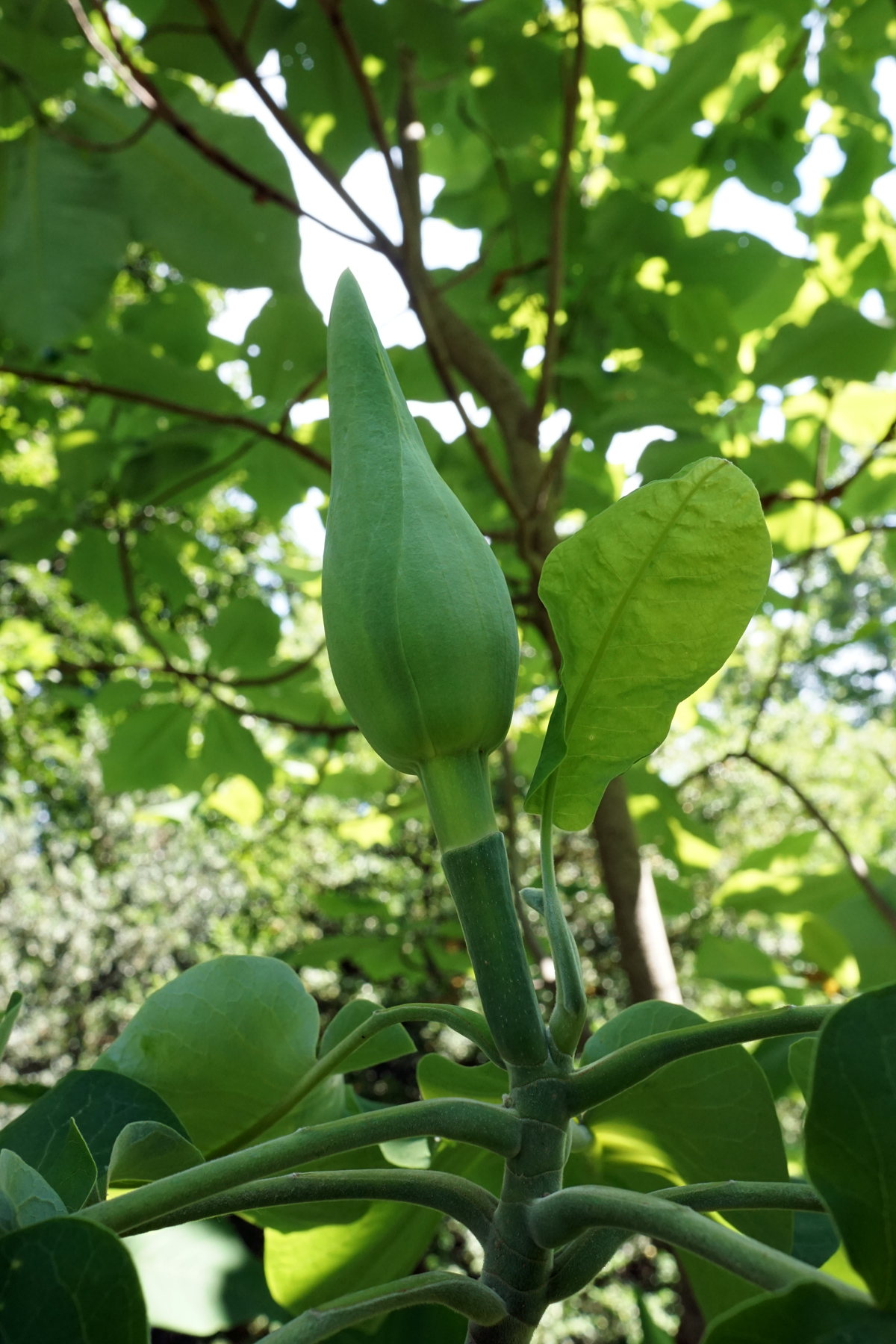
Flowers open in May and June after the leaves have expanded, each one creamy white, fragrant, and 8 to 14 inches across — the largest flower of any tree native to North America. Nine broad, somewhat floppy tepals arrange in three whorls of three; the three inner tepals typically carry a rose-purple blotch at the base, a nectar guide for the beetles that pollinate the flower. Because the blooms open high in the canopy and are often partly hidden by the huge leaves, they are more often smelled than seen from the ground.
Fruit & Seeds
Like other magnolias, the fruit is an egg-shaped aggregate of follicles, 2.5 to 3.5 inches long, rose-pink to red when ripe in late summer and early fall. Individual seeds are coated in a bright orange-red fleshy aril and dangle from the cone on thin silken threads once the follicles split open, dropping from the canopy in a way that is both visually striking and highly attractive to birds.
Quick Facts
| Scientific Name | Magnolia macrophylla |
| Family | Magnoliaceae (Magnolia) |
| Plant Type | Deciduous Understory Tree |
| Mature Height | 30–40 ft |
| Mature Spread | 30–40 ft |
| Growth Rate | Moderate |
| Sun Exposure | Part Shade to Full Sun |
| Water Needs | Moderate to High |
| Soil Type | Rich, moist, well-drained loam |
| Soil pH | 5.5–6.5 (acidic to slightly acidic) |
| Bloom Time | May – June |
| Flower Color | Creamy white with purple basal blotches |
| Fall Color | Dull yellow-brown |
| Fruit | Rose-pink to red cone-like aggregate with orange-arilled seeds |
| Deer Resistant | Moderate (seedlings can be browsed) |
| USDA Hardiness Zones | 5–8 |
Native Range
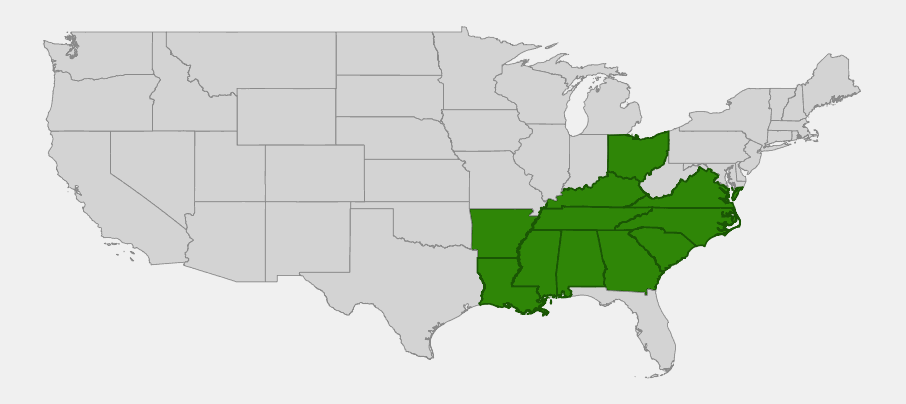
Bigleaf Magnolia occurs in a scattered, patchy band through the southern Appalachians and the uplands of the lower Southeast, from southern Ohio and far southwestern Virginia (recorded only in Lee County) south through Kentucky, Tennessee, and the Carolinas to Georgia, Alabama, and Mississippi, and west into northern Louisiana and southeastern Arkansas, with a notable disjunct population on Crowley’s Ridge. It is never abundant anywhere in this range — populations are typically small, isolated groves tucked into favorable coves rather than a continuous forest component.
Throughout its range the tree is tied to mesic, nutrient-rich forest soils: ravines, lower slopes, and streamside coves, often over limestone or other base-rich parent material, and sheltered enough that its brittle leaves aren’t constantly shredded by wind. It grows as scattered individuals in the subcanopy beneath taller hardwoods rather than forming pure stands, and it tends to concentrate on north- and east-facing slopes where soil moisture stays more consistent through the growing season.
Because Bigleaf Magnolia has always been naturally uncommon and local, several states track it as a species of conservation concern even though it is not federally listed; disturbance, logging of mature cove forests, and the loss of specific microsites it depends on are the main pressures on existing populations. Widely cultivated bigleaf-type magnolias sold at nurseries outside this range — including in the Pacific Northwest and Northeast — are planted ornamentals, not naturalized populations, and should not be mistaken for native occurrences.
📋 Regional plant lists featuring Bigleaf Magnolia: Georgia, Alabama & Mississippi · Arkansas, Louisiana, Eastern Oklahoma & Eastern Texas · Kentucky & Tennessee · North Carolina & South Carolina · Maryland, Virginia & West Virginia · Ohio & Indiana
Growing & Care Guide
Bigleaf Magnolia rewards a gardener who picks the right spot the first time. It is not a tree for an exposed lawn or a windy ridge — those huge leaves act like sails and will shred in any strong, sustained wind. Give it a sheltered position, rich soil, and consistent moisture, and it will reward you with a dramatic, unmistakable specimen that few neighbors will be able to name.
Light
In the wild it grows as an understory tree in part shade, and that remains its best garden performance — morning sun with afternoon shade, or the dappled light at a woodland edge. It will tolerate more sun with adequate soil moisture, producing a denser crown and more flowers, but the leaves are more prone to scorch and wind damage in full, unsheltered sun.
Soil & Water
Plant in deep, rich, well-drained soil with reliable moisture — the kind found naturally in a cove or ravine bottom. It does not tolerate standing water or prolonged drought well. A slightly acidic pH in the 5.5 to 6.5 range suits it best. Mulch generously with leaf litter or shredded bark to keep roots cool and moist, especially through the first several summers after planting.
Planting Tips
Choose a sheltered site — a courtyard, a spot behind a windbreak of taller trees, or a protected north- or east-facing slope — before anything else; this single decision determines whether the leaves stay intact or shred by midsummer. Plant container-grown stock in spring or fall, and stake loosely for the first year or two since the large leaves make young trees top-heavy in wind. Space at least 25 to 30 feet from structures and other trees to allow for the eventual spread.
Pruning & Maintenance
Prune minimally, removing only dead, damaged, or crossing branches in late winter while dormant. Avoid heading cuts, which spoil the tree’s natural tiered form and are slow to heal. Fallen leaves are large and slow to break down; raking them into a woodland mulch pile rather than a tidy lawn bed keeps maintenance simple.
Landscape Uses
Bigleaf Magnolia works best as a feature tree rather than a utility planting:
- Specimen tree in a sheltered courtyard or woodland garden
- Shade garden canopy underplanted with ferns and spring ephemerals
- Naturalized cove or ravine restoration in its native range
- Fragrance garden sited near a patio or window to catch the flower’s scent
- Wildlife garden — fruit draws birds through late summer and fall
Wildlife & Ecological Value
Despite its scattered distribution, Bigleaf Magnolia pulls real ecological weight wherever it grows, offering an unusual pollination pathway and a seasonal food source other native trees don’t provide in quite the same way.
For Pollinators
Like other magnolias, the flowers are pollinated primarily by beetles rather than bees — an ancient pollination strategy that predates bee evolution. Sap beetles and other small beetles crawl into the flower to feed on pollen and the tough tissue of the tepals, picking up pollen as they move between blooms. The large, open flower structure and strong fragrance are specifically suited to attracting these beetle pollinators rather than more typical garden visitors.
For Birds
When the cone-like fruit ripens and splits in late summer and fall, the bright orange-arilled seeds dangling on silk threads are quickly found by woodland songbirds, including thrushes and woodpeckers, which pluck the seeds and disperse them away from the parent tree.
For Mammals
Squirrels and other small mammals take advantage of fallen seeds and fruit, and deer will occasionally browse young seedlings and low foliage, though mature trees are generally left alone.
Ecosystem Role
As a true subcanopy specialist of rich cove forests, Bigleaf Magnolia helps fill a structural niche between the forest floor and the closed canopy above, and its massive leaf litter — slow to decompose — adds a distinct layer to the forest floor that shelters invertebrates and contributes organic matter over time. Because the species is naturally rare and patchily distributed, individual populations matter disproportionately for the genetic diversity of the species as a whole.
Cultural & Historical Uses
Bigleaf Magnolia has long been admired more for its sheer spectacle than put to practical use. Early botanical explorers, including André Michaux, who formally described the species in the late 18th century, were struck by the scale of its leaves and flowers — qualities that made it an object of fascination for botanical gardens and plant collectors in Europe and the eastern United States well before it became a nursery staple.
Indigenous peoples of the southern Appalachians and Gulf South were familiar with the tree within its native range, though it was never as widely utilized as more common regional magnolias; its scattered, local distribution meant it was encountered as a notable curiosity rather than a staple resource in any one community’s plant knowledge.
In more recent horticultural history, Bigleaf Magnolia has become a prized specimen in botanical collections and large private gardens specifically because of its rarity and scale — a tree planted as much for conversation and shade as for any practical yield. Its wood has seen only limited, local use in woodworking, since the tree’s naturally scattered occurrence never supported it as a timber species.
Frequently Asked Questions
Is Bigleaf Magnolia the same as Southern Magnolia?
No. Southern Magnolia (Magnolia grandiflora) is evergreen with smaller, glossy leaves and is native mainly to the Coastal Plain. Bigleaf Magnolia is deciduous, has vastly larger leaves, and occurs farther inland in cooler upland coves — the two are easy to tell apart once you’ve seen a leaf of each side by side.
Why are Bigleaf Magnolia’s leaves so enormous?
The huge leaf surface is an adaptation for capturing scarce light as an understory tree beneath a closed forest canopy — more leaf area means more photosynthesis in low-light conditions. The tradeoff is that the leaves are brittle and prone to wind damage, which is why sheltered planting sites matter so much.
How fast does Bigleaf Magnolia grow?
Growth is moderate, typically 1 to 2 feet per year once established, faster in rich, consistently moist soil with some protection from wind. Trees usually begin flowering within 8 to 12 years from a young container-grown specimen.
Is Bigleaf Magnolia rare or endangered?
It is not federally listed, but because it has always occurred in small, scattered populations, several states within its range track it as a species of conservation concern. Planting responsibly sourced, nursery-propagated stock supports the species without pressuring wild populations.
Can Bigleaf Magnolia grow outside its native Southeast range?
Yes, within USDA Zones 5 through 8 it is cultivated well beyond its native range, including parts of the Pacific Northwest and Northeast, where it is grown ornamentally. These plantings are not naturalized native populations — the tree’s true native range stays confined to the southern Appalachians and lower Southeast.

Looking for a nursery that carries Bigleaf Magnolia?
Browse our native plant nursery directory: Alabama & Arkansas · Georgia · Kentucky, Louisiana & Mississippi · North Carolina & Ohio · South Carolina, Tennessee & Virginia