Red Maple (Acer rubrum)
Acer rubrum, commonly known as Red Maple, Swamp Maple, or Soft Maple, is one of North America’s most widespread and adaptable native trees, renowned for its spectacular scarlet fall color and remarkable ability to thrive in diverse growing conditions. This member of the Sapindaceae (soapberry) family typically reaches 50 to 75 feet in height with a pyramidal to oval crown, and is instantly recognizable by its distinctive three-to-five lobed leaves, red buds and young twigs, and brilliant autumn display that can range from yellow through orange to deep crimson.
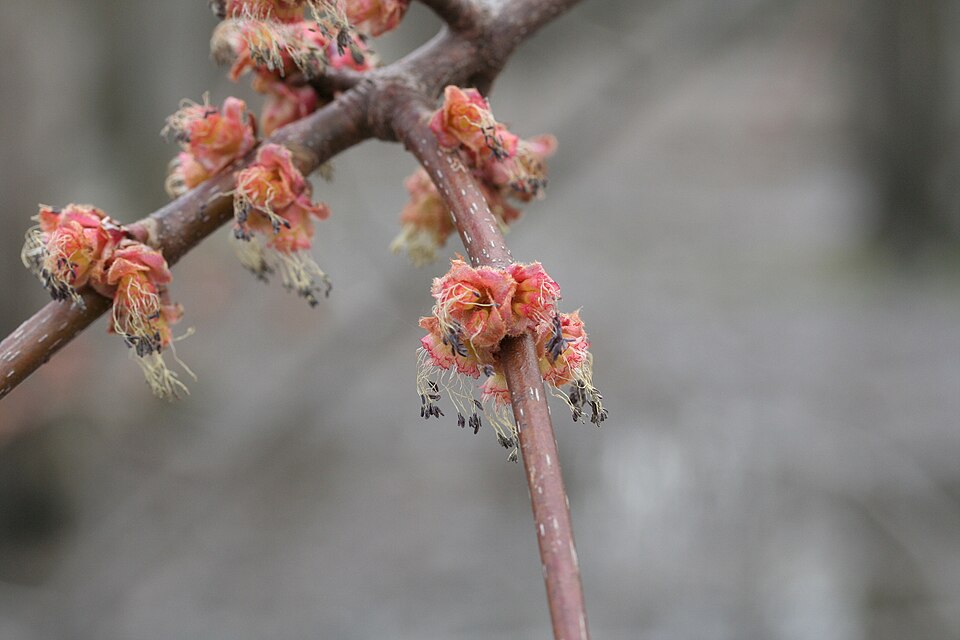
The “red” in Red Maple’s name is well-earned, as the tree displays red coloration throughout much of the year. In late winter, the buds swell with red hues; in early spring, clusters of small red flowers appear before the leaves; in summer, the leaf petioles (stems) remain reddish; and in fall, the tree transforms into a blaze of red, orange, and yellow that marks the pinnacle of autumn color in eastern North America. Even the young bark has a reddish tinge, and the seeds (samaras) are often tinged with red or pink.
Red Maple’s extraordinary adaptability to different moisture conditions—from swamp margins to dry uplands—makes it one of the most ecologically successful trees in eastern North America. It thrives equally in wet bottomlands and dry ridges, in acidic and alkaline soils, and in both full sun and partial shade. This adaptability, combined with its rapid growth rate and stunning fall color, has made Red Maple not only a dominant forest species but also one of the most popular native trees for landscaping and restoration projects throughout its vast range.
Identification
Red Maple is a medium to large deciduous tree that typically grows 50 to 75 feet tall (occasionally to 100+ feet) with a trunk diameter of 1 to 3 feet. In forest settings, it develops a straight trunk with a narrow, oval crown; in open areas, the crown becomes broader and more rounded. The overall form is graceful and well-proportioned, with ascending branches and a relatively dense canopy.
Bark
Young Red Maple bark is smooth and gray, often with a slight reddish tinge that hints at the tree’s identity. As the tree matures, the bark develops shallow furrows with long, smooth, light gray plates. On very old trees, the bark becomes darker gray-brown with irregular ridges and furrows. The bark never becomes as deeply furrowed as that of Sugar Maple or as smooth as that of American Beech.
Leaves
The leaves are simple, opposite, and palmately lobed with 3 to 5 lobes (most commonly 3). Each leaf is 2 to 6 inches long and wide, with irregular, coarsely toothed margins. The leaves are green above and whitish or pale green beneath, giving the canopy a silvery appearance when wind stirs the foliage. The leaf petioles (stems) are characteristically red or reddish, providing year-round identification. In fall, leaves turn brilliant colors ranging from yellow and orange to deep red and crimson, often with multiple colors on the same tree.
Buds & Twigs
Winter buds are small, reddish, and bluntly pointed, arranged oppositely on the twigs. Young twigs are slender, smooth, and reddish-brown, especially noticeable during winter months. This red coloration of buds and young twigs is one of the most reliable year-round identifying features of Red Maple.
Flowers
Red Maple flowers appear in early spring before the leaves emerge, creating clouds of red color in the still-bare forest. The small, perfect or imperfect flowers are clustered in dense umbels, with individual flowers having red sepals and petals (when present). Trees may be entirely male, entirely female, or have both male and female flowers. The flowers are among the earliest to bloom in spring, providing crucial early nectar for pollinators.
Fruit & Seeds
The fruits are paired samaras (winged seeds) that mature in late spring to early summer, much earlier than those of other maples. Each samara is about 1 inch long with a wing that may be red, pink, or green. The early ripening allows Red Maple to occupy sites before other species can establish, contributing to its ecological success.
Quick Facts
| Scientific Name | Acer rubrum |
| Family | Sapindaceae (Soapberry) |
| Plant Type | Deciduous Tree |
| Mature Height | 50–75 ft |
| Sun Exposure | Full Sun |
| Water Needs | Moderate to High |
| Bloom Time | March – April |
| Flower Color | Red |
| USDA Hardiness Zones | 3–9 |
Native Range
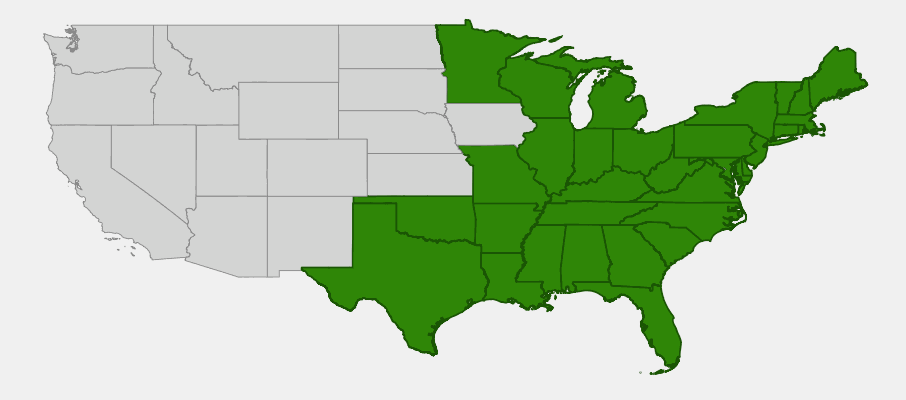
Red Maple has one of the largest native ranges of any North American tree, extending from southeastern Canada south to southern Florida and west from the Atlantic coast to eastern Texas, Minnesota, and southeastern Saskatchewan. This enormous distribution—covering virtually the entire eastern half of North America—reflects the species’ exceptional ecological adaptability and its ability to thrive in diverse climates and growing conditions.
The species occurs naturally in an extraordinary variety of habitats, from dry upland ridges to wet swamplands, from sea level to elevations of over 3,000 feet in the southern Appalachians. Red Maple is equally at home in acidic bog margins and limestone-derived soils, in pure stands and as a component of mixed forests. This habitat versatility has made it a dominant tree species throughout much of eastern North America.
In many regions, Red Maple has actually expanded its range and abundance due to human activities such as fire suppression, logging practices that favor its regeneration, and landscape fragmentation that creates edge habitats where it thrives. Climate change may further expand its northern range, making it an increasingly important component of North American forests.
📋 Regional plant lists featuring Red Maple: North Carolina & South Carolina
Growing & Care Guide
Red Maple is one of the most adaptable and forgiving native trees to grow, thriving in a wide range of conditions that would challenge many other species. Its rapid growth rate and spectacular fall color make it an excellent choice for both quick landscape impact and long-term beauty.
Light
Red Maple performs best in full sun but tolerates partial shade well. In full sun, the tree develops its best form and most intense fall color. Trees grown in shade tend to be more open and may have less brilliant autumn coloration.
Soil & Water
This is where Red Maple truly shines in its adaptability. It thrives in both wet and dry soils, acidic and alkaline conditions, and various soil types from sandy to clay. The tree can grow with its roots in standing water or on dry hillsides, making it ideal for challenging sites. Once established, it shows good drought tolerance, though it prefers consistent moisture for optimal growth.
Planting Tips
Plant in spring or fall when temperatures are moderate. Red Maple transplants easily and establishes quickly. Choose a site appropriate for the tree’s mature size, allowing at least 20-30 feet from buildings and power lines. The tree is fast-growing, so patience is not required as with slower-growing species.
Pruning & Maintenance
Young trees benefit from structural pruning to establish a strong framework. Remove competing leaders and weak crotches. Mature trees need little pruning beyond removing dead or damaged branches. Avoid heavy pruning during spring when sap flow is high.
Landscape Uses
Red Maple is excellent for a wide variety of landscape applications: specimen trees, shade trees, naturalized areas, rain gardens, street trees (where salt tolerance is not required), and restoration projects. Its rapid growth and brilliant fall color make it particularly valuable where quick impact is desired.
Wildlife & Ecological Value
Red Maple provides significant ecological benefits throughout the year, supporting wildlife through its flowers, seeds, foliage, and structure. As one of the most abundant trees in eastern North America, it plays a crucial role in forest ecosystems.
For Pollinators
The early spring flowers provide crucial nectar for bees, flies, and other pollinators when few other food sources are available. Honeybees, in particular, value Red Maple as an early season nectar source, and the tree can produce commercially significant amounts of honey in good flower years.
For Birds
Red Maple seeds are eaten by numerous bird species including finches, grosbeaks, and nuthatches. The tree’s branching structure provides excellent nesting sites for many songbirds. Cavity-nesting birds use older trees, and the bark crevices provide hunting grounds for woodpeckers searching for insects.
For Mammals
Squirrels, chipmunks, and other small mammals consume the seeds. Deer browse young shoots and foliage, while rabbits may feed on young bark. The tree also supports numerous insects that serve as food for birds and other wildlife.
For Lepidoptera
Red Maple serves as a host plant for several butterfly and moth species, including the Rosy Maple Moth and various Underwing moths. While not as important a host as oaks or hickories, it contributes to the diversity of caterpillars available to support bird populations.
Cultural & Historical Uses
Red Maple has played an important role in North American culture and economy for centuries. Native American peoples recognized the tree’s value both for its useful properties and as an indicator of seasonal changes, often timing agricultural activities by the tree’s flowering and leafing schedules.
The tree’s wood, while not as hard as Sugar Maple, has been used for furniture, flooring, and various woodworking projects. Red Maple lumber is often marketed as “soft maple” to distinguish it from the harder Sugar Maple. The wood is particularly valued for its light color and fine grain, making it popular for painted furniture and interior finishing work.
Colonial and early American settlers learned to tap Red Maple for syrup production, though the sugar content is lower than that of Sugar Maple. Red Maple syrup has a distinctive flavor that some prefer to traditional Sugar Maple syrup, and small-scale syrup production from Red Maple continues today in some regions.
The tree’s brilliant fall color has made it an icon of autumn in eastern North America, featured in countless photographs, paintings, and poems celebrating the changing seasons. New England’s famous fall foliage displays owe much of their intensity to the abundant Red Maples throughout the region.
In modern landscaping, Red Maple has become one of the most planted native trees, valued for its adaptability, rapid growth, and spectacular fall display. Numerous cultivars have been developed to enhance specific characteristics such as fall color intensity, form, or tolerance to specific growing conditions.
Frequently Asked Questions
Why are the leaves on my Red Maple turning red in summer?
Early reddening of leaves is often a sign of stress, typically from drought, root damage, or disease. While Red Maple leaves normally turn red in fall, summer reddening usually indicates the tree needs attention. Check soil moisture and watch for signs of pests or diseases.
Can Red Maple be tapped for syrup like Sugar Maple?
Yes, Red Maple can be tapped for syrup production, though the sugar content is lower than Sugar Maple (about 1-2% vs. 2-3% for Sugar Maple). This means more sap is needed to produce the same amount of syrup, but many people enjoy the unique flavor of Red Maple syrup.
How can I get better fall color from my Red Maple?
The best fall color develops on trees growing in full sun with adequate soil moisture. Stressed trees often have poor color. Some individual trees and cultivars naturally have better color than others – if fall color is a priority, choose named cultivars selected for this trait.
Is Red Maple the same as Japanese Maple?
No, Red Maple (Acer rubrum) is a large North American native tree, while Japanese Maples (Acer palmatum and related species) are smaller Asian trees commonly used in landscaping. While both have red coloration, they are quite different in size, form, and growing requirements.
Do Red Maples have problems with surface roots?
Red Maples can develop surface roots, especially in compacted soils or where irrigation is shallow. To minimize this, water deeply but infrequently, avoid soil compaction around the tree, and mulch to keep roots cool and moist deeper in the soil.

Looking for a nursery that carries Red Maple?
Browse our native plant nursery directory: North Carolina · South Carolina