Chinkapin Oak (Quercus muehlenbergii)
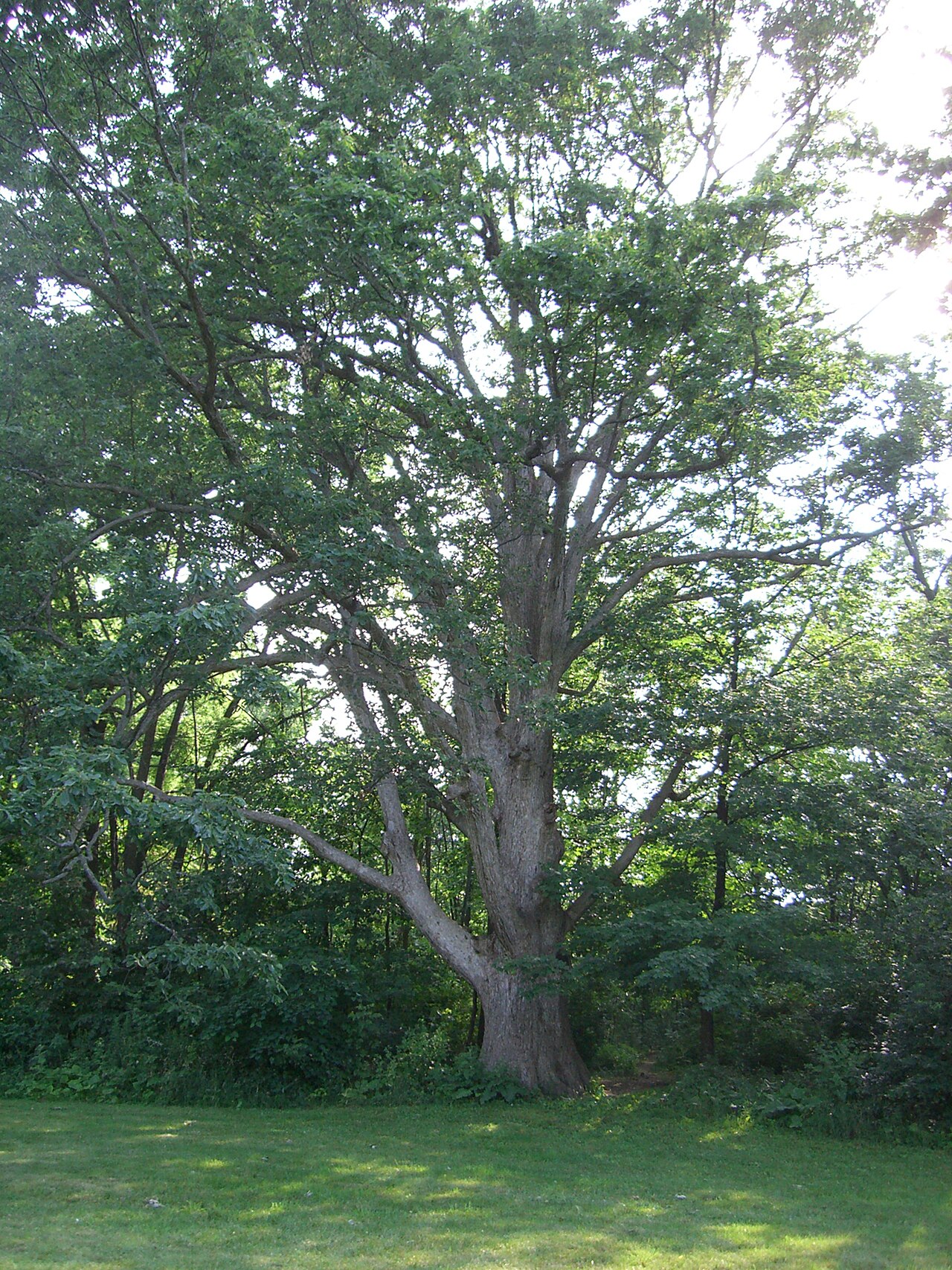
Quercus muehlenbergii, the Chinkapin Oak (also spelled chinquapin oak, and known regionally as yellow oak or yellow chestnut oak), is a tough, limestone-loving tree of the white oak group found across much of the eastern and central United States. It takes its common name from its leaves, which resemble those of the chinkapin (Castanea pumila), with the same coarse, even teeth running down each side. Where the underlying rock is limestone, dolomite, or other calcium-rich stone, chinkapin oak is often the signature tree of the local woods, rooted into bluffs, glades, and rocky slopes that discourage less adaptable species.
In the open, chinkapin oak develops a broad, rounded crown on a sturdy trunk, typically reaching 40 to 60 feet tall with an equal spread, though old trees on the best sites in the Ohio and Wabash valleys have topped 100 feet. The bark is thin, light ashy-gray, and flaky, giving it a family resemblance to white oak but with a warmer, more yellow-brown cast — one source of the “yellow oak” name. Its acorns are small, sweet, and nearly tannin-free, arguably the best-tasting of any native oak, and they disappear quickly into the stomachs of squirrels, deer, turkeys, and jays each fall.
For gardeners on alkaline or neutral soils — the kind that frustrate acid-loving plants — chinkapin oak is an excellent long-lived shade tree that asks for very little once established. It tolerates heat, drought, wind, and the kind of thin, rocky ground that would stunt most trees, while still producing a dense, handsome canopy and a reliable crop of wildlife food.
Identification
Chinkapin oak is a medium to large deciduous tree, usually 40 to 60 feet tall but capable of 80 feet or more on deep, fertile soil. Trees growing in the open develop a short trunk and a wide, rounded crown with large lower branches; in closed forest stands the trunk grows straighter and the crown narrows as the tree reaches for light. Young trees grow at a moderate pace that slows noticeably with age, and the species is only moderately shade tolerant, becoming more light-demanding as it matures.
Bark
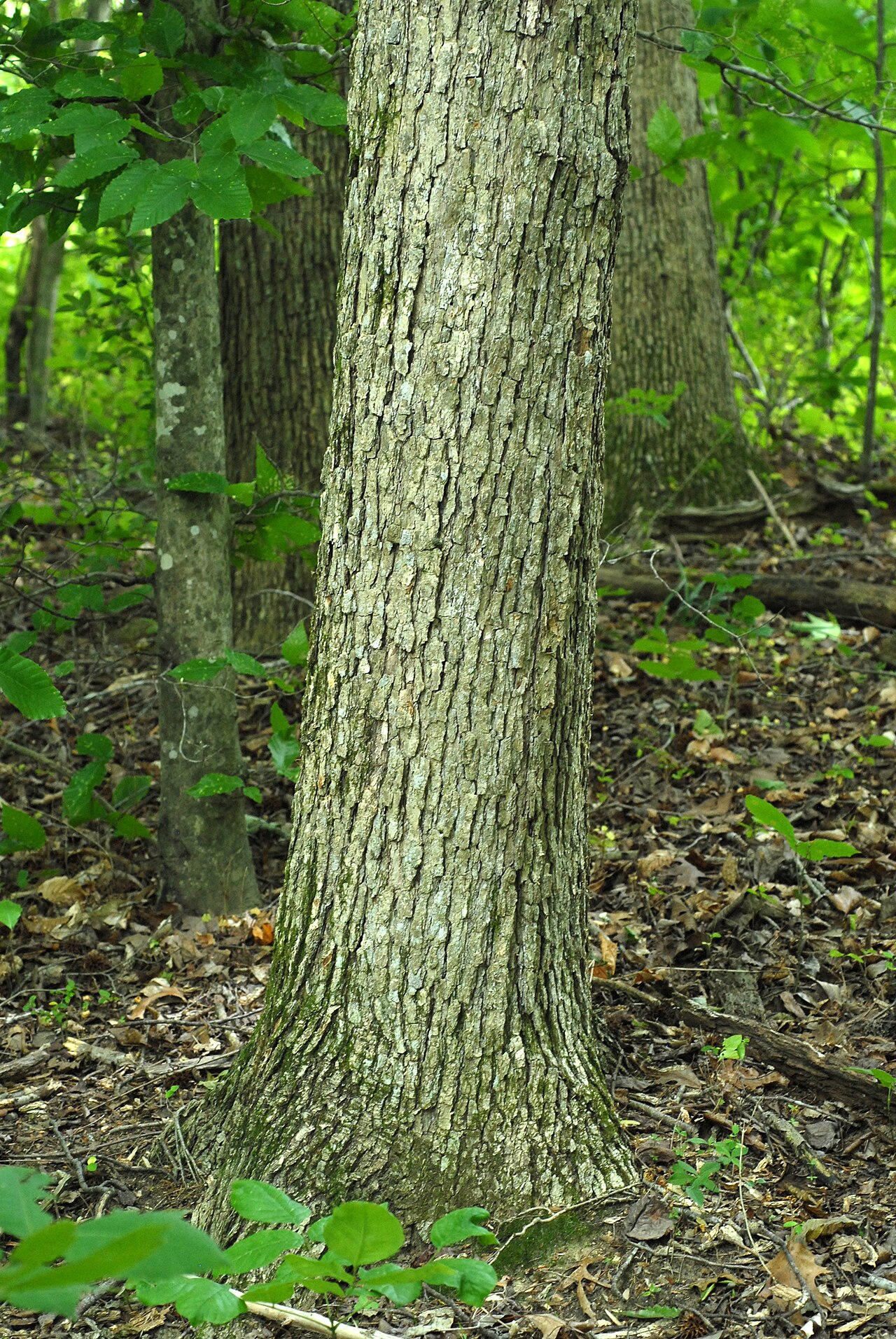
The bark is thin for an oak, light ashy-gray to silvery, and breaks into small, flaky plates or scales rather than the deep furrows of red oaks. It closely resembles white oak bark but often shows a more yellowish-brown tone, which is where the alternate name “yellow oak” comes from. The thin bark offers little fire protection to mature trunks, though the tree resprouts vigorously from the root crown after top-kill.
Leaves
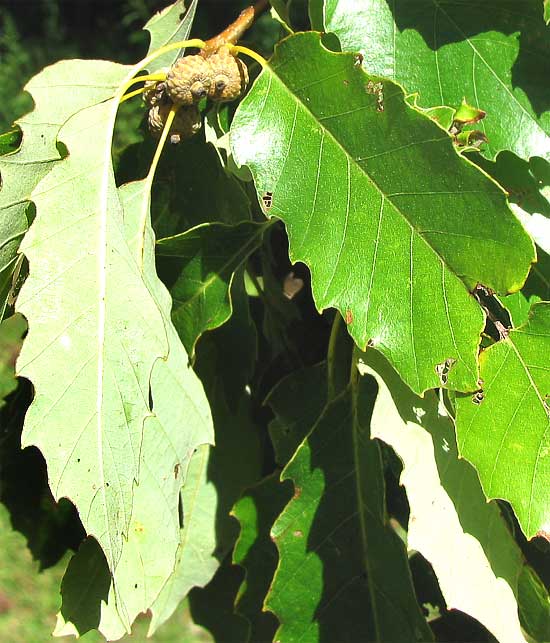
Leaves are 4 to 6 inches long, oblong to lance-shaped, with a rounded base and a pointed tip. The margin is lined with 8 to 13 pairs of coarse, even, forward-pointing teeth, each tipped with a small bristleless gland — a detail that separates chinkapin oak from the bristle-tipped red oaks. The upper surface is shiny dark green; the underside is paler and often finely hairy, giving the foliage a two-toned look in a breeze. Fall color is a warm yellow to yellow-bronze, less showy than a red oak but still attractive against the gray bark.
Flowers & Fruit
Chinkapin oak is monoecious, flowering in April and May as the leaves emerge. Male flowers hang in slender yellow-green catkins from the previous year’s twigs; female flowers are small and inconspicuous in the axils of the new leaves. Acorns mature in a single season, unlike the two-year acorns of red oaks, and ripen in September and October. They are small — about ½ to ¾ inch long — oval, and dark brown to nearly black at maturity, with roughly half the nut enclosed in a thin, warty, bowl-shaped cup. The kernel is sweet and low in bitter tannins, making chinkapin oak acorns a favorite wild food for people as well as wildlife.
Quick Facts
| Scientific Name | Quercus muehlenbergii (syn. Q. acuminata) |
| Family | Fagaceae (Beech) |
| Plant Type | Deciduous Tree |
| Mature Height | 40–60 ft (to 80+ ft on good sites) |
| Mature Spread | 40–60 ft, often equal to height |
| Growth Rate | Moderate when young, slower with age |
| Sun Exposure | Full Sun to Part Shade |
| Water Needs | Low to Average; drought tolerant once established |
| Soil Type | Well-drained, rocky or limestone-derived; tolerates poor soil |
| Soil pH | Neutral to alkaline (about 6.5–8.0) |
| Bloom Time | April – May |
| Flower Color | Yellow-green (inconspicuous catkins) |
| Fall Color | Yellow to yellow-bronze |
| Fruit | Small, sweet acorns, ½–¾ in, ripening Sept–Oct |
| Deer Resistant | Moderate (seedlings browsed; mature trees generally left alone) |
| USDA Hardiness Zones | 4–9 |
Native Range
Chinkapin oak has one of the broadest ranges of any white oak, stretching from Vermont and western New England west across New York, Pennsylvania, and the Great Lakes states to Minnesota, and south through the Appalachians and the Mississippi and Ohio valleys to the Florida panhandle, the Gulf Coast, and central Texas. Disjunct, often rare populations also occur farther west in New Mexico and the Trans-Pecos of Texas, well separated from the main eastern range. In Canada it is found only in a small area of southern Ontario, and it continues south into northeastern Mexico.
Across this huge range, chinkapin oak is almost always tied to calcium-rich ground: limestone bluffs, dolomite glades, rocky hillsides, and thin soils over calcareous bedrock. It reaches its greatest size and abundance in the Ohio and Mississippi valleys, where deep, fertile, lime-influenced soils let it grow into a full-sized forest tree; on the thinner glade soils of the Ozarks or the rocky ridges of the Appalachians it is often smaller and more gnarled. It is notably rare and local across much of the sandy, acidic Atlantic and Gulf coastal plain, and uncommon in parts of New England and Pennsylvania, even though the state is technically within its mapped range.
Because chinkapin oak needs sufficient light and calcareous soil, it never dominates a forest the way some oaks do; instead it shows up as scattered individuals or small groves within mixed oak-hickory woods, cedar glades, and prairie-margin gallery forests. Fire-maintained oak savannas of the Midwest once favored large, open-grown chinkapin oaks, and long-fire-suppressed sites in that region have gradually shifted toward shade-tolerant species like sugar maple at its expense.
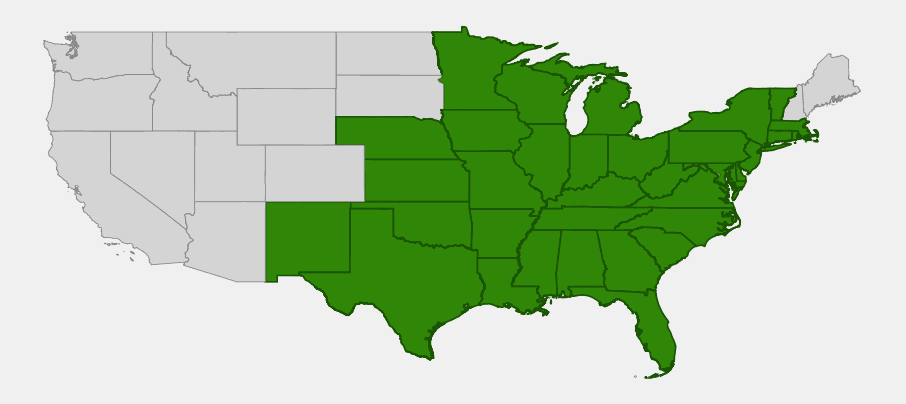
📋 Regional plant lists featuring Chinkapin Oak: New Hampshire, Maine & Vermont · Connecticut, Massachusetts & Rhode Island · New York, Pennsylvania & Northern New Jersey · Delaware, Southern New Jersey & Long Island · Maryland, Virginia & West Virginia · North Carolina & South Carolina · Georgia, Alabama & Mississippi · Arkansas, Louisiana, Eastern Oklahoma & Eastern Texas · Kentucky & Tennessee · Ohio & Indiana · Illinois, Iowa & Missouri · Michigan, Wisconsin & Eastern Minnesota · Nebraska, Kansas & Eastern Colorado · Arizona & New Mexico
Growing & Care Guide
Chinkapin oak is one of the easiest native shade trees to grow on alkaline or neutral soils, and it is far more forgiving of urban conditions, compacted ground, and drought than many other oaks. The main requirement is good drainage; it struggles in wet, poorly drained clay.
Light
Plant chinkapin oak in full sun for the fullest, most symmetrical crown. It tolerates light shade, especially while young, but growth slows and the form becomes more open as shade increases, and old trees become steadily less shade tolerant over time. For a strong specimen or shade tree, give it as much open sky as the site allows.
Soil & Water
This species is unusually tolerant of thin, rocky, and alkaline soils that frustrate many other trees, which is exactly the niche it fills in the wild. It is not fussy about fertility and actually prefers calcareous, well-drained ground over rich, acidic loam. Water young trees regularly for the first two or three seasons to establish a deep root system; once established, chinkapin oak is notably drought tolerant and rarely needs supplemental irrigation except in extended dry spells. Avoid heavy, waterlogged clay or sites with poor drainage.
Planting Tips
Plant container-grown or balled-and-burlapped trees in fall or early spring. Like most oaks, chinkapin oak develops a deep taproot and transplants best when young and small; larger field-dug trees recover more slowly. Give it plenty of room — 40 feet or more from buildings and other large trees — to let the broad crown develop without crowding. It performs especially well on sites with limestone or dolomite close to the surface, including rocky slopes where little else will thrive.
Pruning & Maintenance
Prune young trees to establish a single leader and well-spaced scaffold branches; once the structure is set, chinkapin oak needs little further pruning beyond removing dead or crossing limbs in the dormant season. The tree is relatively resistant to many oak pests and diseases, but like other oaks it is vulnerable to oak wilt, so avoid pruning or wounding trees during the spring and early summer beetle-activity season in regions where oak wilt is present.
Landscape Uses
- Shade tree for lawns, parks, and large residential lots, especially on alkaline soils where other shade trees struggle
- Street and urban tree, tolerant of heat, drought, and compacted soils once established
- Rock gardens and limestone glades, where it grows naturally among exposed stone
- Wildlife gardens, for its sweet, heavily used acorn crop
- Restoration plantings on calcareous bluffs, glades, and savanna remnants
- Naturalized woodland edges alongside white oak, bur oak, and eastern redcedar
Wildlife & Ecological Value
Chinkapin oak is one of the more wildlife-friendly oaks, producing an annual crop of acorns that are sweeter and lower in bitter tannins than those of most other oak species.
For Pollinators
Like other oaks, chinkapin oak is wind-pollinated rather than insect-pollinated, so its inconspicuous spring catkins draw little direct pollinator traffic. Its real ecological value for insects lies elsewhere: oaks as a genus support an enormous number of native caterpillar species, which in turn form the backbone of the food web for breeding songbirds in spring and early summer.
For Birds
Acorns are an especially important fall and winter food for red-headed and red-bellied woodpeckers, blue jays, wild turkeys, and northern bobwhite, along with grouse, ducks, and a range of songbirds. Blue jays in particular cache large numbers of acorns and are an important agent in spreading the species to new ground. The dense summer canopy also provides nesting and roosting cover for many woodland birds.
For Mammals
Squirrels, chipmunks, mice, and voles rely heavily on chinkapin oak acorns, often consuming 90 percent or more of a given year’s crop. White-tailed deer browse the foliage and twigs of young trees and eat fallen acorns, while black bears feed on the acorn crop in fall as part of their pre-hibernation fattening. Beavers gnaw the bark and twigs of trees near water, and porcupines will chew the bark of larger trees.
Ecosystem Role
As a long-lived, deep-rooted tree of calcareous soils, chinkapin oak helps anchor glade and bluff ecosystems that are otherwise prone to erosion on exposed rock. It is a reliable mast producer, and because its acorns mature in a single season and are unusually palatable, they are consumed faster and more completely than the acorns of many oaks, making chinkapin oak a particularly dependable food source in years when other mast crops fail.
Cultural & Historical Uses
Chinkapin oak’s sweet, low-tannin acorns made it one of the most valued wild foods among Indigenous peoples throughout its range, who gathered, dried, and ground the nuts into meal with far less processing than the bitter acorns of red oaks required. The tree’s durable, rot-resistant wood was also prized for tool handles, fence posts, and construction wherever it grew in useful quantity.
European settlers recognized the same qualities. The wood, classified commercially with the select white oak group, was cut for railroad ties, barrel staves, flooring, and furniture, valued for its strength and durability. In the limestone regions of Kentucky, Ohio, and the Midwest, open-grown “oak savanna” chinkapin oaks were sometimes left standing as shade for livestock when surrounding forest was cleared for pasture, a practice that shaped the broad, spreading form many old specimens still show today.
The tree has been cultivated as an ornamental shade tree since at least the early 1800s, prized for its tolerance of difficult, alkaline urban soils where few large native trees perform well. It remains an under-planted but increasingly recommended choice for street tree and parkway plantings in regions with limestone-derived or high-pH soils.
Frequently Asked Questions
Can you eat chinkapin oak acorns?
Yes. Chinkapin oak acorns are among the sweetest of any native oak and are low enough in tannins to be eaten raw or roasted with little or no leaching, unlike the bitter acorns of red oaks. They were an important traditional food for Indigenous peoples. As with any wild food, positively identify the species and harvest only from healthy, unsprayed trees.
Does chinkapin oak need limestone soil to grow?
It does not strictly require limestone, but it performs best and is most common on neutral to alkaline, calcium-rich soils. On acidic soils it can struggle or be outcompeted by other oaks; gardeners on alkaline clay or rocky, high-pH ground will generally have the most success with this species.
How fast does chinkapin oak grow?
Growth is moderate while the tree is young, roughly 1 to 2 feet per year under good conditions, and slows noticeably as the tree matures. It is not a fast shade tree compared to species like red maple, but it is considerably longer-lived and more resilient to drought and poor soil once established.
Is chinkapin oak susceptible to oak wilt?
Yes. Although it belongs to the white oak group, which is generally more resistant than red oaks, chinkapin oak can still contract oak wilt and the disease is usually fatal within two to four years of infection. Avoid pruning or wounding oaks in late spring and early summer in areas where oak wilt is active, and seal any accidental wounds promptly.
What is the difference between chinkapin oak and dwarf chinkapin oak?
Chinkapin oak (Quercus muehlenbergii) is a medium to large tree of calcareous soils, while dwarf chinkapin oak (Quercus prinoides) is a low, clone-forming shrub usually under 10 feet tall that favors sandy or acidic ground. The two are closely related and sometimes hybridize where their ranges and habitats overlap, but they fill very different landscape roles.

Looking for a nursery that carries Chinkapin Oak?
Browse our native plant nursery directory: AL, AR · CT, DE, FL, GA · IL, IN, IA, KS · KY, LA, MD, MA, MI, MN, MS, MO · NE, NJ, NM, NY, NC, OH, OK · PA, RI, SC, TN, TX, VT, VA · WV, WI