
California Fuchsia (Epilobium canum)
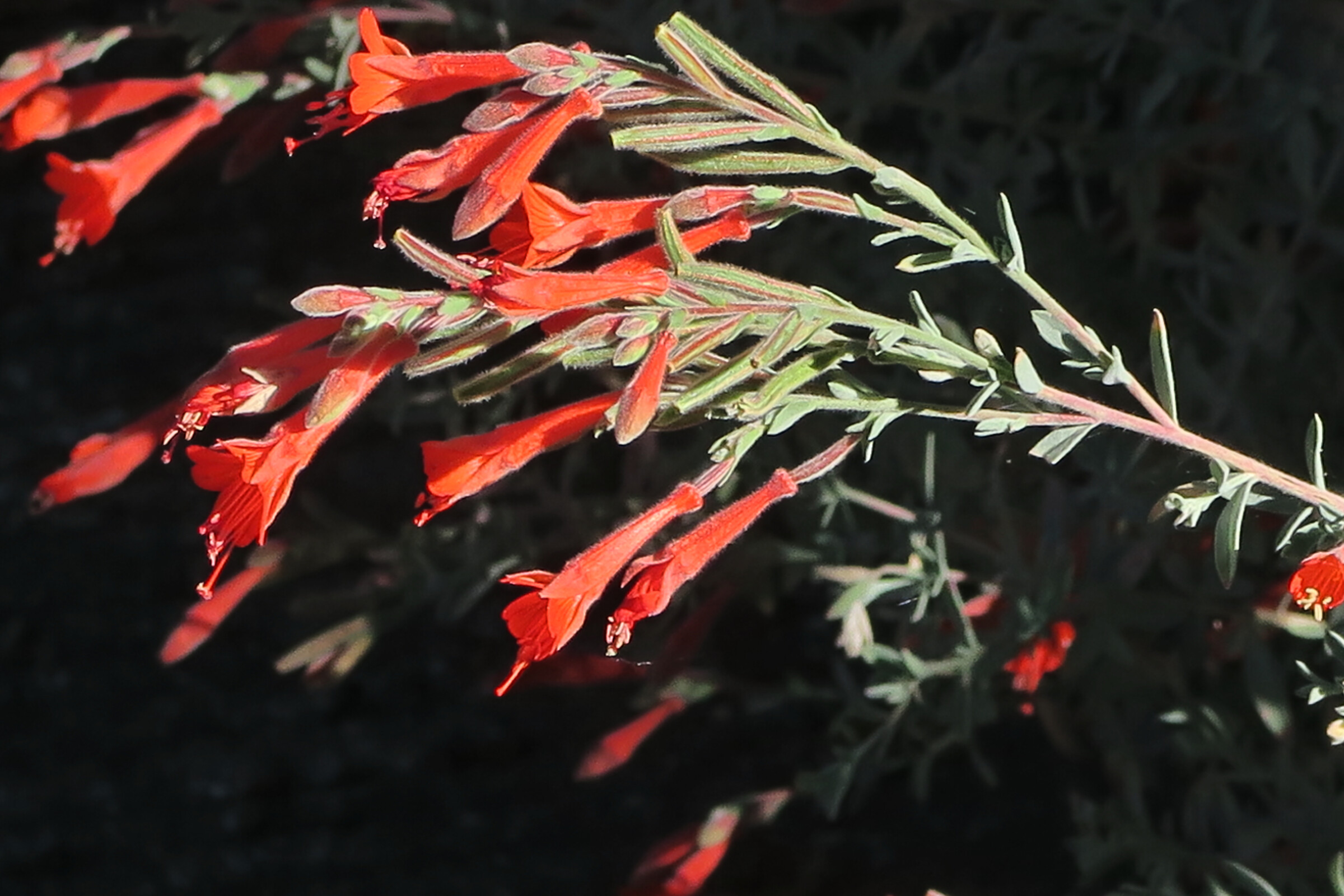
Epilobium canum (long known to gardeners by its older name, Zauschneria californica), commonly called California Fuchsia or Hummingbird Trumpet, is a low, spreading perennial subshrub of the Onagraceae (evening primrose) family. It is one of the most reliable late-season nectar sources in the dry West, throwing up a haze of brilliant scarlet, trumpet-shaped flowers just as most other wildflowers are finishing for the year. Gardeners in California, the Southwest, and the Great Basin prize it precisely because it blooms when little else does — from August into November — drawing in migrating hummingbirds at exactly the moment they most need the fuel.
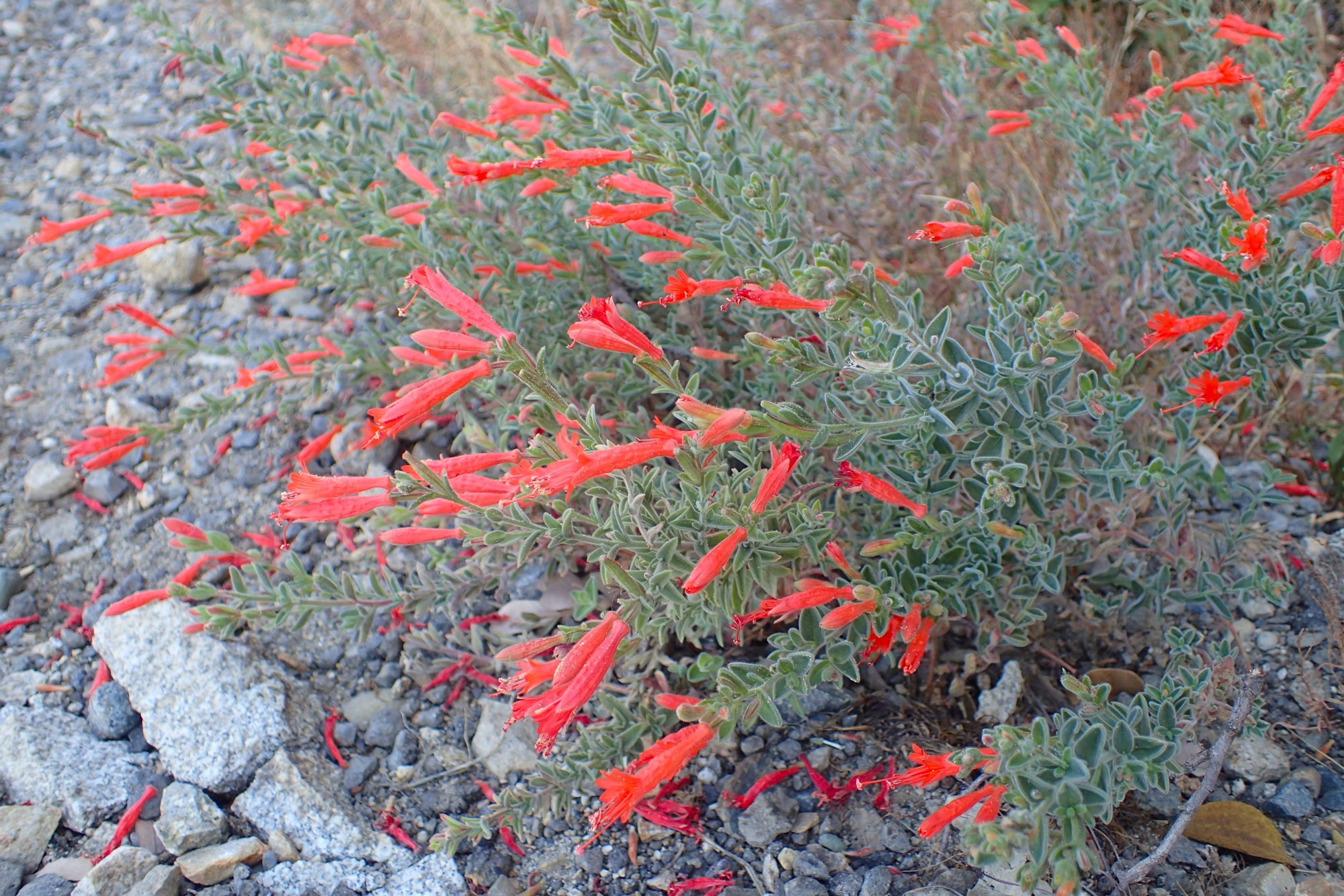
In the wild, California fuchsia grows as a woody-based, loosely mounding or sprawling subshrub, usually 1 to 3 feet tall and spreading 2 to 4 feet or more by shallow, wide-ranging rhizomes. The narrow, gray-green to silvery leaves are often downy or felted, an adaptation that reflects sunlight and conserves moisture on the dry slopes, rocky outcrops, and chaparral edges where the species is most at home. Against that muted foliage the flowers read as pure fire: inch-long tubes of red-orange with four flaring lobes, held well above the leaves on wiry stems.
California fuchsia is extraordinarily easy to grow once established and extraordinarily drought tolerant — it is, after all, a plant that evolved to put on its showiest display during the driest, hottest part of the year in some of the harshest soils in the Southwest. That combination of toughness, long bloom season, and near-magnetic pull on hummingbirds has made it one of the most widely planted native perennials in California gardens, and an increasingly popular choice in low-water landscapes from the coast to the high desert.
Identification
California fuchsia is variable across its range — botanists currently recognize several subspecies that differ in leaf width, hairiness, and habit — but the garden-relevant features are consistent: narrow gray foliage, a low spreading or lightly mounding habit, and tubular red flowers from late summer through fall.
Stems
Stems are slender, often reddish, and woody only at the base; the upper growth dies back substantially over winter in colder parts of the range and resprouts from the semi-woody crown and spreading rhizomes each spring. Plants form loose colonies over time as the rhizomes creep outward, which is part of why the species works so well as a ground-covering drift on a dry slope but also why gardeners sometimes find it wandering further than expected in rich, irrigated soil.
Leaves
Leaves are narrow — lance-shaped to nearly linear, ½ to 1½ inches long — and arranged alternately or in loose clusters along the stem. Color ranges from dull green to a distinctly silvery gray, and the surface is often covered in fine, soft hairs that give the foliage a felted or downy texture. This gray, hairy foliage is one of the easiest field marks separating California fuchsia from garden fuchsias (genus Fuchsia), to which it is not closely related despite the shared common name.
Flowers
The flowers are the plant’s signature: narrow, trumpet-shaped tubes 1 to 1½ inches long, scarlet to orange-red (occasionally salmon, pink, or white in some garden selections and rare wild populations), flaring at the mouth into four narrow, slightly reflexed lobes. Eight long stamens and a protruding style extend past the petals, positioning pollen exactly where a hovering hummingbird’s head will brush it. Bloom runs from roughly August through October or November, peaking as summer heat breaks — a bloom window that overlaps almost perfectly with Anna’s and migrating Rufous and Allen’s Hummingbirds moving through the region.
Fruit & Seeds
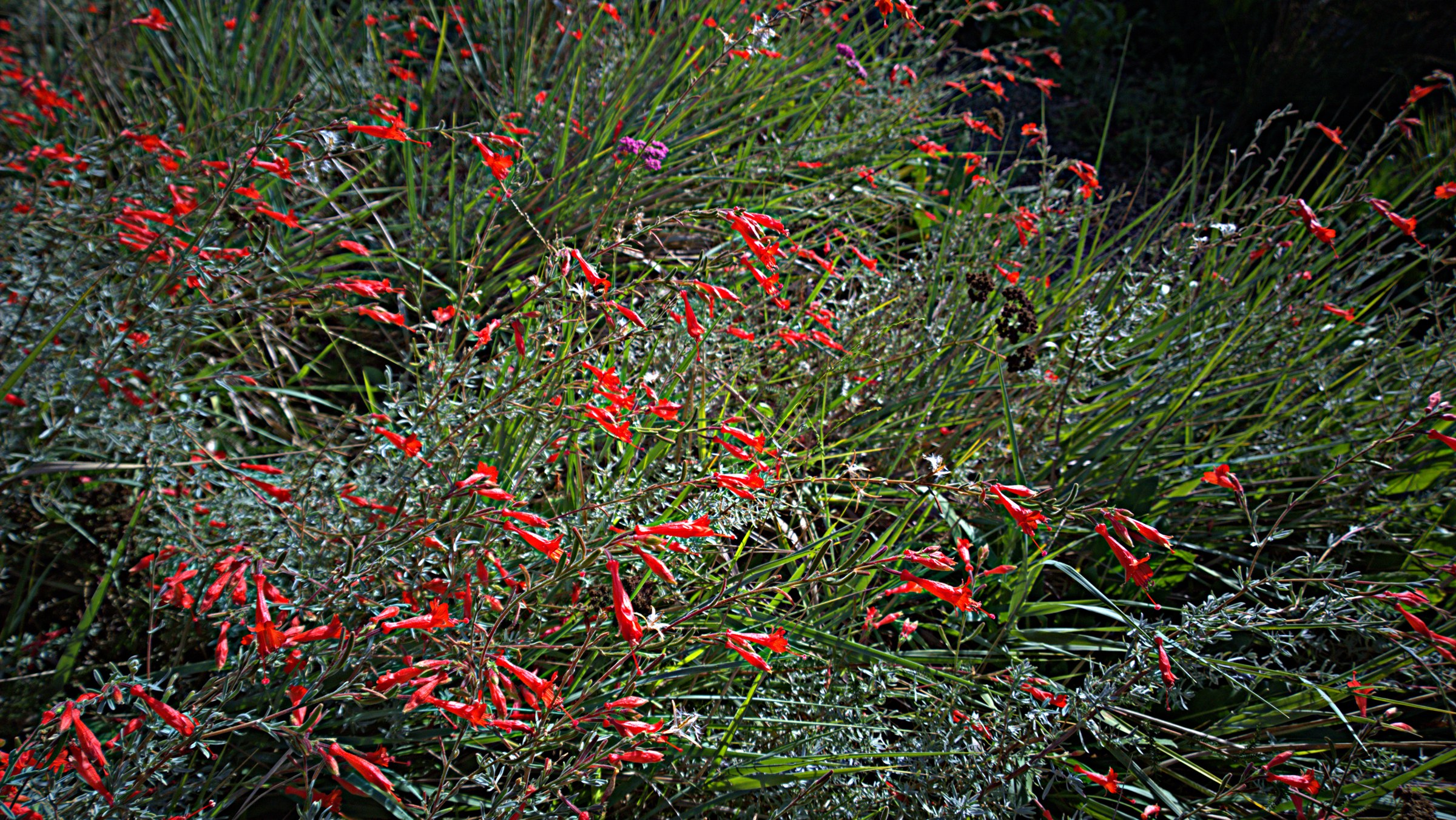
Like other members of the evening primrose family, California fuchsia produces narrow, four-chambered capsules that split open at maturity to release tiny seeds, each tipped with a tuft of silky white hairs. The tufted seeds catch the wind, scattering well beyond the parent plant — one of the reasons the species colonizes disturbed slopes and roadcuts so readily in its native range.
Quick Facts
| Scientific Name | Epilobium canum (syn. Zauschneria californica) |
| Family | Onagraceae (Evening Primrose) |
| Plant Type | Perennial Subshrub |
| Mature Height | 1–3 ft |
| Mature Spread | 2–4 ft (spreads by rhizomes) |
| Growth Rate | Moderate to fast |
| Sun Exposure | Full Sun |
| Water Needs | Low (drought tolerant once established) |
| Soil Type | Lean, rocky, sandy or gravelly; excellent drainage required |
| Soil pH | 6.0–8.0 (tolerates alkaline soils) |
| Bloom Time | Late summer through fall (August–November) |
| Flower Color | Scarlet to orange-red |
| Fall Color | Not notable; foliage is evergreen-gray to semi-dormant |
| Fruit | Narrow capsules with tufted, wind-borne seeds |
| Deer Resistant | Yes (aromatic, felted foliage is rarely browsed) |
| USDA Hardiness Zones | 8–10 |
Native Range
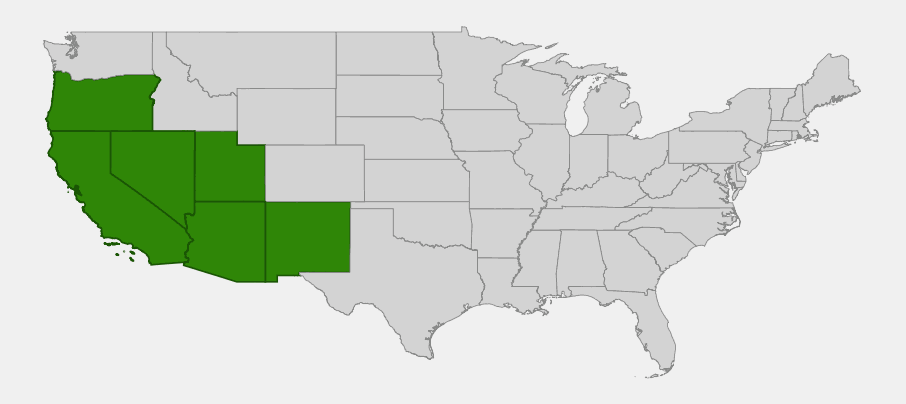
California fuchsia is native to the arid and semi-arid West, centered on California but reaching into the adjacent Great Basin and Southwest. Its core range runs from southwestern Oregon south through California’s Coast Ranges, Sierra Nevada foothills, Transverse and Peninsular Ranges, and into the deserts of the Southwest, continuing south into northern Baja California, Mexico. Outlying populations occur east into Nevada, Utah, Arizona, and southwestern New Mexico, generally in dry, rocky, sun-exposed sites at low to moderate elevation.
Within Arizona and New Mexico — the portion of its range covered by this site’s regional lists — California fuchsia grows mainly in the southern and central mountains and foothills, on dry rocky slopes, canyon walls, and roadcuts in chaparral, oak woodland, and pinyon-juniper habitat, generally between about 3,000 and 8,000 feet elevation. It is much less common here than in California, where it is one of the defining late-season wildflowers of the chaparral and coastal sage scrub.
Note that California fuchsia is widely cultivated well outside this native range — including in gardens throughout the Pacific Northwest, the Intermountain West, and even parts of the Southeast and Europe — because of its drought tolerance and late bloom. It is not native to Oregon’s Willamette Valley, the Pacific Northwest coast, Idaho, Wyoming, or anywhere outside the dry Southwest and California; plant it there as a garden ornamental, not as a native restoration species.
📋 Regional plant lists featuring California Fuchsia: Arizona & New Mexico
Growing & Care Guide
California fuchsia rewards neglect. The single most common way gardeners kill it is kindness — too much water, too rich a soil, or too much shade. Give it what it evolved for (lean soil, full sun, and infrequent deep watering) and it will reward you with months of hummingbird traffic for very little maintenance.
Light
Full sun is essential for strong, compact growth and heavy bloom. In partial shade the plant stretches, flops, and blooms far less; in the hottest low-desert gardens of southern Arizona, a little afternoon shade can help it look its best through summer, but anywhere in its cooler mountain and foothill range it wants as much sun as you can give it.
Soil & Water
Drainage is the non-negotiable requirement. California fuchsia is adapted to lean, rocky, often decomposed-granite or caliche soils and performs poorly in heavy clay or any soil that stays wet. Once established — typically after the first growing season — it needs little supplemental water and often does best on an occasional deep soak rather than frequent light irrigation. In regular garden conditions with some irrigation it will grow larger and bloom more lushly, but it is also more prone to root rot and a shorter lifespan; many experienced native-plant gardeners treat it as a plant to water sparingly and replace every few years as older clumps decline, relying on its spreading habit to provide replacements nearby.
Planting Tips
Plant in fall or early spring to allow roots to establish before summer heat. Amend heavy soils with coarse grit or decomposed granite rather than compost, which holds too much moisture. Space plants 2 to 3 feet apart to allow for spread — they will fill in via rhizomes within a season or two. Container plants with felted or glaucous foliage and a compact, non-leggy habit transplant most reliably.
Pruning & Maintenance
Cut plants back hard — to a few inches above the woody base — in late winter or very early spring, after the last hard freeze but before new growth starts. This keeps the plant compact, encourages fresh growth, and removes the previous season’s tangled, often frost-damaged stems. Without this annual cutback, clumps become woody, sparse at the center, and floppy.
Propagation
California fuchsia is easiest to propagate by dividing rooted sections of the spreading rhizome in fall or early spring, or by taking semi-hardwood cuttings in summer. Seed germination is possible but slower and less reliable for home gardeners than vegetative methods.
Landscape Uses
- Hummingbird gardens — few native plants deliver as much late-season nectar
- Dry slopes and rock gardens, where its spreading habit helps stabilize loose soil
- Xeriscape and low-water borders paired with other chaparral and desert natives
- Erosion control on sunny, well-drained banks
- Container plantings on patios where hummingbirds can be watched up close
- Fall-interest plantings that extend bloom after summer perennials fade
Wildlife & Ecological Value
California fuchsia is, first and foremost, a hummingbird plant — its flowers are a textbook example of ornithophilous (bird-pollinated) floral design, and the timing of its bloom makes it disproportionately important in the fall landscape.
For Pollinators
Hummingbirds are the primary pollinators, drawn to the long red tubes and abundant nectar; the protruding stamens dust a hovering bird’s forehead with pollen as it feeds. Native bees and some butterflies will visit for nectar as well, though the narrow floral tube is best suited to long hummingbird bills and tongues.
For Birds
Beyond hummingbirds, the tiny seeds in the fall and winter capsules provide a minor food source for small songbirds, and the dense, spreading clumps offer low cover for ground-foraging birds in open, rocky habitat.
Ecosystem Role
Because it blooms from late summer into fall — after most chaparral wildflowers have set seed and dried — California fuchsia fills a critical nectar gap for migrating Rufous and Allen’s Hummingbirds moving south through California and the Southwest, and for resident Anna’s Hummingbirds building fat reserves before winter. Its spreading rhizomes also help stabilize loose, disturbed soils on slopes and roadcuts, making it a useful early colonizer after fire or grading in its native range.
Cultural & Historical Uses
California fuchsia has a long history of use among Indigenous peoples of California, who used preparations of the plant topically for wounds, sores, and skin irritation; some groups also used the leaves and roots in traditional remedies for digestive complaints. These uses are documented in ethnobotanical records as historical practice, not as a modern herbal recommendation.
The plant’s scientific history is almost as tangled as its stems: for much of the twentieth century it was classified in its own genus, Zauschneria, named for the Bohemian botanist Johann Baptista Josef Zauschner. Molecular studies eventually showed it to be nested within Epilobium (the willowherbs), and the genus Zauschneria was folded into Epilobium — though “zauschneria” remains in common use among California gardeners and nurseries, and both names still appear on plant tags today.
In horticulture, California fuchsia has been a mainstay of California native-plant gardening since the mid-twentieth century, and selections and hybrids — ‘Catalina’, ‘Select Mattole’, and others — have been bred for compact habit, extended bloom, or particular flower shades, expanding its use well beyond its native range into gardens across the drier parts of North America and even into cultivation in Europe and Japan.
Frequently Asked Questions
Is California fuchsia related to garden fuchsias?
No. Despite the shared common name and vaguely similar tubular flowers, California fuchsia (Epilobium canum) is in the evening primrose family (Onagraceae) and is only a distant relative of true fuchsias (genus Fuchsia, family Onagraceae as well, but a very different lineage). The resemblance is a case of convergent evolution toward hummingbird pollination, not close kinship.
Will California fuchsia take over my garden?
It spreads by rhizomes and can form sizable colonies, especially with regular water and rich soil. In a dedicated dry slope or rock garden this spreading habit is usually welcome; in a small, irrigated bed it can outcompete less vigorous neighbors, so give it room or plan to divide it periodically.
Why isn’t my California fuchsia blooming?
The most common causes are too much shade, too much water (which pushes leafy growth at the expense of flowers), or soil that’s too rich. Cut back hard in late winter, move it to full sun if needed, and ease off supplemental irrigation once established.
Is California fuchsia native to my state if I live outside the Southwest?
No. Its native range is limited to California, southwestern Oregon, Nevada, Utah, Arizona, New Mexico, and northern Baja California. It is a popular and well-behaved garden plant well beyond that range, but it is not a native species in the Pacific Northwest, the Rocky Mountain states, or anywhere east of the desert Southwest.
What pairs well with California fuchsia in a desert garden?
In Arizona and New Mexico gardens, it combines well with other dry-site natives such as Creosote Bush, Ocotillo, and Desert Willow, all of which share its drought tolerance and sun requirements while offering contrasting form and bloom timing.

Looking for a nursery that carries California Fuchsia?
Browse our native plant nursery directory: California · Oregon · Nevada & New Mexico · Utah · Arizona