
Texas Mountain Laurel (Sophora secundiflora)
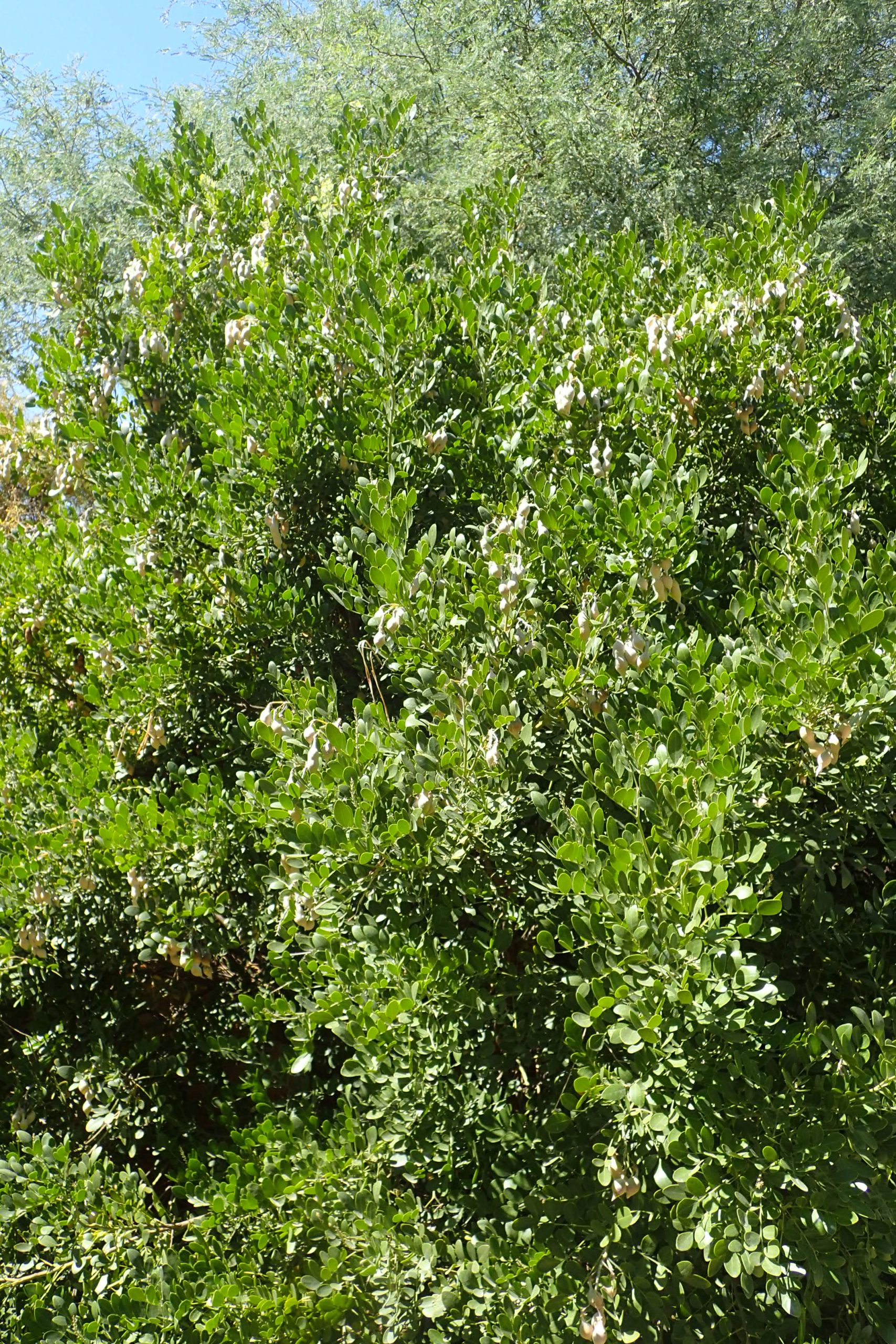
Sophora secundiflora (also classified as Dermatophyllum secundiflorum), commonly known as Texas Mountain Laurel or Mescal Bean, is a slow-growing evergreen shrub or small tree native to the limestone hill country of Texas and the borderlands of New Mexico. Few native plants reward patience the way this one does: in late winter and early spring it erupts in dense, drooping clusters of violet-purple, wisteria-like flowers that fill the air with a fragrance many gardeners compare to grape soda or artificial grape candy. The glossy, dark green compound leaves hold their color through the heat of a South Texas summer and the occasional hard freeze of a Hill Country winter, making this one of the few broadleaf evergreens truly suited to the limestone soils of the region.
In the wild, Texas Mountain Laurel grows on rocky, well-drained limestone and caliche outcrops across the Edwards Plateau, the South Texas Plains, and the Chihuahuan Desert borderlands, where it often forms part of the shrub understory beneath Ashe Juniper and live oak. It is extremely drought-tolerant once established, asking for little beyond sun and sharp drainage, and it is almost never bothered by deer. The tradeoff for all this toughness is patience: left unirrigated on poor caliche, a Texas Mountain Laurel may add only a few inches a year, which is part of why old specimens trained into single-trunk small trees are so prized in older Texas landscapes.
Every part of this plant that produces the hard, bright red-orange seeds inside its woolly gray pods is toxic, and that fact is inseparable from its cultural history — the seeds, known as mescal beans, were used ceremonially by Indigenous peoples of the southern Plains and northern Mexico long before the unrelated agave spirit mezcal borrowed a similar-sounding name. None of that history is a reason to avoid planting it; it is a reason to know what you are growing, especially around small children or pets who might be tempted by a bright, bean-like seed.
Identification
Texas Mountain Laurel typically grows as a dense, multi-stemmed large shrub 10 to 15 feet tall and nearly as wide, though old, unpruned specimens trained to a single trunk can reach 25 to 30 feet in favorable sites with deep soil. Growth is slow — often just 6 to 12 inches a year — which is one reason mature specimens are valued and rarely removed once established.
Bark & Stems
Young stems are covered in fine silvery hairs that wear away with age, leaving smooth gray-brown bark on older wood. The plant branches low and densely unless trained upward, which is why most landscape specimens are grown as rounded, multi-trunked shrubs rather than single-trunk trees.
Leaves
Leaves are pinnately compound, 4 to 6 inches long, made up of 7 to 9 (occasionally 13) leaflets that are oval, glossy, and dark green above with a paler, slightly fuzzy underside. The foliage is evergreen and holds its deep green color year-round, dropping only the oldest leaves gradually rather than all at once. This evergreen habit, rare among Texas natives adapted to limestone soils, is one of the plant’s most valued landscape traits.
Flowers
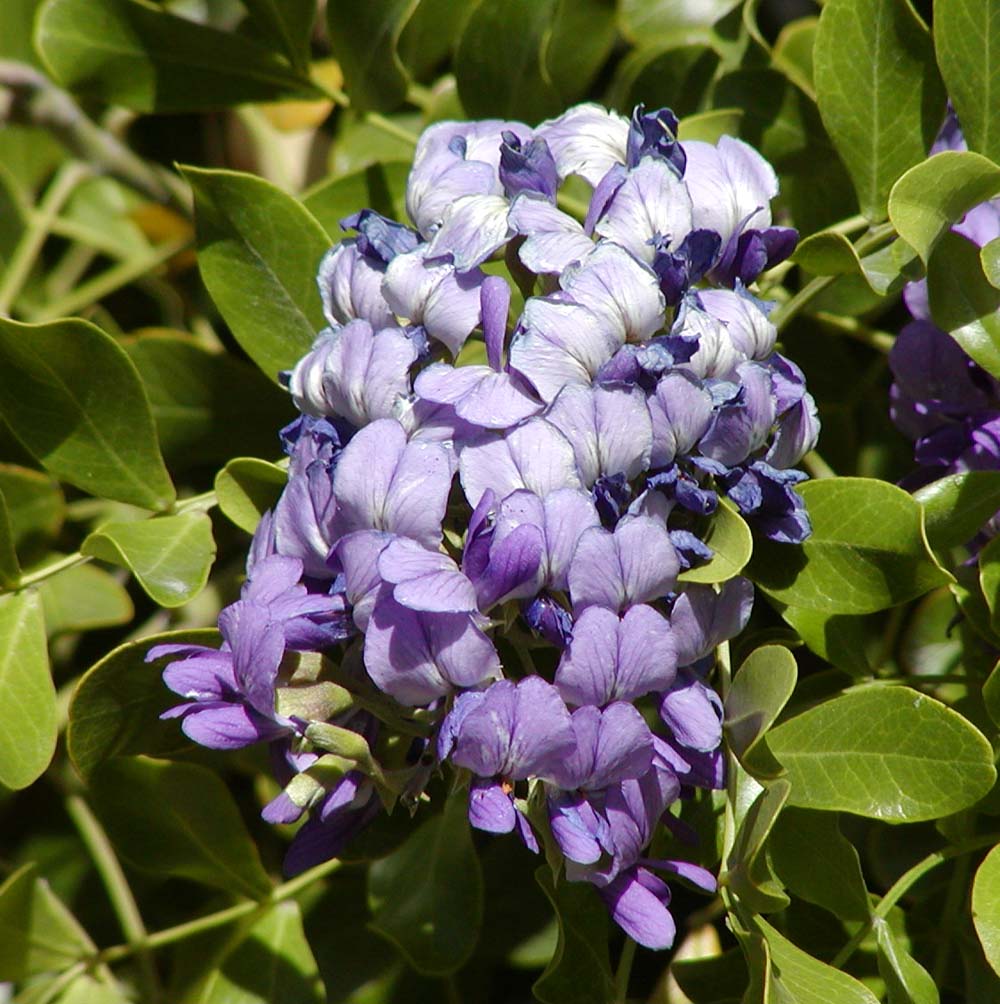
The flowers are the plant’s signature feature: dense, pendulous racemes 3 to 6 inches long, packed with pea-like blossoms in shades from pale lavender to deep violet-purple, occasionally fading to near white. They open from late February into April depending on latitude and spring warmth, and their strong grape-like fragrance can be detected from a considerable distance — a trait that has made the plant a favorite near patios, walkways, and windows where the scent can be enjoyed up close.
Fruit & Seeds
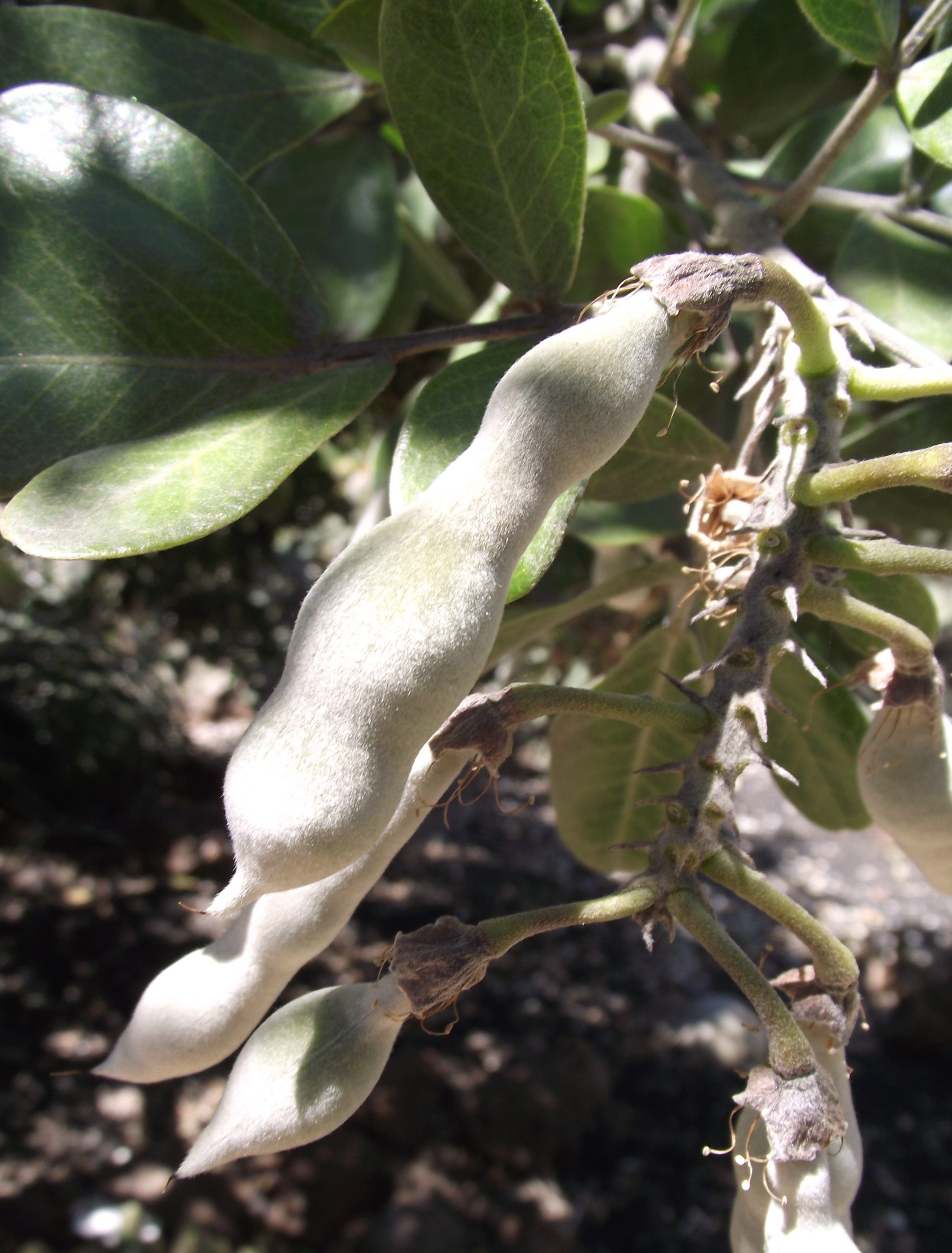
Flowers give way to thick, woolly, silver-gray seed pods 1 to 7 inches long with constrictions between the seeds, giving older pods a knobby, bead-like look. Inside are hard, bright red-orange seeds about ½ inch long known as mescal beans. All parts of the plant, and especially the seeds, are toxic — they contain the alkaloid cytisine, which can cause nausea, convulsions, and in sufficient quantity can be fatal. The pods are tough enough to persist on the shrub well after the seeds inside have matured, and the hard seed coat means seeds that do fall are not quickly broken down, so they should be kept away from small children and pets who might mistake them for candy or beans.
Quick Facts
| Scientific Name | Sophora secundiflora (syn. Dermatophyllum secundiflorum, Calia secundiflora) |
| Family | Fabaceae (Legume) |
| Plant Type | Evergreen Shrub / Small Tree |
| Mature Height | 10–15 ft (to 25–30 ft as a trained single-trunk tree) |
| Mature Spread | 8–10 ft |
| Growth Rate | Slow |
| Sun Exposure | Full Sun to Part Shade |
| Water Needs | Low |
| Soil Type | Rocky limestone or caliche; well-drained |
| Soil pH | 7.0–8.5 (alkaline) |
| Bloom Time | February – April |
| Flower Color | Violet-purple, grape-scented |
| Fall Color | None (evergreen) |
| Fruit | Woolly gray pods with hard red-orange seeds (toxic) |
| Deer Resistant | Yes |
| USDA Hardiness Zones | 7b – 11 |
Native Range
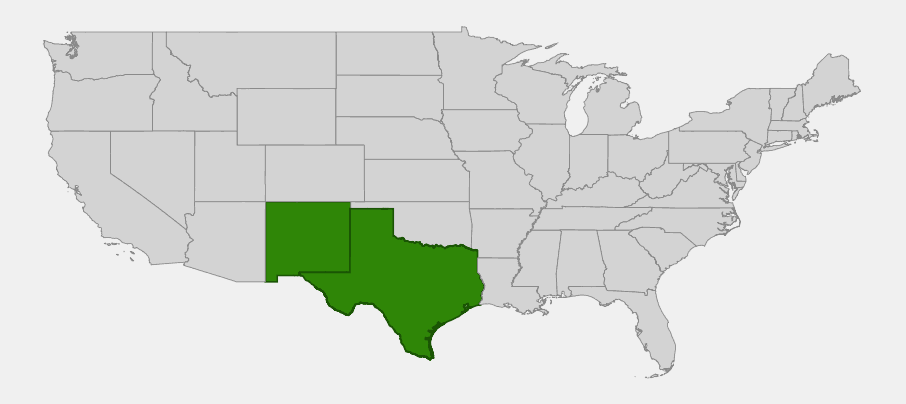
Texas Mountain Laurel is native to the limestone hill country and caliche plains of central, south, and west Texas, extending west into southern New Mexico, and south into the Mexican states of Chihuahua, Coahuila, Nuevo León, Tamaulipas, and San Luis Potosí. Within Texas it is especially common on the Edwards Plateau (the Texas Hill Country around Austin and San Antonio), the South Texas Plains, and the Chihuahuan Desert border country of the Trans-Pecos.
It grows almost exclusively on rocky, alkaline, well-drained ground — limestone outcrops, caliche slopes, dry canyon walls, and thin rocky soils over bedrock — where few other broadleaf evergreens can compete. It is frequently found growing alongside Ashe Juniper, Texas Persimmon, Agarita, and Cenizo in Edwards Plateau limestone shrublands, and it tolerates the shallow, drought-prone soils typical of these sites better than almost any other native shrub of its size.
Despite its popularity in cultivated landscapes well beyond its native range — it is widely planted as an ornamental throughout the warmer parts of the Southwest and the Gulf Coast — Texas Mountain Laurel should not be assumed native outside Texas and New Mexico. It is not native to Arizona, where it is nonetheless a common nursery item, nor to the eastern or coastal plains of Texas outside its limestone and caliche habitat.
📋 Regional plant lists featuring Texas Mountain Laurel: Arizona & New Mexico
Growing & Care Guide
Texas Mountain Laurel is one of the toughest, most forgiving evergreen shrubs available to Southwestern gardeners once it is established — the challenge is almost entirely in the first year or two, and in managing expectations about its slow growth.
Light
Plant in full sun for the densest growth and heaviest bloom. It will tolerate part shade, especially in the hottest parts of its range, but flowering and form both become looser and less floriferous with less light.
Soil & Water
Sharp drainage matters more than soil fertility. Texas Mountain Laurel thrives in rocky, caliche, or limestone-derived soils that would stunt many other shrubs, and it is intolerant of wet feet — poorly drained clay or regularly irrigated turf-adjacent beds are the most common ways gardeners kill it. Water deeply but infrequently during the first two years to establish a deep root system, then taper off; established plants need supplemental water only during extended drought.
Planting Tips
Set out container-grown plants in fall or early spring. Because the taproot resents disturbance, choose a permanent site and avoid transplanting older plants. Amend heavy clay with coarse gravel or decomposed granite rather than organic matter, which holds too much moisture around the root crown. Expect slow establishment — a young plant may show little top growth for its first year or two while it builds roots.
Pruning & Maintenance
Left alone, Texas Mountain Laurel forms a dense, rounded multi-stemmed shrub; to train it into a small single-trunk tree, remove lower and competing stems gradually over several years while the plant is young. Prune right after flowering to avoid cutting off next year’s bloom, since flower buds form on the previous season’s growth. Established plants need little else — they are not prone to pests or disease and tolerate hard pruning if rejuvenation is needed, though recovery is slow given the plant’s naturally deliberate growth rate.
Landscape Uses
Its dense evergreen form, fragrant spring bloom, and extreme drought tolerance make it valuable in several roles:
- Evergreen screen or hedge in dry, sunny beds where irrigation is limited
- Specimen shrub or small patio tree, planted where its grape fragrance can be enjoyed up close
- Xeriscape and rock garden anchor plant for caliche or limestone sites
- Foundation planting against stone or stucco, echoing the region’s native limestone character
- Wildlife and pollinator garden component, especially for native bees
Wildlife & Ecological Value
Texas Mountain Laurel is a reliable early-season nectar source in a landscape where little else is blooming, and its dense evergreen structure provides year-round cover that many of its deciduous neighbors cannot offer in late winter.
For Pollinators
The fragrant, nectar-rich flowers open in late winter and early spring, well before most other Hill Country natives, making the plant an important early resource for native bees, including large carpenter bees and leafcutter bees, as well as honeybees. The dense flower racemes can hum audibly with bee activity on a warm February or March afternoon.
For Birds
The thick evergreen canopy offers year-round roosting and nesting cover, which is especially valuable in winter when many surrounding shrubs and trees are bare. Small songbirds use dense mountain laurel thickets for shelter from both weather and predators.
Ecosystem Role
As one of the few broadleaf evergreens adapted to thin limestone and caliche soils, Texas Mountain Laurel helps stabilize rocky slopes and canyon walls where erosion from exposed caliche is otherwise a concern. Its toxic seeds, while a hazard to pets and children in a garden setting, deter most browsing mammals in the wild, allowing the plant to persist and provide structure in heavily grazed rangeland where more palatable shrubs are cropped back.
Cultural & Historical Uses
The seeds of Texas Mountain Laurel — known as mescal beans or frijolitos — have a documented history of ceremonial use among Indigenous peoples of the southern Plains and northern Mexico that predates European contact by centuries. Archaeological sites in Texas and northern Mexico have yielded mescal bean necklaces and ceremonial items, and some ethnographic accounts describe the beans’ use in vision-related rites by certain groups, a practice largely displaced after the 19th century by the spread of peyote ceremonialism.
The common confusion between “mescal beans” and the agave-derived spirit mezcal is worth clearing up: the two share a Spanish-derived name but are otherwise unrelated — one is a toxic legume seed, the other a distilled agave liquor. Despite the shared name, the seeds of Texas Mountain Laurel have never been a food or beverage ingredient; their toxicity, driven by the alkaloid cytisine, made them a ceremonial and symbolic object rather than a consumable one, and any folk use was approached with extreme caution given the narrow margin between a psychoactive and a lethal dose.
In more recent history, the plant’s toughness, fragrance, and evergreen foliage made it a favorite dooryard shrub across generations of Texas gardens, frequently planted near porches and walkways so its grape-scented bloom could be enjoyed each spring — a horticultural tradition that continues largely unchanged today.
Frequently Asked Questions
Is Texas Mountain Laurel poisonous?
Yes. The seeds (mescal beans) contain the toxic alkaloid cytisine and can cause nausea, convulsions, and other serious symptoms if ingested; in sufficient quantity they can be fatal. Keep the hard red-orange seeds away from children and pets, and never regard any part of this plant as edible.
Is Texas Mountain Laurel the same plant as mezcal?
No. “Mescal bean” is the common name for this plant’s toxic seed, while mezcal is a distilled spirit made from agave. The names sound alike but refer to entirely unrelated plants and products.
How fast does Texas Mountain Laurel grow?
Slowly — often just 6 to 12 inches per year, especially on dry, rocky sites. This slow, steady growth is part of why mature specimens are valued and rarely removed; be patient during the first few years while the root system establishes.
Will Texas Mountain Laurel grow outside Texas and New Mexico?
It is only native to Texas and New Mexico, but it is widely planted as an ornamental throughout the warmer, drier parts of the Southwest, including Arizona, wherever winters stay mild enough (roughly USDA zones 7b–11) and drainage is sharp.
Does Texas Mountain Laurel need much water?
No. Once established, it is highly drought-tolerant and actually performs poorly with regular irrigation or heavy clay soil. Deep, infrequent watering during the establishment period is all it needs before becoming largely self-sufficient.

Looking for a nursery that carries Texas Mountain Laurel?
Browse our native plant nursery directory: Texas · New Mexico