California Fan Palm (Washingtonia filifera)
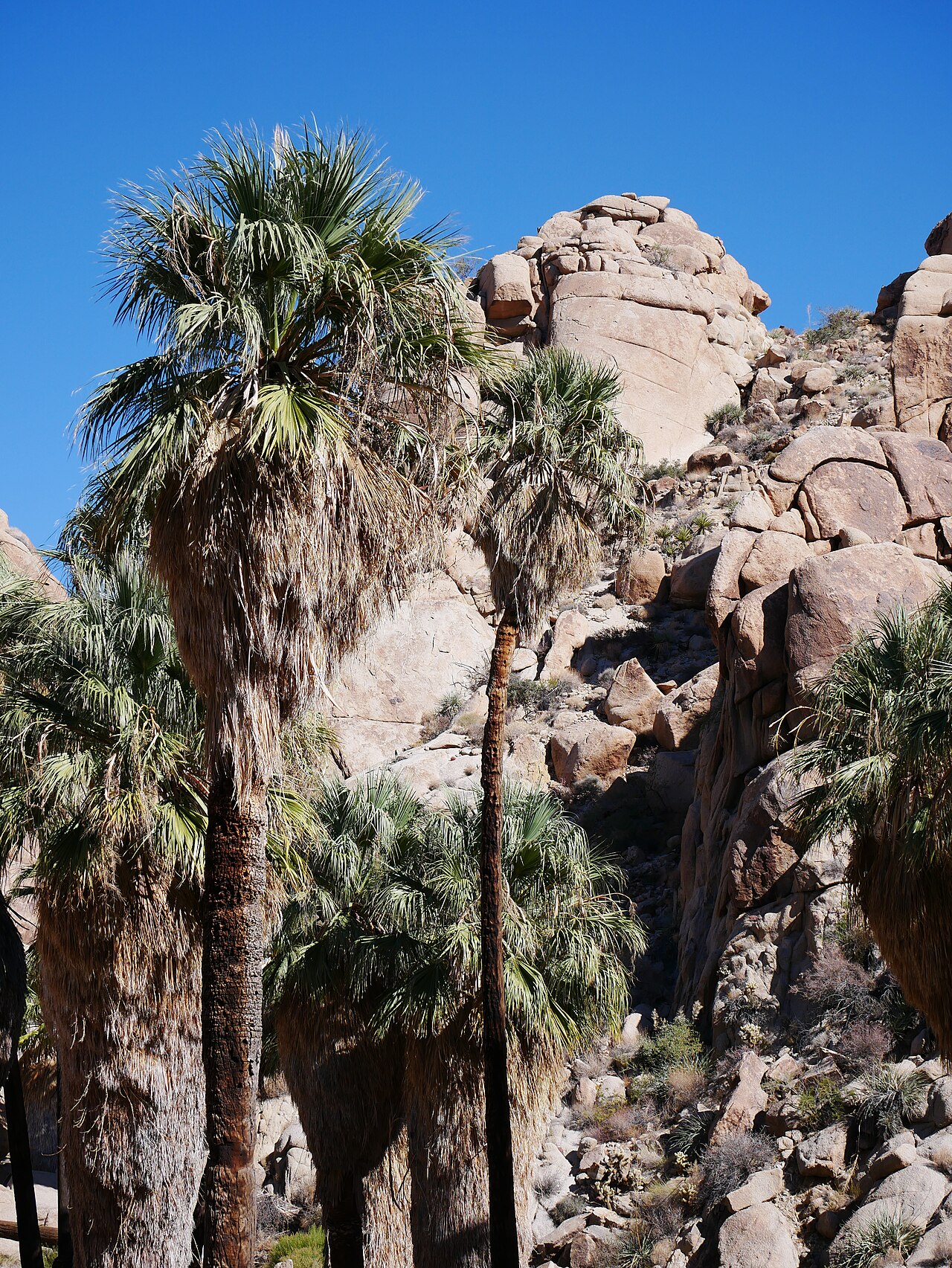
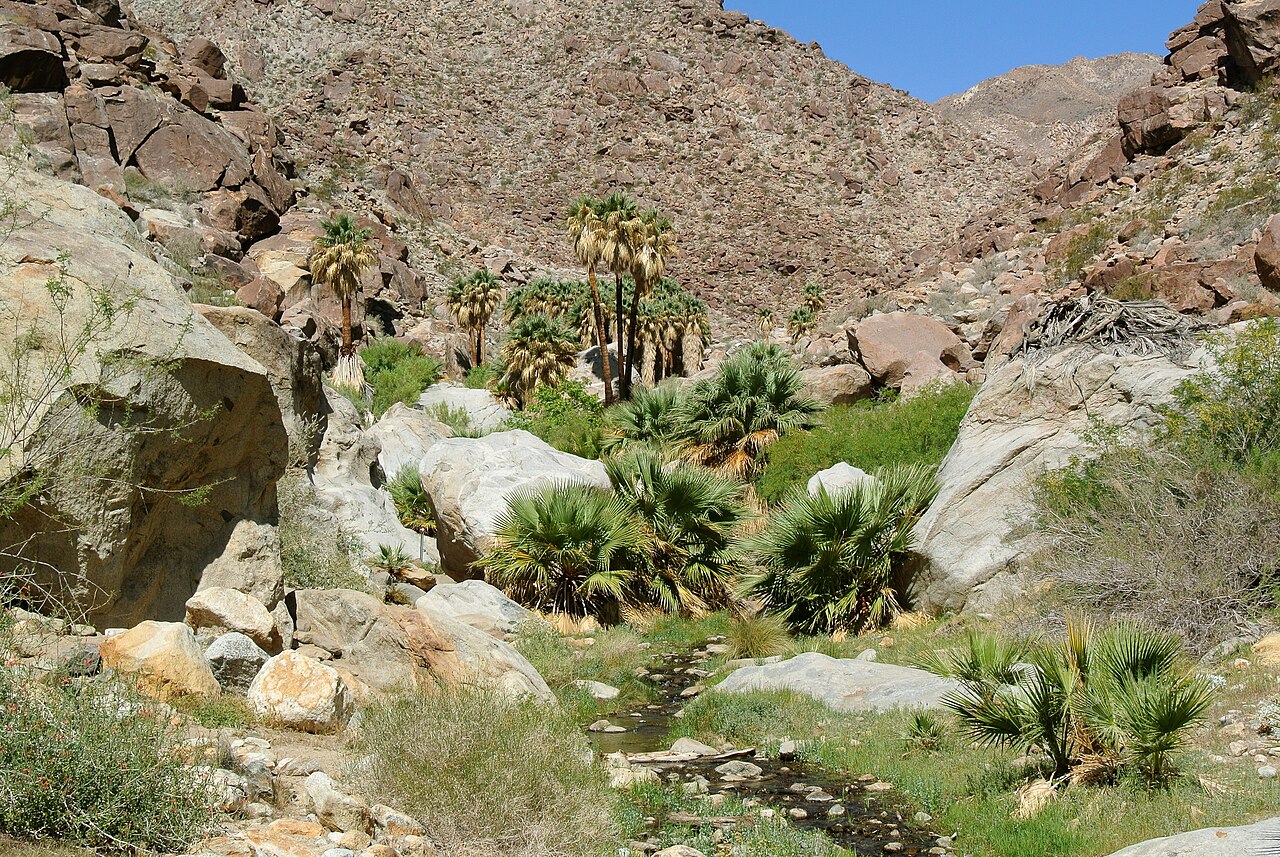
Washingtonia filifera (Linden ex André) H. Wendl., the California Fan Palm, also called Desert Palm or Desert Fan Palm, is the only palm native to the western United States and one of the most iconic plants of the low desert Southwest. It is the signature tree of the desert oasis — wherever a spring, seep, or fault-line crack brings permanent groundwater to the surface in the Colorado and Mojave deserts, this massive fan palm is often what marks the spot, visible for miles as a dark green island rising out of bare rock and sand.
A true native fan palm of the genus Washingtonia, this species is unmistakable: a thick, columnar gray-brown trunk up to 2.5 feet across, topped with a dense crown of huge, pleated, fan-shaped leaves up to 6 feet across. Left untrimmed, dead fronds droop down and cling to the trunk for years, forming the famous shaggy “skirt” that can run most of the tree’s 40-to-60-foot height — prime real estate for owls, bats, and other wildlife, and historically a source of fuel for the wildfires that are part of this palm’s natural life cycle.
In the wild, California Fan Palm is a genuine rarity — a narrow desert endemic restricted to a few hundred known oases and spring sites in southeastern California and a handful of locations in Arizona, almost always tied to a permanent source of groundwater. In cultivated landscapes across the warm, arid Southwest it is planted far beyond this native range, so it is worth knowing where it truly belongs versus where it is simply a popular, drought-tolerant ornamental.
Identification
California Fan Palm is a single-trunked palm with no branches, growing slowly for its first years and then more quickly once established, eventually reaching 40 to 60 feet (occasionally more) with a trunk diameter of 2 to 3 feet.
Trunk
The trunk is stout, gray-brown, and columnar, often slightly swollen near the base. On actively growing wild and garden specimens, a thick thatch of dead, drooping fronds forms a continuous “skirt” down much of the trunk, trapping seeds, debris, and moisture and creating habitat for cavity-nesting birds, bats, and insects. Where fire or pruning has removed the skirt, the trunk shows a distinctive, closely cross-hatched pattern of old leaf-base scars.
Leaves
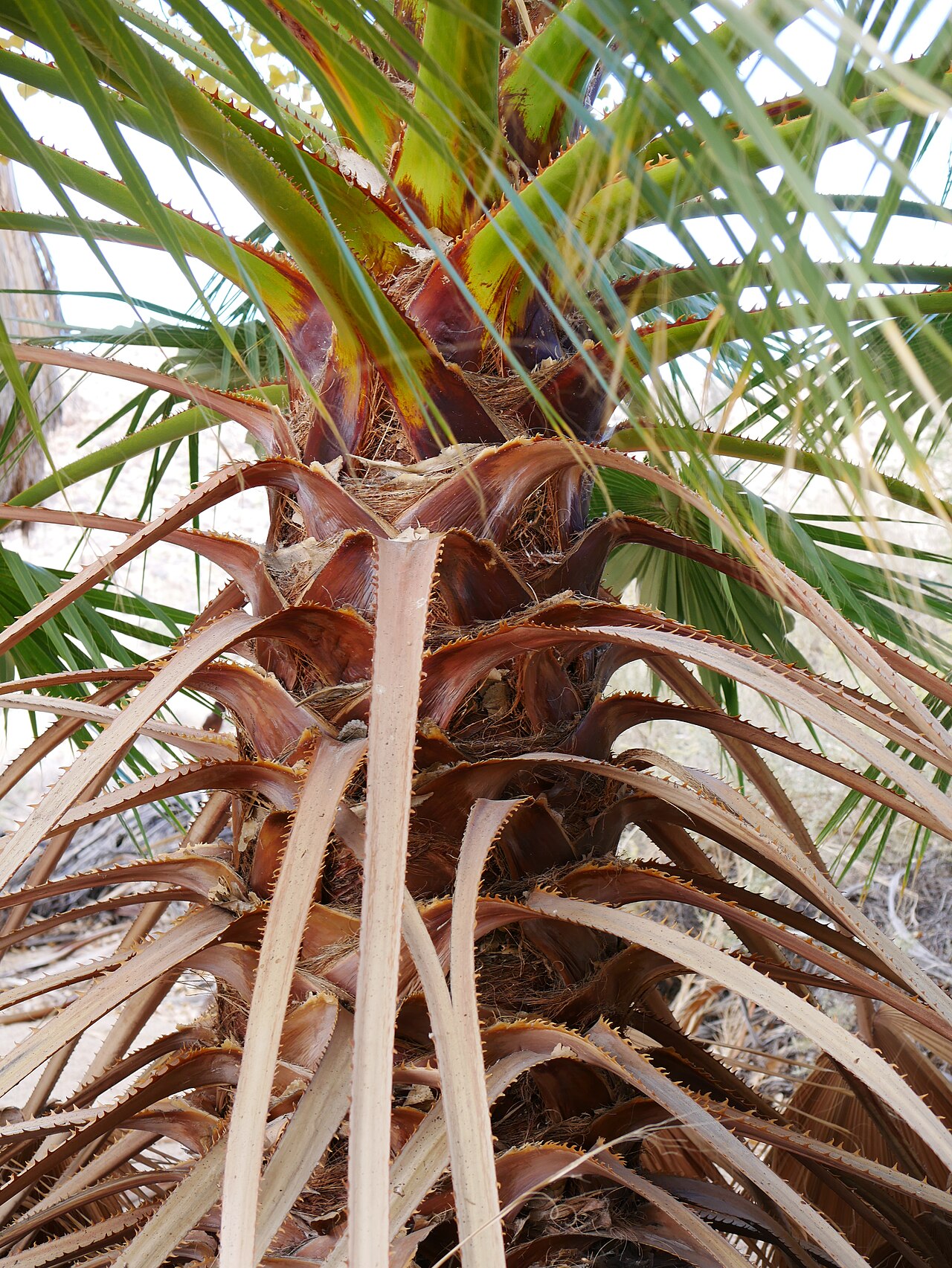
Leaves are large, costapalmate (fan-shaped but with a slight downward curve to the blade) fans 3 to 6 feet across, blue-green to gray-green, deeply pleated, and split partway into 40 or more narrow segments that themselves split further at the tips into drooping threads — the “filifera” (thread-bearing) of the scientific name. Leaf stalks (petioles) are armed with sharp, curved orange-brown spines along the edges, a feature that demands care when working near the plant.
Flowers
In late spring to early summer, long, arching flower stalks (inflorescences) up to 12 feet long emerge from among the leaves, carrying thousands of small, creamy-white, fragrant flowers in branched clusters that droop well below the crown — one of the showiest blooms of any native North American palm.
Fruit & Seeds
Flowers are followed by enormous crops of small, oval, blue-black fruits about 1/3 to 1/2 inch long, each containing a single hard seed surrounded by a thin, sweet, date-like pulp. A mature palm can produce hundreds of thousands of fruits in a good year, ripening from late summer into fall and persisting into winter, making this one of the most important wildlife food sources in the desert oasis ecosystem.
Quick Facts
| Scientific Name | Washingtonia filifera |
| Family | Arecaceae (Palm) |
| Plant Type | Evergreen fan palm |
| Mature Height | 40–60 ft |
| Mature Spread | Crown 10–15 ft wide |
| Growth Rate | Slow when young, moderate once established |
| Sun Exposure | Full Sun |
| Water Needs | Low once established; needs reliable groundwater or irrigation to reach full size |
| Soil Type | Sandy, gravelly, or rocky desert soils; well-drained |
| Soil pH | 7.0–8.5 (neutral to alkaline) |
| Bloom Time | May – June |
| Flower Color | Creamy white, fragrant |
| Fall Color | Evergreen (no fall color change) |
| Fruit | Small blue-black, date-like drupes, heavy crops |
| Deer Resistant | Yes |
| USDA Hardiness Zones | 8b–11 |
Native Range
California Fan Palm has one of the most restricted native ranges of any North American tree. It is native almost entirely to southern California, where it occurs as scattered, often small, isolated oasis populations across the Colorado Desert (Riverside, San Diego, and Imperial counties — including the well-known groves at Palm Springs’ Indian Canyons, Joshua Tree National Park, and Anza-Borrego Desert State Park) and a few sites in the Mojave Desert. In Arizona it is native only in a very small number of desert spring and seep sites, principally in the Kofa Mountains of Yuma County and at Castle Creek/Alkali Springs in the Bradshaw Mountains of Yavapai County. The species also occurs natively across the border in Baja California, Mexico, south to Bahía de los Ángeles.
Despite its popularity as an ornamental and its common appearance in Las Vegas, Phoenix, and other Southwestern cities, California Fan Palm is not native to Nevada. The scattered palm groves found in places such as the Moapa Valley and the famous “Palm Springs” of the Amargosa/Nevada desert are the result of mid-20th-century plantings rather than natural populations, though a few sites show evidence of older establishment; either way, botanists consider the Nevada occurrences introduced, not native. Nor is it a native tree anywhere outside of these specific low-desert oasis sites in California and Arizona — the countless street and landscape plantings of this palm across Arizona, Nevada, and beyond are cultivated, not wild stands.
The common thread across every true native population is permanent groundwater: California Fan Palm grows naturally only where a spring, seep, or fault line keeps water at or near the surface year-round, in canyons and washes within the hot, arid Colorado and Mojave deserts. It does not occur naturally on dry upland desert slopes away from a reliable water source.
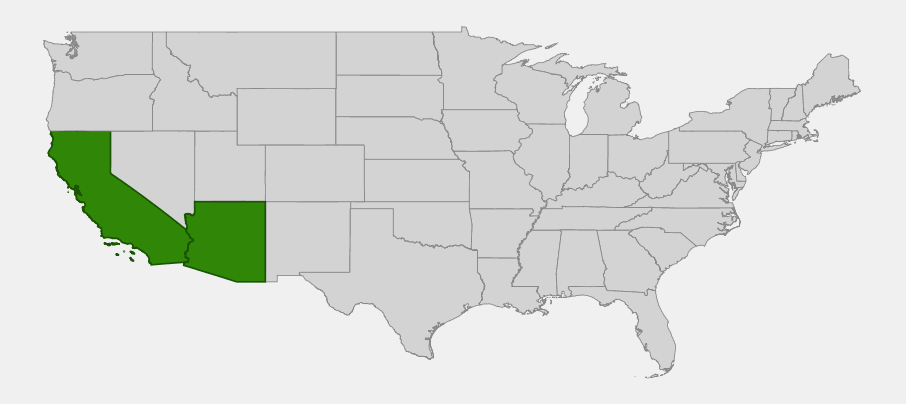
📋 Regional plant lists featuring California Fan Palm: Arizona & New Mexico
Growing & Care Guide
Outside its narrow native oasis habitat, California Fan Palm is one of the toughest, most drought-adapted palms available for low-desert landscaping — provided it gets enough room to reach its true mature size.
Light
This palm demands full sun. It will survive light shade as a seedling in the understory of taller palms, but a mature specimen needs direct, all-day sun to develop a healthy, full crown.
Soil & Water
California Fan Palm tolerates a wide range of soils, from sand to rocky, gravelly ground, as long as drainage is good; it is not fussy about fertility. Once established, it is strongly drought tolerant and can survive on natural rainfall in much of its low-desert range, but it grows fastest and reaches its largest size with regular deep watering or access to a high water table — exactly the condition that defines its native oases. In a home landscape, young palms benefit from supplemental irrigation during the first several years.
Planting Tips
Give this palm plenty of room — mature specimens need significant vertical and horizontal clearance from structures, power lines, and walkways, both for the crown and for the long flower/fruit stalks that droop well below it. Plant from container stock in warm weather so roots establish before the first cool season. It is intolerant of hard freezes; sustained temperatures well below 20°F can cause serious damage.
Pruning & Maintenance
Whether to remove the dead-frond “skirt” is largely an aesthetic and safety decision rather than a horticultural requirement: an unpruned skirt is the plant’s natural, wildlife-rich form, but in urban settings it is often trimmed for fire safety, to remove rodent and pest habitat near structures, or simply for a tidier look. Use caution and proper equipment — the leaf-stalk spines are sharp and the fronds are heavy. Avoid over-pruning live green fronds, which stresses the palm and can slow growth.
Landscape Uses
In appropriate low-desert settings, California Fan Palm serves many purposes:
- Oasis and water-feature plantings that echo its natural habitat
- Large-scale focal specimen for parks, resorts, and spacious residential lots
- Wildlife plantings — the dense skirt and heavy fruit crop support desert animals
- Street and avenue plantings in warm, frost-free climates (with care for mature size)
- Restoration plantings at degraded desert spring and seep sites within its true native range
Wildlife & Ecological Value
In the harsh low desert, an oasis stand of California Fan Palm functions as a wildlife magnet out of all proportion to its small footprint.
For Pollinators
The huge, fragrant flower clusters attract large numbers of native bees and other insects during the late-spring bloom, an important nectar source in a landscape where flowering plants are otherwise scarce for much of the year.
For Birds
The massive fruit crops feed many desert and migratory bird species, including orioles, finches, mockingbirds, and especially coyotes and other wildlife that forage beneath the trees after fruit drop. The dense frond skirt is prime nesting and roosting habitat for owls (including Western Screech-Owls), hawks, and smaller cavity- and crevice-using birds, and the trunk thatch of older palms often hosts bat roosts as well.
For Mammals
Coyotes, foxes, raccoons, and rodents all feed heavily on the fallen fruit, and the dense skirts provide shelter from the extreme desert sun and from predators. Bighorn sheep and other desert mammals depend on the same permanent water sources that support the palms themselves.
Ecosystem Role
Because it only grows where water reaches the surface, a stand of California Fan Palm is itself a reliable signpost of a desert spring or seep — a keystone resource for the surrounding ecosystem. Fire is a natural and important part of its life cycle: periodic burns consume the dry frond skirt, which helps control pests and competing vegetation, while the palm’s protected growing point and fire-resistant trunk let it survive and resprout green within weeks.
Cultural & Historical Uses
California Fan Palm has long been central to the lives of Indigenous peoples of the Colorado Desert, including the Cahuilla, who call the Palm Springs/Coachella Valley area home and whose traditional territory includes some of the most significant native palm oases, such as the canyons now protected within the Agua Caliente Indian Reservation. The sweet fruit was gathered and eaten fresh or dried for storage, the large fronds were woven into sandals, baskets, mats, and thatching for shelters, and the fibrous material was used in cordage. Oases themselves were, and remain, vital gathering and ceremonial sites.
European and American settlement brought new uses: the palm was widely transplanted into ornamental landscaping across the Southwest beginning in the late 1800s, prized for its drought tolerance, dramatic silhouette, and rapid establishment in hot, arid cities. This ornamental popularity is the reason the species is so often mistaken for being native well beyond its true range — including in much of Arizona and Nevada, where naturally occurring stands are actually extremely limited or absent.
Today, the native oasis groves are increasingly valued for conservation and recreation — protected within parks such as Joshua Tree National Park, Anza-Borrego Desert State Park, and the Indian Canyons near Palm Springs — while the species’ outsized role in Southwestern urban landscaping continues largely as a separate, cultivated story.
Frequently Asked Questions
Is the California Fan Palm native to Las Vegas or Nevada?
No. Despite scattered wild-looking palm groves in parts of the Nevada desert, botanists consider these populations introduced, likely planted in the mid-20th century rather than naturally occurring. The species’ true native range in the United States is limited to southern California and a small part of Arizona.
How can I tell a California Fan Palm from a Mexican Fan Palm?
California Fan Palm (Washingtonia filifera) has a notably thicker trunk, bluer-gray leaves, and a shorter overall height (40–60 ft) compared to the closely related Mexican Fan Palm (Washingtonia robusta), which is taller, thinner-trunked, brighter green, and not native to the United States. Many street plantings across the Southwest are actually Mexican Fan Palm or hybrids between the two.
Are the fruits edible?
Yes — the small blue-black fruits have a thin, sweet, date-like pulp around a single hard seed and were traditionally eaten by Indigenous peoples of the Colorado Desert, fresh or dried. The pulp layer is thin, so the fruit is a minor, labor-intensive food source by modern standards, but it is not toxic.
Why do California Fan Palms have a skirt of dead leaves?
Unless removed by fire, wind, or pruning, old fronds die but remain attached to the trunk, drooping down to form the characteristic “skirt.” This is the plant’s natural, undisturbed growth habit and provides important wildlife habitat, though it is also more flammable than a trimmed trunk, which is why maintained landscape specimens are often periodically skirted for fire safety.
Does California Fan Palm need a lot of water to grow?
Established plants are quite drought tolerant and can survive on natural desert rainfall in much of their native range, but they grow fastest and reach their largest size with consistent access to water — which is exactly why wild populations are confined to springs, seeps, and other sites with permanent groundwater.

Looking for a nursery that carries California Fan Palm?
Browse our native plant nursery directory: California · Arizona