
Flame Acanthus (Anisacanthus quadrifidus var. wrightii)
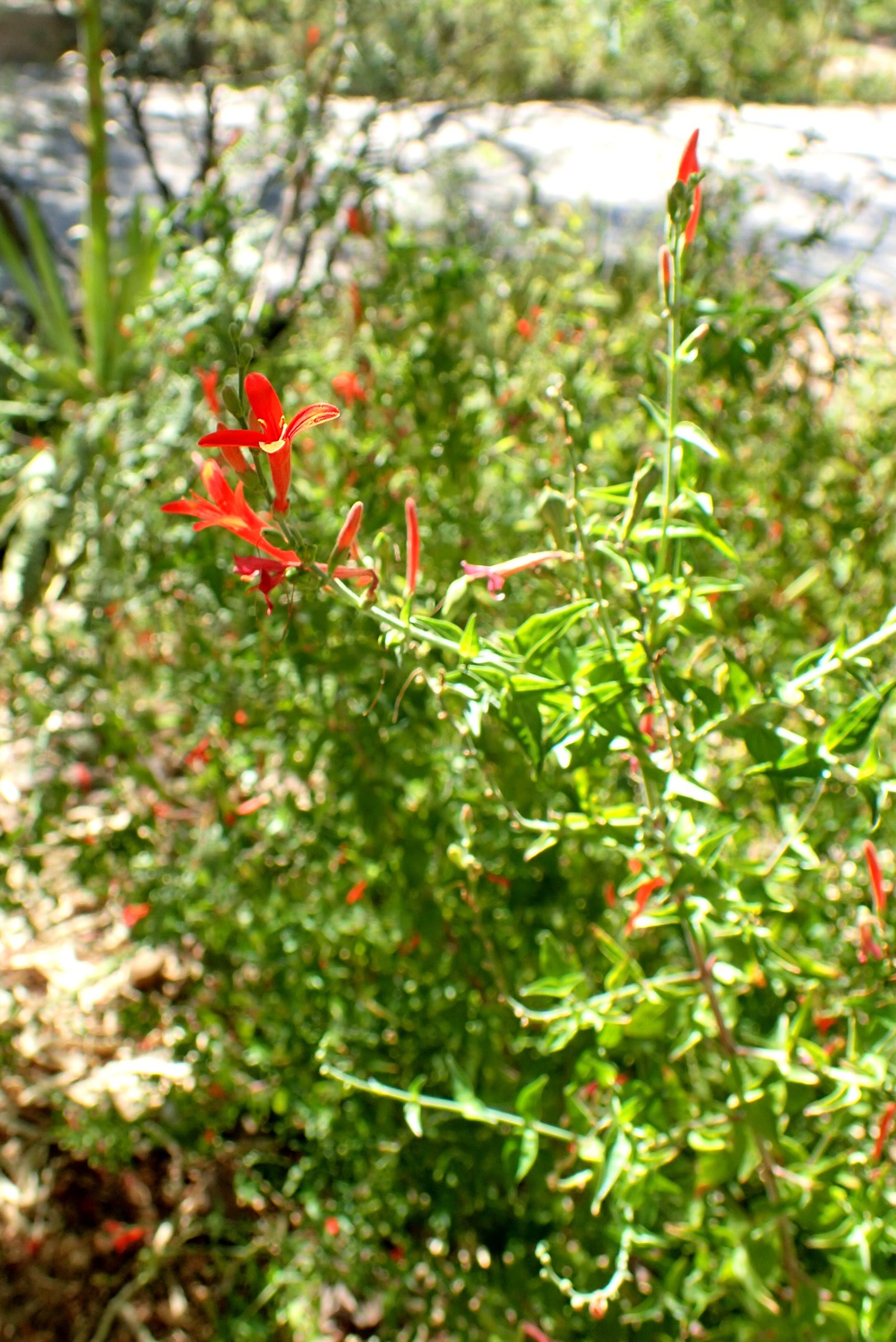
Anisacanthus quadrifidus var. wrightii, commonly called Flame Acanthus, Wright’s Desert Honeysuckle, or Hummingbird Bush, is a loose, airy deciduous shrub found only on the limestone hills and caliche flats of south-central and west Texas. It belongs to the Acanthaceae, the acanthus family, a mostly tropical group with relatively few native representatives this far north. Gardeners across the Texas Hill Country and well beyond grow it for one reason above all: from late spring until the first hard freeze, its narrow orange-red trumpets are in near-constant motion with hummingbirds.
In the wild, Flame Acanthus is a plant of tough, thin-soiled ground — rocky limestone slopes, dry washes, and caliche outcrops on the Edwards Plateau, where little else holds on through a Texas summer. It responds to rain with flushes of new flowers within days, then slows again during drought without complaint, which is exactly the kind of resilience that has made it a staple of xeriscaping and wildlife gardening throughout its native range and, informally, across much of the warmer United States.
The shrub itself is unassuming: slender gray-green stems, narrow lance-shaped leaves, and an open, wiry habit that never gets dense or heavy. It is the flowers that do the work, held out from the foliage on short side branches where hummingbirds and butterflies can reach them easily. Left alone it forms a loose 3- to 5-foot mound; cut back hard each winter it stays tidy and blooms even more freely the following season.
Identification
Flame Acanthus is a many-branched, deciduous shrub with a loose, somewhat sprawling silhouette rather than a dense, rounded one. New growth is soft and semi-woody; older stems become gray and slightly ridged. The whole plant has a light, airy quality in the landscape, letting other plants show through even when it is in full bloom.
Bark & Stems
Young stems are slender, four-angled in cross-section (a trait shared by many Acanthaceae), and pale green to gray-green with fine hairs. With age the lower stems lose the angled look and develop thin, gray-brown bark. The plant freezes to the ground in a hard winter across much of its range and resprouts vigorously from the base in spring, so most garden specimens are effectively herbaceous perennials in form even though the species is technically a woody shrub.
Leaves
Leaves are opposite, narrowly lance-shaped to elliptic, 1 to 3 inches long and less than an inch wide, tapering to a point at both ends. They are a dull gray-green, thin-textured, and smooth-margined, with a short petiole. The narrow leaf shape and gray cast are adaptations to the intense sun and shallow, rocky soils of the Edwards Plateau, reducing water loss through a smaller leaf surface.
Flowers
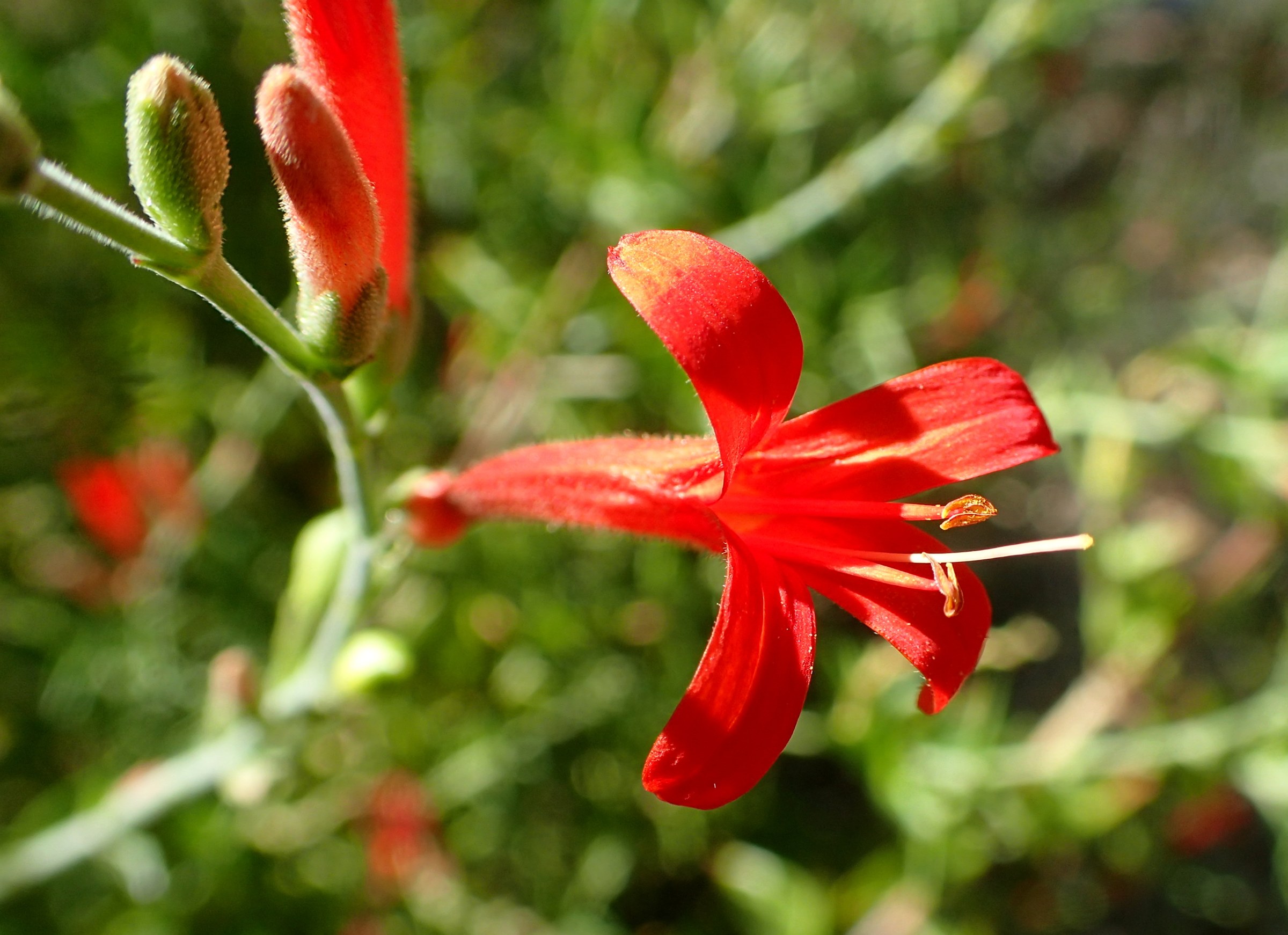
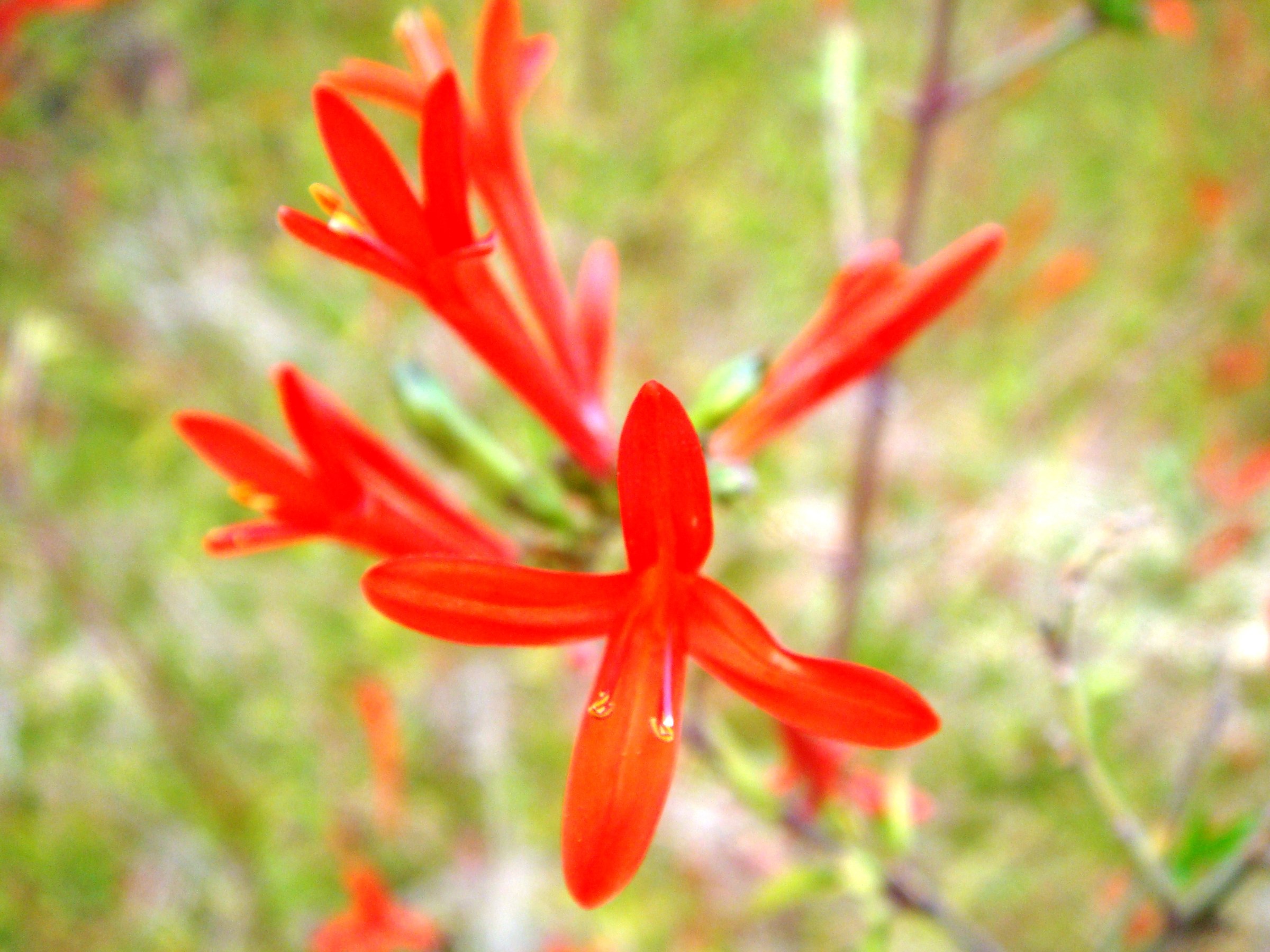
The flowers are the plant’s signature feature: slender, tubular, two-lipped corollas 1 to 1½ inches long in shades of orange-red to true scarlet, with the upper lip narrow and arching and the lower lip curved downward, exposing the long stamens. They are borne in small clusters along the upper stems, opening in flushes from late spring through fall, with the heaviest bloom typically following summer rains. Each individual flower lasts only a day or two, but the plant is rarely without some open blooms through the warm season. Variants with yellow-orange or near-yellow flowers occur occasionally, both in the wild and in cultivation, but the species is predominantly red-orange.
Fruit & Seeds
Flowers are followed by small, two-valved capsules typical of the acanthus family, which split explosively when dry to eject a few flattened seeds a short distance from the parent plant. The capsules are inconspicuous and not an ornamental feature; most gardeners never notice them among the foliage.
Quick Facts
| Scientific Name | Anisacanthus quadrifidus var. wrightii (syn. Anisacanthus wrightii) |
| Family | Acanthaceae (Acanthus) |
| Plant Type | Deciduous Shrub |
| Mature Height | 3–5 ft (to 6 ft in favorable sites) |
| Mature Spread | 3–5 ft |
| Growth Rate | Moderate to fast |
| Sun Exposure | Full Sun |
| Water Needs | Low once established |
| Soil Type | Rocky, caliche or limestone-based, well-drained |
| Soil pH | 7.0–8.5 (alkaline) |
| Bloom Time | Late spring – fall, heaviest after rain |
| Flower Color | Orange-red to scarlet (occasionally yellow-orange) |
| Fall Color | None notable; leaves drop green to yellow-green |
| Fruit | Small explosive capsules (inconspicuous) |
| Deer Resistant | Generally yes |
| USDA Hardiness Zones | 7–10 |
Native Range
Flame Acanthus is a Texas endemic in the United States, native to the Edwards Plateau and adjacent parts of south-central and west-central Texas, where it grows on limestone hills, caliche flats, and the gravelly floodplains of Hill Country rivers and creeks. Its range continues south across the Rio Grande into the states of Coahuila and Nuevo León in northern Mexico, where the broader species Anisacanthus quadrifidus extends further still.
Within Texas it is most common from roughly the Austin–San Antonio corridor west through the Hill Country toward the Trans-Pecos, favoring thin, rocky, often shallow soils over limestone bedrock. It is not native east of about the Interstate 35 corridor, and despite its wide popularity in xeriscape and hummingbird gardens throughout the warmer United States, it should not be assumed native outside this core Texas and northern Mexico range — plant it elsewhere as a garden ornamental, not as a restoration species.
Flame Acanthus tolerates the extremes typical of the Edwards Plateau: thin alkaline soils, long summer droughts, intense sun, and occasional hard freezes, resprouting readily from the base after both drought dieback and winter cold. This toughness, rather than broad geographic range, explains why it has become such a popular choice well beyond its small native footprint.
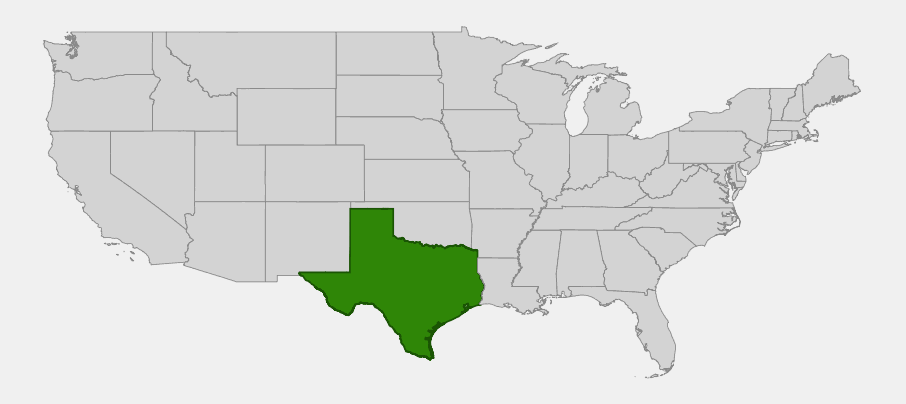
📋 Flame Acanthus’s native range falls outside the area covered by any current plantnative.org regional plant list (the closest, Arkansas/Louisiana/Eastern Oklahoma/Eastern Texas, does not reach the Edwards Plateau), so it is not yet included on a regional table.
Growing & Care Guide
Flame Acanthus is about as low-maintenance as a flowering shrub gets, provided it has the one thing it truly needs: sun. Give it a hot, well-drained spot and it will reward you with months of hummingbird traffic for very little effort on your part.
Light
Full sun is essential for good bloom. In part shade the plant stretches, flowers sparsely, and tends to flop; in a hot, reflected-heat site against a wall or driveway it thrives and blooms hardest. This is not a plant for shaded beds.
Soil & Water
Flame Acanthus wants sharp drainage above almost anything else — it is naturally a plant of thin, rocky, alkaline soils and will rot in heavy, wet clay. Caliche, limestone gravel, and decomposed granite all suit it well. Once established (after the first full growing season), it needs no supplemental water beyond normal rainfall in most of Texas, though occasional deep watering during extended drought keeps the bloom going. Avoid rich, heavily amended beds and daily irrigation, both of which encourage leggy, weak growth.
Planting Tips
Set out container plants in spring after the last frost, so the root system has a full warm season to establish before winter. Space plants 3 to 4 feet apart for a loose hedge or 4 to 5 feet apart as individual specimens. A raised bed or slope improves drainage on heavier soils. Mulch lightly with gravel or crushed limestone rather than thick organic mulch, which holds more moisture than this plant prefers.
Pruning & Maintenance
Cut the whole plant back hard — to within 6 to 12 inches of the ground — in late winter before new growth starts. This single yearly pruning keeps the naturally rangy habit tidy, encourages denser branching, and results in heavier bloom than an unpruned plant produces. In much of its range the top growth freezes back on its own most winters, effectively doing this pruning for you; simply clean up the dead stems once new growth appears at the base. No fertilizer is needed in average garden soil, and over-fertilizing tends to produce soft, floppy growth with fewer flowers.
Landscape Uses
Flame Acanthus fits naturally into several garden styles:
- Hummingbird gardens — reliably the top hummingbird plant in many Texas Hill Country yards
- Xeriscaping — minimal water once established, ideal for rock gardens and dry slopes
- Informal hedges or screens when planted in a loose row and pruned yearly
- Mixed native borders alongside Cenizo, Agarita, and other Hill Country shrubs
- Butterfly gardens — larval host for the Texan Crescent butterfly, nectar source for many others
- Caliche and limestone slope plantings where few other flowering shrubs succeed
Wildlife & Ecological Value
For a small, locally distributed shrub, Flame Acanthus punches well above its weight ecologically, concentrated almost entirely around its long bloom season.
For Pollinators
The tubular flowers are shaped for long-tongued visitors, and hummingbirds are by far the primary pollinator — Black-chinned Hummingbirds nest and feed around it throughout the Hill Country summer, and migrating Ruby-throated and Rufous Hummingbirds use it heavily in late summer and fall. Butterflies, particularly swallowtails and skippers, also nectar at the flowers, and the foliage serves as a larval host plant for the Texan Crescent butterfly (Anthanassa texana).
For Birds
Beyond hummingbirds, the dense tangle of stems at the base of an older, well-pruned plant provides cover for small ground-foraging birds, and the insects drawn to the flowers in turn attract insectivorous songbirds.
For Mammals
Flame Acanthus is browsed only lightly by White-tailed Deer compared with more palatable Hill Country shrubs, which is part of why it has become a reliable choice in deer-heavy suburban and rural Texas landscapes.
Ecosystem Role
On the thin, rocky soils where it grows wild, Flame Acanthus is one of relatively few shrubs able to establish and flower reliably, making it a locally important nectar source during the hottest, driest part of the Texas summer when many other flowering plants have shut down. Its root system helps stabilize loose caliche and limestone scree on slopes and washes.
Cultural & Historical Uses
Flame Acanthus has no major documented history of use by Indigenous peoples of the region, and it does not appear in historical ethnobotanical records the way many longer-utilized Texas natives do. Its modern significance is almost entirely horticultural: Texas native-plant nurseries and home gardeners popularized it from the mid-20th century onward as interest in low-water, wildlife-friendly landscaping grew across the Hill Country and beyond.
Today it is a signature plant of Texas native and xeriscape gardening, commonly recommended by Texas Native Plant Society chapters, Texas AgriLife Extension, and municipal water-conservation programs as a reliable, low-input alternative to thirstier ornamental shrubs. Selected forms with especially large or vividly colored flowers have been introduced into the nursery trade, but the straight species remains widely available and performs just as well in most gardens.
No medicinal or culinary use of Flame Acanthus is documented, and none should be assumed; it is grown strictly as an ornamental and wildlife plant.
Frequently Asked Questions
Is Flame Acanthus the same as Flame Anisacanthus or Hummingbird Bush?
Yes. These are all common names for Anisacanthus quadrifidus var. wrightii; “Wright’s Desert Honeysuckle” is another name seen in older references, though it is unrelated to true honeysuckles.
Will Flame Acanthus survive winter in my area?
It is reliably hardy in USDA zones 7–10. In the colder part of that range, the top growth typically freezes back to the ground each winter and resprouts from the roots in spring — this is normal and does not harm the plant’s long-term health.
Why isn’t my Flame Acanthus blooming heavily?
The most common causes are too much shade, soil that is too rich or consistently wet, or a plant that hasn’t been cut back in winter. Full sun, lean rocky soil, and an annual hard pruning in late winter together produce the heaviest bloom.
Is Flame Acanthus native to my state if I live outside Texas?
No. In the United States it is native only to Texas, concentrated on the Edwards Plateau and surrounding limestone country, with its range continuing into adjacent northern Mexico. It is widely planted as a garden ornamental across much of the warmer U.S., but it is not native outside this Texas and northern Mexico range.
Do I need to fertilize Flame Acanthus?
Generally no. It evolved on thin, nutrient-poor limestone soils, and heavy fertilizing tends to produce soft, floppy stems with fewer flowers. Average garden soil provides plenty of fertility on its own.

Looking for a nursery that carries Flame Acanthus?
Browse our native plant nursery directory: Texas