
Anacacho Orchid Tree (Bauhinia lunarioides)
Bauhinia lunarioides (also sold as Bauhinia congesta), commonly called the Anacacho orchid tree or Texasplume, is a small multi-trunked shrub or tree in the legume family (Fabaceae) found wild in only a handful of counties in south-central Texas. It takes its common name from the Anacacho Mountains west of Uvalde, where botanists first collected it, and its “orchid tree” nickname from flowers that resemble the showy blossoms of its tropical Asian relatives in the genus Bauhinia. In spring, established plants can disappear almost completely under a flush of white, orchid-shaped flowers, each with five long, slightly twisted petals.
In the wild, Anacacho orchid tree grows on dry limestone slopes and canyon rims of the Edwards Plateau and the Chihuahuan Desert fringe, rooting into thin, rocky soil where few other woody plants can compete. It typically reaches 8 to 15 feet tall with an open, airy branching habit and small, rounded, two-lobed leaves that fold slightly at the central notch — a family trait shared with redbuds and other legumes. The blue-gray-green foliage and pale, exfoliating bark give the plant a soft, almost silvery look even without flowers.
Because its entire wild population is restricted to a small corner of Texas, Anacacho orchid tree is considered uncommon in the wild and is tracked by Texas botanists, even though it is not federally listed. It has become a popular low-water landscape shrub across central and south Texas nurseries, which has helped take some collecting pressure off wild stands, but gardeners outside its native range should know this is a true Texas endemic, not a plant native to the rest of the Southwest.
Identification
Anacacho orchid tree is usually seen as a large, multi-stemmed shrub, though it can be trained as a small single-trunked tree. Mature plants form a loose, rounded crown of slender branches that often arch slightly under the weight of spring bloom.
Bark & Stems
Young stems are slender, reddish-brown, and slightly zigzag between leaf nodes. Older bark turns gray-brown and can develop thin, papery exfoliation on larger stems, though it never becomes deeply furrowed the way a mature tree trunk does. The overall silhouette stays open and twiggy rather than dense.
Leaves
Leaves are small, usually 1 to 2 inches long, rounded, and deeply notched at the tip so that each leaf forms two overlapping lobes — a bilobed shape typical of the Bauhinia genus and often compared to a butterfly or a camel’s hoofprint. The blue-green color and fine texture of the foliage are part of what make the plant attractive even when it is not in bloom.
Flowers
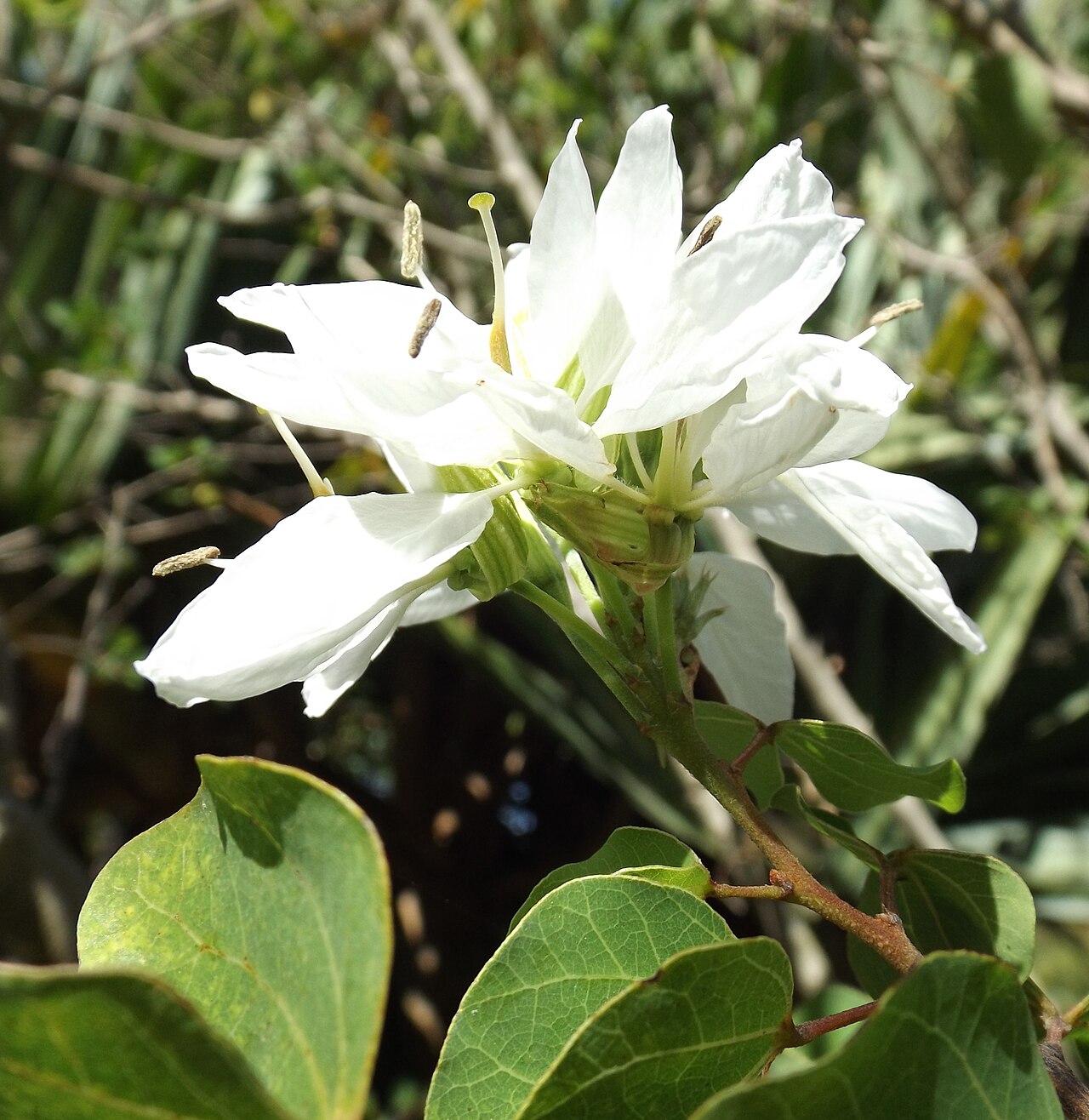
Flowers open in flushes from early spring into summer, especially after rain, and can appear sporadically into fall in mild years. Each flower is 1.5 to 2 inches across with five narrow, slightly twisted white petals (rarely blushed pink) radiating from a small green center, giving the bloom its orchid-like look. Flowers cluster at branch tips and along the stems, often covering the plant heavily enough to hide the foliage.
Fruit & Seeds
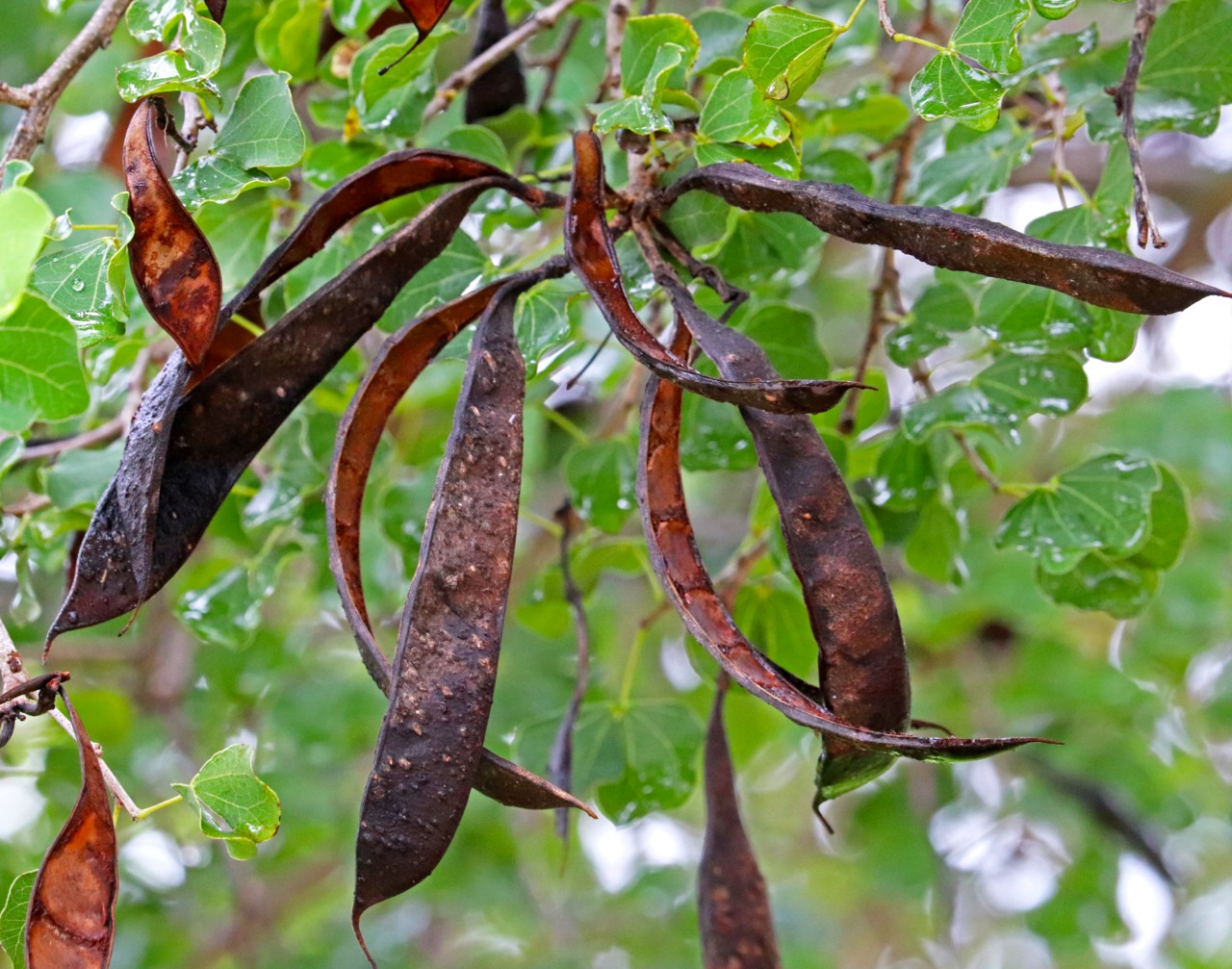
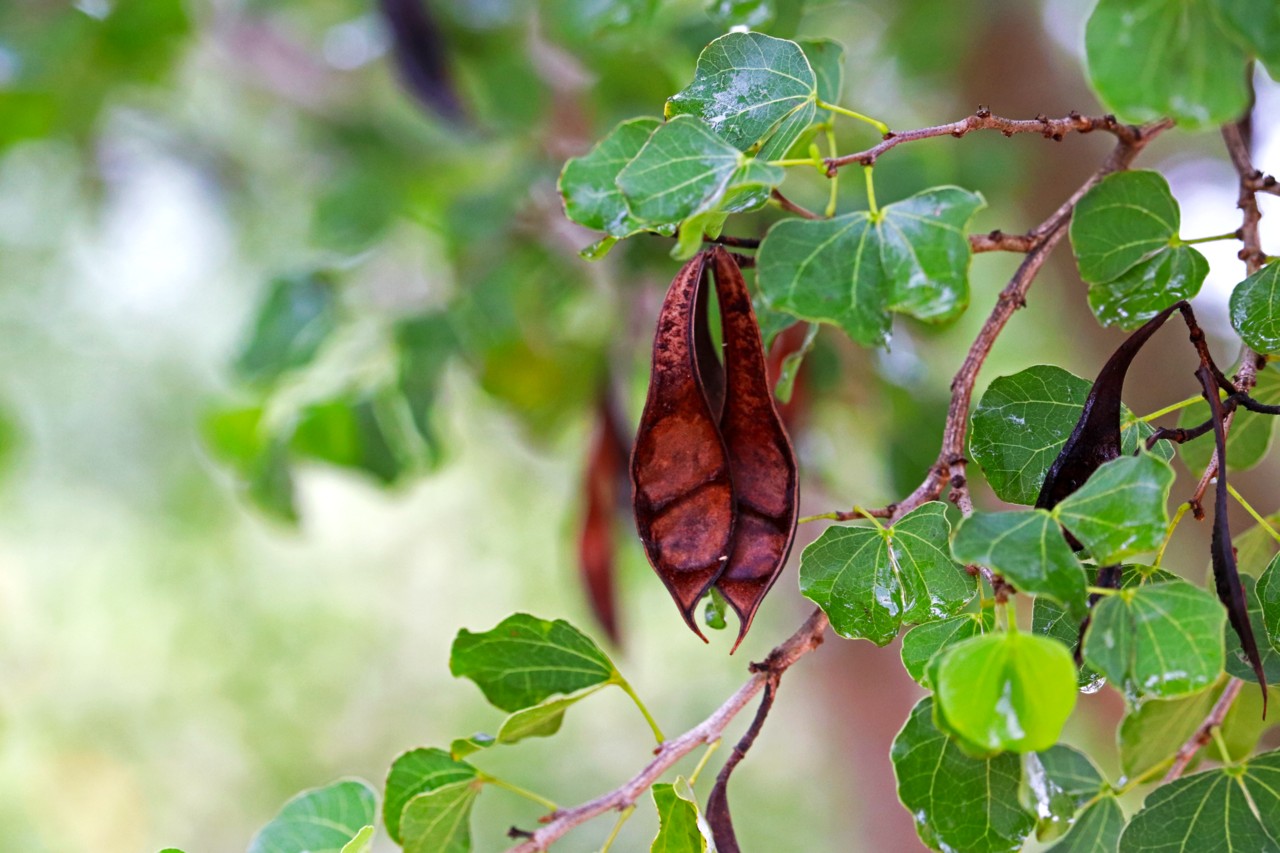
Flowers are followed by flat, narrow, elongated seed pods 3 to 6 inches long, typical of the legume family. Pods start green, ripen to reddish-brown, and persist on the branches well into winter, splitting open to release flattened brown seeds. The dried pods rattle in the wind and are a useful identification feature even when the plant is leafless.
Quick Facts
| Scientific Name | Bauhinia lunarioides (syn. Bauhinia congesta) |
| Family | Fabaceae (Legume) |
| Plant Type | Deciduous Shrub / Small Tree |
| Mature Height | 8–15 ft |
| Mature Spread | 6–10 ft |
| Growth Rate | Slow to Moderate |
| Sun Exposure | Full Sun to Part Sun |
| Water Needs | Low |
| Soil Type | Rocky, limestone, well-drained |
| Soil pH | Neutral to alkaline (7.0–8.5) |
| Bloom Time | March – October (flushes after rain) |
| Flower Color | White, occasionally blushed pink |
| Fall Color | Not showy; leaves drop green to yellow-green |
| Fruit | Flat brown legume pods, 3–6 in, persistent |
| Deer Resistant | Yes, generally |
| USDA Hardiness Zones | 8–10 |
Native Range
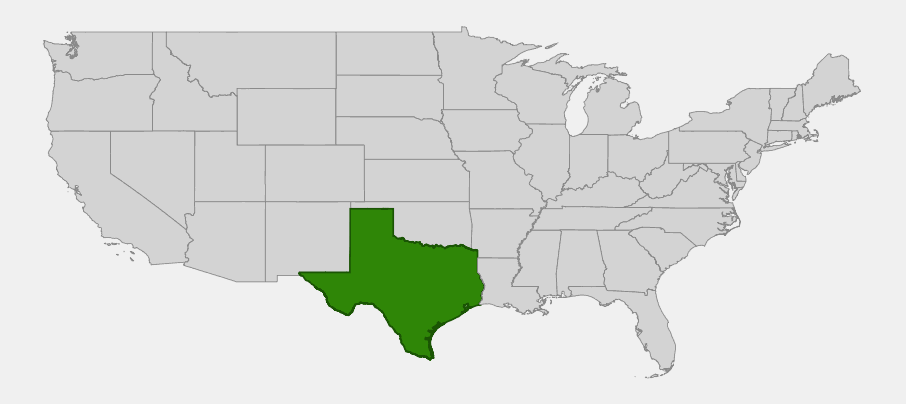
Anacacho orchid tree is a true Texas endemic. Its entire known wild distribution lies in a small cluster of counties in south-central Texas centered on the Anacacho Mountains, Edwards Plateau canyonlands, and the brushy transition toward the Rio Grande Plains — roughly the Uvalde, Kinney, and Val Verde county area. It is not native anywhere else in Texas, let alone outside the state, and the widely sold nursery plant should not be assumed native to other parts of the Southwest just because it tolerates heat and drought there.
Within this narrow range, it grows on dry, rocky limestone hillsides, canyon rims, and brushy slopes, often rooted directly into exposed caliche or thin soil pockets between boulders. It shares this tough habitat with other Edwards Plateau and Rio Grande Plains specialists such as Texas mountain laurel and cenizo, and it tolerates the extreme heat, periodic drought, and alkaline soils typical of this part of the state.
Because the native population is so geographically limited, Anacacho orchid tree is considered a plant of conservation interest in Texas even though it carries no federal protected status. Nursery propagation from cultivated stock, rather than wild collection, is the appropriate way to add it to a garden.
📋 Regional plant lists featuring Anacacho orchid tree: Its native range falls outside the counties covered by our current Texas regional plant lists, so it is not yet linked from a regional list page.
Growing & Care Guide
Anacacho orchid tree has become a favorite low-water landscape shrub in central and south Texas precisely because it asks for so little once established — the main requirements are sharp drainage and plenty of sun.
Light
Give it full sun for the heaviest bloom, though it tolerates light afternoon shade in the hottest parts of its range. Plants grown in too much shade become leggy and flower sparsely.
Soil & Water
This shrub is built for thin, rocky, alkaline soil and poor fertility. The single most important factor for long-term health is drainage — it will not tolerate soggy or heavy clay soil, especially in winter. Water regularly the first one to two growing seasons to establish a deep root system, then taper off; established plants handle long dry spells with ease and may even bloom more reliably after a good rain following drought.
Planting Tips
Plant in spring after the last frost so roots can establish before the first winter. Choose a site with excellent drainage — a raised bed, slope, or naturally rocky area is ideal. Avoid low spots where water collects. Because it is slow to moderate in growth, start with a larger container size if a quicker landscape effect is wanted.
Pruning & Maintenance
Prune lightly after the main spring flush to shape the plant or remove winter dieback; it tolerates pruning well and can be trained as a single-trunk small tree by removing competing stems while young. In the coldest parts of its hardiness range it may freeze back to the ground in a hard winter but typically resprouts from the base.
Landscape Uses
Anacacho orchid tree fits several roles in a water-wise Texas garden:
- Specimen shrub or small patio tree for its airy form and long bloom season
- Xeriscape and rock garden plantings where drainage is already good
- Screening or informal hedge when planted in groups
- Pollinator gardens paired with other Edwards Plateau natives
- Caliche and limestone slope plantings where few other shrubs thrive
Wildlife & Ecological Value
As a legume adapted to thin, dry soils, Anacacho orchid tree contributes to its tough limestone habitat beyond its ornamental appeal.
For Pollinators
The large white flowers attract bees and other pollinating insects throughout the long bloom season, providing a nectar source in a landscape where flowering shrubs can be scarce during the hottest, driest stretches of the Texas summer.
For Birds
The dense, twiggy branching offers cover and nesting structure for small songbirds in brushy canyon and slope habitat, and the open form allows birds to forage easily among the foliage.
Ecosystem Role
Like many legumes, Anacacho orchid tree can fix atmospheric nitrogen through root nodules, modestly enriching the thin, rocky soils it grows in. Its root system also helps stabilize loose caliche slopes, a useful trait in the erosion-prone canyon country of its native range.
Cultural & Historical Uses
Anacacho orchid tree was first collected and described from the Anacacho Mountains of Kinney County, Texas, in the 19th century, and it remained a little-known regional curiosity for decades. Its ornamental value — a long bloom season, drought tolerance, and a graceful, airy form — was recognized by Texas horticulturists well before the plant became widely available commercially.
Today it is grown almost entirely as a landscape ornamental rather than for any traditional or medicinal use, and it has become a signature low-water shrub in central and south Texas nurseries and public gardens, including botanical collections such as the San Antonio Botanical Garden. Its rise in cultivation has also helped raise awareness of its narrow native range and the importance of propagating from nursery stock rather than collecting from the wild.
Frequently Asked Questions
Is Anacacho orchid tree native to my state if I live outside Texas?
No. Its only wild populations are in a small area of south-central Texas. It is widely planted as an ornamental well beyond that range because of its heat and drought tolerance, but it should not be considered native outside Texas.
How cold-hardy is it?
It is reliably hardy in USDA zones 8–10. In a hard freeze at the colder end of its range, plants may die back to the ground but typically resprout from the base the following spring.
Does it need a lot of water once established?
No. After one to two seasons of regular watering to establish roots, it is quite drought tolerant and often blooms more heavily after a good rain following a dry spell.
Is Anacacho orchid tree the same as the tropical orchid trees sold in South Florida?
No. Those are usually Bauhinia or Bauhinia variegata species from Asia that are not cold-hardy and are not native anywhere in the United States. Bauhinia lunarioides is the cold-hardier Texas native species.
Will it tolerate clay soil?
Only if the clay drains well. Anacacho orchid tree is adapted to thin, rocky limestone soils and is intolerant of soggy or poorly drained clay, especially during winter dormancy.

Looking for a nursery that carries Anacacho orchid tree?
Browse our native plant nursery directory: Texas
Similar tough Texas natives worth considering alongside Anacacho orchid tree: Texas mountain laurel, cenizo, and feather dalea.