
Blackbrush (Coleogyne ramosissima)
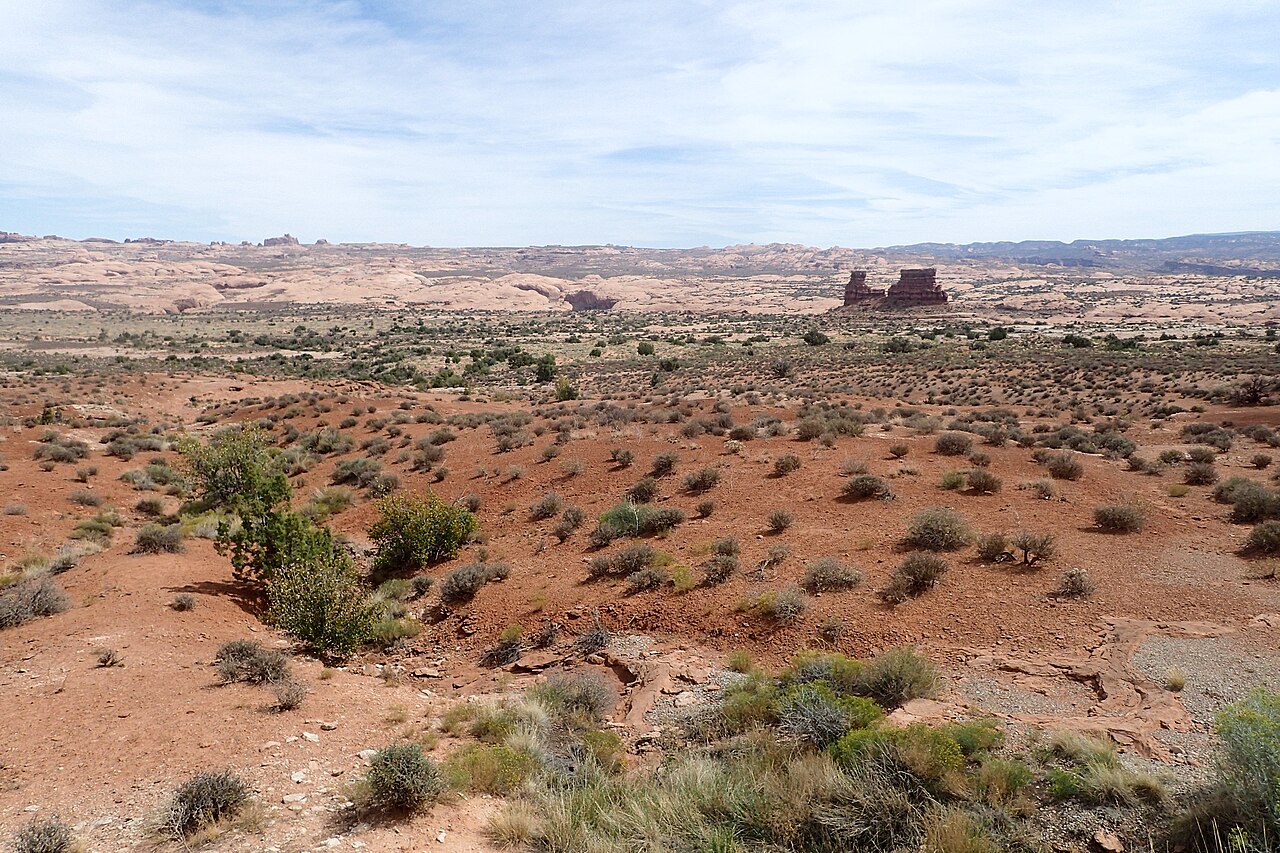
Coleogyne ramosissima, commonly called Blackbrush (also Dixie blackbrush or burrobush), is a tough, slow-growing evergreen shrub of the warm desert Southwest. It is the only species in its genus, a relative of the rose family that looks nothing like a rose: a low, rounded, densely branched shrub with small gray-green leaves and stiff, nearly thorn-tipped twigs. Blackbrush is best known not as a garden plant but as the namesake of an entire desert plant community — the “blackbrush scrub” that blankets huge stretches of the transition zone between the Mojave and Great Basin deserts.
The common name comes from its bark: the fine branches are gray when dry but darken to black when wet, so a blackbrush flat can look charcoal-colored after a desert rain. Stands are often strikingly uniform, with evenly spaced shrubs of similar size and almost no other vegetation between them — a pattern that has fascinated desert ecologists for decades and that is still not fully explained.
Blackbrush is not a plant for conventional landscaping. It grows exceedingly slowly, resents disturbance, and rarely appears in nurseries. Its value to native-plant gardeners is mostly as a long-lived, extremely drought-tolerant accent for authentic desert and xeriscape plantings within its native elevation band, and as a species worth recognizing and protecting where it already grows wild.
Identification
Blackbrush is a compact, rounded, many-branched shrub usually 1 to 6 feet (0.3–1.8 m) tall, about as wide as it is tall. Individual plants eventually split into several stem clusters as the main stem divides with age, so an old blackbrush often looks like a tight cluster of several smaller shrubs sharing one root crown.
Bark & Branches
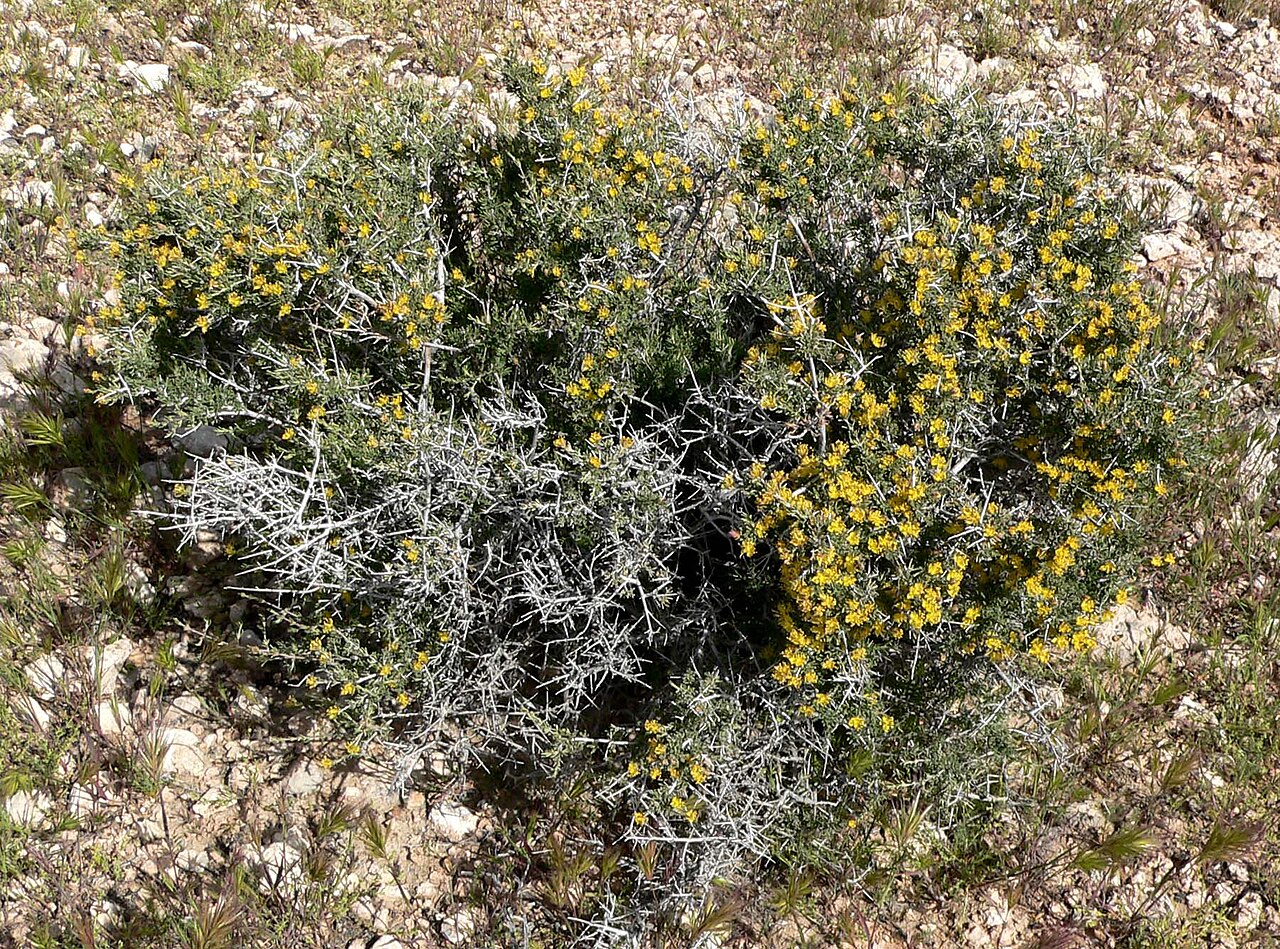
Young twigs are gray and wiry; wetted or aged bark turns black, which is the source of the common name. Terminal twigs grow for a few years, then die back several centimeters from the tip. This kills the growing point and forces side branches lower down to take over, which over years produces the shrub’s characteristic dense, tangled, spine-like branching — the “spines” are actually dead twig tips, not true thorns.
Leaves
Leaves are small, narrow, and gray-green to blue-green, clustered in tight groups along the branches. Blackbrush is technically evergreen but is also drought-deciduous: in a dry summer it sheds its older leaves and goes into a long dormancy, only to leaf out again with the first substantial rain. This makes the shrub look noticeably grayer and sparser by late summer than it does in spring.
Flowers & Fruit
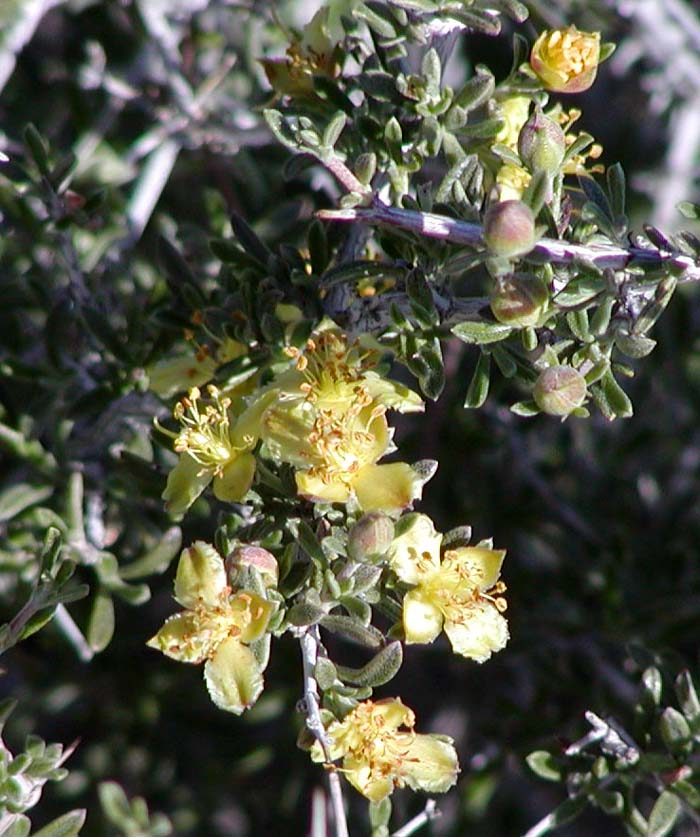
Blackbrush flowers are unusual for the rose family: they have no petals at all. What looks like a small four-parted bloom is actually four pale yellow to cream sepals, often aging toward maroon, surrounding a ring of stamens. Flowers are solitary, borne singly at the tips of young branchlets, and appear from March into May depending on elevation and winter moisture. The fruit is a small, dry, leathery achene only 3 to 4 mm long with a bent, twisted style — inconspicuous and easy to miss.
Quick Facts
| Scientific Name | Coleogyne ramosissima |
| Family | Rosaceae (Rose) |
| Plant Type | Evergreen, drought-deciduous shrub |
| Mature Height | 1–6 ft (0.3–1.8 m) |
| Growth Rate | Very slow |
| Sun Exposure | Full sun |
| Water Needs | Very low; exceptionally drought tolerant once established |
| Soil Type | Rocky, shallow, well-drained desert soils, often calcareous |
| Soil pH | Neutral to alkaline |
| Bloom Time | March – May |
| Flower Color | Pale yellow to cream sepals (no petals) |
| Fall Color | None; foliage stays gray-green, thins in dry summers |
| Fruit | Tiny dry achene, 3–4 mm, inconspicuous |
| Deer Resistant | Mostly; not preferred browse, but used by mule deer in winter |
| USDA Hardiness Zones | 7–9 |
Native Range
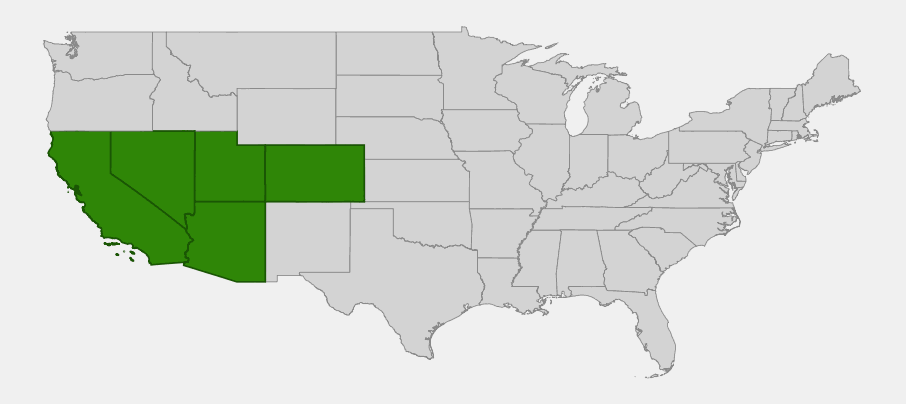
Blackbrush occupies the transition zone between the Mojave and Great Basin deserts and the western edge of the Sonoran Desert, forming a broad band from southeastern California across southern Nevada and southern Utah into northern Arizona, with its eastern limit in southwestern Colorado along the Colorado and San Juan river drainages. It typically grows between about 2,500 and 6,500 feet (760–1,980 m) elevation, usually on rocky slopes, mesas, and alluvial fans with thin, calcareous soils.
Blackbrush is not native east of this core desert region. It has been reported as a spreading, non-native brush species in rangelands of western Texas, well outside its natural distribution, so it should not be planted there or treated as a Texas native.
Where conditions suit it, blackbrush often dominates completely, forming the nearly pure “blackbrush scrub” plant community for which it is named — dense, evenly spaced shrubs with little room for anything else to grow between them. It commonly grows alongside fourwing saltbush, desert bitterbrush, shrub live oak, banana yucca, and perennial bunchgrasses such as galleta and black grama.
📋 Regional plant lists featuring Blackbrush: Utah & Western Colorado · Arizona & New Mexico
Growing & Care Guide
Blackbrush is rarely offered in the nursery trade and is not an easy or fast garden plant — it is included here mainly for gardeners restoring or landscaping within its native desert range who want strict regional authenticity, and for anyone wanting to recognize the shrub where it already grows wild. Treat it as a long-term, very low-input planting rather than a quick landscape fix.
Light
Blackbrush needs full, intense sun. It is a plant of open desert flats and slopes and has no tolerance for shade.
Soil & Water
Give it rocky, shallow, fast-draining soil — sandy or gravelly ground over caliche or bedrock mimics its wild habitat well. Most of its root mass stays in the top 4 to 12 inches of soil, spreading out rather than digging deep, so good drainage right at the surface matters more than deep soil. Once established, blackbrush needs essentially no supplemental water and should never be irrigated on a regular garden schedule; occasional deep winter watering closer to its natural rainfall pattern is safer than frequent light watering.
Planting Tips
Because germination is naturally rare and unpredictable — it typically requires cold, moist stratification followed by a wet spring, and most seedlings still die before their first summer — blackbrush is difficult to start from seed and very slow to show results even when it succeeds. Nursery-grown container stock, where available, should be planted in fall so roots can establish before summer heat. Expect minimal visible growth for years; this is a shrub grown for permanence, not speed.
Pruning & Maintenance
Blackbrush needs no pruning and is best left alone. Its tangled, apparently dead-looking branch tips are a normal part of its growth habit, not a sign of a problem to be cut back.
Landscape Uses
- Authentic desert restoration on rocky, low-elevation sites within its native range
- Xeriscape accent for gardeners wanting true regional character rather than imported desert species
- Erosion control on undisturbed rocky slopes, where its root system and the cryptogamic soil crusts that develop between plants help stabilize thin desert soils
- Wildlife habitat plantings paired with other true blackbrush-community natives such as banana yucca and big sagebrush
Fire Ecology
Blackbrush is poorly adapted to fire. Its dense, resinous, tinder-like growth carries flame readily, but the shrub does not resprout after burning and is slow to reestablish from seed, so fire can remove it from a site for decades. Where fire has swept through blackbrush stands, grasses and fast-colonizing shrubs often dominate for years afterward, and the fragile cryptogamic soil crusts between plants — an important part of the undisturbed community — can take many decades to recover. Because of this, protecting unburned blackbrush stands from fire is far more effective than trying to restore them afterward.
Wildlife & Ecological Value
Blackbrush is a foundation species of its desert community, and though it is not a preferred forage plant, it plays an outsized role simply because of how much ground it covers.
For Mammals
Blackbrush is the principal forage species for desert bighorn sheep across much of its range, and blackbrush-dominated terrain provides important bighorn habitat in Nevada and elsewhere. Mule deer browse it mainly in winter — in parts of California it has made up as much as a quarter of the winter diet — though it is not a preferred food plant for deer or pronghorn. Its spine-like dead branch tips and low proportion of accessible new growth limit how much livestock and wildlife can actually eat, which is part of why it persists so well even on heavily grazed range.
For Birds & Small Mammals
Small mammals and birds feed on blackbrush’s seeds, and rodents caching the heavy, poorly dispersed seeds are the main way new plants get started, since the fruits have no built-in mechanism for spreading far from the parent plant.
Ecosystem Role
Blackbrush stands are unusual among desert shrublands for their strikingly even spacing and near-total dominance by a single species, a pattern that helps define the look of huge areas of the Mojave–Great Basin transition and Colorado Plateau. Between the shrubs, cryptogamic (biological) soil crusts of mosses, lichens and cyanobacteria often cover a meaningful share of the ground, stabilizing soil and cycling nutrients — one more reason undisturbed stands are worth protecting rather than disturbing.
Cultural & Historical Uses
Blackbrush has left a smaller mark on written ethnobotanical history than many desert shrubs, likely because of its limited forage value and its growth in some of the most sparsely settled parts of the Southwest. It has long served as rangeland browse for livestock on the Colorado Plateau and in the Great Basin, valued more for its abundance and persistence under grazing pressure than for its quality as feed. Its deepest significance has always been ecological rather than economic: as the defining shrub of its own desert plant community, providing winter forage and cover for desert bighorn sheep and structuring enormous stretches of the warm desert landscape.
Frequently Asked Questions
Why is it called blackbrush if it isn’t black?
The fine gray twigs darken to black when wet, so after rain an entire hillside of blackbrush can take on a charcoal-black cast, even though the plants look gray the rest of the time.
Can I grow blackbrush outside the desert Southwest?
It is not recommended. Blackbrush is adapted to a very specific combination of low rainfall, intense sun, and thin, rocky, often calcareous soil at moderate desert elevation. Outside that range and elevation band it is unlikely to thrive, and it is not native east of the Mojave–Great Basin–Colorado Plateau region, including Texas.
Does blackbrush have thorns?
Not true thorns. Its tangled, spine-like look comes from terminal twigs that grow for a few years, then die back, leaving stiff, pointed dead tips among the living branches.
Is blackbrush good for pollinators?
Its flowers are wind-pollinated rather than insect-pollinated, so it is not a significant nectar or pollen source for bees. Its main wildlife value is as winter browse and cover, especially for desert bighorn sheep.
How fast does blackbrush grow?
Very slowly. It is a long-lived shrub that invests in persistence rather than speed, with seedlings establishing only rarely — typically after an unusually wet spring — and surviving plants adding height gradually over many years.

Looking for a nursery that carries Blackbrush?
Browse our native plant nursery directory: California · Nevada · Utah · Arizona · Colorado