
Dwarf Fothergilla (Fothergilla gardenii)
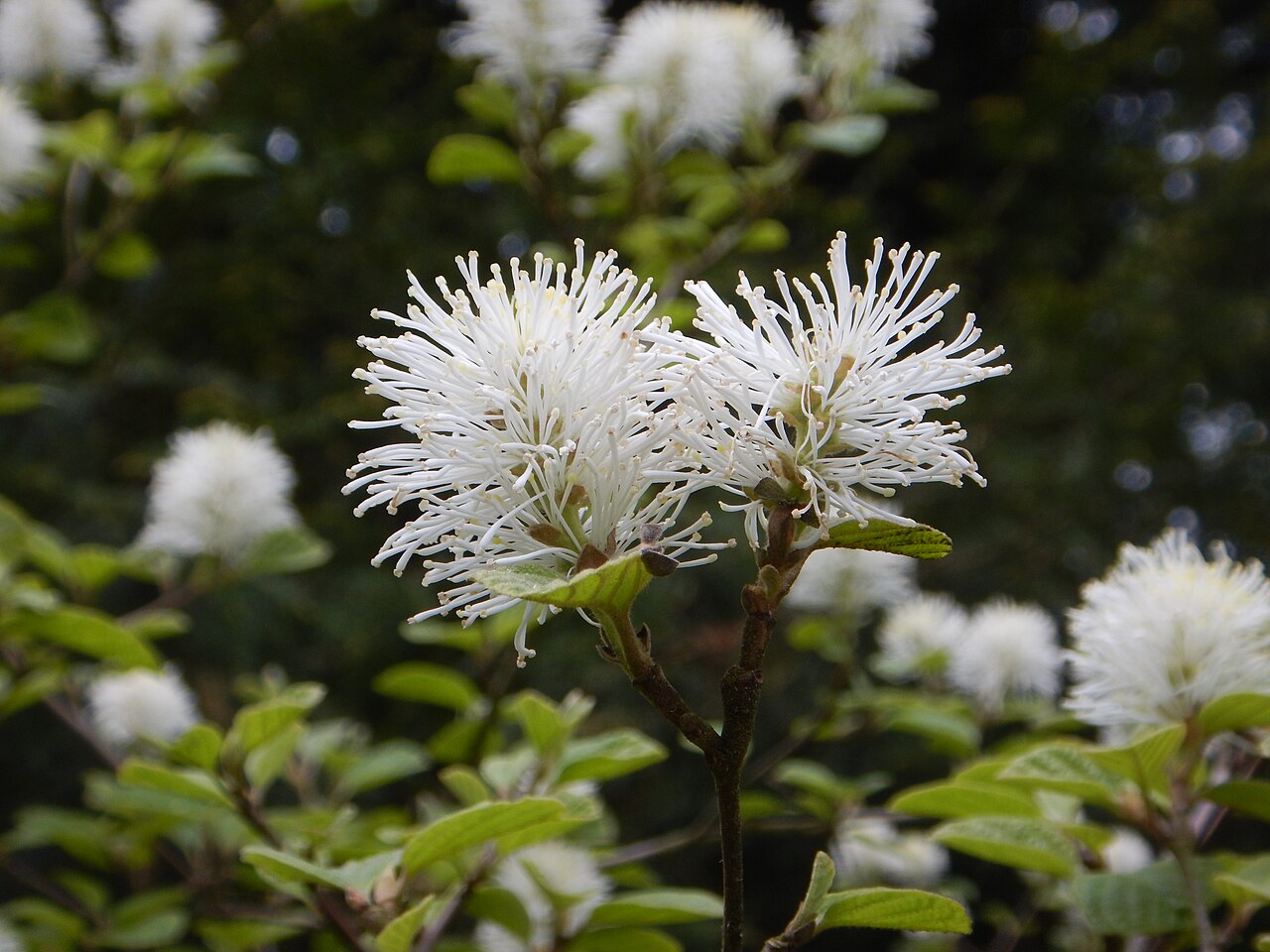
Fothergilla gardenii, commonly called Dwarf Fothergilla or Dwarf Witchalder, is a small, slow-growing deciduous shrub native to the wet pine savannas and pocosin edges of the southeastern Coastal Plain. A member of the witch-hazel family (Hamamelidaceae), it is one of only two species in its genus, and it shares that family’s knack for understated, fragrant, oddly beautiful flowers. In mid-spring, bare branches erupt with dozens of white, honey-scented, bottlebrush-shaped flower clusters, made up almost entirely of showy stamens rather than petals.
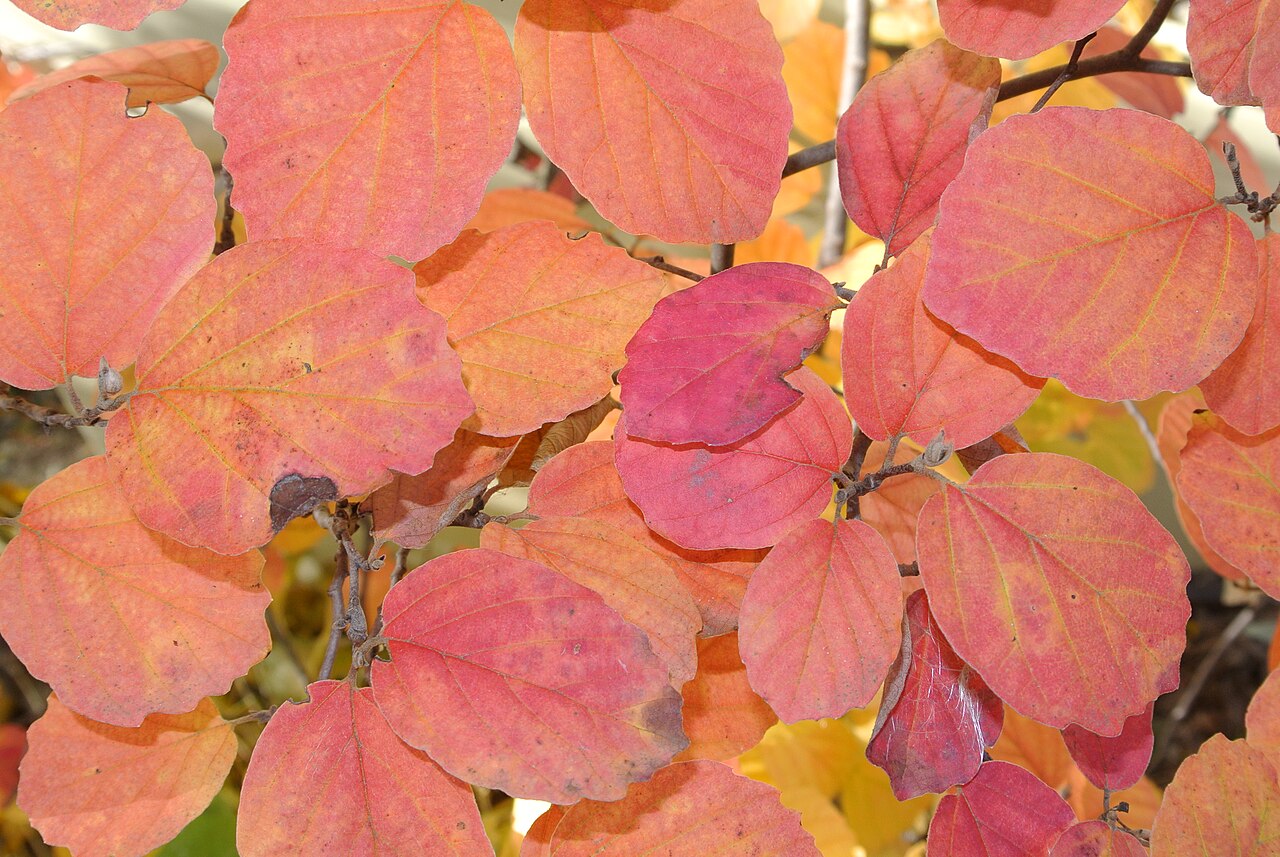
Dwarf Fothergilla stays compact, usually 2 to 3 feet tall and a bit wider, forming a dense, rounded mound through slow-spreading underground suckers. Its blue-green summer foliage is handsome on its own, but the plant saves its best trick for autumn, when the leaves turn a spectacular, often multicolored blend of yellow, orange and scarlet, frequently all on the same branch at once. Few native shrubs of this size offer three seasons of real garden interest: fragrant spring flowers, clean blue-green summer leaves, and fall color that rivals any burning bush.
In the wild, Dwarf Fothergilla is a plant of damp, acidic, sandy soils at the edges of pocosins, wet pine flatwoods and seasonally moist savannas in the coastal plain of the Carolinas, Georgia and Florida. It has become increasingly uncommon in the wild as those wetland habitats have been drained and developed, but it has become a mainstay of Southeastern native gardens, where its small size makes it useful in spots too tight for most flowering shrubs.
Identification
Dwarf Fothergilla is a low, dense, multi-stemmed shrub, typically 2 to 3 feet tall and 2 to 4 feet wide, though old colonies can form broader patches as underground stems (rhizomes) sucker outward. The overall form is rounded and twiggy, with no single dominant trunk.
Bark & Stems
Young twigs are slender, grayish-brown, and covered in fine star-shaped (stellate) hairs, a hallmark of the witch-hazel family. Older stems smooth out to a thin, gray-brown bark. Buds are naked (lacking protective bud scales), sitting exposed at the stem tips through winter, another family trait shared with witch-hazel.
Leaves
The leaves are simple, alternate, oval to obovate, 1 to 3 inches long, with a coarsely toothed or wavy margin toward the tip and a smooth base. They emerge later than the flowers, a blue-green to dull dark green above and paler, often slightly hairy beneath. In autumn the foliage turns a striking mix of yellow, orange and red, sometimes shifting color from the outer, sunnier branches inward.
Flowers & Fruit
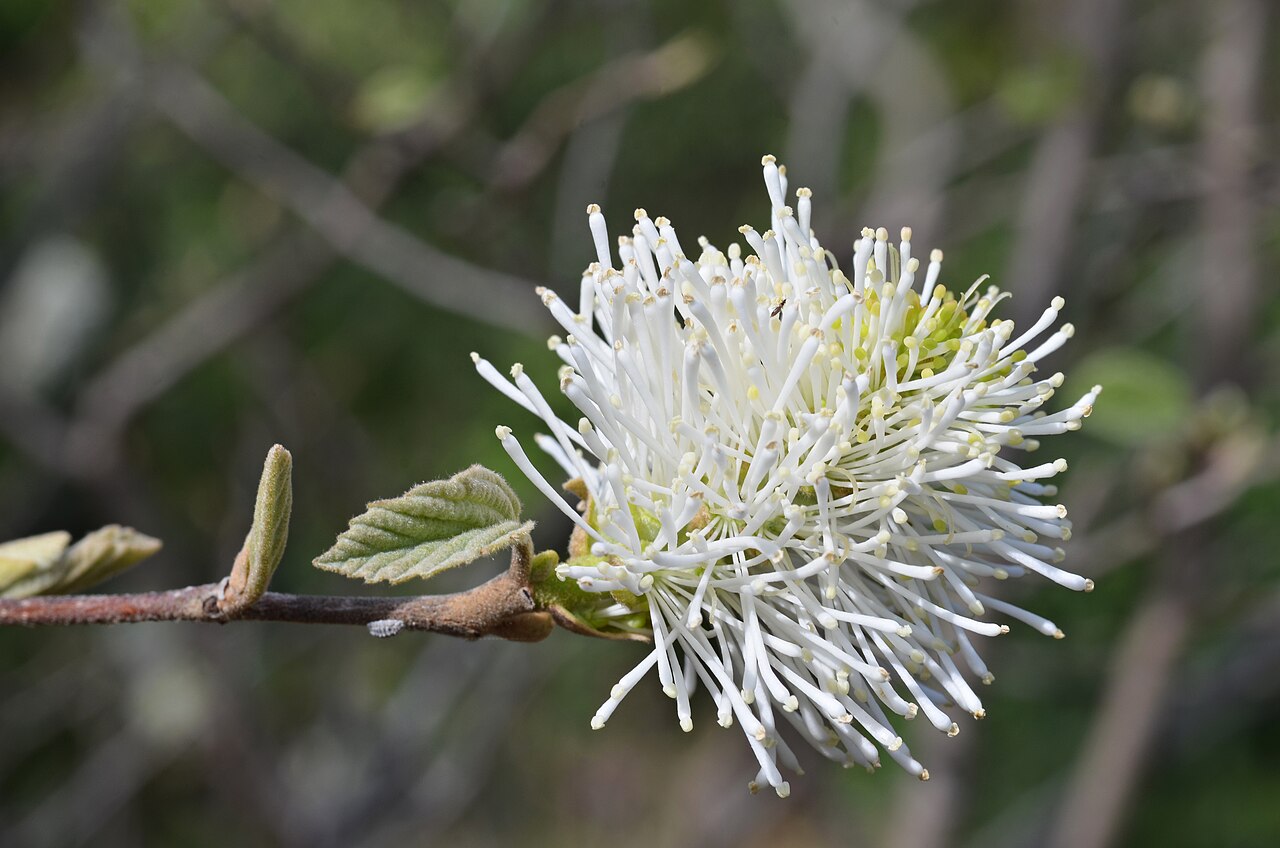
Flowers appear in early to mid-spring before or just as the leaves unfold, in upright, cylindrical spikes 1 to 2 inches long at the branch tips. Each spike is made up of many tiny flowers that lack true petals; what you actually see are dozens of long white stamens tipped with cream to yellow anthers, giving each spike its bottlebrush look. The flowers carry a light, sweet, honey-like fragrance that carries well on a still spring day. Fruit is a small, hairy, two-beaked woody capsule that matures by late summer and splits explosively, flinging its one or two shiny black seeds a short distance from the parent plant.
Quick Facts
| Scientific Name | Fothergilla gardenii |
| Family | Hamamelidaceae (Witch-hazel) |
| Plant Type | Deciduous shrub |
| Mature Height | 2–3 ft |
| Mature Spread | 2–4 ft (spreads slowly by suckers) |
| Growth Rate | Slow |
| Sun Exposure | Full Sun to Part Shade |
| Water Needs | Moderate to High; tolerates wet, boggy soil |
| Soil Type | Moist, acidic, sandy to peaty; tolerates seasonal wetness |
| Soil pH | 4.5–6.0 (acidic) |
| Bloom Time | March – April |
| Flower Color | White (stamens; no true petals) |
| Fall Color | Yellow, orange and scarlet, often mixed |
| Fruit | Small two-beaked woody capsule, splits to eject seed |
| Deer Resistant | Yes, generally deer-resistant |
| USDA Hardiness Zones | 5–9 |
Native Range
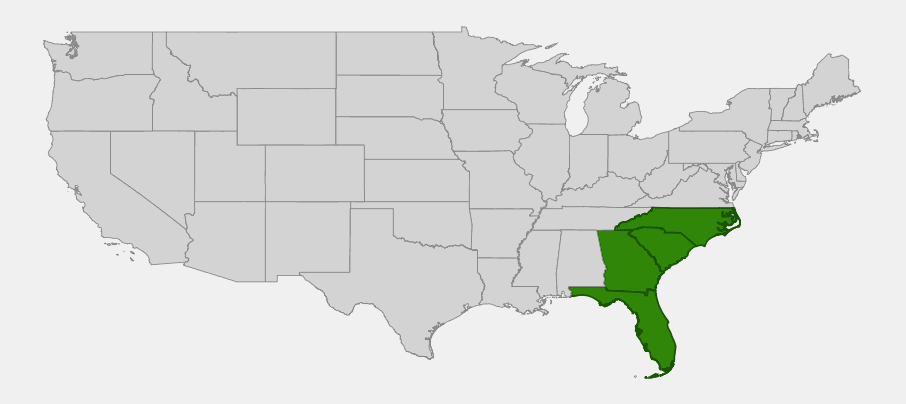
Dwarf Fothergilla is native to the Atlantic and Gulf coastal plain of the southeastern United States, from North Carolina south through South Carolina and Georgia to the Florida panhandle, with scattered, often rare populations near the Georgia–Alabama border. It is strictly a coastal plain species and does not occur naturally in the Piedmont or mountains.
Across this range it is tied to wet, acidic, sandy habitats: the edges of pocosins (shrub bogs), wet pine flatwoods and savannas, and the moist margins of bay forests, often alongside other acid-wetland shrubs. It needs consistently damp soil and full to partial sun; it is not a shade-tolerant forest-floor plant, and it struggles where soils dry out or where taller vegetation closes in overhead.
Much of its native wetland habitat has been drained, converted to pine plantation, or developed, and Dwarf Fothergilla is now considered uncommon to rare in parts of its range, including state-level rarity concern in Georgia. The species’ continued presence in cultivation — it is a popular garden shrub throughout the Southeast and well beyond — has not replaced the need to protect its remaining wild pocosin and savanna habitat.
📋 Regional plant lists featuring Dwarf Fothergilla: North Carolina & South Carolina · Georgia, Alabama & Mississippi
Growing & Care Guide
Dwarf Fothergilla has become a garden favorite for good reason: it asks for little beyond consistent moisture and gives back three distinct seasons of interest in return. It is a forgiving shrub as long as its soil does not dry out for long stretches.
Light
Full sun produces the densest flowering and the most vivid, saturated fall color. The shrub also tolerates part shade, especially with some afternoon relief in the hottest parts of its range, but flowering is lighter and fall color duller as shade increases. Avoid deep shade.
Soil & Water
Give it a moist, acidic soil — sandy, peaty or loamy — and keep it from drying out, particularly during its first two seasons in the ground. In the wild it grows at pocosin and savanna edges that stay damp much of the year, and garden plants perform best when that moisture is replicated with regular watering or a consistently moist site such as a rain garden or low spot. It does not tolerate alkaline soil well; a pH above about 6.5 can cause chlorotic (yellowing) foliage.
Planting Tips
Plant in spring or fall from container stock, spacing plants 3 to 4 feet apart for a continuous mass or hedge. A 2- to 3-inch mulch layer of pine straw or shredded bark helps hold moisture and mimics the acidic litter of its native habitat. Dwarf Fothergilla is an excellent choice for the front of a shrub border, a foundation planting, or massed along a damp swale, where its small size keeps it from overwhelming the space.
Pruning & Maintenance
Little pruning is needed. Remove dead, damaged or crossing stems after flowering in late spring; because flower buds form on old wood, pruning in winter or early spring sacrifices that year’s bloom. The shrub spreads slowly by root suckers, which can be left to widen the colony or removed if a tighter clump is wanted. It is largely free of serious pests and diseases.
Propagation
Dwarf Fothergilla is most reliably propagated from softwood cuttings taken in early summer, rooted under mist or a humidity tent. Division of rooted suckers from an established colony also works and is the simplest method for home gardeners. Seed propagation is possible but slow: the capsules eject their seeds explosively at maturity, and the seeds typically need a warm, then cold stratification period before they will germinate, often taking until the second spring.
Landscape Uses
- Foundation and entry plantings, where its small size and tidy habit fit tight spaces
- Rain gardens and damp low spots that stay too wet for many other flowering shrubs
- Mixed shrub borders, paired with other acid-loving wetland-edge natives
- Massed plantings or low hedges along a path, where the spring fragrance can be appreciated up close
- Fall color accents near patios and windows where the multicolored foliage can be seen
- Pollinator gardens, since the early, fragrant flowers draw bees before most other shrubs bloom
Wildlife & Ecological Value
Dwarf Fothergilla’s early, abundant, fragrant flowers make it a valuable nectar source in the brief window between winter and the main spring flush, while its wetland-edge habitat supports a community of coastal plain insects and birds.
For Pollinators
The honey-scented flowers, blooming before or alongside the leaves, draw native bees, honeybees, flies and butterflies at a time when relatively few other woody plants are in bloom. Because the flowers lack petals and nectar guides, their fragrance does most of the work of attracting pollinators from a distance.
For Birds
The dense, twiggy growth form offers good low cover and nesting structure for small songbirds that frequent shrubby pocosin and savanna edges, including towhees and sparrows. Insects drawn to the spring flowers and summer foliage, in turn, supply food for insectivorous birds feeding their young.
For Mammals
Dwarf Fothergilla is not a major food source for large mammals, and its relative lack of palatability is part of why it is considered deer-resistant. Small mammals use the dense branching for cover, as they do with many pocosin-edge shrubs.
Ecosystem Role
As a low shrub-layer species in wet pine savannas and pocosin margins, Dwarf Fothergilla adds structural diversity to habitats that are otherwise dominated by taller shrubs and pines. Its tolerance of seasonally saturated, acidic soils lets it fill a niche few other flowering shrubs occupy, helping stabilize soil and moderate moisture at these wetland edges.
Cultural & Historical Uses
Dwarf Fothergilla has no significant history as a food, fiber or medicinal plant among Indigenous peoples of the Southeast, likely owing to its small size, restricted wetland habitat and lack of notably useful parts. Its historical significance is almost entirely botanical and horticultural rather than practical.
The genus Fothergilla was named in the 18th century for Dr. John Fothergill, an English physician and botanist who cultivated rare American plants in his garden near London, while the species name gardenii honors Alexander Garden, the Scottish-American naturalist for whom the gardenia is also named. Early botanical explorers collecting in the Carolina lowcountry sent specimens and live plants back to European gardens, where the shrub’s unusual petal-less flowers attracted considerable curiosity.
In the 20th century, as pocosin wetlands across the coastal plain were increasingly drained for agriculture and silviculture, Dwarf Fothergilla moved from a wild curiosity to a cultivated staple, prized by nurseries and landscape designers for its compact size and reliable multi-season show. Today it is one of the most widely planted native shrubs from the Southeast, grown in gardens well north and west of its small natural range.
Frequently Asked Questions
Does Dwarf Fothergilla need wet soil?
It needs consistently moist soil, not standing water. In the wild it grows at the damp edges of pocosins and wet pine savannas, so garden plants do best with regular water and struggle if the soil is allowed to dry out for long periods, especially while young.
Why didn’t my Dwarf Fothergilla flower this year?
Flower buds form on the previous year’s wood, so pruning in late winter or early spring removes the coming season’s blooms. Prune only right after flowering finishes. Poor flowering can also follow deep shade, alkaline soil, or a hard late frost on the opening buds.
Is Dwarf Fothergilla the same as Large Fothergilla?
No. Fothergilla gardenii (Dwarf Fothergilla) stays under 3 feet and is native to the coastal plain. Fothergilla major (Large Fothergilla) grows 6 to 10 feet tall and is native farther inland in the southern Appalachians. Many popular nursery cultivars are hybrids between the two.
Is Dwarf Fothergilla deer resistant?
Generally yes. It is rarely a preferred browse for deer, though in areas with heavy deer pressure and little else to eat, any plant can be sampled. It is considered one of the more reliably deer-resistant flowering native shrubs.
Can Dwarf Fothergilla grow outside its native coastal plain range?
Yes — it is winter hardy to USDA zone 5 and is widely grown well north and west of its small natural range in North Carolina, South Carolina, Georgia and Florida, as long as gardeners provide the acidic, consistently moist soil it needs.

Looking for a nursery that carries Dwarf Fothergilla?
Browse our native plant nursery directory: North Carolina · South Carolina · Georgia & Florida