
Coyote Bush (Baccharis pilularis)
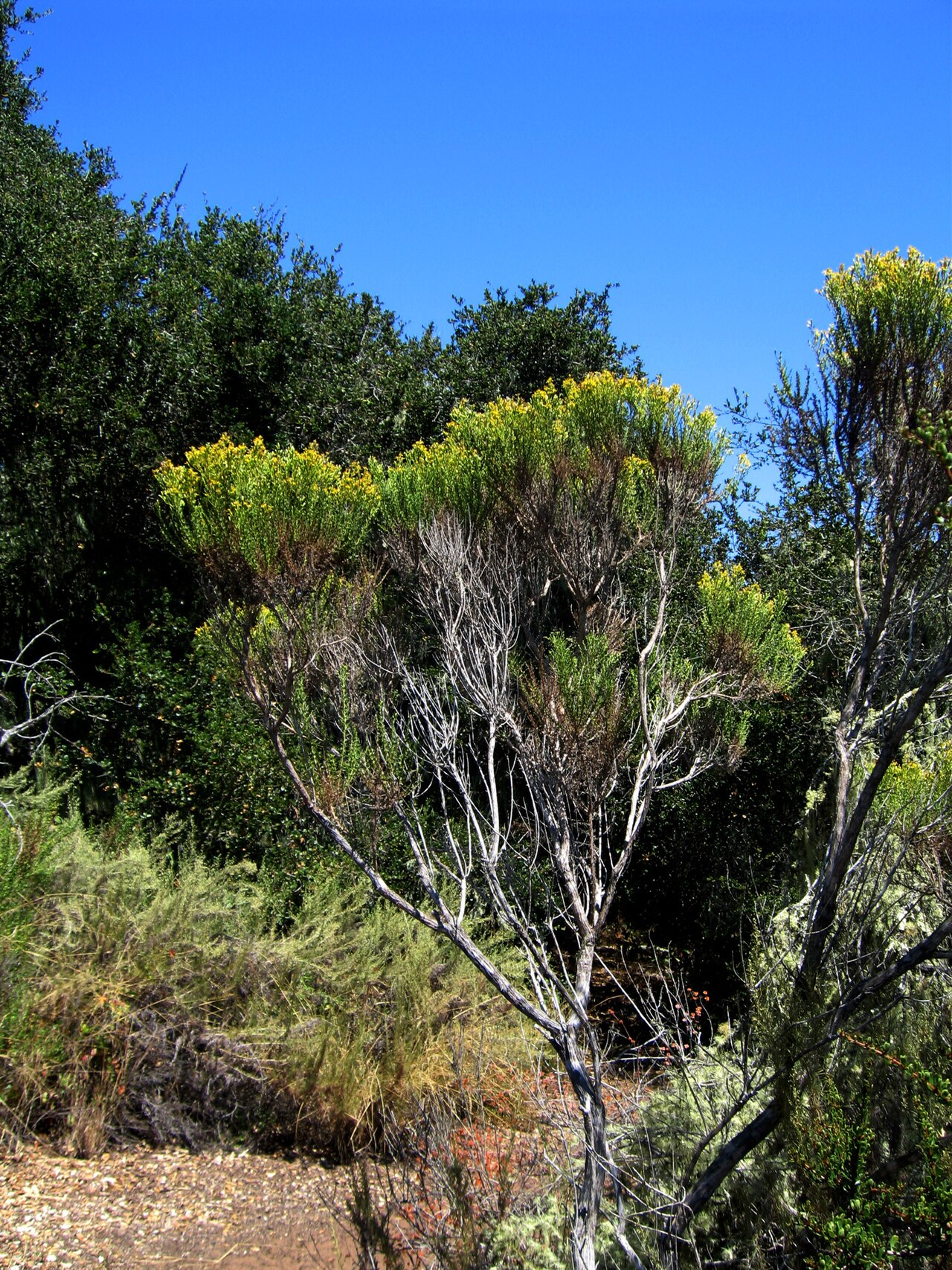
Baccharis pilularis, known as Coyote Bush or Coyote Brush, is an evergreen shrub in the Asteraceae (aster/sunflower family) native to the California coast and a narrow strip of the southern Oregon coast. It is one of the most widely planted California native shrubs, valued equally for its toughness in difficult sites and for the extraordinary number of insects and birds it supports, especially in fall when the female plants burst into a haze of fluffy white seed heads.
Coyote Bush grows in two distinct forms. The straight species and its “upright” cultivated selections form a dense, rounded shrub 3 to 10 feet tall and as wide, with small, wedge-shaped, leathery evergreen leaves. A separate, naturally occurring prostrate form — sold under cultivar names like ‘Pigeon Point’ and ‘Twin Peaks’ — hugs the ground at 1 to 2 feet tall and spreads several feet across, making it one of the most popular low-water groundcovers in California horticulture. Both forms are dioecious, meaning individual plants are either male or female, a detail that matters for how the shrub looks and performs in the garden.
However it is grown, Coyote Bush is exceptionally tough: wind-resistant, salt-tolerant, deep-rooted, and able to thrive on poor, rocky, or sandy soil with no summer water once established. It also does more ecological work per square foot than almost any other California native shrub, serving as a critical late-season nectar source when most other plants have finished blooming for the year.
Identification
Coyote Bush is an evergreen, multi-stemmed shrub with fine-textured, resinous foliage and a dense, twiggy branching structure.
Stems
Stems are slender, woody, and much-branched, ranging from upright and rounded in the typical shrub form to trailing and mat-forming in the prostrate form. Young growth is often slightly sticky to the touch from resin.
Leaves
Leaves are small — typically ½ to 1 inch long — alternate, evergreen, and wedge-shaped to oval, widest near the tip and tapering to the base, with a few coarse teeth along the upper margin. They are leathery, bright to deep green, and thick enough to resist moisture loss through the dry California summer.
Flowers
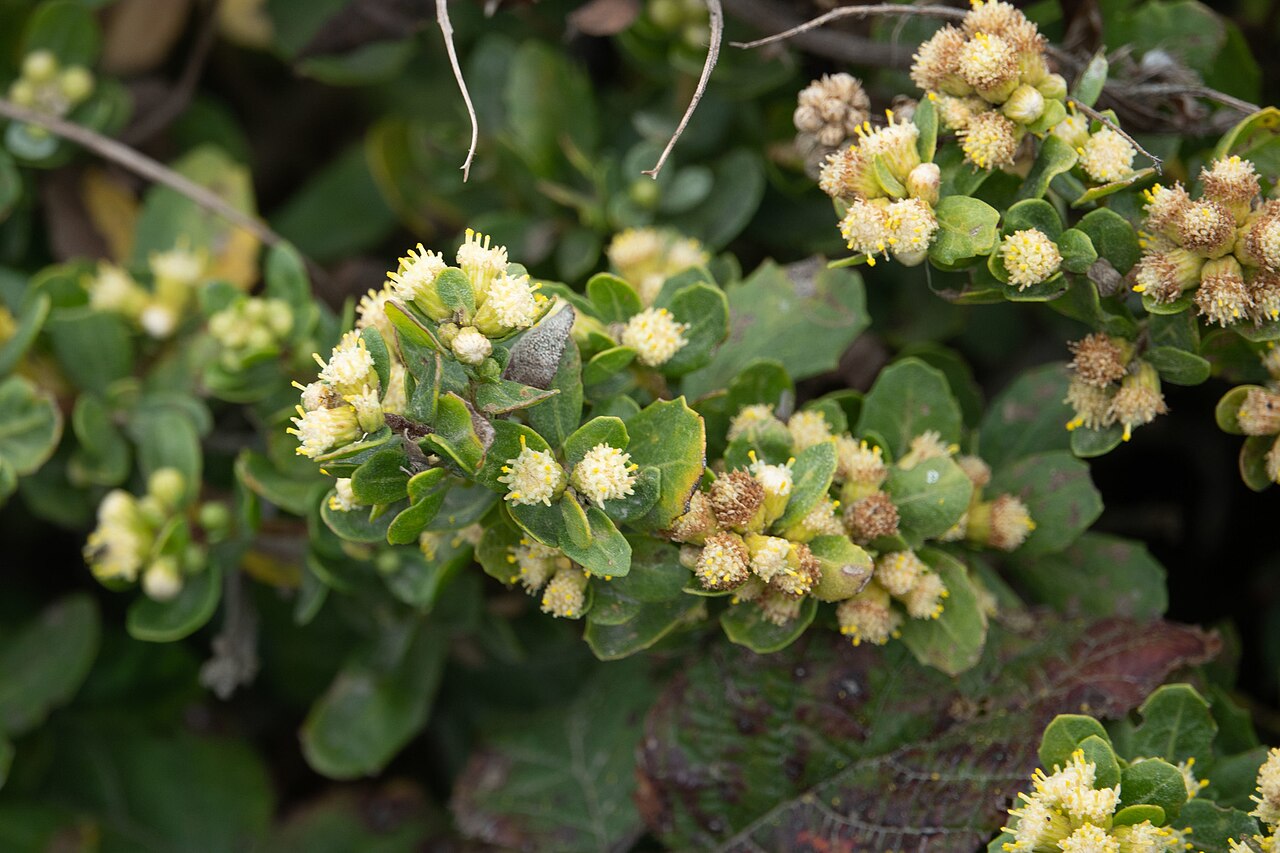
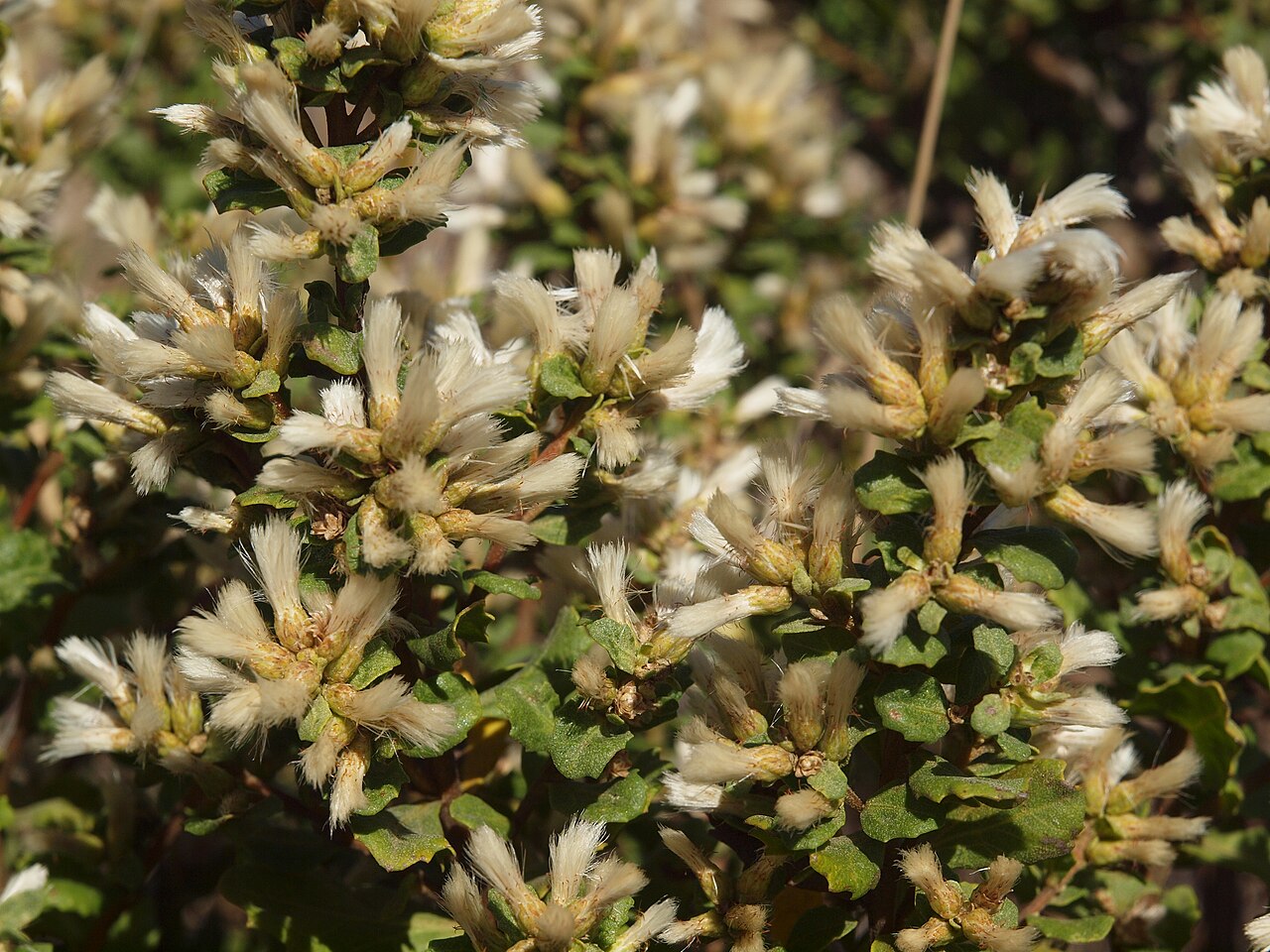
Because the species is dioecious, male and female flower heads look quite different and appear on separate plants. Male plants produce small, rounded, creamy-yellow flower heads packed with disk flowers and pollen. Female plants produce flower heads that mature into a mass of fine white silky bristles (pappus) attached to the seeds, giving female shrubs a snowy, cottony appearance in late fall that is often mistaken for a bloom in its own right. Flowering runs from August into November, peaking when little else in the coastal landscape is in flower.
Fruit & Seeds
The fruit is a tiny, dry achene tipped with the showy white pappus, dispersed on the wind much like a dandelion seed. A single large female shrub can release an enormous number of seeds, which is part of why nurseries and many home gardeners favor male selections for tidier, non-seeding landscape plantings.
Quick Facts
| Scientific Name | Baccharis pilularis |
| Family | Asteraceae (Aster/Sunflower) |
| Plant Type | Evergreen Shrub (upright or prostrate forms) |
| Mature Height | 1–2 ft (groundcover form) or 3–10 ft (upright form) |
| Mature Spread | 3–8 ft |
| Growth Rate | Fast |
| Sun Exposure | Full Sun to Light Shade |
| Water Needs | Low once established |
| Soil Type | Adaptable; thrives in poor, sandy or rocky soil |
| Soil pH | 6.0–8.0 (neutral to slightly alkaline) |
| Bloom Time | August – November |
| Flower Color | Creamy-yellow (male) / white-tufted (female) |
| Fall Color | Evergreen; female plants turn cottony-white with seed |
| Fruit | Tiny achenes with silky white pappus |
| Deer Resistant | Mostly (resinous foliage is rarely browsed) |
| USDA Hardiness Zones | 8–11 |
Native Range
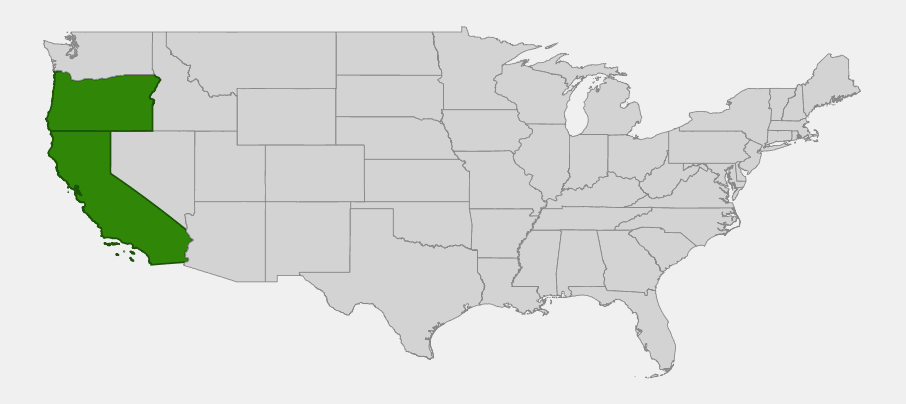
Coyote Bush is native to the immediate California coast and near-coastal hills, from the Oregon border south to Baja California, and it also occurs somewhat inland in the Sierra Nevada foothills and parts of the Central Valley margins. Its range extends a short distance north across the border into coastal southwestern Oregon, roughly as far as the Coos Bay area, but it is not native to Washington state — plants sold or seen further north are garden escapes or plantings, not wild populations.
Across this range, Coyote Bush is a dominant or co-dominant shrub of coastal scrub and coastal bluff plant communities, and it also colonizes chaparral margins, grassland edges, and disturbed sites such as old fields and roadcuts. It tolerates salt spray and strong onshore winds better than almost any other native shrub, which is why it so often forms the first line of woody vegetation right at the immediate coast.
Because of its wide cultivation as a landscape and erosion-control plant, Coyote Bush is now found well outside this native range in gardens and revegetation projects throughout the West. Gardeners in states beyond California and the southern Oregon coast should treat it as a non-native (if generally well-behaved) introduction rather than a local native species.
📋 Regional plant lists featuring Coyote Bush: Western Oregon & Western Washington (native to the western Oregon portion only)
Growing & Care Guide
Coyote Bush is about as low-maintenance as native shrubs get, which is why it shows up everywhere from freeway medians to high-end coastal gardens. The main decisions gardeners need to make are which form to plant and how much, if any, pruning to commit to.
Light
Full sun produces the densest, most compact growth and the heaviest flowering. Plants tolerate light shade, especially inland where afternoon shade can reduce stress, but become looser and less floriferous as shade increases.
Soil & Water
This is a shrub built for lean conditions: it thrives in poor, sandy, rocky, or clay soils with little organic matter, and established plants need no supplemental irrigation in coastal California’s Mediterranean climate. New plantings benefit from regular water through their first summer to establish a deep root system; after that, occasional deep watering during extended drought is plenty, and overwatering (especially with poor drainage) is a more common problem than underwatering.
Planting Tips
Plant from containers in fall or early spring to take advantage of winter rains for establishment. Space upright forms 4 to 6 feet apart for a continuous hedge or screen, or wider for individual specimens; space the prostrate groundcover form 3 to 5 feet apart to fill in within a season or two. If a tidy, non-seeding planting is the goal, look for male cultivars at the nursery — most named groundcover selections such as ‘Pigeon Point’ and ‘Twin Peaks’ are male clones precisely for this reason.
Pruning & Maintenance
Coyote Bush tolerates hard pruning well and responds with dense new growth, making it a good choice for a clipped hedge as well as an informal shrub. Prune in late winter before new growth begins, or shear lightly through the growing season to maintain a tidy shape. Because the resinous foliage and twiggy structure can carry fire readily if the planting becomes dry, woody, and neglected, periodic pruning to remove dead wood and keep growth fresh is especially important in fire-prone areas, and plantings near structures should be kept well-irrigated and thinned rather than left to grow unchecked.
Landscape Uses
Coyote Bush fills a wide range of landscape roles:
- Erosion control on slopes, bluffs, and disturbed banks
- Low-water groundcover using prostrate cultivars
- Informal or clipped hedges and screens using upright forms
- Coastal and wind-exposed gardens where salt spray limits other choices
- Pollinator gardens, filling the late-season nectar gap
- Habitat restoration and revegetation projects
Wildlife & Ecological Value
Few California native shrubs support as much wildlife activity as Coyote Bush, largely because its fall bloom period fills a nectar gap left by most other plants.
For Pollinators
The male flower heads are a magnet for a huge range of insects from August through November — native bees, honeybees, syrphid flies, beetles, wasps, and butterflies all feed on the abundant pollen and nectar at a time when little else is flowering in coastal scrub and chaparral. Entomologists studying California native plants have repeatedly found Coyote Bush in bloom to host one of the highest diversities of insect visitors of any native shrub.
For Birds
The dense, twiggy structure provides excellent nesting cover and shelter for small birds such as wrentits, California towhees, and various sparrows, while the insects drawn to its flowers and foliage supply an important food source for insectivorous birds, particularly during fall migration.
For Other Wildlife
Coyote Bush thickets provide cover for small mammals, and the plant serves as a larval host for several moth and butterfly species. Its resinous, somewhat bitter foliage is not a preferred browse for deer, which makes it a reliable choice in areas with heavy deer pressure.
Fire Ecology
Coyote Bush is adapted to the fire regimes of California’s chaparral and coastal scrub communities and typically resprouts vigorously from the root crown after fire, while also regenerating readily from the abundant wind-dispersed seed of surviving nearby plants. This resilience is part of why it is often one of the first native shrubs to recolonize burned or disturbed ground.
Cultural & Historical Uses
Coyote Bush does not carry the extensive documented ethnobotanical record of some California native plants, but it has long been recognized by Indigenous peoples of the California coast as a common, hardy component of the coastal scrub landscape, and its wood and brushy stems saw occasional use as kindling and small construction material where more substantial wood was scarce near the open coast.
In more recent history, Coyote Bush became a cornerstone of California’s native plant horticulture movement starting in the mid-20th century, when plant breeders and native plant nurseries selected low, dense, male groundcover forms for erosion control and low-water landscaping. Selections like ‘Pigeon Point’ and ‘Twin Peaks’ remain some of the most widely sold native groundcovers in the state, used everywhere from freeway plantings to residential slopes.
Today, Coyote Bush is also a frequent subject of fire-adapted landscaping guidance in California, where its drought tolerance is weighed against the flammability of unmaintained, woody specimens. Most fire-safety resources recommend it with the caveat that it should be kept pruned, well-spaced from structures, and not allowed to accumulate dead wood — a reminder that even a fire-adapted native shrub needs some stewardship close to a home.
Frequently Asked Questions
Is Coyote Bush the same as Coyote Brush?
Yes, these are simply two common names for the same species, Baccharis pilularis. “Coyote Brush” is especially common in California horticultural references.
Why does my Coyote Bush never flower?
It may be a male plant, which produces small yellow flower heads that are easy to overlook, rather than the showier white, cottony female flower heads. Both sexes flower — the female display is simply more conspicuous.
Is Coyote Bush native to Washington state?
No. Its native range reaches only the southern Oregon coast; plants grown further north, including in Washington, are garden introductions rather than wild native populations.
Is Coyote Bush a fire hazard?
Like most woody shrubs, an old, dry, neglected Coyote Bush can carry fire. Kept pruned, irrigated during establishment, and free of accumulated dead wood, it is a standard component of defensible-space and fire-wise native landscaping in California, but it should not be planted unmaintained right against a structure.
Can I use Coyote Bush as a lawn substitute?
The prostrate groundcover selections make an attractive, low-water, no-mow alternative to turf on slopes and in informal areas, though they are not foot-traffic tolerant the way an actual lawn is, so they work best as a visual groundcover rather than a walkable surface.

Looking for a nursery that carries Coyote Bush?
Browse our native plant nursery directory: California · Oregon