
Table Mountain Pine (Pinus pungens)
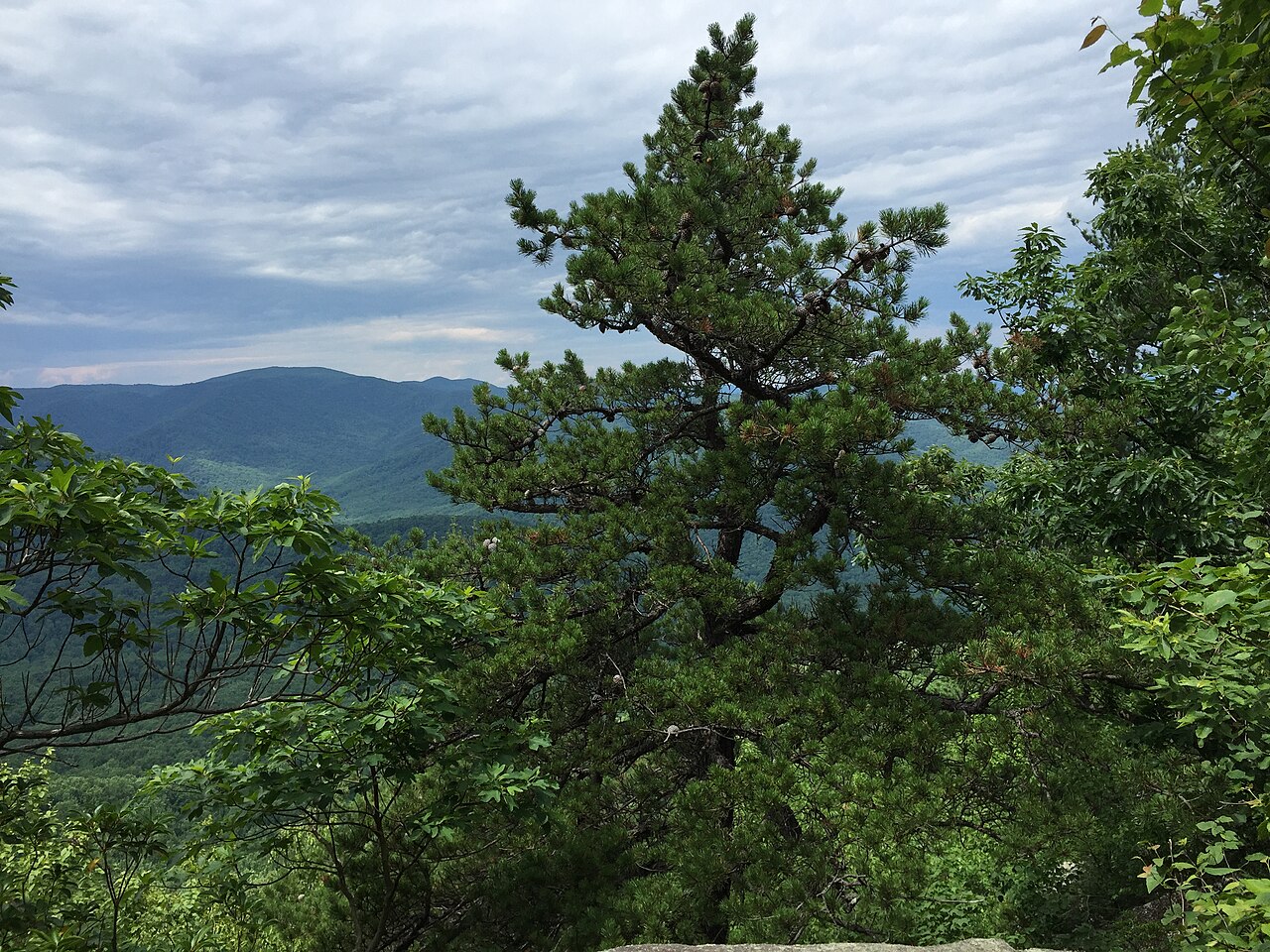
Pinus pungens, commonly called Table Mountain Pine (also hickory pine, prickly pine, or mountain pine), is a tough, scrappy little conifer found almost nowhere outside the central and southern Appalachian Mountains. It is one of the most narrowly distributed pines in eastern North America, growing on dry, rocky ridgelines and exposed outcrops where few other trees can get a foothold. The name comes from Table Rock in North Carolina’s Blue Ridge, one of the rugged landforms where this pine is typically found.
This is not a graceful landscape tree. Table Mountain Pine is usually short, gnarled, and irregular, shaped by wind and poor soil into a picturesque, windswept form that looks older than its years. Its stout, curved-spine cones are among the most distinctive of any American pine, clinging tightly to the branches — sometimes for decades — until a fire finally opens them. That fire dependence is central to the species’ story: Table Mountain Pine is a classic fire-adapted tree of the dry Appalachian ridge, and decades of fire suppression across its range have made regeneration increasingly rare.
For most home gardeners, Table Mountain Pine is a specialty tree rather than an everyday landscape choice. It belongs on dry, rocky, sun-baked sites in the mountains and piedmont of its native range, where it can be nearly impossible to grow anything else. Used there — on a ridge-top garden, a rock garden, or a restoration planting on thin mountain soil — it is an authentic and ecologically valuable native conifer that few nurseries offer and even fewer gardens contain.
Identification
Table Mountain Pine is a small to medium pine, typically 20 to 40 feet tall (occasionally to 60 feet on better sites), with a short trunk, often leaning or twisted, and an irregular, open, flat-topped or rounded crown. Many wild trees look more like wind-sculpted bonsai than typical forest pines, especially on the driest, most exposed ridges.
Bark & Stems
Young bark is reddish-brown and scaly; with age it becomes thick, dark gray-brown, and deeply furrowed into irregular plates. Branches are stout and often twisted, radiating unevenly from the trunk rather than in the tidy whorls typical of many pines, which contributes to the species’ ragged, characterful silhouette.
Needles
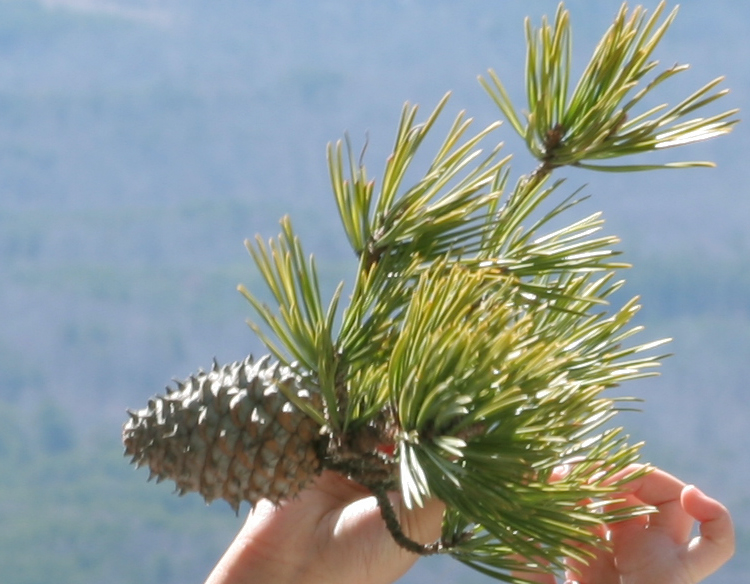
Needles grow in bundles (fascicles) of two, are stiff and twisted, 1.5 to 3 inches long, and a dull yellow-green color. They are shorter and stouter than the needles of the similar pitch pine and Virginia pine that often grow alongside it.
Cones
The cones are the tree’s signature feature: broadly egg-shaped, 2 to 3.5 inches long, with thick woody scales armed with stout, curved spines — tough enough to catch skin or clothing. Cones are usually borne in whorled clusters of three or more around the branch and are strongly serotinous, meaning they stay tightly sealed with resin for years and open only when exposed to the heat of fire. On some trees, decades of unopened cones accumulate along the branches.
Quick Facts
| Scientific Name | Pinus pungens |
| Family | Pinaceae (Pine) |
| Plant Type | Evergreen Conifer Tree |
| Mature Height | 20–40 ft (rarely to 60 ft) |
| Mature Spread | 15–25 ft, often irregular |
| Growth Rate | Slow |
| Sun Exposure | Full Sun |
| Water Needs | Low once established |
| Soil Type | Thin, rocky, sandy or shaly; very well-drained |
| Soil pH | Acidic |
| Bloom Time | Spring (pollen cones) |
| Flower Color | Yellow-brown pollen cones |
| Fall Color | None (evergreen) |
| Fruit | Spiny, serotinous woody cones |
| Deer Resistant | Yes |
| USDA Hardiness Zones | 5–7 |
Native Range
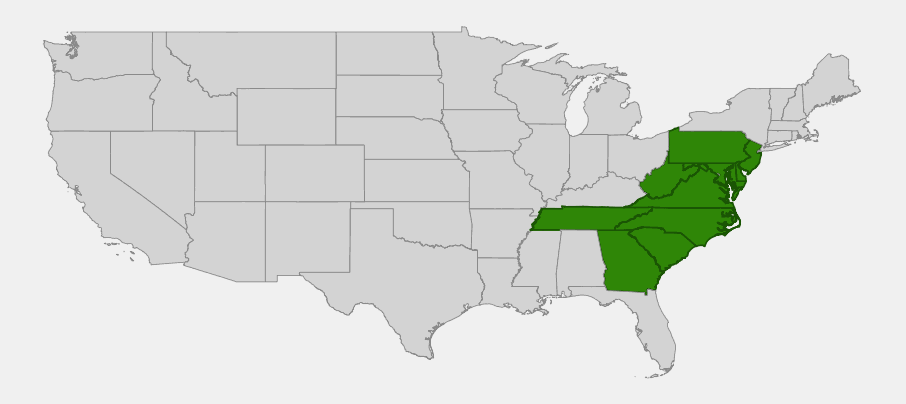
Table Mountain Pine is an Appalachian endemic, found almost nowhere else in the world. Its core range runs through the Blue Ridge and Valley-and-Ridge provinces from central Pennsylvania southwest through West Virginia and Virginia into western North Carolina, eastern Tennessee, and the extreme northeastern corner of Georgia, with South Carolina populations recorded on rocky summits such as Paris Mountain. Scattered outlying stands occur to the east of the main mountain chain on isolated Piedmont monadnocks and ridges in Maryland, Delaware, and northern New Jersey, where the species is uncommon and, in New Jersey, considered critically imperiled.
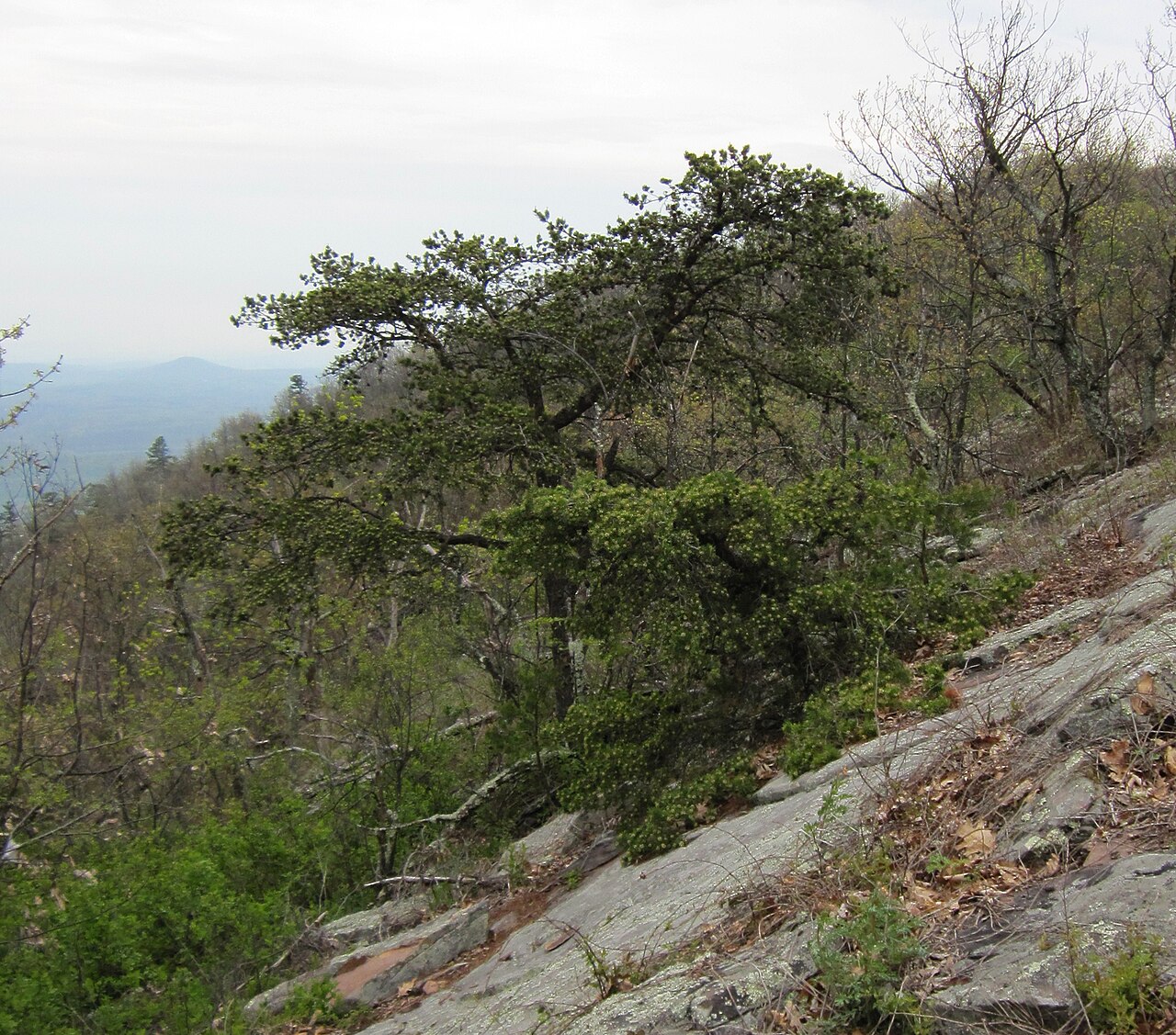
Across this range, Table Mountain Pine sticks to one kind of site: dry, rocky ridgetops, knobs, and steep upper slopes from roughly 1,000 to 4,300 feet elevation, where thin, acidic soil and exposure to wind and sun keep out most competing hardwoods. It rarely forms large forests, growing instead as scattered individuals or small stands, often mixed with pitch pine, Virginia pine, and shortleaf pine, with chestnut oak and other drought-tolerant oaks in the understory.
Because the species depends on periodic fire to open its cones and clear competing vegetation, decades of fire suppression across the Appalachians have reduced regeneration in many stands, and older trees are not always being replaced. Conservation groups and some national forests have reintroduced prescribed burns specifically to help Table Mountain Pine reproduce on its native ridgetops.
📋 Regional plant lists featuring Table Mountain Pine: New York, Pennsylvania & Northern New Jersey · Delaware, Southern New Jersey & Long Island · Maryland, Virginia & West Virginia · North Carolina & South Carolina · Georgia, Alabama & Mississippi · Kentucky & Tennessee
Growing & Care Guide
Table Mountain Pine is not a tree for an ordinary garden bed. It is built for the toughest, driest, sunniest, rockiest spot on the property, and it performs poorly almost anywhere else. Gardeners within its native Appalachian range who have thin, rocky, infertile soil and full sun are the best candidates for success with this species.
Light
Give it full sun. Table Mountain Pine is intolerant of shade at every life stage and will thin out, lean, and eventually decline if crowded or overtopped by faster-growing hardwoods or pines.
Soil & Water
This pine wants thin, rocky, acidic, extremely well-drained soil — exactly the kind of poor ground that discourages most other trees. Rich garden loam or consistently moist soil is a poor match and can predispose the tree to root problems. Once established, it needs no supplemental irrigation and is highly drought tolerant, reflecting its native life on sun-baked ridgetops.
Planting Tips
Choose the driest, rockiest, most exposed site available — a slope, outcrop, or thin-soiled bank in full sun. Avoid low spots, heavy clay, or anywhere water collects. Young nursery-grown trees establish best when planted small, since Table Mountain Pine resents root disturbance and transplants poorly once large.
Pruning & Maintenance
Little to no pruning is needed or desirable; much of this tree’s appeal lies in its naturally irregular, windswept form. Remove only dead or broken branches. Because old cones persist unopened on the tree for years, a fallen or cut branch dense with cones is typical, not a sign of poor health.
Propagation
Table Mountain Pine is propagated from seed. In the wild the thick-scaled, serotinous cones usually require fire to open and release seed, though cones can also be opened artificially with heat for nursery production. Germination and early growth are slow, which is part of why the species is rarely offered commercially.
Landscape Uses
- Rock gardens and dry, rocky slopes where little else will grow
- Ridge-top or outcrop restoration plantings within its native range
- Erosion control on thin-soiled, sun-exposed banks
- Specimen tree for a naturalistic, windswept silhouette
- Wildlife plantings that favor dry pine-oak habitat
Wildlife & Ecological Value
Table Mountain Pine is a minor but distinctive component of the dry Appalachian ridgetop ecosystems it dominates, supporting a community of wildlife adapted to exposed, fire-prone habitat.
For Birds
The tightly closed, long-persistent cones are an important late-winter and early-spring food source for seed-eating birds, especially when other seed crops run short. Pine Warblers, Red-breasted Nuthatches, and various finches forage through the crowns for insects and seeds, and the open, irregular branching provides exposed perches favored by raptors and other birds on these high, windy sites.
For Mammals
Eastern Gray Squirrels and Red Squirrels tear into the tough, spiny cones to reach the seeds, and White-tailed Deer occasionally browse young seedlings, though the species is generally considered deer resistant once past the seedling stage.
Ecosystem Role
Because Table Mountain Pine grows almost exclusively on the driest, most fire-prone ridges in the Appalachians, it functions as an indicator and stabilizer of a rare habitat type: the fire-maintained pine-oak heath community. Its resinous wood and persistent cones are part of a feedback loop with fire — the tree both depends on periodic burns to regenerate and, through its flammable needle litter and resinous bark, helps carry the fires that keep its ridgetop habitat open for itself and other fire-adapted species like Table Mountain Pine’s frequent neighbor, pitch pine.
Cultural & Historical Uses
Table Mountain Pine has never been an important timber species — its small size, twisted trunk, and remote, inaccessible rocky habitat make it commercially marginal. Where it has been cut, the wood has served mainly local, small-scale purposes: fuelwood and rough pulpwood, since the knotty, irregular trunks are poorly suited to dimensional lumber.
The tree’s larger significance has always been ecological and scenic rather than economic. Its gnarled form on exposed Blue Ridge and Appalachian outcrops has made it a recognizable feature of mountain overlooks and hiking trails throughout Virginia, West Virginia, and North Carolina, where many of the region’s most scenic rock outcrops and cliff-top vistas are framed by wind-sculpted Table Mountain Pines.
In recent decades the species has drawn attention from foresters and ecologists concerned about its regeneration failure under modern fire suppression. Prescribed burn programs on national forest land within its range are, in part, aimed at sustaining Table Mountain Pine populations, making the tree something of a symbol for fire-ecology restoration work in the central Appalachians.
Frequently Asked Questions
Why are Table Mountain Pine cones so spiny?
The stout, curved spines on each cone scale are thought to help protect developing seeds from seed predators. Combined with the cone’s serotiny — staying sealed shut with resin for years — the spines are part of an overall strategy built around infrequent, fire-triggered reproduction rather than opening every year like most pines.
Can I grow Table Mountain Pine outside the Appalachian Mountains?
It is possible in similar climates with very poor, rocky, well-drained, acidic soil and full sun, but it rarely thrives in average garden conditions or outside USDA zones 5–7. It is a true specialist, and gardeners outside its native range and habitat type are usually better served by other native pines suited to their local conditions.
Does Table Mountain Pine need fire to survive?
Not every individual tree needs fire to live, but the species as a whole depends on periodic fire for long-term regeneration, since its serotinous cones mostly need fire’s heat to open and release seed onto a cleared, sunlit seedbed. Without occasional fire, stands can fail to regenerate over time.
Is Table Mountain Pine the same as pitch pine?
No, though the two often grow side by side on dry Appalachian ridges and are sometimes confused. Table Mountain Pine has shorter, stouter, two-needle bundles and distinctive spiny, asymmetrical cones usually in whorled clusters, while pitch pine has three-needle bundles and smaller, less heavily armed cones.
Is Table Mountain Pine endangered?
It is not federally listed, but it is considered rare and declining in parts of its range due to long-term fire suppression, and New Jersey lists it as critically imperiled. Its overall Appalachian range is secure, but local populations on specific ridges can be vulnerable without active fire management.

Looking for a nursery that carries Table Mountain Pine?
Browse our native plant nursery directory: PA, VA, TN & SC · NJ & NC · DE & GA · MD · WV