California Bay Laurel (Umbellularia californica)
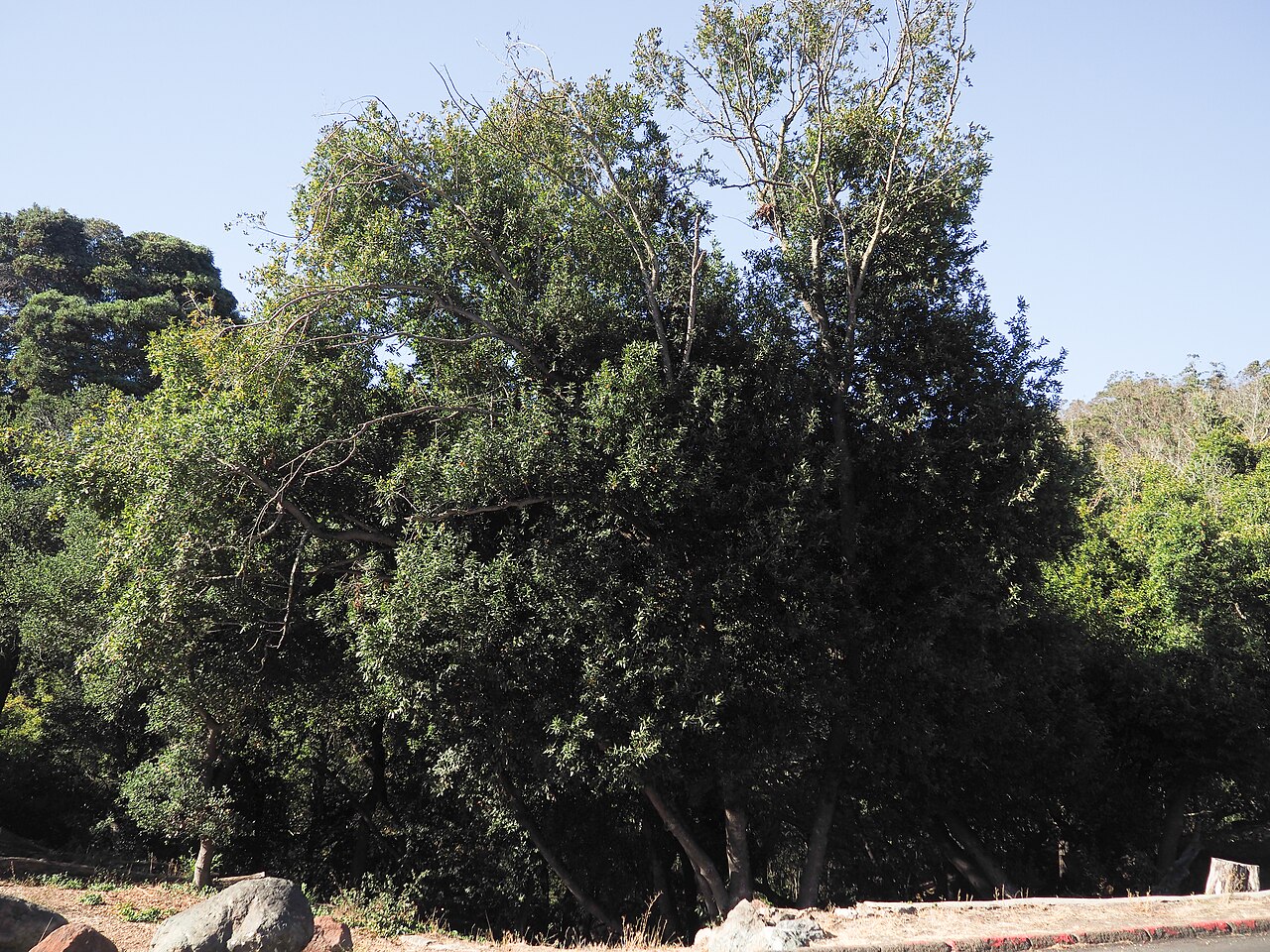
Umbellularia californica, the California Bay Laurel, is an aromatic evergreen tree found throughout the woodlands, canyons, and stream corridors of California and southwestern Oregon. It is the sole member of its genus, a distinctive representative of the Lauraceae (laurel family) in a flora otherwise dominated by oaks, pines, and chaparral shrubs. Crush a leaf and the pungent, almost medicinal scent — somewhere between bay leaf, eucalyptus, and camphor — is unmistakable and gives the tree several of its other common names: Oregon myrtle, pepperwood, and headache tree.
In open ground the species grows as a single-trunked tree 40 to 80 feet tall, but on steep slopes, after fire, or where it has resprouted from a cut stump, it just as often forms a broad, multi-trunked shrub or small grove. Its glossy, leathery leaves stay on the tree year-round, its inconspicuous yellow-green flowers appear in late winter, and its olive-like fruits ripen through fall, feeding squirrels, deer, and other wildlife. The thin, aromatic bark and foliage are also mildly toxic and irritating in quantity, a fact herbicide-free land managers and firewood-splitters alike learn quickly.
For California and Oregon gardeners with room for a large evergreen, bay laurel is a tough, long-lived, drought-tolerant native that asks for almost nothing once established. It is equally valuable planted as a windbreak, a background screen, or a single specimen allowed to develop its handsome, irregular form, and it anchors streamside plantings and oak-woodland restorations across its range.
Identification
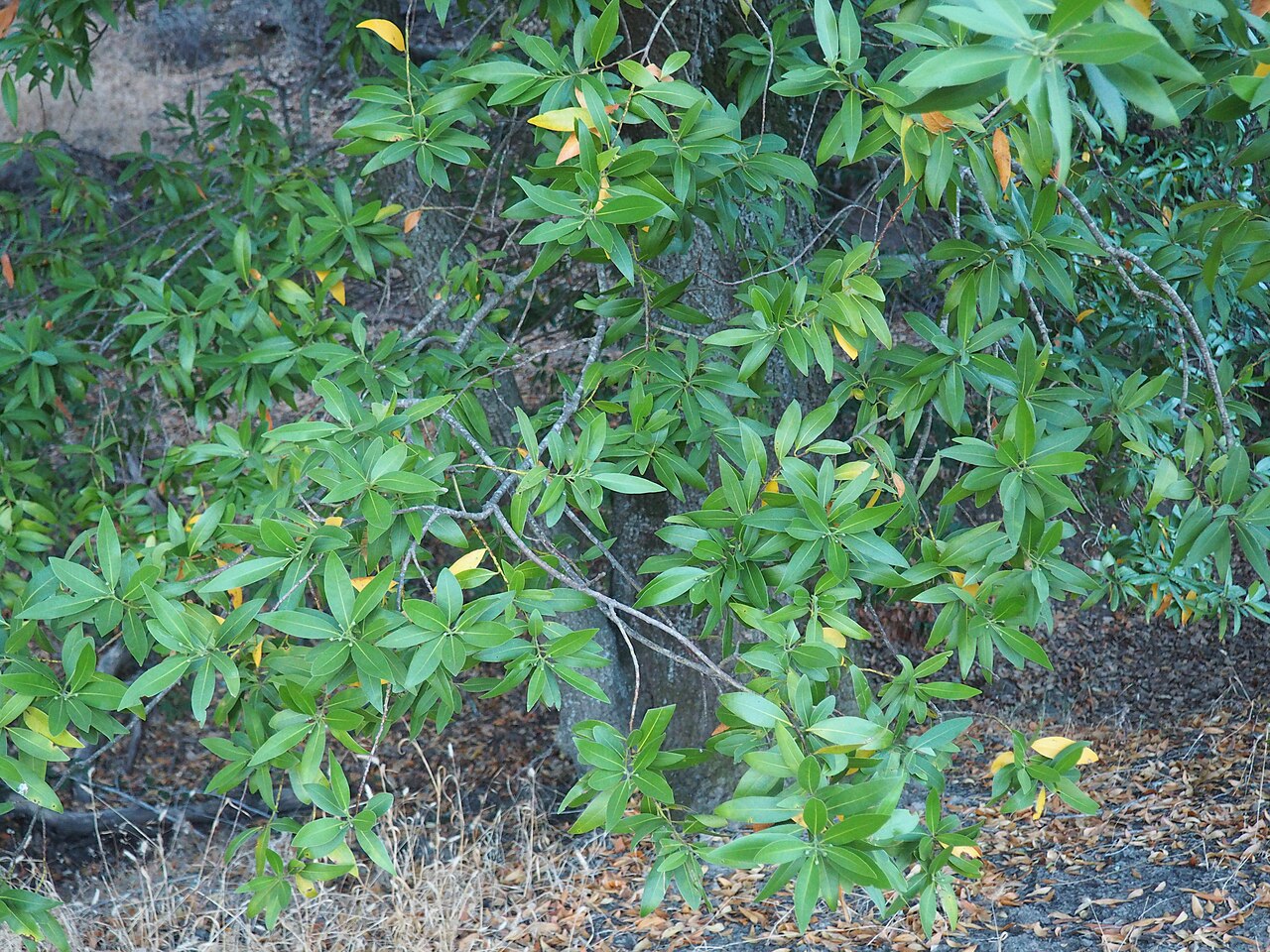
California bay laurel is most easily recognized by its narrow, pointed, leathery leaves and their strong aromatic scent when crushed. Growth habit is variable: trees in favorable canyon-bottom sites can reach 80 feet with a single straight trunk, while trees on dry ridges, serpentine soils, or those that have resprouted after fire or cutting are often shrubby, multi-trunked, and under 20 feet.
Bark & Stems
Young bark is smooth and olive-brown to gray; with age it becomes thin, scaly, and slightly furrowed, but it never develops the thick, deeply ridged plates typical of the oaks it often grows beside. The wood and bark are aromatic, and because the bark is thin, mature trees are easily top-killed by fire — though they almost always resprout vigorously from the root crown and stump afterward, which is why so many wild bay laurels appear as multi-stemmed clumps rather than single trunks.
Leaves
Leaves are simple, alternate, evergreen, and lance-shaped to narrowly elliptic, 2 to 5 inches long, with smooth (entire) margins, a glossy dark yellow-green upper surface, and a paler underside. They are leathery, somewhat stiff, and release a strong, pungent, camphor-like odor when crushed or bruised — the single most reliable field mark for the species. The scent is powerful enough that inhaling it directly from a crushed leaf can trigger a sneezing fit or headache in sensitive people, the source of the folk name “headache tree.”
Flowers
Small, yellow-green, and unshowy, the flowers are borne in compact clusters (umbels) at branch tips, blooming from December through April depending on elevation and weather — among the earliest native trees to flower in California. Each flower has six petal-like tepals and is pollinated primarily by flies, bees, and other small insects drawn to its mild fragrance.
Fruit & Seeds
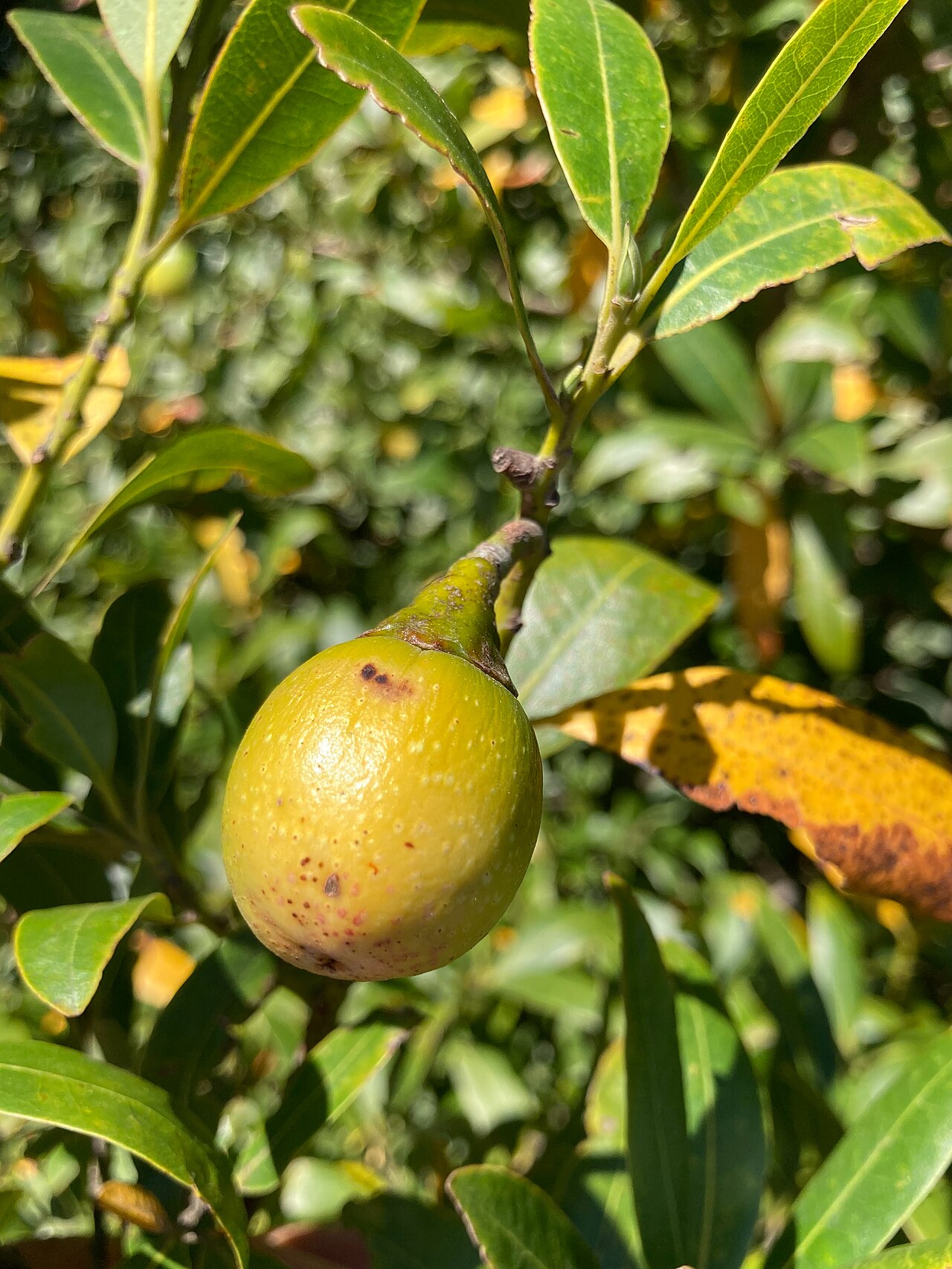
The fruit is a round to egg-shaped drupe about 1 inch long, resembling a small olive. It ripens from green to yellow-green and finally deep purple between late summer and November, with a thin aromatic skin, a layer of oily flesh, and a single large seed. The fallen fruit and its oily pulp are eaten by squirrels, other rodents, and occasionally deer; Indigenous peoples of California roasted and ground the seeds much like acorns, after the strongly flavored flesh was removed.
Quick Facts
| Scientific Name | Umbellularia californica |
| Family | Lauraceae (Laurel) |
| Plant Type | Evergreen tree (often multi-trunked) |
| Mature Height | 40–80 ft in favorable sites; often 15–30 ft on dry ridges |
| Mature Spread | 20–40 ft, wider when multi-trunked |
| Growth Rate | Slow to moderate |
| Sun Exposure | Full Sun to Part Shade |
| Water Needs | Low once established; tolerates summer drought |
| Soil Type | Adaptable; loam, clay, serpentine or rocky soils |
| Soil pH | Tolerates a wide range, acidic to alkaline |
| Bloom Time | December – April |
| Flower Color | Yellow-green |
| Fall Color | None (evergreen) |
| Fruit | Olive-like purple drupe, about 1 in, ripens late summer–fall |
| Deer Resistant | Yes (aromatic foliage is rarely browsed) |
| USDA Hardiness Zones | 7–10 |
Native Range
California bay laurel is native to California and southwestern Oregon, where it grows from the southern Oregon Coast Range and Klamath Mountains south through the Coast Ranges, San Francisco Bay Area, Sierra Nevada foothills, and Central Valley margins to the Transverse and Peninsular Ranges of Southern California. It is absent from the high Sierra Nevada crest, the Mojave and Colorado deserts, and the Great Basin, including Nevada, despite being a familiar tree of the broader California flora.
The species occupies a wide range of plant communities: mixed-evergreen and oak woodlands, redwood forest margins, riparian corridors, and north-facing chaparral slopes. It is especially common along streams and in shaded canyons, where its roots help stabilize banks, but it is equally capable of growing on dry, exposed ridgelines and even unusual soils such as serpentine, where few other trees compete. Elevation ranges from near sea level along the coast to around 5,000 feet in the southern Sierra foothills and Transverse Ranges.
Because bay laurel resprouts so readily from its root crown, individual clumps can be centuries old even where the above-ground trunks look young, having been repeatedly top-killed by wildfire and regrown. The species has also drawn scientific attention as the primary host of Phytophthora ramorum, the pathogen that causes sudden oak death; bay laurel leaves harbor the pathogen and spread spores to neighboring oaks without being killed by it themselves.
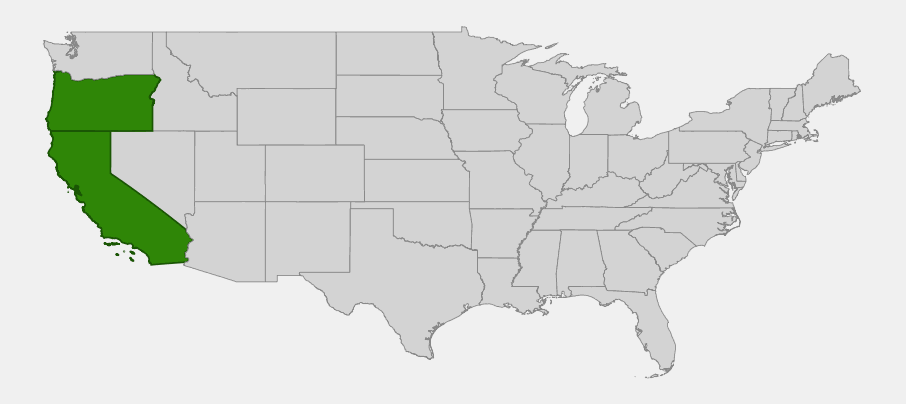
📋 Regional plant lists featuring California Bay Laurel: California & Nevada · Western Oregon & Western Washington
Growing & Care Guide
California bay laurel is a forgiving, long-lived tree that tolerates far more neglect than most ornamental trees, making it a dependable choice once you have the space for its eventual size.
Light
Bay laurel grows well in full sun along the coast and in part shade inland, where afternoon shade helps reduce summer stress on young trees. In deep shade beneath taller conifers it survives but grows more slowly and sparsely. Most garden specimens do best with at least a half-day of direct sun.
Soil & Water
This species is remarkably adaptable to soil type, growing naturally in everything from rich alluvial canyon soil to thin, rocky, and even serpentine ground. Drainage matters more than fertility — soggy, poorly drained sites can encourage root rot. Established trees need no supplemental irrigation in most of their range and handle California’s long dry summers without difficulty; young trees benefit from deep, infrequent watering for the first two to three years.
Planting Tips
Plant container-grown bay laurels in fall or early winter so roots can establish during the rainy season before summer drought arrives. Give the tree plenty of room — 20 feet or more from structures and paved areas — since mature specimens develop a broad canopy and can produce substantial surface roots. Where a tidier form is wanted, select and stake a single leader early; left alone, the tree will often develop several co-dominant trunks.
Pruning & Maintenance
Prune in late summer or fall to remove dead wood or to select a dominant leader while the tree is young; bay laurel resprouts vigorously from cuts, so hard pruning can be used to coppice an overgrown specimen back to a manageable multi-stemmed shrub. Rake and dispose of fallen leaves away from oaks if sudden oak death is a known concern in your area, since bay laurel foliage can carry the pathogen.
Landscape Uses
- Windbreaks and screens — dense, year-round evergreen cover
- Specimen tree for its handsome, irregular form and glossy foliage
- Oak woodland restoration alongside coast live oak and valley oak
- Streamside and riparian plantings, where its roots help stabilize banks
- Culinary garden — fresh or dried leaves substitute for (stronger-flavored) bay leaf in cooking, used sparingly
- Wildlife habitat plantings for squirrels, deer, and cavity-nesting birds
Wildlife & Ecological Value
Despite its pungent, somewhat forbidding foliage, bay laurel supports a surprising range of wildlife across its canyon and woodland habitats.
For Pollinators
The early, mild-scented winter flowers are an important nectar source at a time when few other California natives are blooming, visited by flies, small native bees, and other early-season insects.
For Birds
The dense, evergreen canopy offers year-round cover and nesting sites for woodland birds, including jays, chickadees, and various woodpeckers, which also forage the bark and foliage for insects. Acorn woodpeckers and other cavity nesters readily use mature, multi-trunked bay laurels.
For Mammals
Western gray squirrels and other rodents are the primary consumers of the oily fruit and seed, often caching them in large numbers. Black-tailed deer browse the foliage only lightly, since the aromatic oils are a natural deterrent, which makes bay laurel one of the more reliably deer-resistant native trees in California gardens.
Ecosystem Role
As a long-lived, fire-resprouting tree, bay laurel stabilizes slopes and streambanks, contributes structure to mixed-evergreen woodlands, and — through its well-documented role as the main host of the sudden oak death pathogen — has become an important subject of forest health research across coastal California and Oregon.
Cultural & Historical Uses
California Indigenous peoples across the tree’s range, including the Pomo, Miwok, and Karuk, made extensive use of bay laurel. The oily seeds, similar in size to a small acorn, were roasted and ground into meal after the pungent outer flesh was removed, providing a nutritious food that stored well through winter. Crushed leaves were used medicinally as a headache remedy — held under the nose or tied to the forehead — and as an insect repellent, and the aromatic smoke from burning leaves was used in some groups for ceremonial purposes.
Early European settlers adopted many of these uses and added their own, employing the strong-smelling leaves to repel fleas and other household pests and occasionally as a substitute for true Mediterranean bay leaf (Laurus nobilis) in cooking, though California bay’s flavor is markedly sharper and should be used far more sparingly. In Oregon, where the tree is known as Oregon myrtle, the fine-grained, richly figured wood has long been prized by woodturners and furniture makers for bowls, veneers, and small decorative objects, supporting a small but enduring craft industry centered on the southern Oregon coast.
The tree’s many common names — pepperwood, headache tree, balm of heaven, myrtlewood — reflect just how familiar and useful a presence it has been across the length of its range, from Indigenous communities to today’s woodworkers and gardeners.
Frequently Asked Questions
Is California bay laurel the same as the bay leaf used in cooking?
No. Culinary bay leaf usually comes from the Mediterranean Laurus nobilis. California bay laurel leaves are edible and aromatic but much stronger and sharper in flavor, so recipes calling for bay leaf need only a small fraction of the amount if substituting this species.
Why do bay laurels so often have multiple trunks?
The species resprouts vigorously from its root crown after fire, cutting, or storm damage. Many multi-trunked bay laurels seen today are regrowth from root systems that may be far older than the visible trunks.
Does bay laurel cause sudden oak death?
Bay laurel is the primary host and spreader of Phytophthora ramorum, the pathogen behind sudden oak death, but the tree itself is rarely killed by the disease. Its leaves can carry and spread spores to nearby susceptible oaks, which is an important consideration when planting near valuable oak specimens in affected regions.
Is California bay laurel toxic?
The aromatic oils in the leaves and fruit flesh can irritate skin and mucous membranes in some people, and inhaling the scent directly from a crushed leaf can trigger headaches or sneezing. The seeds are edible only after the pungent flesh is removed and the seed is roasted; the plant is not considered a garden food source and should not be eaten casually.
How much space does a mature bay laurel need?
Plan for an eventual spread of 20 to 40 feet and a height of 40 feet or more in good sites, though trees on dry or exposed ground often stay considerably smaller and shrubbier. Site it well away from structures, septic systems, and paved walkways.

Looking for a nursery that carries California Bay Laurel?
Browse our native plant nursery directory: California · Oregon