Valley Oak (Quercus lobata)
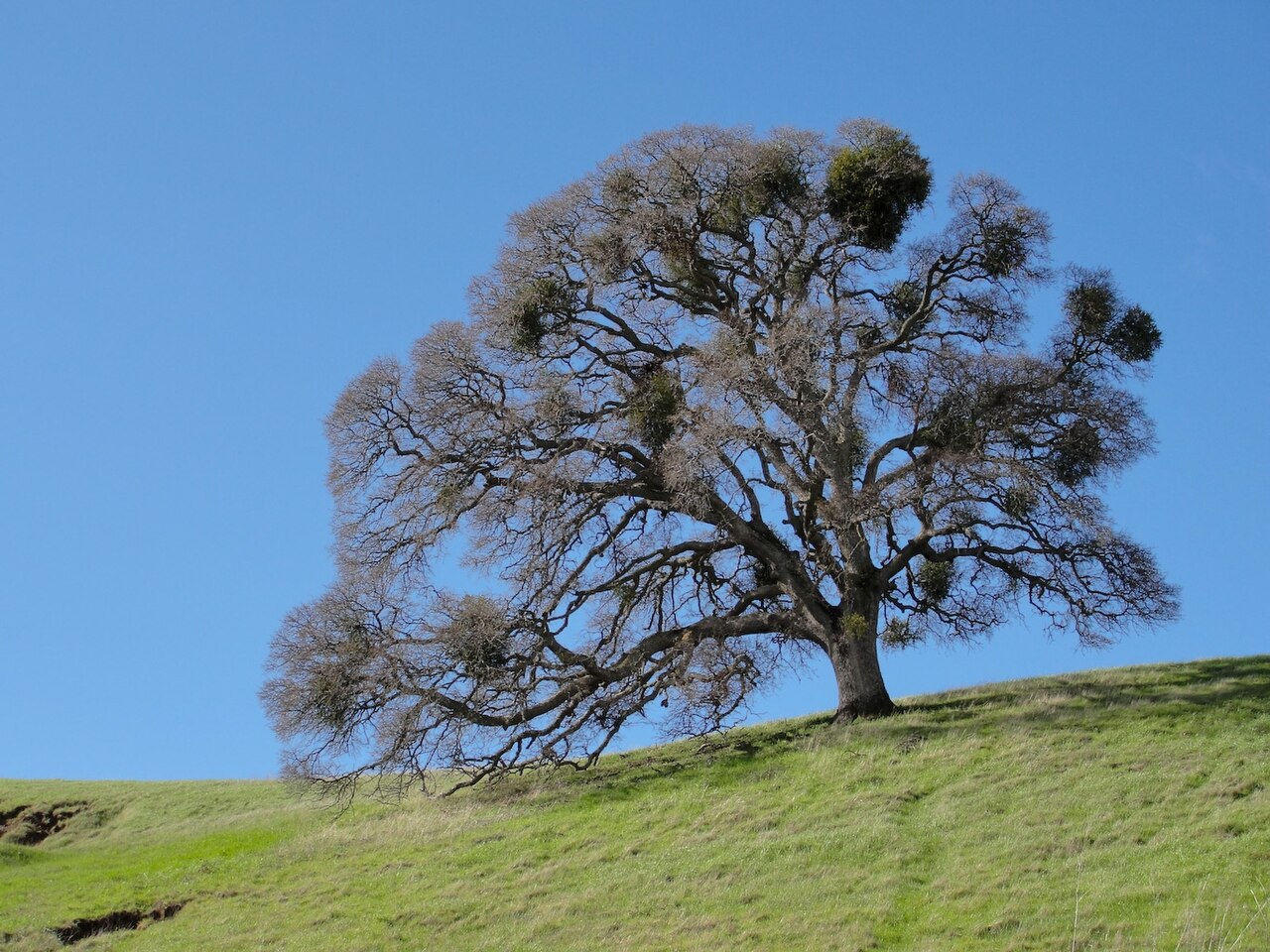
Quercus lobata, the Valley Oak, is the largest native oak in North America and one of the most iconic trees of the California landscape. Endemic to California, it is the signature tree of the Central Valley’s old savanna grasslands and the broad valleys and foothills that ring the Coast Ranges and Sierra Nevada. A single ancient valley oak, broad-crowned and deeply furrowed, standing alone in a golden summer field, is one of the defining images of rural California.
Valley oak is a deciduous tree that can reach 70 to over 100 feet tall with a trunk several feet in diameter, developing a massive, wide-spreading crown whose lower branches often sweep down gracefully toward the ground — a growth habit sometimes called “weeping.” Its deeply lobed leaves, thick checkered bark, and abundant acorn crops support one of the richest wildlife communities of any California native tree, from acorn woodpeckers to mule deer.
For California gardeners and land managers with the space, few native trees offer more long-term value than valley oak: century-scale longevity, outstanding drought tolerance once established, and an unmatched contribution to local wildlife. Because mature trees can live 300 years or more and eventually need enormous room to grow, it is best planted with a clear understanding of its ultimate size and a commitment to protecting it from root disturbance for decades to come.
Identification
Valley oak is usually easy to distinguish from California’s other oaks by its combination of deeply lobed, deciduous leaves, thick dark bark broken into small rectangular plates, and an often dramatically wide, open crown with drooping lower branches on older trees.
Bark & Stems
The bark is thick, dark gray-brown, and deeply furrowed into a checkered pattern of small rectangular or irregular plates, becoming rougher and more deeply fissured with age. Young twigs are slender and grayish, and the overall branch architecture on mature, open-grown trees is distinctive: large lower limbs often arch outward and down, sometimes touching the ground, giving old valley oaks their characteristic graceful, weeping silhouette, especially visible in winter when the tree is bare.
Leaves
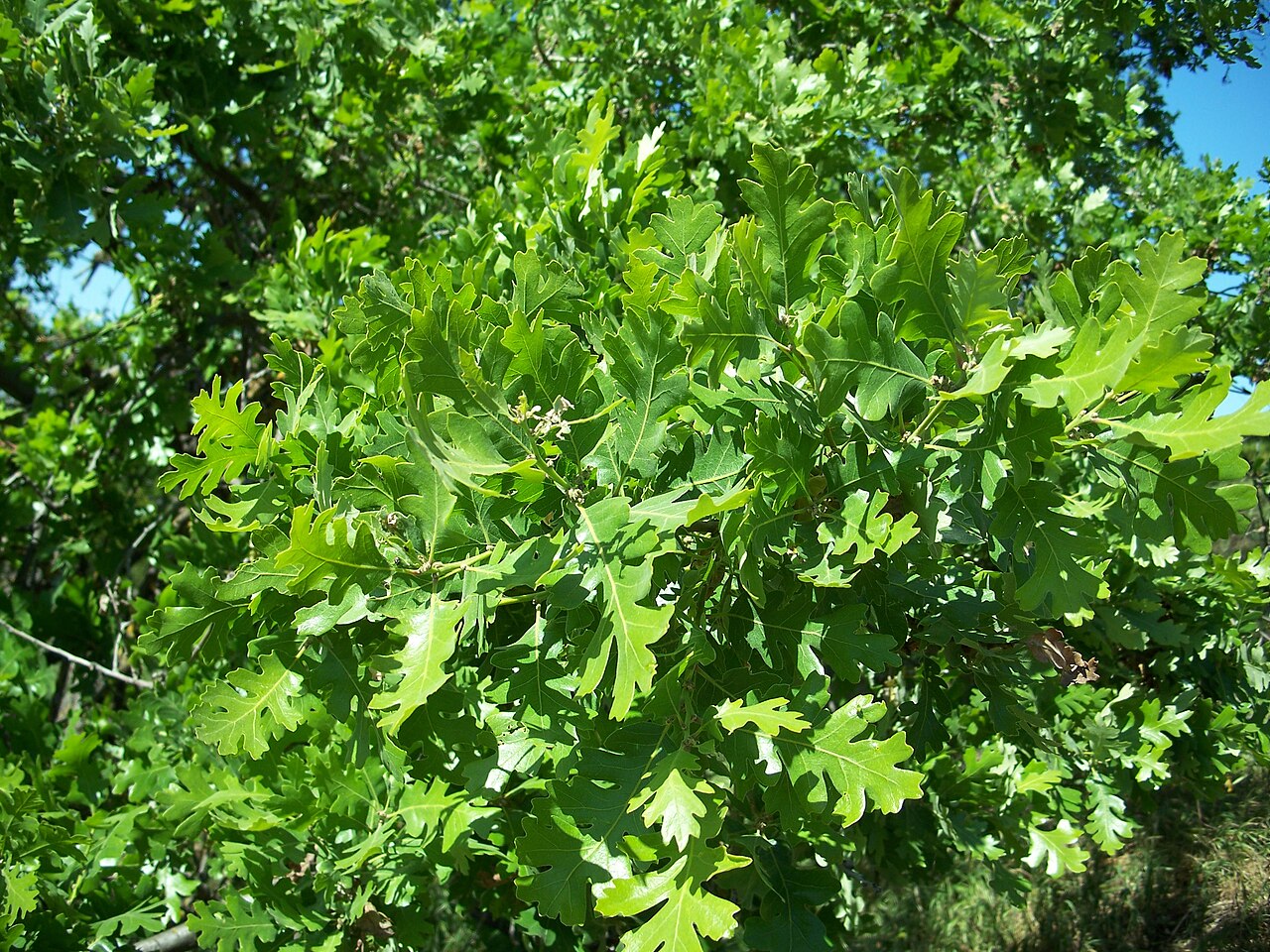
Leaves are deciduous, alternate, 2 to 4 inches long, with 7 to 11 deep, rounded lobes (unlike the bristle-tipped lobes of red oaks) and a dull to somewhat glossy dark green upper surface with a paler, finely hairy underside. The deep sinuses between lobes often reach more than halfway to the midrib, giving the leaf a lacy, deeply cut outline. Leaves emerge in spring and drop in fall, sometimes turning a dull yellow-brown beforehand, though fall color is not showy.
Flowers
Like other oaks, valley oak is wind-pollinated. Male flowers hang in slender, drooping catkins 2 to 4 inches long that appear with the new leaves in spring; female flowers are small and inconspicuous, borne singly or in small clusters in leaf axils.
Fruit & Seeds
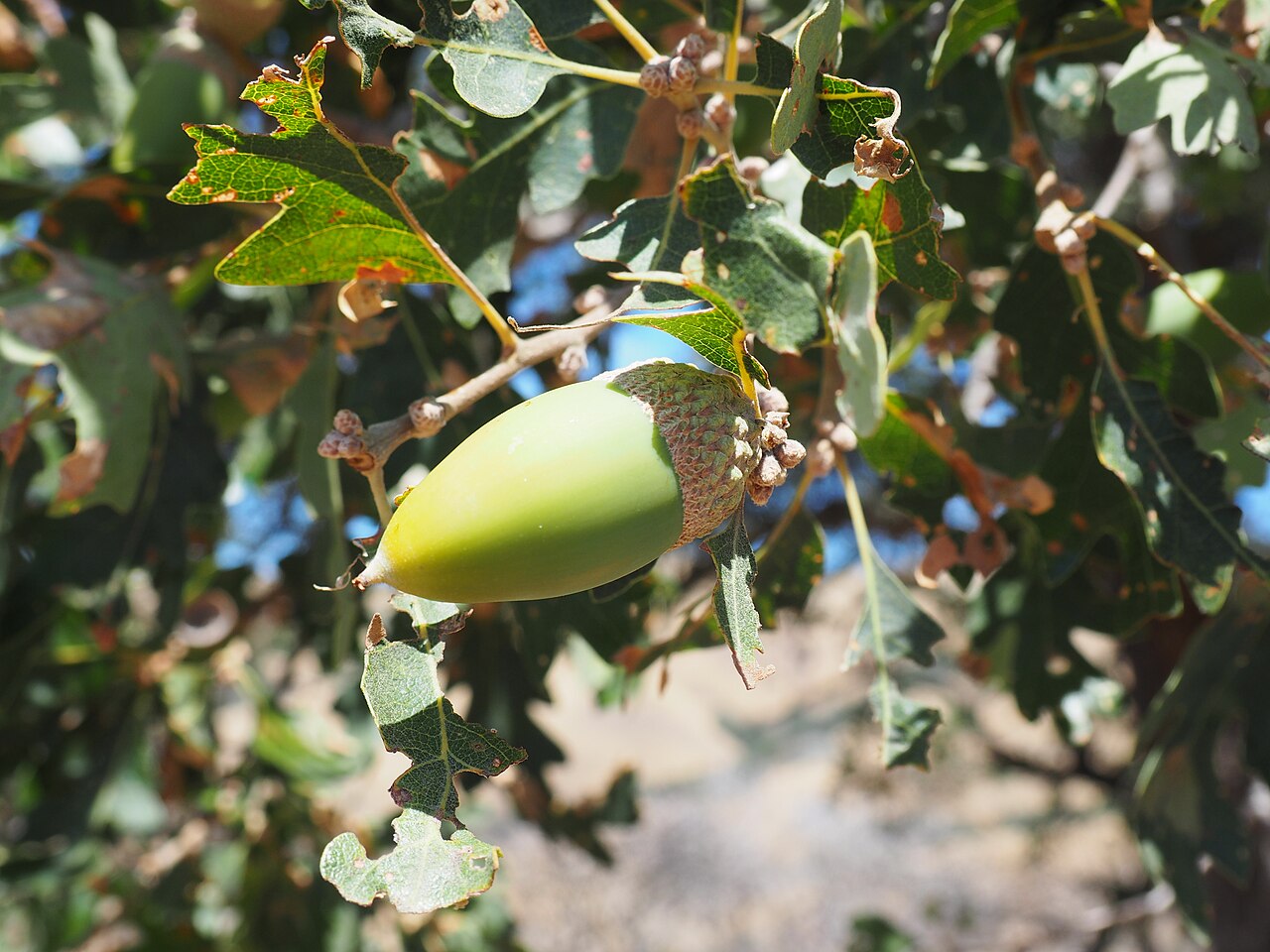
The acorns are the largest of any California oak, 1 to 2 inches long, narrow and elongated with a distinctive pointed tip, and a warty, deeply scaled cap that covers up to a third of the nut. Acorns mature in a single season, ripening from green to light brown in fall, and crops vary enormously from year to year — a pattern called masting that helps satiate acorn predators in boom years and limit their populations in lean ones.
Quick Facts
| Scientific Name | Quercus lobata |
| Family | Fagaceae (Beech/Oak) |
| Plant Type | Deciduous tree |
| Mature Height | 70–100+ ft at full maturity |
| Mature Spread | Often equal to or greater than height; 70–100+ ft in open-grown trees |
| Growth Rate | Moderate when young, slowing with age; long-lived (often 200–300+ years) |
| Sun Exposure | Full Sun |
| Water Needs | Low once established; naturally taps deep groundwater on valley sites |
| Soil Type | Deep alluvial loam preferred; adapts to clay and other valley soils |
| Soil pH | Tolerates a wide range, slightly acidic to alkaline |
| Bloom Time | March – April (catkins with new leaves) |
| Flower Color | Yellow-green (inconspicuous) |
| Fall Color | Dull yellow-brown, not showy |
| Fruit | Large elongated acorn, 1–2 in, ripens in fall |
| Deer Resistant | Moderate (seedlings are heavily browsed by deer and livestock) |
| USDA Hardiness Zones | 7–10 |
Native Range
Valley oak is endemic to California, found nowhere else in the wild. Its range centers on the Great Central Valley — the Sacramento and San Joaquin valleys — and extends into the surrounding Coast Range valleys, the foothills of the Sierra Nevada and Coast Ranges, and south through the Transverse Ranges into parts of the Tehachapi and foothill regions of Southern California. It is not native to Oregon, Nevada, or any state outside California.
The species is the characteristic tree of California’s oak savanna and oak woodland, typically growing scattered or in open groves across valley floors, alluvial terraces, and gentle foothill slopes, usually below about 2,000 feet elevation. Because valley oak depends on deep, well-drained alluvial soils and access to groundwater, it is strongly tied to valley bottoms and old floodplains rather than steep, rocky terrain, where blue oak and interior live oak are more likely to dominate instead.
Historic valley oak savanna once covered vast stretches of the Central Valley, but agricultural conversion, urban development, and decades of poor natural regeneration (largely from grazing pressure on seedlings and altered floodplain hydrology) have eliminated or fragmented much of this habitat. Many of the valley’s largest remaining individual trees are many centuries old and are now actively protected as irreplaceable landscape and ecological features.
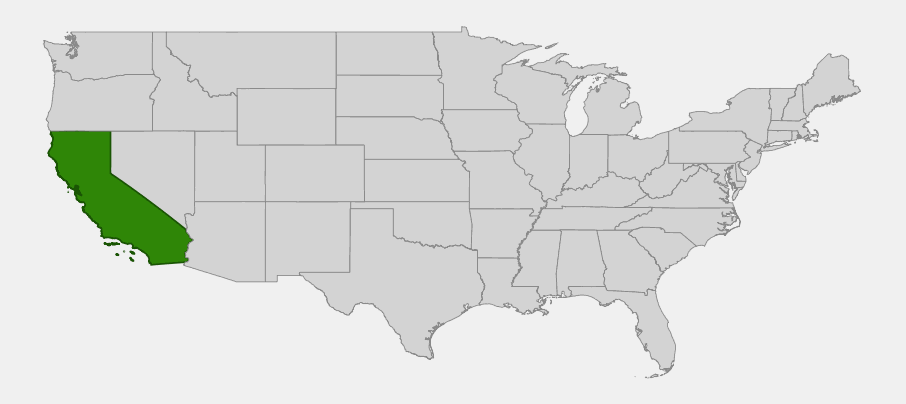
📋 Regional plant lists featuring Valley Oak: California & Nevada
Growing & Care Guide
Valley oak rewards patience. It grows at a modest pace and needs decades to show its full character, but a well-sited tree can become a defining feature of a property for generations.
Light
Valley oak needs full sun to develop its characteristic broad, open crown. Young trees tolerate some light shade but grow slowly and weakly under a closed canopy; for best form and vigor, plant in open, unobstructed ground.
Soil & Water
This species favors deep, well-drained alluvial soils, reflecting its natural home on valley floors and old floodplains where roots can reach groundwater. It adapts to a range of valley soils, including clay, as long as drainage is adequate, but struggles in heavy compacted ground or where summer irrigation keeps the root zone constantly wet — a leading cause of root disease in landscape plantings. Established trees are highly drought tolerant and should receive minimal to no supplemental summer water; occasional deep watering during extended drought is more appropriate than regular irrigation.
Planting Tips
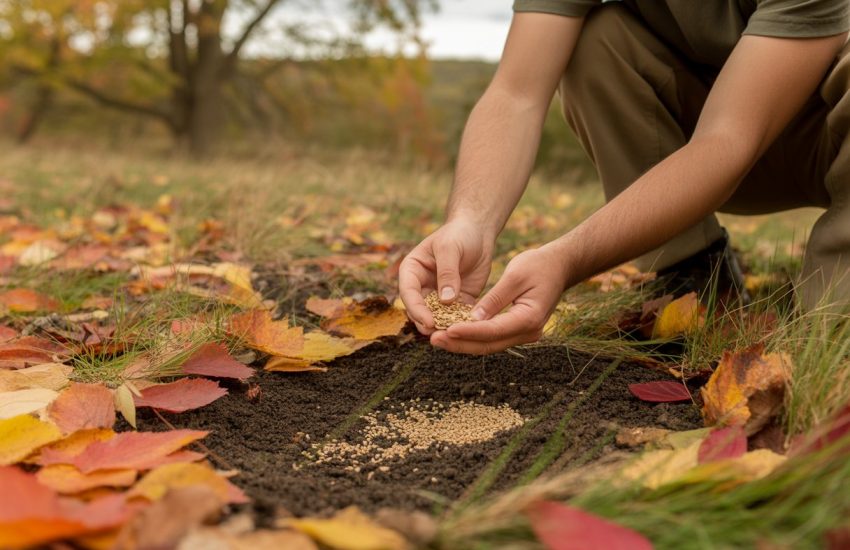
Grow valley oak from acorns or young container stock planted in fall, which allows roots to establish over the wet season. Acorns germinate readily if planted soon after they fall, before they dry out, and direct-seeding often produces a better root system than transplanting container stock. Protect young seedlings from deer, gophers, and livestock browsing with a cage or tree shelter for the first several years — seedling predation is one of the main reasons natural regeneration has declined across much of the valley oak’s range. Site new trees well away from buildings, driveways, and septic systems, anticipating a mature spread of 70 feet or more.
Pruning & Maintenance
Mature valley oaks need very little pruning beyond removing dead or hazardous limbs, ideally by an arborist familiar with native oaks. Avoid any grade changes, trenching, irrigation, or soil compaction within the tree’s root zone (which extends well beyond the canopy edge), since mature valley oaks are notably sensitive to changes in soil moisture and are vulnerable to root pathogens when overwatered or disturbed.
Landscape Uses
- Specimen and legacy tree for large properties, parks, and open spaces
- Oak savanna and woodland restoration projects across the Central Valley and Coast Range foothills
- Shade tree for expansive, unirrigated landscapes
- Wildlife habitat plantings supporting acorn-dependent birds and mammals
- Riparian and floodplain restoration on appropriate valley and terrace sites
Wildlife & Ecological Value
Few California trees match valley oak’s ecological footprint. Its acorns, structure, and sheer longevity make it a keystone species of the Central Valley and surrounding foothills.
For Pollinators
Though wind-pollinated and not a major nectar source, valley oak’s foliage hosts an enormous diversity of native insects — some estimates place oaks among the highest insect-supporting tree genera in North America — which in turn sustain the insect-eating birds and pollinators that depend on that food web throughout the surrounding landscape.
For Birds
Acorn woodpeckers are perhaps the most famous valley oak associate, drilling and filling “granary trees” with thousands of acorns for winter storage. Western scrub-jays, which cache acorns widely and are a major agent of natural oak dispersal and regeneration, Nuttall’s woodpeckers, oak titmice, and numerous other cavity-nesting and foliage-gleaning birds depend on mature valley oak woodlands.
For Mammals
Acorns are a critical fall and winter food source for mule deer, ground squirrels, and historically for black bears across much of the valley oak’s range. Before widespread agricultural conversion, valley oak acorns were also a dietary staple supporting dense populations of California’s Indigenous peoples and the wildlife they shared the landscape with.
Ecosystem Role
As the dominant tree of California’s oak savanna, valley oak structures an entire ecosystem: its canopy moderates summer temperatures for understory grasses and forbs, its root systems stabilize floodplain soils, and its acorn crops drive boom-and-bust population cycles in everything from insects to large mammals. Because so few young valley oaks are successfully regenerating in grazed or developed landscapes, mature trees are increasingly irreplaceable within a human lifetime.
Cultural & Historical Uses
Valley oak acorns were a dietary staple for many California Indigenous peoples, including the Miwok, Yokuts, and Patwin, whose territories overlapped much of the valley oak’s range. Acorns were gathered in great quantity each fall, dried and stored, then leached of their bitter tannins before being ground into flour used for acorn mush and bread — a food system so central that oak groves were actively tended and protected across generations.
Early American settlers and ranchers recognized valley oak savanna as prime agricultural land, and the deep, fertile alluvial soils that the trees favored were rapidly converted to orchards, row crops, and grazing land throughout the 19th and 20th centuries, eliminating the great majority of the original oak savanna. Scattered “heritage” valley oaks left standing in fields, along roadsides, and on ranch land today are often many centuries old, predating European settlement, and are now valued as living landmarks and protected under local oak preservation ordinances in many California counties.
The wood itself, while heavy and strong, was historically used only modestly — for fence posts, firewood, and rough construction — since the irregular, often hollow or burl-laden trunks of old valley oaks are poorly suited to milling compared to straighter-grained lumber species.
Frequently Asked Questions
How big does a valley oak get?
Valley oak is the largest native oak in North America. Mature trees commonly reach 70 to over 100 feet tall with a crown spread as wide or wider, and exceptional old specimens have exceeded 150 feet in height and many centuries in age.
How fast does valley oak grow?
Growth is moderate in youth, often 2 feet or more per year under good conditions with available moisture, slowing considerably as the tree matures. Valley oaks are long-lived, commonly reaching 200 to 300 years or more.
Can I eat valley oak acorns?
The acorns are edible after the bitter tannins are removed through leaching, a process long practiced by California’s Indigenous peoples to produce acorn meal. Raw, unleached acorns are too bitter and astringent to eat and are not a casual garden food source.
Why are there so few young valley oaks in the wild?
Decades of heavy grazing by livestock and deer, along with altered floodplain hydrology from dams and agriculture, have made it difficult for valley oak seedlings to survive to maturity across much of the historic range. Protecting young seedlings from browsing is often the single most important step in supporting natural regeneration.
How much water does a mature valley oak need?
Very little. Established trees are highly drought tolerant and are often harmed, not helped, by regular summer irrigation, which can promote root rot. Deep, infrequent watering during severe drought is preferable to a regular watering schedule.

Looking for a nursery that carries Valley Oak?
Browse our native plant nursery directory: California