California Wax Myrtle (Morella californica)

Morella californica (syn. Myrica californica), commonly known as California wax myrtle, is an evergreen shrub or small tree that forms some of the most reliable natural hedges along the Pacific Coast. Found almost exclusively within sight and smell of the ocean, it builds dense, glossy-leaved thickets on dunes, bluffs and the margins of coastal forest, standing up to salt spray and wind that few other broadleaf shrubs tolerate as well.
The “wax” in its name comes from the small, round, blue-gray berries that coat themselves in a waxy film each fall — the same trait that made its East Coast relative, northern bayberry, famous for candle-making. California wax myrtle’s berries serve a similar purpose in the garden as in the wild: a long-lasting, high-fat food source that keeps songbirds fed through the lean winter months, long after most other fruiting shrubs are picked clean.
For gardeners on the West Coast, wax myrtle is a workhorse native: fast enough to form a screen in a few years, tough enough to handle coastal exposure, and, as a nitrogen-fixer, capable of improving poor sandy soils as it grows. It takes well to shearing as a formal hedge or can be left loose as an informal evergreen screen or small specimen tree.
Identification
California wax myrtle grows as a many-stemmed evergreen shrub 10 to 20 feet tall in most garden settings, though old specimens in sheltered coastal canyons can reach 30 feet or more and take on a small tree form with a single trunk. Plants are typically broad and dense, often as wide as they are tall, and respond well to pruning into a tighter hedge shape.
Bark & Stems
Young twigs are reddish-brown and finely hairy to nearly smooth, dotted with small resin glands that give off a spicy, bayberry-like scent when crushed. Older bark is smooth and gray, thin, and generally unremarkable compared with the foliage and fruit, which are the more useful identification features.
Leaves
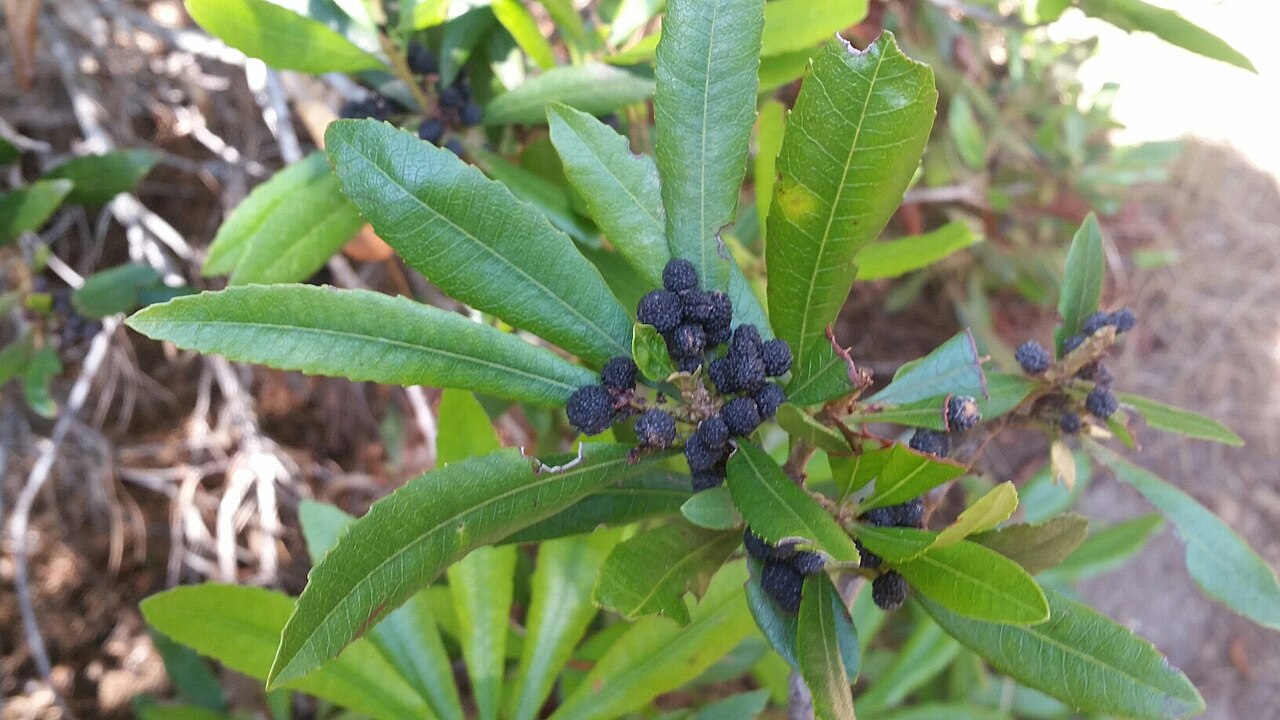
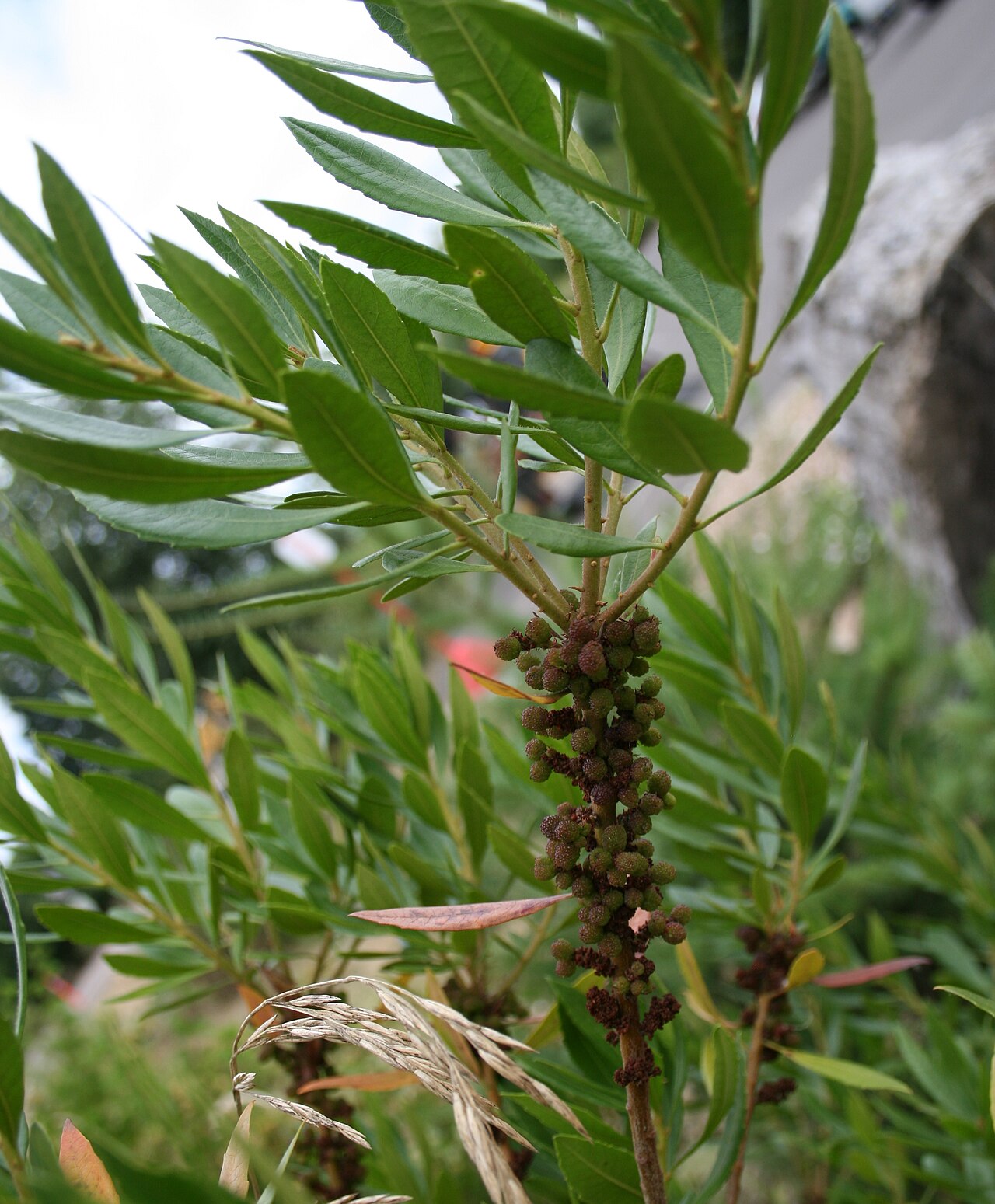
The leaves are evergreen, alternate, narrowly oblong to lance-shaped, 2 to 4 inches long, leathery and glossy dark green above with a paler, resin-dotted underside. Margins are mostly smooth but often show a few shallow teeth toward the leaf tip. Crushed leaves release a strong, resinous, bay-like fragrance — a quick and reliable way to confirm the species in the field, since few coastal shrubs smell quite like it.
Flowers
California wax myrtle is wind-pollinated and produces small, inconspicuous catkins rather than showy flowers. Most plants are functionally dioecious, with separate male and female individuals, though some produce both types of flowers. Male catkins are short, yellowish and clustered near branch tips; female catkins are smaller and less noticeable, appearing in late winter to early spring ahead of the new leaves.
Fruit & Seeds
The fruit is a small, round drupe about ¼ inch across, clustered tightly along the stems. As it ripens through late summer and fall, each berry develops a distinctive coating of pale blue-gray wax over a dark purple-brown seed coat, giving mature fruit clusters a dusty, frosted look. Only female plants produce fruit, and the berries often persist on the shrub well into winter, providing an extended food source after most other native fruits are gone.
Quick Facts
| Scientific Name | Morella californica (syn. Myrica californica) |
| Family | Myricaceae (Bayberry) |
| Plant Type | Evergreen Shrub / Small Tree |
| Mature Height | 10–20 ft (to 30 ft in sheltered sites) |
| Mature Spread | 8–15 ft, often as wide as tall |
| Growth Rate | Moderate to fast |
| Sun Exposure | Full Sun to Part Shade |
| Water Needs | Average; tolerates both moist and seasonally dry sites |
| Soil Type | Sandy to loamy, well-drained; tolerates poor coastal soils |
| Soil pH | Slightly acidic to neutral (5.5–7.0) |
| Bloom Time | February – April (inconspicuous catkins) |
| Flower Color | Yellowish-green, inconspicuous |
| Fall Color | None (evergreen) |
| Fruit | Blue-gray waxy berries on female plants, fall–winter |
| Deer Resistant | Yes, generally |
| USDA Hardiness Zones | 7–9 |
Native Range
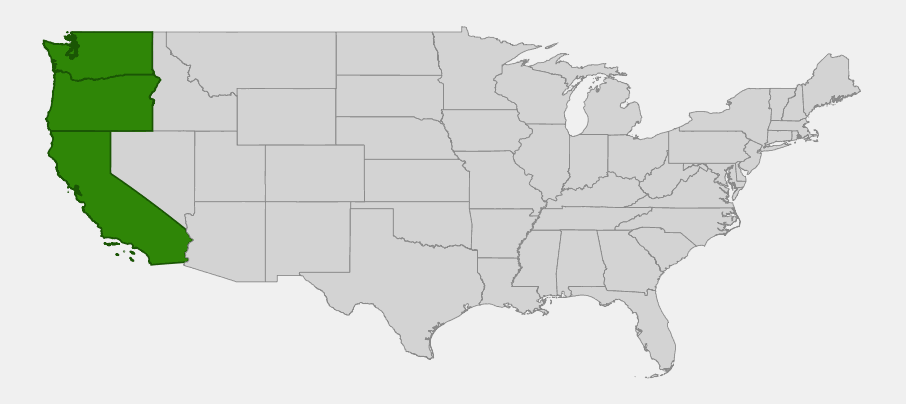
California wax myrtle grows in a narrow coastal strip of the Pacific Coast, from roughly Santa Barbara County in Southern California north through the San Francisco Bay Area and the Northern California coast, continuing through coastal Oregon and into western Washington as far as the Olympic Peninsula and the shores of Puget Sound. It is a strictly coastal species, almost never found more than a few miles inland, and is absent from California’s Central Valley and interior mountains.
Typical habitat includes stabilized coastal dunes, sea bluffs, the margins of coastal scrub and closed-cone pine or redwood forest, and streambanks and seeps close to the shoreline. It frequently grows alongside coyote brush, coastal sagebrush and various dune grasses on exposed sites, and beneath or at the edge of Bishop pine, Monterey pine or Sitka spruce stands in more sheltered coastal forest. Its tolerance for salt spray, wind and sandy, nutrient-poor soils makes it one of the most reliable woody colonizers of disturbed coastal ground.
As a nitrogen-fixing species — its roots host symbiotic Frankia bacteria in small nodules, much like red alder — wax myrtle plays an outsized role in building fertility on young dunes and other low-nutrient coastal soils, often paving the way for less hardy plants to establish nearby.
📋 Regional plant lists featuring California Wax Myrtle: California & Nevada · Western Oregon & Western Washington
Growing & Care Guide
California wax myrtle is one of the easiest native shrubs to grow anywhere within its coastal climate zone, and it adapts readily to garden conditions that are considerably less harsh than the dunes and bluffs it occupies in the wild.
Light
Plant wax myrtle in full sun to light or part shade. It flowers and fruits most heavily in full sun, but tolerates filtered shade well, especially in hotter inland-facing microclimates near the coast. Plants grown in deeper shade become looser and less dense, which can actually suit an informal woodland-edge planting.
Soil & Water
This shrub is remarkably unfussy about soil, thriving in sandy, rocky or loamy ground as long as drainage is adequate; it does not tolerate prolonged standing water at the root crown. Water regularly during the first one to two years to establish a deep root system. Once established, California wax myrtle tolerates considerable drought, particularly in coastal fog-belt gardens, though occasional deep watering keeps the foliage denser in hot or dry inland sites.
Planting Tips
Set out container plants in fall or early spring. Because most plants are functionally dioecious, include several individuals if fruit production for wildlife is a goal, since a planting of all-male stock will never produce berries. Space plants 6 to 10 feet apart for a continuous hedge, or farther apart for individual specimens. Wax myrtle handles coastal wind and salt spray well, making it a strong first-line planting near the ocean where many other shrubs fail.
Pruning & Maintenance
Wax myrtle tolerates shearing well and is frequently grown as a formal hedge; prune after the main flush of spring growth to shape without removing too much of the current year’s wood. For a more natural form, simply remove dead, crossing or overly vigorous shoots in late winter. The species suckers somewhat from the base, which can be left to thicken a hedge or removed to maintain a more tree-like single- or multi-trunk form.
Landscape Uses
- Coastal hedges and screens, tolerating wind, salt spray and sandy soil better than most broadleaf shrubs
- Windbreaks for more tender plantings on exposed coastal sites
- Wildlife gardens, for its long-lasting winter berry crop on female plants
- Dune and bluff stabilization and other coastal restoration plantings
- Mixed native borders alongside Toyon and other evergreen coastal shrubs
- Espalier or small specimen tree when limbed up and trained to a single trunk
Wildlife & Ecological Value
California wax myrtle punches well above its weight ecologically, thanks to a combination of dense evergreen cover, abundant winter fruit, and soil-building nitrogen fixation.
For Pollinators
Because it is wind-pollinated, wax myrtle offers little in the way of nectar, but its dense evergreen structure provides shelter for a range of beneficial insects, and the catkins shed abundant pollen that supports some generalist pollen-feeding insects in late winter when few other food sources are available.
For Birds
The waxy berries are an important late-season and winter food source for many songbirds, including yellow-rumped warblers, which are especially adapted to digesting the waxy fruit coating, along with chickadees, bushtits, towhees and various sparrows. The dense branching structure also provides excellent nesting and roosting cover close to the often-windy coastal environment it grows in.
For Mammals
Small mammals use the thick cover for shelter from both predators and coastal weather, while the berries are occasionally taken by raccoons and other opportunistic feeders. Dense wax myrtle stands help anchor dune and bluff soils, indirectly supporting the burrowing mammals that depend on stable coastal ground.
Ecosystem Role
As a nitrogen-fixing pioneer species, wax myrtle improves soil fertility on young dunes, landslide scars and other disturbed coastal ground, often being among the first woody plants to establish and paving the way for less hardy natives to follow. Its evergreen cover also buffers wind and salt spray for understory plants and animals, functioning as a nurse shrub along much of the Pacific Coast’s exposed shoreline.
Cultural & Historical Uses
Indigenous peoples along the Pacific Coast, including Coast Miwok, Pomo and other coastal groups, made some use of wax myrtle’s aromatic leaves and the waxy coating on its berries, following practices broadly similar to those used with the related eastern bayberry, though California wax myrtle was never as central to any single documented tradition of candle-making as its Atlantic Coast cousin.
Early California settlers and botanists noted the resemblance to the bayberry of the Atlantic states and occasionally rendered the wax coating from the berries for candle- and soap-making on a small, local scale, though this was never a significant commercial industry on the West Coast the way it was in colonial New England. The aromatic foliage was sometimes used as a natural air freshener or insect-repellent strewn herb in household use.
In the twentieth century, California wax myrtle’s main cultural role shifted toward horticulture: it became, and remains, one of the most widely planted native shrubs for coastal landscaping in California, Oregon and Washington, valued by professional landscapers for its reliability in difficult coastal conditions long before native plant gardening became mainstream.
Frequently Asked Questions
Is California wax myrtle the same as bayberry?
It is a close relative in the same family (Myricaceae) as the East Coast’s northern bayberry (Morella pensylvanica), and both produce waxy berries, but they are distinct species native to opposite coasts. California wax myrtle is sometimes informally called “California bayberry.”
Do I need a male and a female plant to get berries?
Most California wax myrtle plants are functionally dioecious, meaning individual plants tend to produce mostly male or mostly female flowers, though some plants bear both. For reliable fruit, plant several individuals grown from seed or a mix of nursery stock rather than a single clone.
How salt-tolerant is California wax myrtle?
Very. It is one of the most salt- and wind-tolerant native shrubs on the Pacific Coast and is regularly used as a first line of planting on exposed bluffs and near beaches, where it often outperforms non-native hedge shrubs.
Can California wax myrtle be grown as a small tree?
Yes. Left unpruned at the base and with lower branches gradually removed, it can be trained into a small, multi-trunked or single-trunked tree form, especially in sheltered sites where it can reach 25 to 30 feet.
Is California wax myrtle fast-growing?
It grows at a moderate to fast pace for an evergreen native shrub, often adding a foot or more per year under good conditions, which makes it a popular choice when a privacy screen or windbreak is needed within a few growing seasons.

Looking for a nursery that carries California Wax Myrtle?
Browse our native plant nursery directory: California · Oregon · Washington