Mountain Whitethorn (Ceanothus cordulatus)
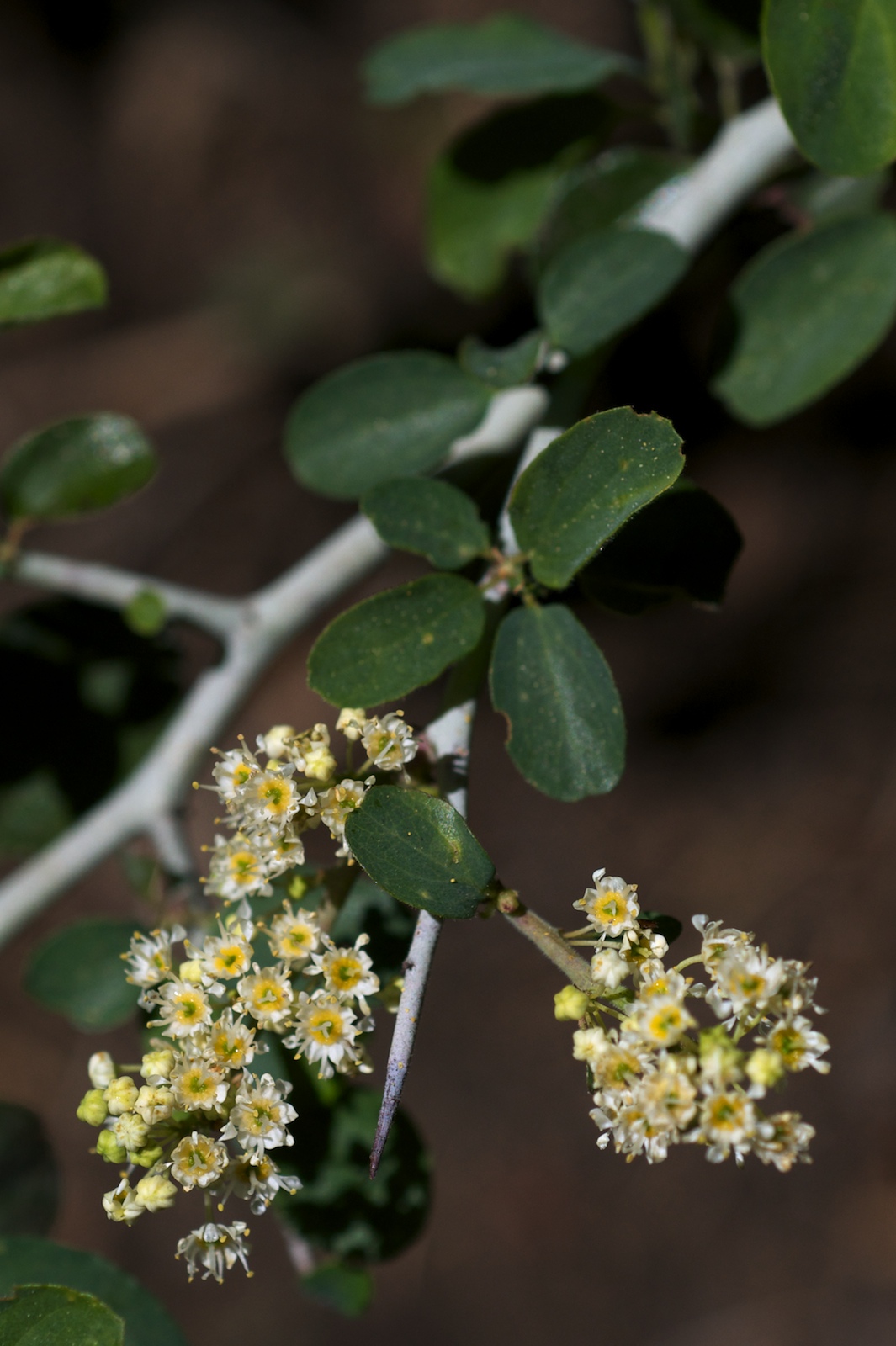
Ceanothus cordulatus, commonly known as mountain whitethorn or whitethorn ceanothus, is a tough, low, spreading shrub of California’s mountain forests. Unlike the California lilacs grown mainly for their blue flowers, mountain whitethorn belongs to the Rhamnaceae (buckthorn family) and carries white to cream-colored blooms, along with a distinctive thorny architecture that gives the species its common name — mature plants bristle with rigid, spine-tipped branchlets that make dense stands notoriously difficult to walk through.
Mountain whitethorn typically grows wider than tall, forming a low, dense, rounded mound usually under 5 feet in height but often spreading considerably wider. It is a true high-elevation specialist, most common in the open understory and burned or logged clearings of California’s mixed-conifer and red fir forests, from roughly 3,000 to 9,000 feet. Gray, rigid stems and small, three-ribbed evergreen leaves give it a tidy, textured appearance even outside of bloom.
Beyond its drought tolerance and deer-resistant structure, mountain whitethorn plays an outsized ecological role: like other ceanothus species, it hosts nitrogen-fixing bacteria in its roots, and research has found it to be an unusually important source of nitrogen input in old-growth Sierra Nevada forests — a quiet but significant contribution to forest fertility that makes it valuable well beyond the garden.
Identification
Mountain whitethorn is best identified by its low, wide-spreading mounded form, gray woody stems ending in sharp spine-like tips, and small, oval, three-ribbed evergreen leaves. The thorny branch architecture combined with white (not blue) flower clusters helps separate it from many of the more familiar blue-flowered garden ceanothus species.
Bark & Stems
Stems are gray and rigid, often ending in a sharp, spine-like point, with new twigs yellow-green and lightly fuzzy before hardening. This spiny branching habit, dense and tangled in older stands, is the source of the common name “whitethorn” and makes established thickets effective, if prickly, wildlife cover.
Leaves
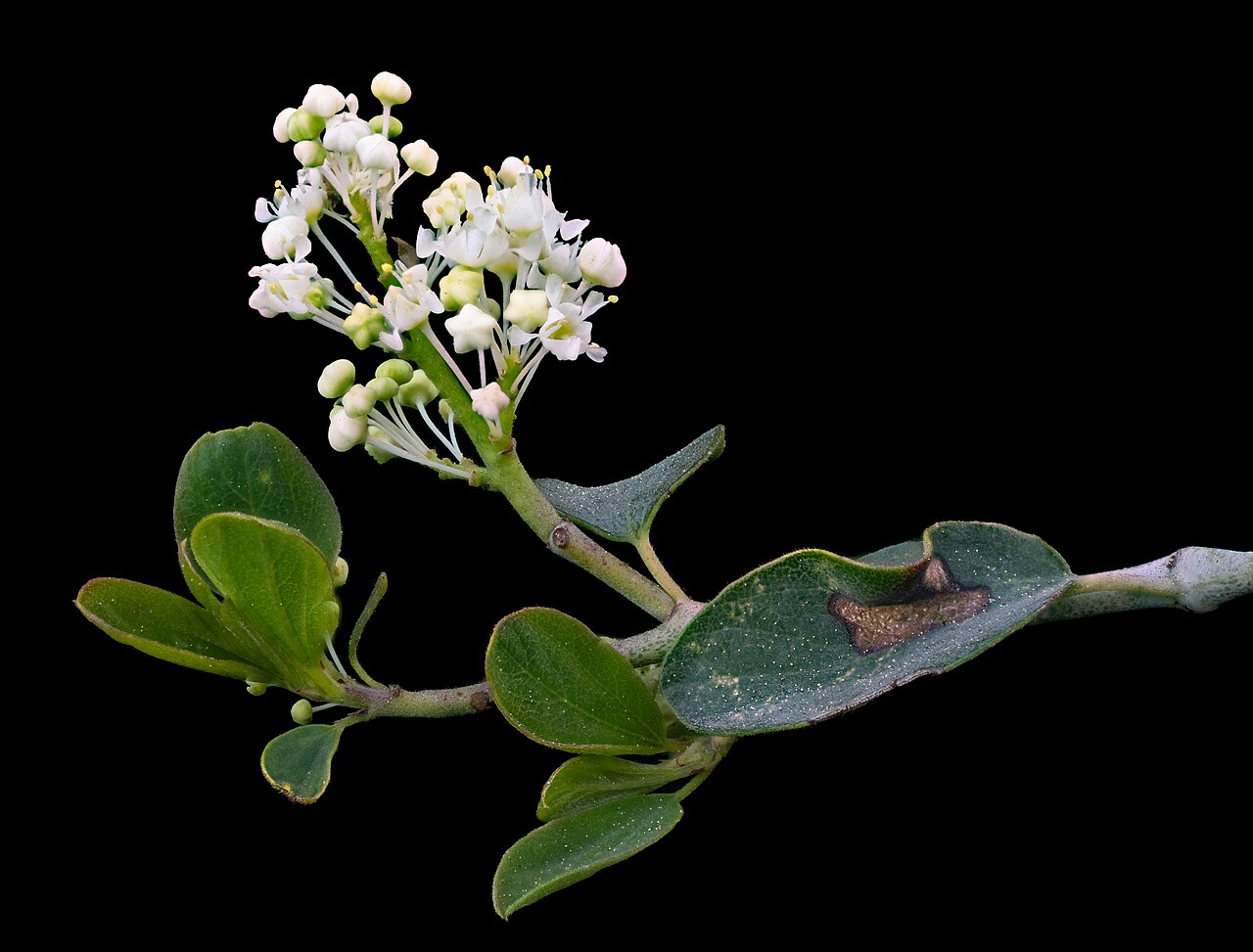
Leaves are evergreen, alternately arranged, oval in shape, and up to about 1.2 inches long, with three prominent parallel ribs running the length of the leaf — a useful field mark shared by several ceanothus species. Margins are generally smooth (not toothed), and the leaf surface may be hairy or nearly hairless depending on the individual plant.
Flowers
Flowers are small, white to creamy off-white, with five petals and five sepals, held in rounded to elongated panicle clusters up to about 1.5 inches long at the branch tips. Bloom time runs from late spring into summer, varying with elevation, and the flowers have the faintly sweet fragrance typical of many ceanothus species.
Fruit & Seeds
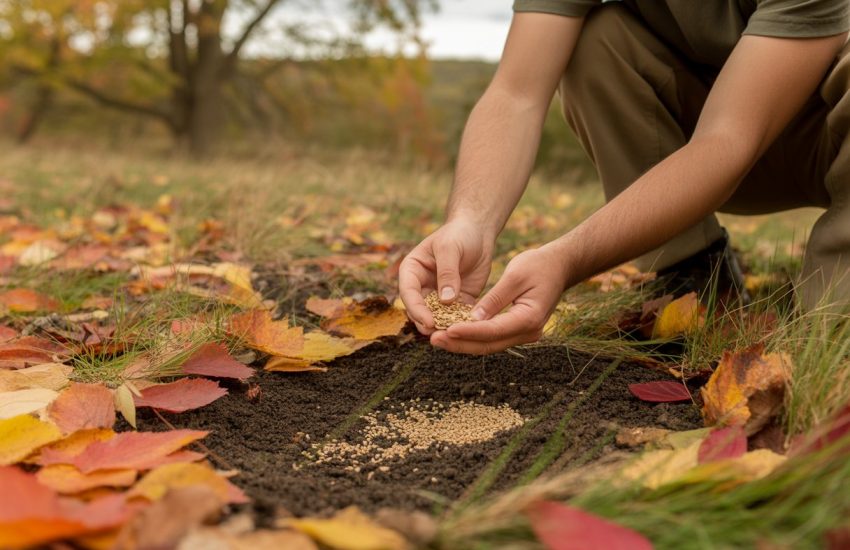
The fruit is a small, rough, ridged capsule up to about ¼ inch across, divided into three valves, each containing a single hard seed. The capsules dry and split open at maturity, and like many chaparral and forest shrubs, the seeds can remain viable in the soil for years, germinating readily after fire.
Quick Facts
| Scientific Name | Ceanothus cordulatus |
| Family | Rhamnaceae (Buckthorn) |
| Plant Type | Evergreen Shrub |
| Mature Height | 2–5 ft (0.6–1.5 m) |
| Mature Spread | 4–10 ft (1.2–3 m) |
| Growth Rate | Moderate |
| Sun Exposure | Full Sun to Light Shade |
| Water Needs | Low |
| Soil Type | Rocky or gravelly mountain soils; well-drained |
| Soil pH | 5.5–7.0 |
| Bloom Time | May – July |
| Flower Color | White to creamy off-white |
| Fall Color | None (evergreen) |
| Fruit | Small ridged three-valved seed capsules |
| Deer Resistant | Moderate (thorny structure deters browsing) |
| USDA Hardiness Zones | 6–9 |
Native Range
Mountain whitethorn is native to California, with confirmed county-level populations concentrated in the Sierra Nevada, southern Cascades, and the mountains of the Transverse and Peninsular Ranges. Some references describe the species’ broader distribution as extending into adjacent Oregon, Nevada, and northern Baja California, but confirmed county-level native populations documented for this page are limited to California.
It is a mid-to-high elevation species, typically found from about 3,000 to 9,000 feet, where it grows in the open or partly shaded understory of mixed-conifer, Jeffrey pine, and red fir forests, as well as on dry ridges and ledges. It is especially abundant in recently burned or logged openings, where it often forms dense, nearly solid thickets in the years following disturbance.
Mountain whitethorn is strongly fire-adapted: its seeds are stimulated to germinate by the heat and chemical cues of fire and can persist viable in the forest soil seed bank for decades, allowing the species to flush into open, sunlit growth immediately after a burn. As a nitrogen-fixing shrub, it also plays an important role in restoring soil fertility to burned or disturbed forest ground, and research has identified it as an unusually significant nitrogen source in old-growth Sierra Nevada forest conditions.
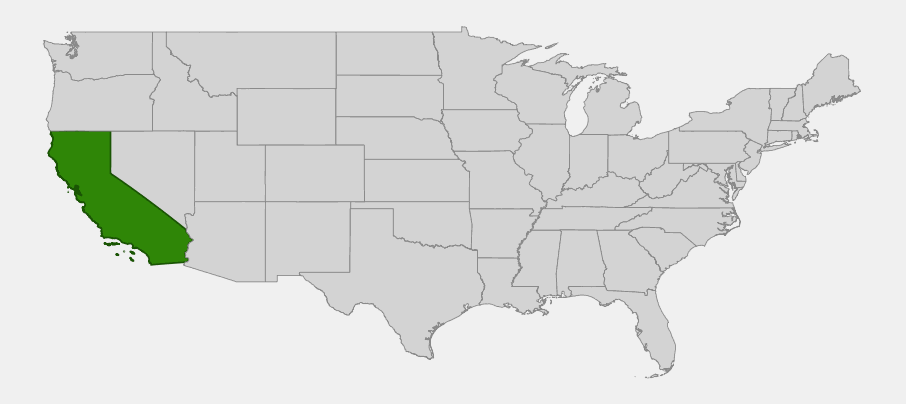
📋 Regional plant lists featuring mountain whitethorn: California & Nevada
Growing & Care Guide
Mountain whitethorn is best suited to mountain and foothill gardens that can replicate its native high-elevation, well-drained conditions. It is a tough, low-water shrub once established, valued more for structure, wildlife habitat, and soil-building than for ornamental display.
Light
Full sun to light, high-elevation shade suits this species well, mirroring the open to partly shaded forest understory and recently disturbed openings where it naturally thrives.
Soil & Water
Mountain whitethorn prefers lean, rocky, well-drained mountain soils and is not suited to heavy clay or constantly moist ground. It is drought-tolerant once established and, like many California ceanothus species, is sensitive to summer irrigation, which can promote root rot. Water during establishment, then taper off significantly.
Planting Tips
Plant in fall or early spring in higher-elevation gardens, choosing an open, sunny to lightly shaded site with excellent drainage. As a nitrogen-fixer, it generally does not need supplemental fertilizer and may actually improve soil fertility over time. Give it room to spread, since mature plants grow considerably wider than tall.
Pruning & Maintenance
Light shaping after bloom can keep plants tidier, but avoid heavy pruning into old wood, which ceanothus species tolerate poorly. The spiny branch structure means pruning is best done with gloves. Once established in suitable conditions, mountain whitethorn requires little ongoing maintenance.
Landscape Uses
Mountain whitethorn’s low, thorny, spreading habit suits several mountain-garden roles:
- Slope and bank stabilization at mid-to-high elevations
- Wildlife hedgerow or barrier planting, using its thorny structure as a natural deterrent
- Post-fire and forest-edge restoration plantings
- Low-water mountain and foothill gardens
- Soil-building in nitrogen-poor forest or disturbed sites
Fire Ecology
Mountain whitethorn is a classic post-fire pioneer of California’s mixed-conifer forests. Its seed can lie dormant in the forest floor for decades, germinating in mass flushes after fire clears the overstory and exposes mineral soil. The resulting dense thickets provide early-successional habitat and begin restoring nitrogen to burned ground within a few years, before gradually being shaded out as the conifer canopy regrows.
Wildlife & Ecological Value
Mountain whitethorn is a key component of Sierra Nevada forest ecology, particularly in the years following fire or logging.
For Birds
Dense, thorny thickets provide excellent nesting cover and protection from predators for a variety of mountain forest birds, while the summer flowers attract insects that many songbirds rely on for food.
For Mammals
Mule deer browse the foliage, especially in burned areas where whitethorn forms a major part of early post-fire browse, and black bears and small mammals use dense stands for cover. The spiny stems also make mature thickets a useful natural barrier in restoration plantings.
For Pollinators
The fragrant white flower clusters attract a range of native bees and other pollinating insects during the summer bloom period, when they provide an important nectar and pollen source in the mid-elevation forest zone.
Ecosystem Role
As a nitrogen-fixing shrub, mountain whitethorn plays an outsized role in restoring soil fertility after fire or logging in Sierra Nevada forests, and studies have identified it as an unusually important nitrogen source even in old-growth forest conditions — a quiet but significant contribution to long-term forest health.
Cultural & Historical Uses
Like other ceanothus species, mountain whitethorn has a history of use among California Indigenous peoples, including as material for tool handles and brush-like implements from its rigid branches. These are historical uses rather than guidance for present-day use; always confirm identification with an expert before working with any wild-collected plant material.
Frequently Asked Questions
Why is it called “whitethorn”?
The name refers to the plant’s rigid, gray, spine-tipped branches combined with its white (rather than the more familiar blue) ceanothus flowers.
Is mountain whitethorn the same as the blue-flowered ceanothus sold at nurseries?
No. Many popular garden ceanothus cultivars are selections of blue-flowered species or hybrids. Mountain whitethorn is a distinct, white-flowered, high-elevation species valued more for toughness and wildlife habitat than for ornamental flower color.
Does mountain whitethorn need fertilizer?
No — as a nitrogen-fixing plant, it generally improves soil fertility on its own and does not need supplemental fertilizer. Over-fertilizing can actually harm many California native shrubs.
Why does it grow so densely after wildfires?
Mountain whitethorn seed can remain dormant in forest soil for decades and is triggered to germinate en masse by the heat and chemical signals of fire, allowing the species to quickly colonize newly opened, sunlit ground.
Is mountain whitethorn a good choice for a low-elevation garden?
It is best suited to mountain and upper-foothill gardens that can mimic its native high-elevation conditions; it may struggle with the heat and different soil conditions typical of low-elevation valley gardens.

Looking for a nursery that carries mountain whitethorn?
Browse our native plant nursery directory: California