Trailing Indigo Bush (Dalea greggii)
Dalea greggii, known as Trailing Indigo Bush or Gregg’s Dalea, is a low, sprawling, silvery-leaved shrub native to the rocky limestone hills of the Texas Trans-Pecos. Named for Josiah Gregg, the 19th-century trader and naturalist who traveled the Southwest, this evergreen-to-semi-evergreen groundcover has become one of the more widely planted low-water shrubs in arid Southwestern landscaping, prized for its dense, mounding habit and fine silvery-gray foliage that holds its color through the hottest, driest months.
In its native West Texas range, Trailing Indigo Bush grows as a low, spreading mat rarely more than 2 feet tall but often 4 to 6 feet across, hugging rocky slopes and caliche banks. The fine, pinnately compound leaves are covered in silky hairs that give the whole plant a soft, silvery-gray cast, a classic adaptation to intense desert sun and reflected heat. In spring and early summer, small heads of purple, pea-shaped flowers with cream-colored accents appear scattered across the plant, drawing bees in good numbers even though the individual flowers are modest in size.
Because it tolerates extreme heat, reflected sun, and rocky, poor soil while asking for almost no water once established, Trailing Indigo Bush has become a horticultural staple well beyond its native range, widely sold and planted across the warm, dry Southwest. Gardeners outside the Trans-Pecos should understand that while it performs beautifully in similar hot, dry conditions, it is native only to a limited part of far West Texas and does not occur naturally in Arizona, New Mexico, or elsewhere, despite its popularity as a landscape plant in those states.
Identification
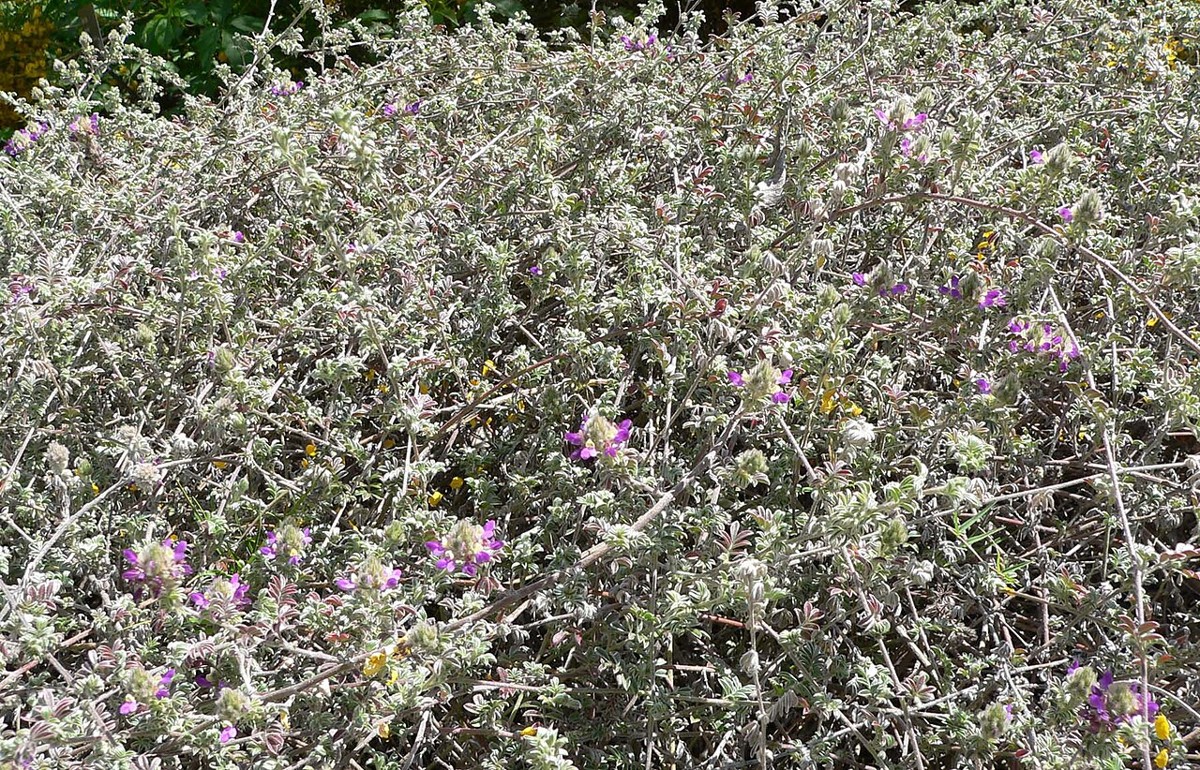
Trailing Indigo Bush forms a low, dense, mounding to sprawling shrub, typically 1 to 2 feet tall but spreading 4 to 6 feet or more across as a loose groundcover. Its overall form is soft and silvery rather than upright or woody-looking.
Bark & Stems
Stems are slender, woody at the base, and spread outward and somewhat downward, often rooting where they touch soil, which contributes to the plant’s effective use as erosion-controlling groundcover on slopes. Young growth is covered in fine silvery hairs.
Leaves
Leaves are small, pinnately compound, with numerous tiny, gray-green to silvery leaflets covered in dense silky hairs. This fine pubescence is the plant’s most distinctive identification feature, giving the foliage a soft, almost felted silver-gray appearance that persists through the growing season and helps the plant reflect intense desert sunlight.
Flowers
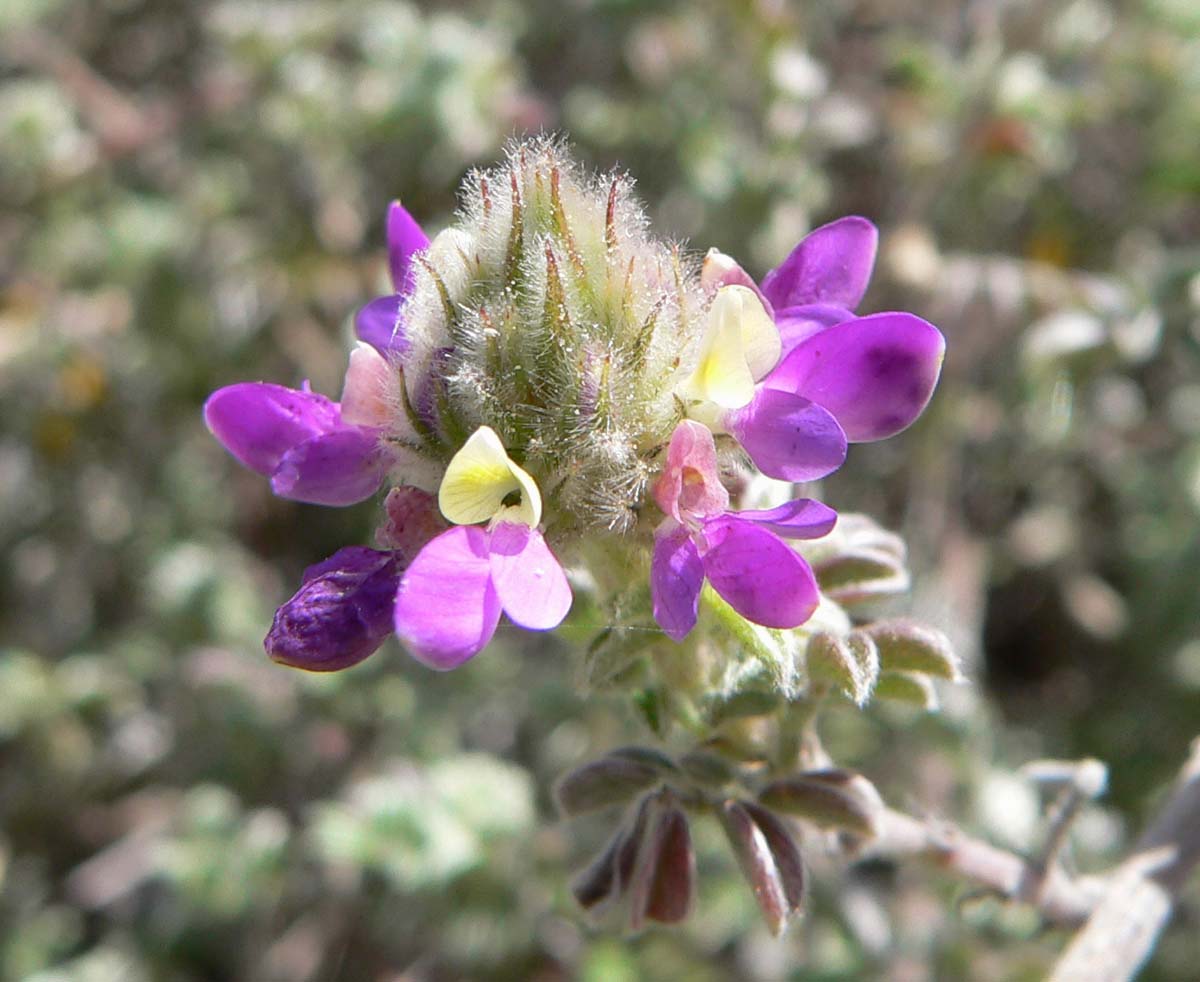
Flowers are small and pea-shaped, clustered into dense, silky-haired, cone-like heads about ½ to ¾ inch long at the branch tips. Individual flowers are purple to magenta with a contrasting cream-to-pale-yellow banner petal. Bloom occurs mainly in spring through early summer, with occasional rebloom after rain, and the fuzzy, silvery flower heads are attractive even before the petals fully open.
Fruit & Seeds
Small, inconspicuous, single-seeded pods form within the dried flower heads after bloom. They are not ornamentally significant and are easily overlooked among the silvery foliage.
Quick Facts
| Scientific Name | Dalea greggii |
| Family | Fabaceae (Pea/Legume) |
| Plant Type | Evergreen to Semi-evergreen Shrub / Groundcover |
| Mature Height | 1–2 ft |
| Mature Spread | 4–6 ft |
| Growth Rate | Moderate |
| Sun Exposure | Full Sun |
| Water Needs | Low |
| Soil Type | Rocky, caliche, limestone; well-drained |
| Soil pH | 7.0–8.5 (neutral to alkaline) |
| Bloom Time | March – June, sporadic after rain |
| Flower Color | Purple with cream-yellow banner |
| Fall Color | None (evergreen silvery-gray foliage) |
| Fruit | Small, inconspicuous single-seeded pods |
| Deer Resistant | Yes |
| USDA Hardiness Zones | 8–10 |
Native Range
Trailing Indigo Bush is native to a limited area of far West Texas, centered on the Trans-Pecos region — the Big Bend country and surrounding limestone ranges along the Rio Grande. County-level botanical records confirm it as a native species in this Trans-Pecos core, extending south into adjacent northern Mexico (Chihuahua and Coahuila). Despite its popularity as a landscape plant across the wider Southwest, it is not documented as naturally occurring in Arizona or New Mexico; its wide availability in nurseries throughout those states reflects cultivation, not native range.
Within its native Trans-Pecos range, Trailing Indigo Bush grows on dry, rocky limestone slopes, caliche banks, and desert scrub flats, often in full, unshaded sun with minimal soil development. It associates with other Chihuahuan Desert shrubs such as creosote bush, ocotillo, and lechuguilla, typically at elevations from about 2,000 to 5,000 feet.
Gardeners in Arizona, southern New Mexico, and similar hot desert climates can grow Trailing Indigo Bush successfully as a low-water landscape plant, but should recognize it as an introduced, cultivated species in those areas rather than a native one, and should favor locally native Dalea species where a strictly native planting is the goal.
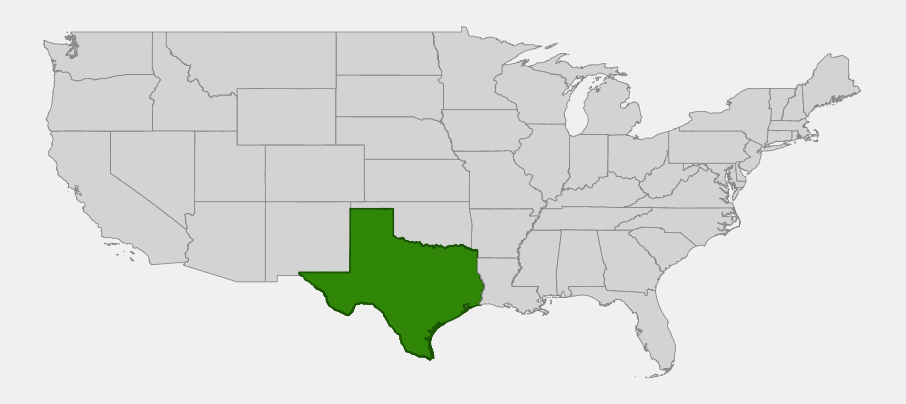
📋 Regional plant lists featuring Trailing Indigo Bush: South and West Texas
Growing & Care Guide
Light
Give Trailing Indigo Bush full sun, including hot, reflected exposures such as south-facing slopes or areas near pavement and stone. It tolerates intense desert light better than most groundcovers.
Soil & Water
This shrub wants lean, rocky, fast-draining, alkaline soil, matching its native caliche and limestone habitat. Established plants need very little supplemental water and are genuinely drought tolerant; overwatering in heavy or poorly drained soil is the most common cause of failure.
Planting Tips
Plant in fall or early spring on a slope, berm, or raised area with excellent drainage. Space plants 4 to 6 feet apart to allow for their spreading, mounding habit; a single plant can cover a surprisingly large area over a few years.
Pruning & Maintenance
Minimal pruning is needed. An occasional light shearing in late winter keeps the mound tidy and can encourage denser growth, but Trailing Indigo Bush generally looks best left to its naturally informal, mounding form.
Propagation
Propagate from seed, scarified to improve germination of the hard seed coat, or from semi-hardwood cuttings taken in summer, which root readily given the plant’s naturally spreading, rooting-at-the-nodes growth habit.
Landscape Uses
- Xeric groundcover for slopes and banks
- Erosion control on dry, rocky grades
- Silver-foliage accent in desert and rock gardens
- Low-water foundation planting in hot, reflected-sun sites
- Pollinator planting for spring and early-summer bloom
Wildlife & Ecological Value
For Pollinators
The small purple flower heads attract native bees and honeybees during the spring and early-summer bloom, providing a useful nectar source in Chihuahuan Desert habitats where floral resources can be scarce during the hottest months.
Birds
While not a major food source, the dense, low, spreading growth offers useful ground-level cover for small birds and other wildlife moving through open desert scrub.
Mammals
Trailing Indigo Bush is generally left alone by deer and rabbits, making it a reliable low-water groundcover choice in areas with significant browsing pressure.
Ecosystem Role
As a nitrogen-fixing legume, Trailing Indigo Bush contributes to soil fertility on the thin, rocky Trans-Pecos sites where it grows, and its spreading, rooting stems help stabilize loose caliche and limestone scree on slopes, reducing erosion.
Cultural & Historical Uses
Trailing Indigo Bush bears the species name of Josiah Gregg (1806–1850), a trader, explorer, and amateur naturalist whose travels and writings along the Santa Fe Trail and into Texas and Mexico documented much of the Southwest’s flora for 19th-century botanists.
Within its native Trans-Pecos range, the plant has no well-documented history of significant Indigenous or settler utilitarian use; its primary historical importance has been botanical, as a distinctive component of Big Bend-area limestone scrub documented by early plant collectors.
Its modern cultural footprint is almost entirely horticultural. Since the mid-20th century, Trailing Indigo Bush has become one of the most widely recommended low-water groundcovers for xeriscape gardens across the hot, dry Southwest, prized specifically for the silvery foliage and spreading habit that make it equally useful on a Texas limestone slope or an Arizona parking-lot median.
Frequently Asked Questions
Is Trailing Indigo Bush native to Arizona or New Mexico?
No. Despite being very widely planted throughout Arizona, New Mexico, and the broader Southwest, documented native populations are limited to the Trans-Pecos region of far West Texas and adjacent northern Mexico. Elsewhere it is a popular but introduced landscape plant.
How much water does Trailing Indigo Bush need?
Very little once established. It is adapted to rocky, fast-draining Chihuahuan Desert soils and performs best with infrequent deep watering or reliance on natural rainfall; it does poorly in heavy, slow-draining, or consistently moist soil.
How big does Trailing Indigo Bush get?
It typically stays under 2 feet tall but spreads 4 to 6 feet or more as a mounding groundcover, making it well suited to covering slopes and banks rather than functioning as an upright shrub.
Is Trailing Indigo Bush evergreen?
It is evergreen to semi-evergreen depending on winter severity, generally holding its silvery foliage year-round in its mild, hardiness zone 8–10 native range and nearby cultivated areas.
Does Trailing Indigo Bush attract pollinators?
Yes. Its small purple-and-cream flower heads attract native bees and honeybees during the spring and early-summer bloom period, making it a useful low-water nectar source in desert gardens.
Looking for a nursery that carries native plants for your area? Check this regional native plant nursery directory: Texas.