Red Prickly Poppy (Argemone sanguinea)
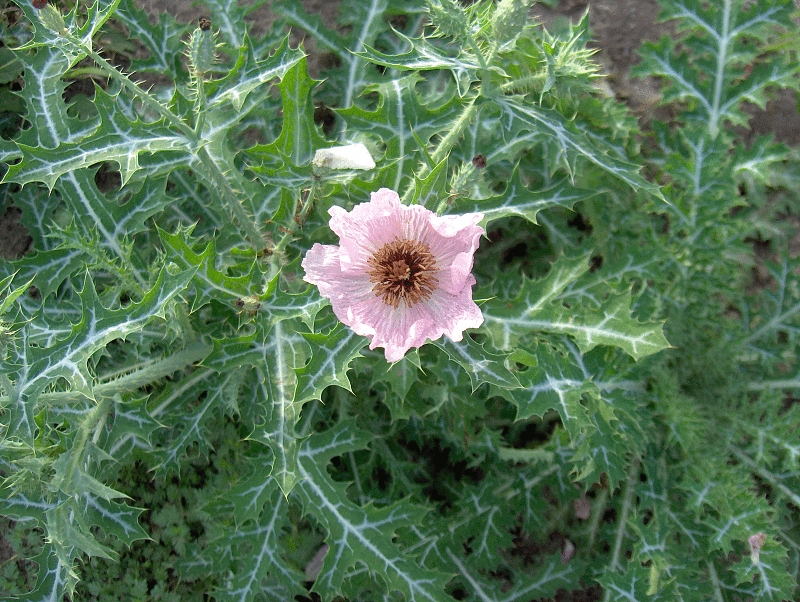
Argemone sanguinea, commonly called red prickly poppy, is a bristly, bold-leaved annual or short-lived perennial wildflower native to south and west Texas. Despite the common name, the four-petaled, crepe-paper flowers are usually a soft pink or pale rose rather than true red, a color that sets it apart from the more common white-flowered prickly poppies found across the same Texas fields and roadsides.
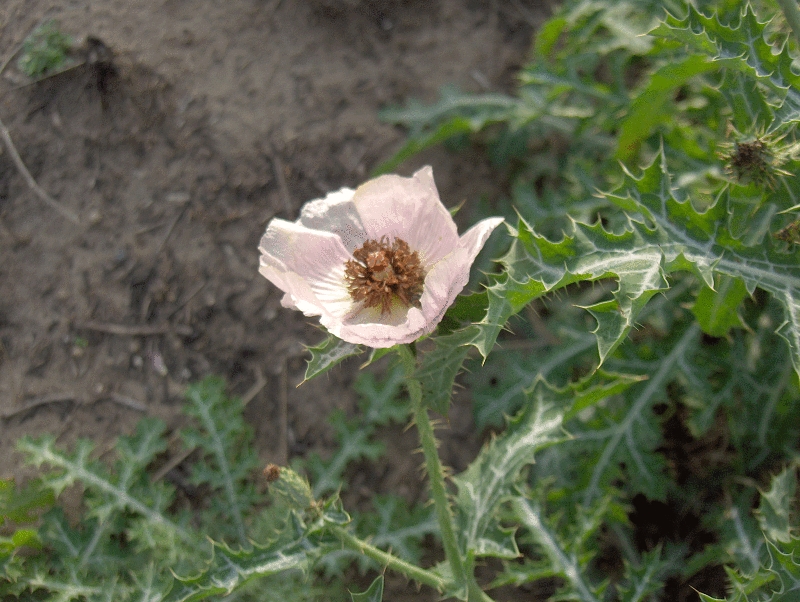
Every part of the plant above ground is armed with sharp yellow-tipped spines, and the thistle-like, gray-green leaves are strikingly marked with pale, whitish veins. When cut or bruised, the stems and leaves bleed a yellow-orange latex sap that is irritating to skin and eyes and toxic if ingested, a defense that keeps deer and livestock from browsing it and has given the whole genus its folk reputation as “Mexican poppy” or “cowboy’s fried egg.”
Red prickly poppy is a common sight on disturbed ground, roadsides, pastures and chaparral edges across its native range, where its showy, bee-attracting flowers open through the cooler months of late winter and spring. It is not typically planted in formal gardens, given its spines and toxicity, but it is a worthwhile, low-maintenance addition to a wild, pollinator-friendly corner of a south or west Texas native landscape.
Identification
Red prickly poppy grows as a bushy annual or short-lived perennial, usually 1 to 3 feet tall, with pale, waxy-blue-green stems and foliage armed throughout with sharp yellow spines.
Leaves
The leaves are deeply lobed and spiny-toothed, similar in silhouette to a thistle leaf, colored a dusty blue-green and conspicuously marked with pale, almost white veins that stand out clearly against the darker leaf surface. Leaves clasp the stem at their base and are armed on both surfaces and along the margins with stiff yellow prickles.
Flowers
Flowers are large and showy, 2 to 3 inches across, with four crinkled, crepe-paper-textured petals in shades of pale pink to rose, occasionally deepening to a darker rose-red, surrounding a dense cluster of yellow to orange-brown stamens at the center. Flowers open mainly from February through April, sometimes continuing later, and each bloom lasts only a day or two before the petals drop.
Fruit & Sap
After flowering, an egg-shaped, spiny seed capsule develops, splitting open at maturity to release numerous small, round, dark seeds. All parts of the plant, when cut or broken, exude a yellow-orange latex sap that stains and irritates skin, a trait shared across the prickly poppy genus and the reason the plant should always be handled with gloves.
Quick Facts
| Scientific Name | Argemone sanguinea |
| Family | Papaveraceae (Poppy) |
| Plant Type | Annual or short-lived perennial wildflower |
| Mature Height | 1–3 ft |
| Mature Spread | 1–2 ft |
| Growth Rate | Fast |
| Sun Exposure | Full Sun |
| Water Needs | Low; drought tolerant once established |
| Soil Type | Dry, disturbed, well-drained soils of many textures |
| Soil pH | Neutral to alkaline |
| Bloom Time | February – April |
| Flower Color | Pale pink to rose |
| Fall Color | None notable |
| Fruit | Spiny, egg-shaped seed capsule |
| Deer Resistant | Yes (spiny, toxic sap) |
| USDA Hardiness Zones | 7–10 |
Native Range
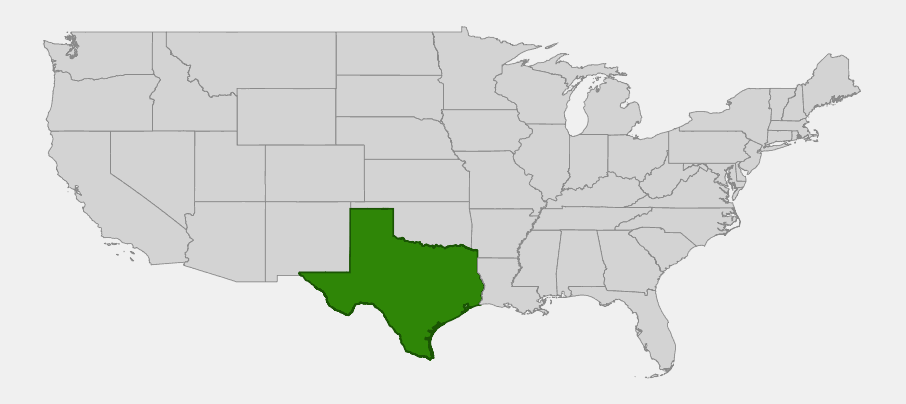
Red prickly poppy is native to south and west Texas, continuing south into northeastern Mexico. It is one of several closely related prickly poppies found across Texas, and it is distinguished from its white-flowered relatives mainly by its pink to rose petal color, though the depth of color can vary from plant to plant.
Typical habitat is open, sunny, often disturbed ground: chaparral edges, roadsides, pastures, fields, prairies and savannas, generally on dry, well-drained soils of many textures. It thrives in exactly the kind of overgrazed or recently disturbed ground where its spiny, unpalatable foliage gives it a competitive edge over plants more readily eaten by livestock.
Red prickly poppy is not listed as rare, threatened, or of conservation concern, and it remains common across suitable habitat within its south and west Texas range, often appearing in large numbers along roadsides and in pastures during its February-through-April bloom season.
📋 Regional plant lists featuring Red Prickly Poppy: South and West Texas
Growing & Care Guide
Red prickly poppy is an easy, fast-growing wildflower for a sunny, out-of-the-way spot in south or west Texas, best suited to a wild or naturalistic planting rather than a bed close to foot traffic.
Light
Give it full sun. This species thrives on open, exposed ground, and strong light produces the most compact, floriferous plants; shaded plants stretch and flower poorly.
Soil & Water
Red prickly poppy is remarkably unfussy about soil texture, growing in sandy, loamy, caliche or clay ground as long as drainage is reasonably good. It needs only modest water to germinate and establish and is genuinely drought tolerant afterward, often doing best with no supplemental irrigation at all once it is growing on its own.
Planting Tips
Choose a site away from paths, play areas and anywhere people or pets brush past regularly, since every part of the plant is spiny and the sap is irritating to skin and eyes. Direct-sow seed in fall or early spring; this species self-sows readily once established, so a single planting can maintain itself in a wild corner of the garden for years. Wear thick gloves whenever handling the plant.
Pruning & Maintenance
Little maintenance is needed or even possible without gloves, given the spines. Remove spent plants after seed has matured and dropped if a tidier look is wanted, or leave them in place to self-sow for next year’s bloom. The plant has essentially no pest problems, since its spines and toxic sap discourage virtually all browsing animals and most insects.
Propagation
Red prickly poppy is propagated entirely by seed, scattered on the soil surface in fall or early spring and lightly covered. Established plants usually reseed themselves without help, and gardeners in its native range often find the main “propagation” task is simply deciding where to let the volunteer seedlings grow.
Landscape Uses
- Wild, pollinator-friendly corners of a south or west Texas native garden
- Roadside and rangeland restoration on disturbed, low-fertility ground
- Deer-resistant plantings where browsing pressure is heavy
- Dry, difficult sites with poor or disturbed soil where little else will grow
- Security or barrier plantings along a boundary, thanks to its spiny foliage
Wildlife & Ecological Value
Red prickly poppy’s showy, pollen-rich flowers make it a magnet for bees even though it offers almost no nectar reward.
For Pollinators
The large flowers produce abundant pollen and are a strong draw for honeybees, bumblebees and other native bees, which visit primarily to collect pollen rather than nectar, since prickly poppies produce very little of the latter. The open, bowl-shaped flower form makes the pollen easy to access for a wide range of bee species.
For Birds
Small seed-eating birds may feed on the mature seeds once the spiny capsules split open, though the plant is not a major food source for birds compared with its value to pollinating insects.
For Mammals
The sharp spines and toxic, irritating sap make red prickly poppy almost completely unpalatable to deer, cattle and other grazing animals, which is exactly why it often increases in heavily grazed pastures where more palatable plants have been eaten down.
Ecosystem Role
As one of the first wildflowers to colonize disturbed or overgrazed ground across its south and west Texas range, red prickly poppy plays a pioneer role, covering bare soil, supporting early-season pollinators, and persisting on ground too degraded for many other native wildflowers until a more diverse plant community can reestablish.
Cultural & Historical Uses
Prickly poppies as a genus have a long history of use among Indigenous peoples of Mexico and the southwestern United States, most notably the yellow latex sap, which was applied externally in various traditional preparations. Because that sap and the seeds contain isoquinoline alkaloids that are toxic if ingested and irritating to skin and eyes, these traditional external uses should be understood strictly as historical practice, not as guidance for present-day use, and the plant should never be eaten or used internally.
In more recent ranching history across south and west Texas, red prickly poppy earned a reputation as an “increaser” species, a plant whose spread across a pasture signals overgrazing, since it thrives on exactly the disturbed, heavily browsed ground that livestock create by eating down more palatable competitors. Its persistence is, in that sense, as much a story about land management history as about the plant itself.
Frequently Asked Questions
Is red prickly poppy poisonous?
Yes. The yellow-orange sap and seeds contain toxic alkaloids that are irritating to skin and eyes and harmful if ingested. The plant should never be eaten, and gloves should be worn when handling it.
Why are the flowers pink instead of red?
Despite the common name, red prickly poppy flowers are usually pale pink to rose rather than true red, which distinguishes it from the more common white-flowered prickly poppies found in the same Texas range.
Why does red prickly poppy spread in pastures?
Its spines and toxic sap make it unpalatable to deer and livestock, so it tends to increase on heavily grazed or disturbed ground where more palatable plants have been eaten down, making it a classic indicator of overgrazing.
Is red prickly poppy native to my state?
It is native to south and west Texas and adjacent northeastern Mexico. It is not documented as native anywhere else in the United States.
Do pollinators visit red prickly poppy?
Yes, heavily. The large flowers produce abundant pollen that attracts honeybees and native bees, even though the plant offers very little nectar.

Looking for a nursery that carries Red Prickly Poppy?
Browse our native plant nursery directory: Texas