Dwarf Brodiaea (Brodiaea terrestris)
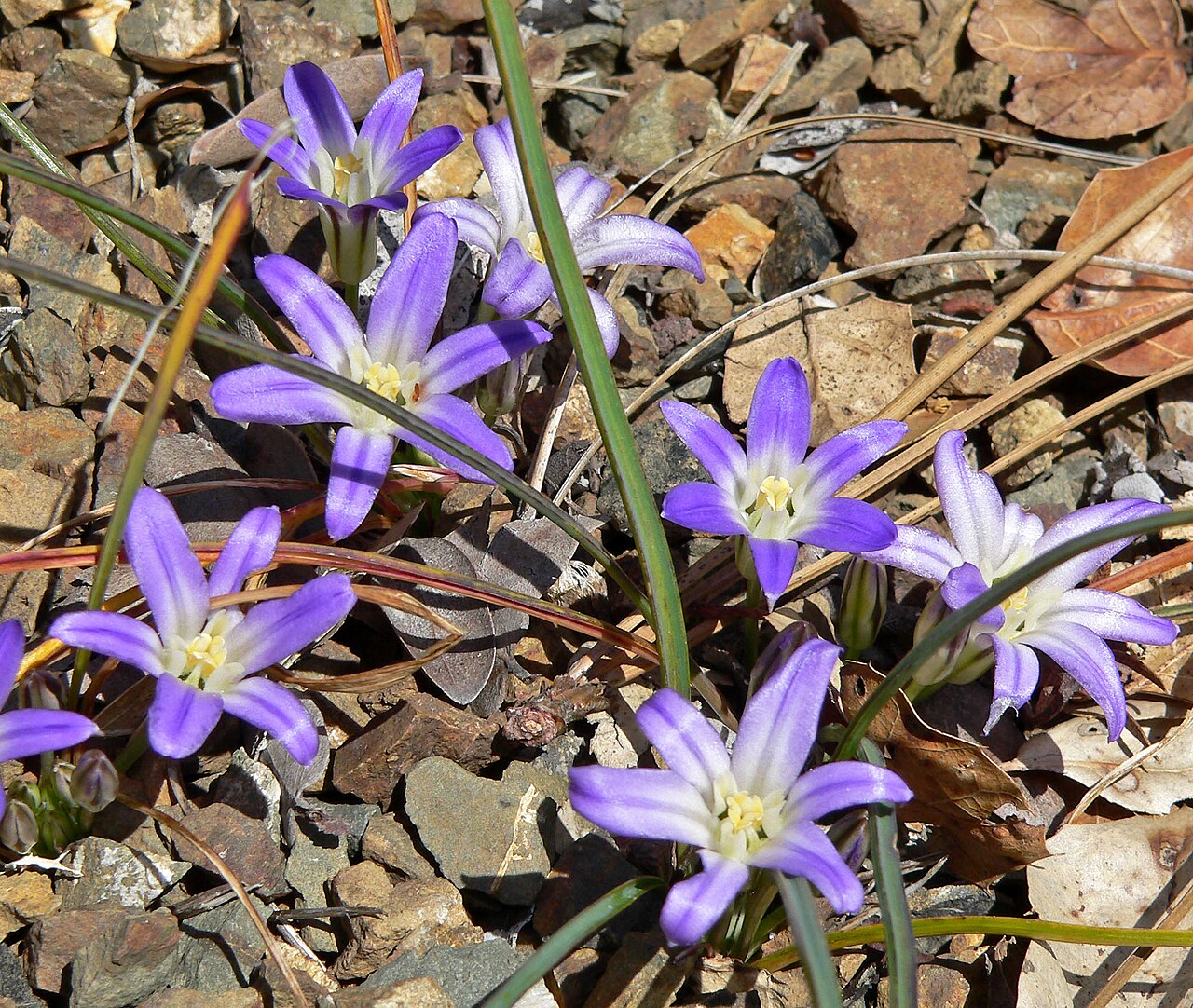
Brodiaea terrestris, commonly called dwarf brodiaea or earth brodiaea, is a petite cormous perennial wildflower found in open grasslands and rocky clearings of California and southwestern Oregon. A member of the Asparagaceae family (subfamily Brodiaeoideae, formerly classified in its own family Themidaceae and, before that, in the lily family), dwarf brodiaea is among the shortest of the Pacific Slope’s many brodiaeas. Its flowers often sit directly on the ground or on stems so short the blossoms seem to float among the surrounding grass blades and gravel.
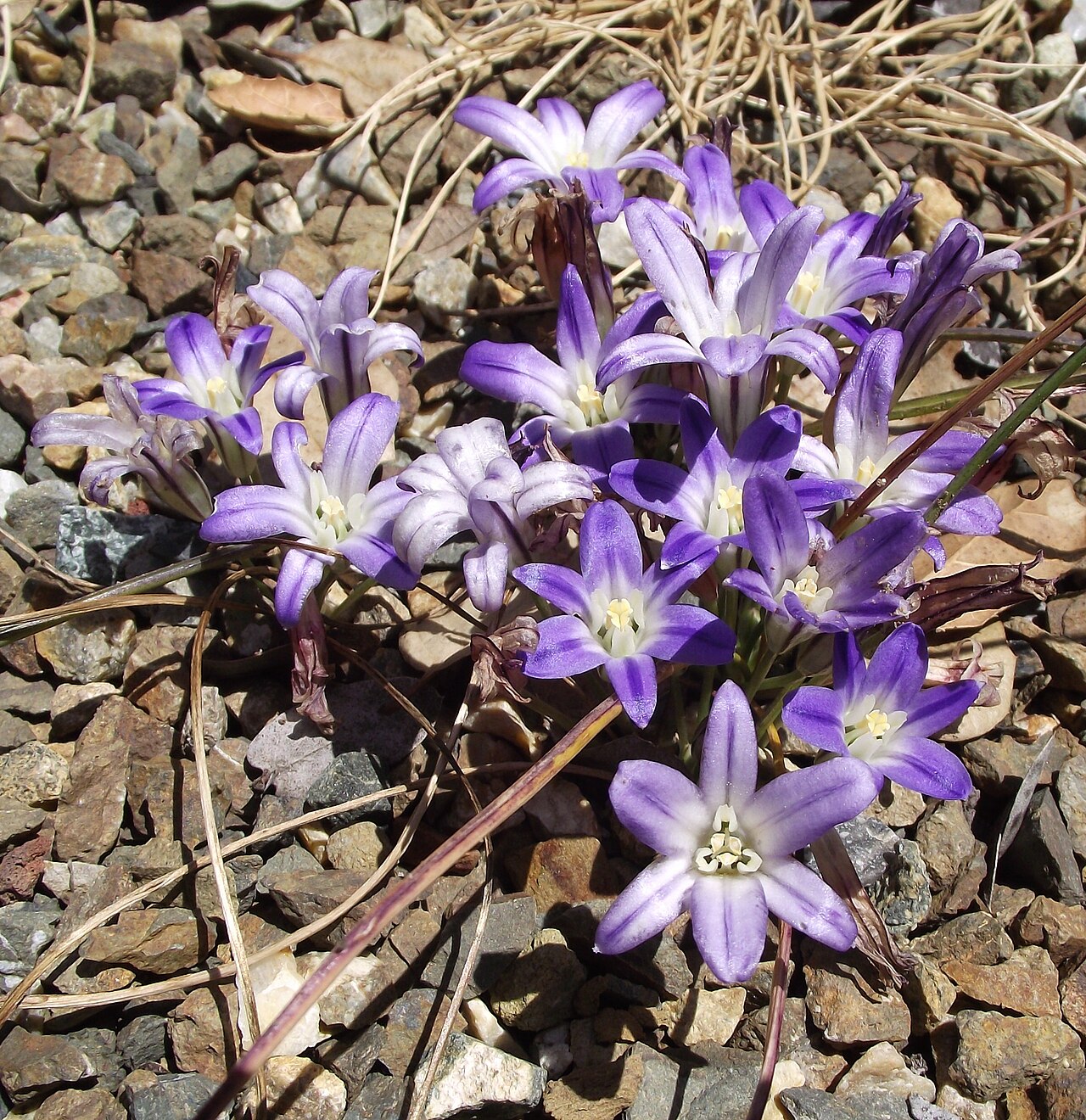
Each spring, a cluster of up to a dozen or more violet-blue, funnel-shaped flowers emerges from a single underground corm, opening low to the soil in a tight rosette-like arrangement rather than atop a tall, visible stalk. The effect is a scattering of small purple stars pressed close to open, sun-baked ground — a distinctive and easily overlooked wildflower of California’s grasslands, serpentine barrens, and oak woodland openings. Two subspecies are recognized: B. terrestris subsp. terrestris, the widespread form described here, and B. terrestris subsp. kernensis (Kern brodiaea), a rarer, more restricted form from the southern Sierra Nevada foothills.
Dwarf brodiaea is a true dry-summer bulb in the Mediterranean-climate sense: it grows and flowers during the wet season, then goes fully dormant underground through the long rainless summer, resprouting again with the autumn and winter rains. That rhythm makes it an excellent, low-maintenance choice for native plant gardeners who want seasonal color in unirrigated meadows, rock gardens, or naturalized lawn alternatives without summer watering.
Identification
Dwarf brodiaea grows from a small, fibrous-coated corm buried a few inches below the soil surface. The entire plant is diminutive, with flowering stems (scapes) typically just 1 to 4 inches tall, occasionally stretching to around 8 inches in richer soil — short enough that the open flowers frequently rest directly against the ground or just above the surrounding turf.
Corm & Stems
The underground corm is small, rounded, and wrapped in fibrous brown coats, typical of the Brodiaeoideae. From it arises a single, usually unbranched flowering scape that can be so short the inflorescence appears nearly stemless or acaulescent. Unlike many related brodiaeas that lift their flower clusters well above the foliage, dwarf brodiaea keeps its blooms close to the soil, an adaptation thought to help the plant persist on shallow, often serpentine or rocky, poorly developed soils.
Leaves
One or two grass-like, linear leaves arise from the base of the plant, usually 4 to 12 inches long and narrow, resembling blades of fine grass. The leaves typically begin to wither by the time the flowers open, so by peak bloom the plant may appear to consist of little more than a cluster of flowers emerging from bare or grassy ground.
Flowers & Fruit
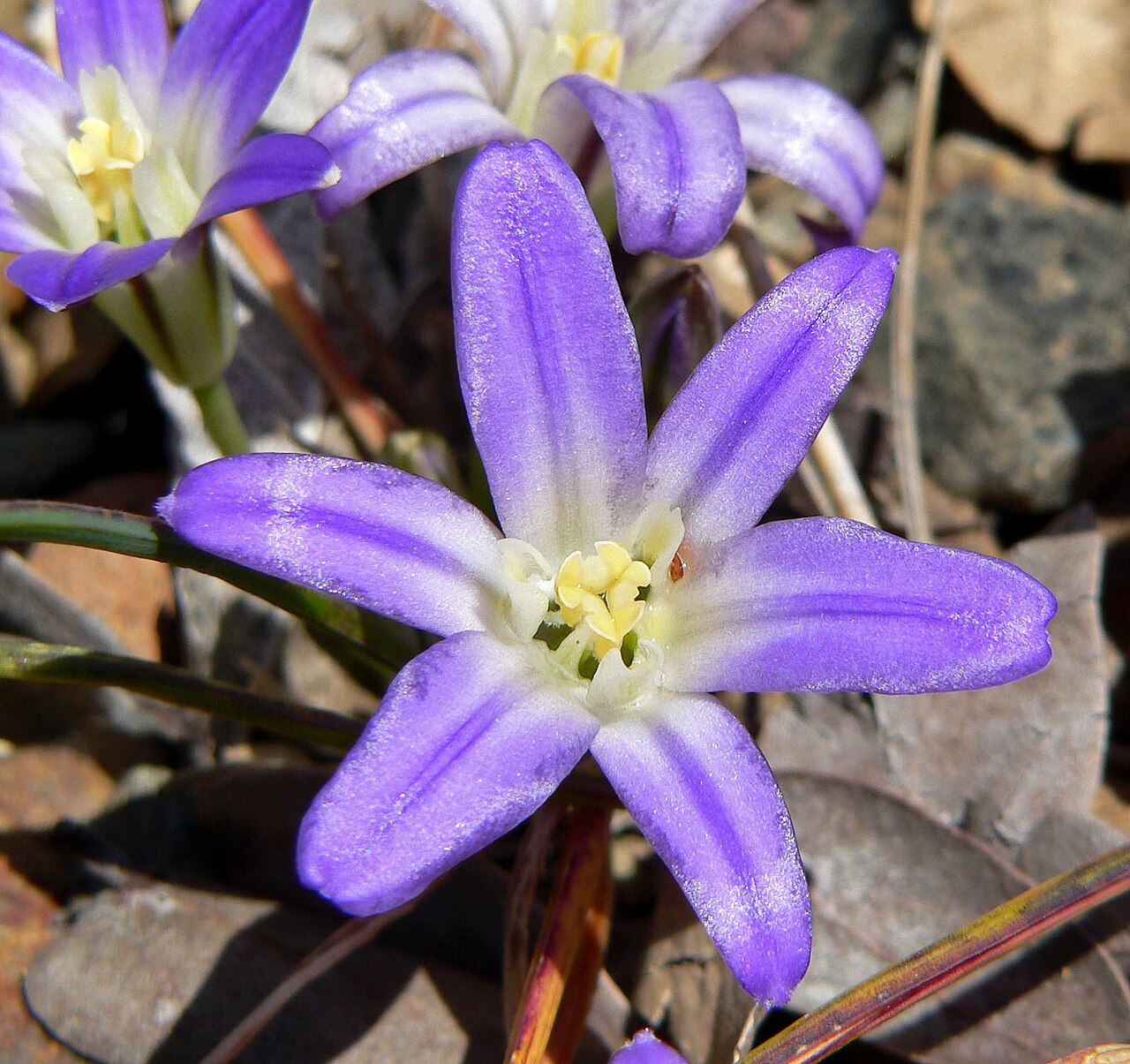
The flowers are borne in a congested, umbel-like cluster (a cyme) of roughly 2 to 15 blossoms, each about ½ to ¾ inch across. Petals (tepals) are light blue to blue-violet, often with a darker violet midstripe, fused at the base into a short funnel or tube before flaring into six pointed lobes. At the throat, pale staminodes (sterile, petal-like structures) stand angled inward around the three fertile stamens, a key identification feature distinguishing Brodiaea from similar genera like Dichelostemma and Triteleia. Bloom occurs from April into June, with timing shifting earlier at low elevation and later at higher, cooler sites. After flowering, a small three-chambered capsule develops, splitting open to release numerous small black seeds as the plant dries down for the summer.
Quick Facts
| Scientific Name | Brodiaea terrestris |
| Family | Asparagaceae (Brodiaeoideae) |
| Plant Type | Perennial Cormous Wildflower |
| Mature Height | 1–8 in (2.5–20 cm) |
| Mature Spread | 3–6 in, clumping slowly by offset corms |
| Growth Rate | Slow (corm offsets and reseeds gradually) |
| Sun Exposure | Full Sun to Light Shade |
| Water Needs | Low once dormant; moist during winter-spring growth |
| Soil Type | Shallow, rocky, clay, or serpentine soils tolerated |
| Soil pH | 6.0–7.5 (tolerates serpentine extremes) |
| Bloom Time | April – June |
| Flower Color | Light blue to blue-violet |
| Fall Color | None (dormant, foliage absent by fall) |
| Fruit | Small three-chambered seed capsule |
| Deer Resistant | Yes (corms more attractive to rodents than browsers) |
| USDA Hardiness Zones | 7–10 |
Native Range
Dwarf brodiaea is native to California and southwestern Oregon. In California it occurs widely in the Coast Ranges from near the Oregon border south through the San Francisco Bay Area to San Diego County, and it also reaches into the central Sierra Nevada foothills. In Oregon, its range is limited to the southwestern corner of the state, in the coastal and inland valleys near the California border, consistent with its broader affinity for the mild, dry-summer climate west of the Cascades.
Across this range the species favors open, sunny ground with thin or poorly developed soils: grassy flats, rocky or gravelly clearings, oak woodland openings, and serpentine barrens where competition from larger plants is limited. It is typically found from near sea level up to roughly 1,500 feet in most of its range, with some populations reaching higher into the foothills.
Because dwarf brodiaea depends on open, uncrowded ground, populations can decline where grassland is overtaken by dense nonnative annual grasses or where habitat is converted to development or intensive agriculture. It remains common in many parts of its range, but gardeners should always source corms or seed from reputable native plant nurseries rather than wild-collected material.
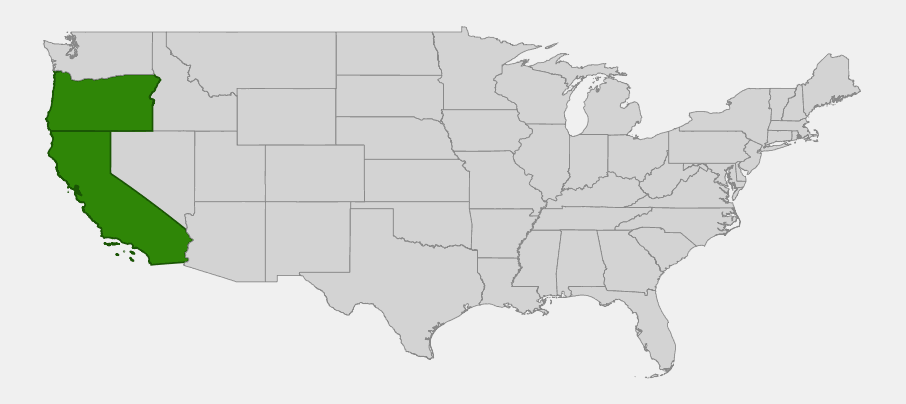
📋 Regional plant lists featuring Dwarf Brodiaea: California & Nevada · Western Oregon & Western Washington
Growing & Care Guide
Dwarf brodiaea is a carefree, low-water bulb for gardeners willing to let a planting go dormant and dry each summer. It rewards minimal intervention: plant the corms, water during the rainy season if rainfall is sparse, then leave the ground undisturbed through summer while the plant rests underground.
Light
Give dwarf brodiaea full sun for the heaviest bloom, though it tolerates light, dappled shade such as beneath open oaks. In its native habitat it grows almost exclusively in open, unshaded ground, so deep shade should be avoided.
Soil & Water
This species thrives in thin, rocky, or clay soils, including serpentine, and does not need rich garden loam — in fact, overly fertile, heavily amended soil can encourage lush grass and weed competition that quickly crowds it out. Water during the winter and spring growing season if rainfall is inadequate, but withhold all supplemental water once foliage yellows in late spring; summer irrigation during dormancy is the most common cause of corm rot in cultivated brodiaeas.
Planting Tips
Plant corms 2 to 3 inches deep in fall, spacing them 2 to 4 inches apart for a naturalistic drift. Choose a site with excellent drainage and minimal competition from aggressive nonnative grasses, which quickly overwhelm this diminutive species. Dwarf brodiaea is well suited to rock gardens, the edges of gravel paths, and unirrigated meadow plantings where its low stature will not be lost among taller companions.
Pruning & Maintenance
No pruning is needed. Allow the foliage to yellow and die back naturally after bloom before removing it, since the leaves are still feeding the corm for next year’s flowering. Avoid mowing or disturbing the planting area until foliage has fully senesced.
Propagation
Dwarf brodiaea spreads slowly by offset corms and by seed. Established clumps can be divided every several years while dormant, in late summer or early fall, by carefully lifting and separating the small cormlets that form around the parent corm. Seed can also be sown in fall and typically takes two to three years to reach flowering size.
Landscape Uses
Dwarf brodiaea’s small scale and reliable spring color suit it to several garden settings:
- Rock gardens and gravel plantings where its low flowers show well against stone
- Unirrigated native meadows mixed with other dry-summer bulbs and bunchgrasses
- Serpentine or poor-soil gardens where few other ornamentals thrive
- Container culture for close-up appreciation of the flowers
- Naturalized lawn alternatives on unmown, unirrigated slopes
Wildlife & Ecological Value
Though small, dwarf brodiaea contributes to the web of life in California’s dry grasslands, particularly as a spring nectar source during a season when competition among flowering plants for pollinators is intense.
For Pollinators
The violet-blue flowers attract a range of native bees, including small solitary bees specialized on Brodiaeoideae flowers, as well as bee flies and other spring-active insects drawn to the nectar pooled at the base of the tepals. Because the flowers sit so close to the ground, they are especially accessible to small-bodied, ground-foraging pollinators.
For Birds & Mammals
Rodents, including pocket gophers and ground squirrels, are significant consumers and dispersers of brodiaea corms, often caching them underground, which can incidentally aid in local spread. Historically, the starchy corms were also an important food resource gathered by California’s Indigenous peoples, underscoring their nutritional value within the grassland food web more broadly.
Ecosystem Role
As a small, early-season geophyte, dwarf brodiaea helps fill the gap in the grassland bloom calendar between the earliest annual wildflowers and the later summer-dormant period. Its presence is also an indicator of relatively intact, uncrowded native grassland and serpentine habitat, since the species struggles to persist once dense nonnative annual grasses dominate a site.
Cultural & Historical Uses
Brodiaea corms, including those of dwarf brodiaea and its many relatives, were a well-documented food source for Indigenous peoples throughout California. Corms were typically dug after flowering, when energy reserves were highest, then roasted, steamed, or boiled before eating — a practice shared broadly among California tribes for brodiaeas, camassias, and other geophytes of the grasslands, sometimes grouped under the common historical term “Indian potato.”
Because dwarf brodiaea is smaller and less prolific than larger relatives such as harvest brodiaea or blue dicks, it was likely a secondary rather than primary food source compared with those bigger-cormed species, but it was part of the same broad traditional harvesting knowledge of grassland geophytes passed down across generations.
Today, dwarf brodiaea holds little commercial or culinary significance and is grown almost exclusively as an ornamental by native plant enthusiasts and in habitat restoration projects aimed at recovering California’s increasingly rare native grassland and serpentine plant communities.
Frequently Asked Questions
Is dwarf brodiaea the same as blue dicks?
No. Blue dicks (Dichelostemma capitatum) is a related, taller, more widespread plant with flowers lifted on a visible stem well above a tight head. Dwarf brodiaea is much shorter, with its flower cluster sitting close to the ground, and is distinguished botanically by its angled staminodes.
Why does dwarf brodiaea disappear in summer?
It is a dry-summer dormant bulb adapted to California’s Mediterranean climate. After flowering and setting seed in late spring, the foliage dies back completely and the plant rests underground as a corm until autumn rains trigger new growth.
Can I grow dwarf brodiaea outside California and Oregon?
It can be grown in other mild, dry-summer climates with similar winter-wet, summer-dry rainfall patterns, but it is not reliably hardy or well adapted to regions with wet summers or hard winter freezes without protection, since summer moisture tends to rot the dormant corm.
Does dwarf brodiaea need to be watered in summer?
No — and it should not be. Summer water during dormancy is the most common cause of corm failure. Water only during the winter-spring growing season if rainfall is insufficient, then let the soil dry out completely once the foliage yellows.
Is dwarf brodiaea endangered?
The species as a whole is not listed as threatened or endangered, but it can be locally uncommon where open grassland habitat has been lost to development or overtaken by nonnative grasses. The rarer subspecies, Kern brodiaea (B. terrestris subsp. kernensis), has a much more restricted range in the southern Sierra Nevada foothills.

Looking for a nursery that carries Dwarf Brodiaea?
Browse our native plant nursery directory: California · Oregon