San Diego Sedge (Carex spissa)
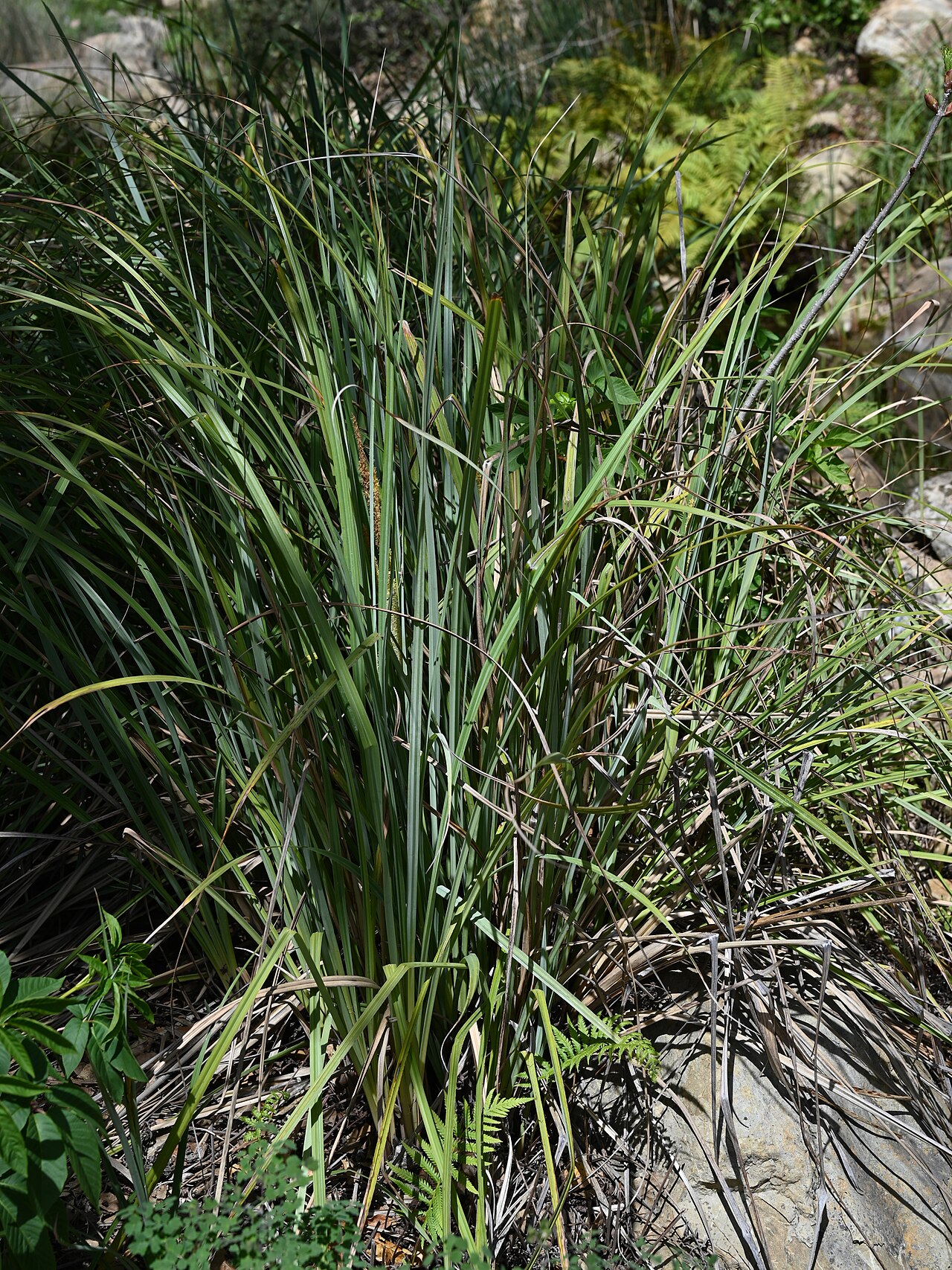
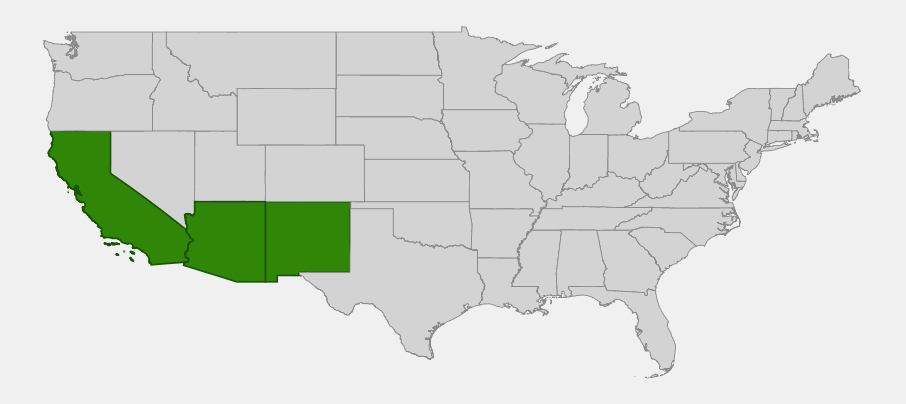
Carex spissa, known as San Diego sedge, is a bold, clump-forming perennial sedge native to the streambanks and seeps of coastal Southern California, extending into southern Arizona, southwestern New Mexico, and far northern Baja California. This member of the Cyperaceae (sedge family) is one of the largest native sedges in the Southwest, sending up thick fountains of stiff, gray-green to blue-green blades that can reach 3 to 5 feet tall and nearly as wide. From a distance it is sometimes mistaken for a small cattail or a coarse ornamental grass.
San Diego sedge grows where water lingers near the surface: canyon bottoms, seasonal creeks, spring-fed seeps, and the margins of coastal sage scrub and oak woodland drainages. It tolerates the periodic flooding and summer drought typical of Southern California’s Mediterranean climate, and it is often found rooted directly in or beside a streambed, sometimes on serpentine-derived soils. Its coarse, architectural form and drooping, caterpillar-like seed spikes make it a standout where other sedges would look delicate or out of scale.
Because it tolerates both soggy winters and dry summers once established, San Diego sedge has become a popular choice for rain gardens, bioswales, and pond edges in California native landscaping. It also plays a quiet but important ecological role, stabilizing streambanks, filtering runoff, and providing cover for birds and small wildlife along riparian corridors that are increasingly rare in the developed coastal landscape.
Identification
San Diego sedge is unmistakable once mature: a dense, upright-arching clump of coarse foliage reaching 3 to 5 feet tall, with individual plants sometimes spreading 4 feet across. It forms a tight, fibrous-rooted crown rather than running by rhizomes, so clumps enlarge slowly in place rather than spreading aggressively.
Stems & Leaves
The triangular flowering stems (culms) are stout and mostly unbranched, rising well above the foliage. Leaves are long, strap-like, and relatively stiff, 1/2 to 3/4 inch wide, with a distinctive gray-green to blue-green cast and a sharply keeled midrib that can feel almost succulent. The leaf margins are finely serrated and can be sharp enough to nick skin, so this is not a plant to handle bare-handed.
Flowers
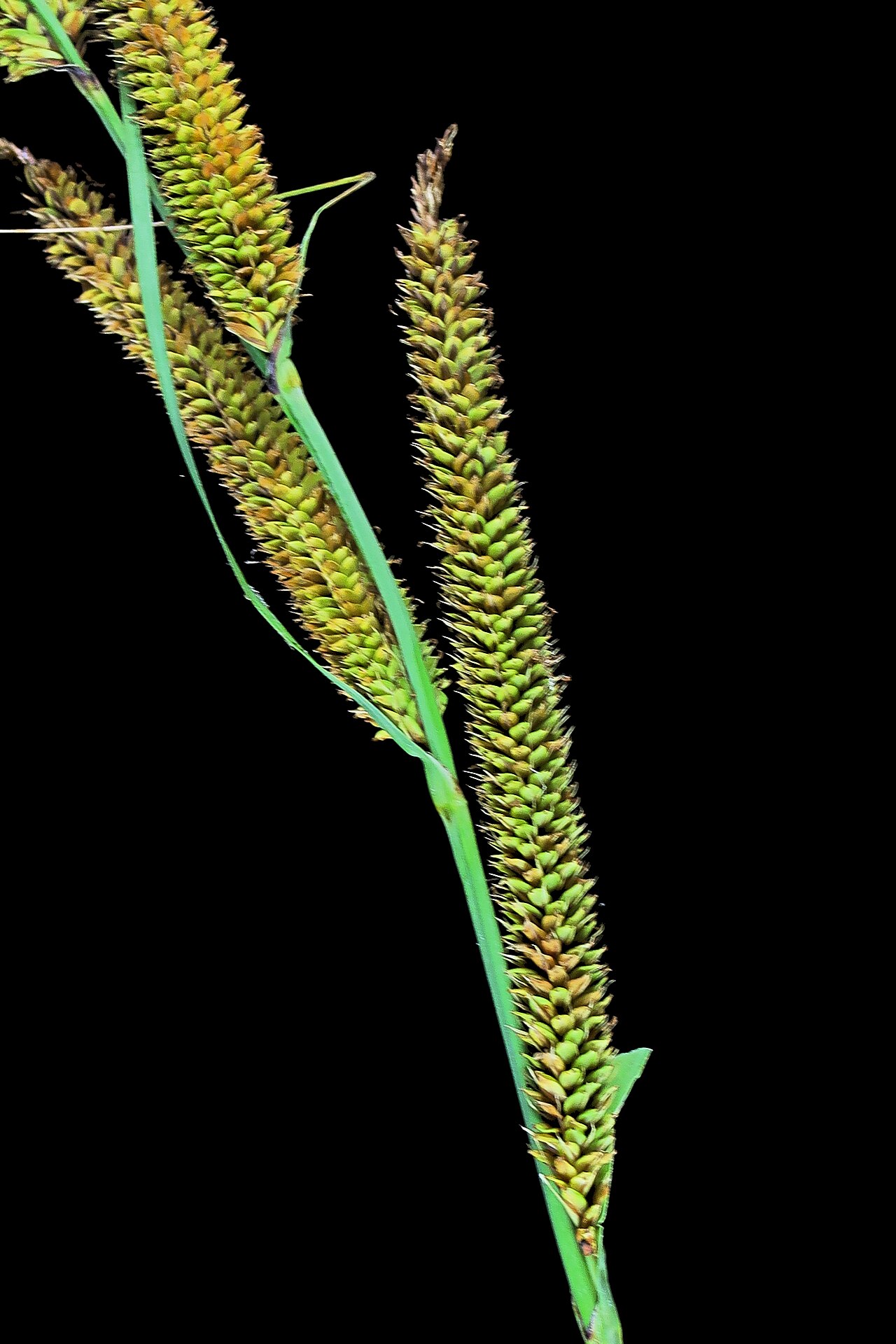
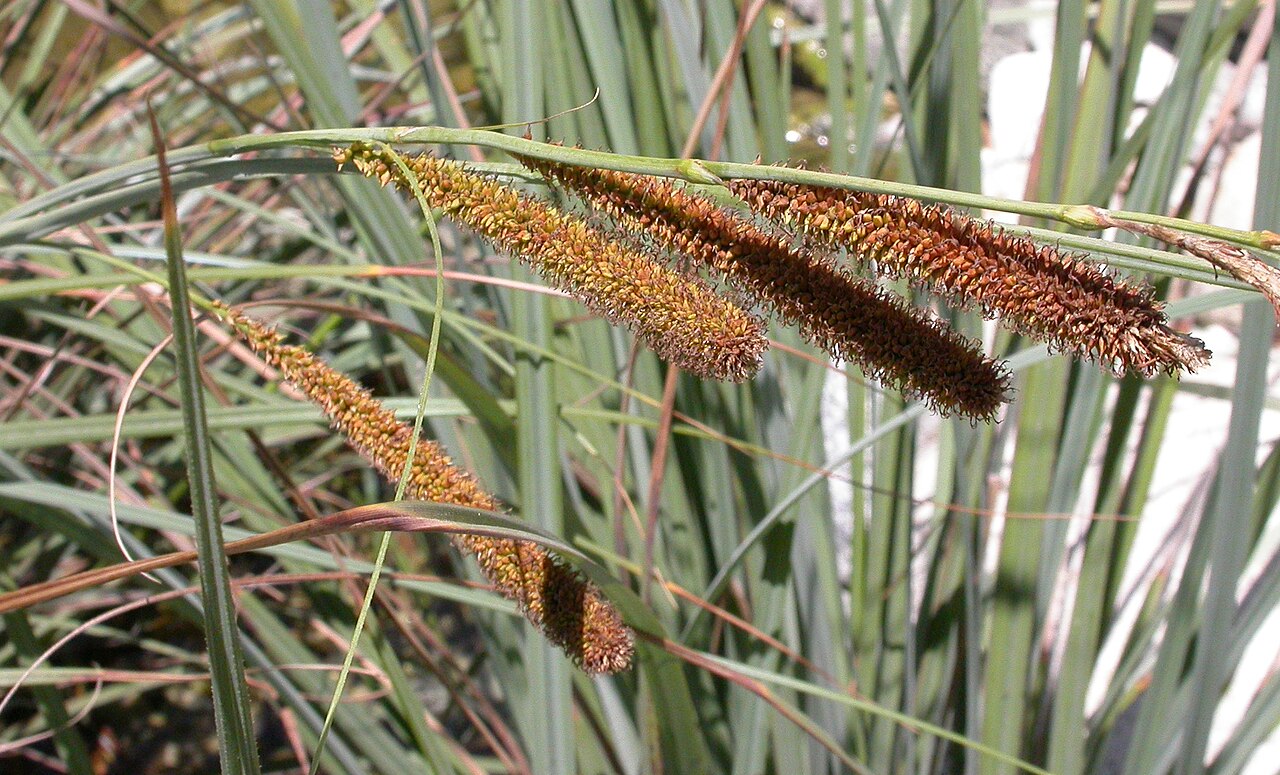
Like all sedges, San Diego sedge is wind-pollinated with no petals. In spring it produces several pendant, caterpillar-shaped spikes 3 to 6 inches long that droop from the upper stem on short stalks. Male spikes are slender and pale at the stem tips; the thicker, denser female spikes below them ripen from green to golden-brown as the tiny perigynia (seed sacs) mature.
Fruit & Seeds
Each female spike is densely packed with small, beaked perigynia enclosing a single achene. The spikes dry to a rich russet-brown by midsummer and persist on the plant well into fall, adding textural interest after the bloom has finished. Seed is dispersed locally by water and by birds that forage among the spikes.
Quick Facts
| Scientific Name | Carex spissa |
| Family | Cyperaceae (Sedge) |
| Plant Type | Evergreen Perennial Sedge |
| Mature Height | 3–5 ft |
| Mature Spread | 3–4 ft |
| Growth Rate | Slow to Moderate |
| Sun Exposure | Full Sun to Part Shade |
| Water Needs | Moderate to High |
| Soil Type | Moist to wet, loam or clay; tolerates serpentine |
| Soil pH | 6.0–7.5 |
| Bloom Time | March – May |
| Flower Color | Green ripening to golden-brown |
| Fall Color | Evergreen (gray-green year-round) |
| Fruit | Small beaked achenes in dense brown spikes |
| Deer Resistant | Yes |
| USDA Hardiness Zones | 8–11 |
Native Range
San Diego sedge is native to coastal and near-coastal Southern California, from roughly San Luis Obispo County south through the Transverse and Peninsular Ranges to San Diego County, where it is most common. Its range continues east into the sky island canyons of southern Arizona and southwestern New Mexico, and south into far northern Baja California, Mexico.
Across this range it grows in moist, often rocky drainages: canyon bottoms, intermittent streambeds, seeps below springs, and the edges of coastal sage scrub, chaparral, and oak woodland where groundwater keeps roots cool through the dry season. In Arizona and New Mexico it is tied to similar riparian pockets in the sky island ranges rather than occurring broadly across the state.
This species is not found naturally outside the Southwest; it is occasionally planted well beyond its native range in California garden settings, but gardeners elsewhere should treat it as a regional specialty rather than assume it suits their local climate.
📋 Regional plant lists featuring San Diego sedge: California & Nevada · Arizona & New Mexico
Growing & Care Guide
San Diego sedge rewards gardeners who can give it reliable moisture, even if only seasonally. Once its fibrous root system is established, it is a tough, low-maintenance anchor plant for the wetter corners of a California native garden.
Light
Plants perform well in full sun near the coast, where fog and cooler temperatures prevent scorching, but appreciate part shade or afternoon shade in hotter inland gardens. In deep shade the clumps stay looser and bloom less heavily.
Soil & Water
This sedge wants consistently moist to wet soil, especially from fall through spring; it is well suited to the edges of ponds, rain gardens, bioswales, and seasonal drainage courses where water collects. It tolerates heavier clay soils and brief standing water, and once roots are deep it can handle a dry summer better than many sedges, though growth slows and leaf tips may brown without supplemental water in a prolonged dry spell.
Planting Tips
Plant from containers in fall or early spring so roots can establish before summer heat arrives. Site it at the low point of a swale, along a streambank, or near a downspout or greywater outlet where it will catch extra moisture. Space clumps 3 to 4 feet apart to allow for their eventual spread. Wear gloves when handling mature plants; the leaf edges are sharp enough to cut skin.
Pruning & Maintenance
Cut back old, tattered foliage and spent flowering stems in late winter before new growth begins, or simply comb out dead blades by hand to keep the clump tidy. San Diego sedge is otherwise low-maintenance, with no significant pest or disease problems reported in cultivation.
Landscape Uses
Its bold form and tolerance of wet feet make San Diego sedge a workhorse in several garden situations:
- Rain gardens and bioswales that handle intermittent runoff
- Pond and stream edges as a vertical, textural accent
- Streambank stabilization and erosion control in riparian restoration
- Specimen or focal plant where its fountain-like form can be appreciated
- Wildlife and habitat gardens near a water feature
Wildlife & Ecological Value
As a dominant plant of Southern California’s increasingly scarce riparian seeps and streambanks, San Diego sedge quietly supports a disproportionate share of local wildlife for a plant with inconspicuous flowers.
For Birds
The dense, persistent seed spikes are foraged by sparrows, finches, and other seed-eating songbirds through summer and fall. The tall clumps also offer nesting cover and refuge close to water for species that favor riparian thickets over open ground.
For Pollinators & Insects
Being wind-pollinated, San Diego sedge offers little nectar, but its foliage hosts various skipper butterfly larvae that feed on sedges and grasses, and the dense clump provides shelter for ground-dwelling insects and spiders that in turn feed birds and amphibians.
Ecosystem Role
The fibrous, mat-forming roots bind streambank soil, reducing erosion during the heavy winter and spring flows typical of Southern California drainages. Clumps also help filter sediment and slow runoff before it reaches a creek, making the species valuable in habitat restoration along degraded urban and suburban waterways.
Cultural & Historical Uses
San Diego sedge does not carry the extensive, well-documented ethnobotanical record of some Southern California natives, but sedges in general, including Carex species, were used by Indigenous peoples of the region in basketry and cordage, where their tough, fibrous leaves provided useful weaving material.
In recent decades the species has moved from a little-known streambank native to a recognized landscape plant, as California water agencies and native-plant advocates have promoted sedges as low-input alternatives to turf and ornamental grasses in rain gardens and stormwater projects.
Today its main cultural role is horticultural: it appears regularly in California native plant nursery catalogs and demonstration gardens as an example of a regionally appropriate, drought-tolerant plant for wet landscape features.
Frequently Asked Questions
Is San Diego sedge the same as a cattail?
No, though the pendant brown seed spikes can look similar from a distance. San Diego sedge is a true sedge (Carex) with much narrower, tufted foliage and a clumping growth habit, unlike the spreading rhizomes and paddle-like leaves of true cattails (Typha).
Does San Diego sedge need standing water to survive?
No. It grows best with consistently moist soil and tolerates brief periods of standing water, but it does not require a permanently flooded site. Established plants can handle a dry summer, especially with some afternoon shade.
Will San Diego sedge spread aggressively in my garden?
No. It is a clumping species that enlarges slowly from a central crown rather than spreading by running rhizomes, so it stays where you plant it and is easy to keep in bounds.
Can San Diego sedge grow outside California, Arizona, and New Mexico?
It can be cultivated in similar mild, dry-summer climates, but it is not native beyond the Southwest and should not be assumed hardy or appropriate in regions with hard freezes or very different rainfall patterns.
Are the leaf edges really sharp?
Yes. The leaf margins are finely serrated and can cause small cuts, so wear gloves and long sleeves when dividing, cutting back, or handling mature clumps.

Looking for a nursery that carries San Diego sedge?
Browse our native plant nursery directory: California · Arizona · New Mexico