Basket Rush (Juncus textilis)
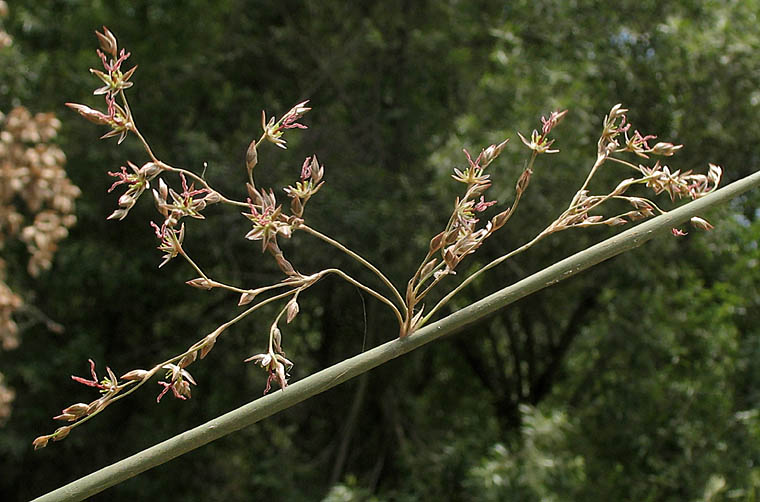
Juncus textilis, commonly called Basket Rush, is a tall, robust perennial rush endemic to California, found along the coast and in the coastal mountain ranges of the southern half of the state. It is one of the largest native California rushes, with stiff, upright, cylindrical stems that can reach 3 to 6 feet in height, towering over most other rushes and sedges in the wetlands where it grows.
True to its name, Basket Rush has long been prized for its strong, pliable stems, which were an important basketry material for Indigenous peoples of Southern California. The stems lack true leaf blades, instead showing small brown sheaths at their base, and the plant spreads by thick rhizomes to form substantial colonies along streambanks, seeps, and spring-fed slopes.
In the garden or restoration setting, Basket Rush offers dramatic vertical structure unmatched by smaller rushes, making it a striking anchor plant for large rain gardens, pond edges, or riparian restoration projects within its native range in Southern and Central California.
Identification
Basket Rush is immediately distinguished from other California rushes by its sheer size, with mature stems commonly reaching 3 to 6 feet and occasionally taller, far exceeding the 1 to 3 foot stature of species like Common Rush.
Stems
The stems are cylindrical, stiff, and faintly ridged lengthwise, colored medium to grayish-green. They grow in dense, upright clusters from thick, spreading rhizomes, eventually forming substantial colonies several feet across in favorable sites.
Leaves
As with other members of its genus, Basket Rush lacks true leaf blades. What appear as leaves are small, brown, papery sheaths that wrap around the base of each stem where it emerges from the rhizome.
Flowers
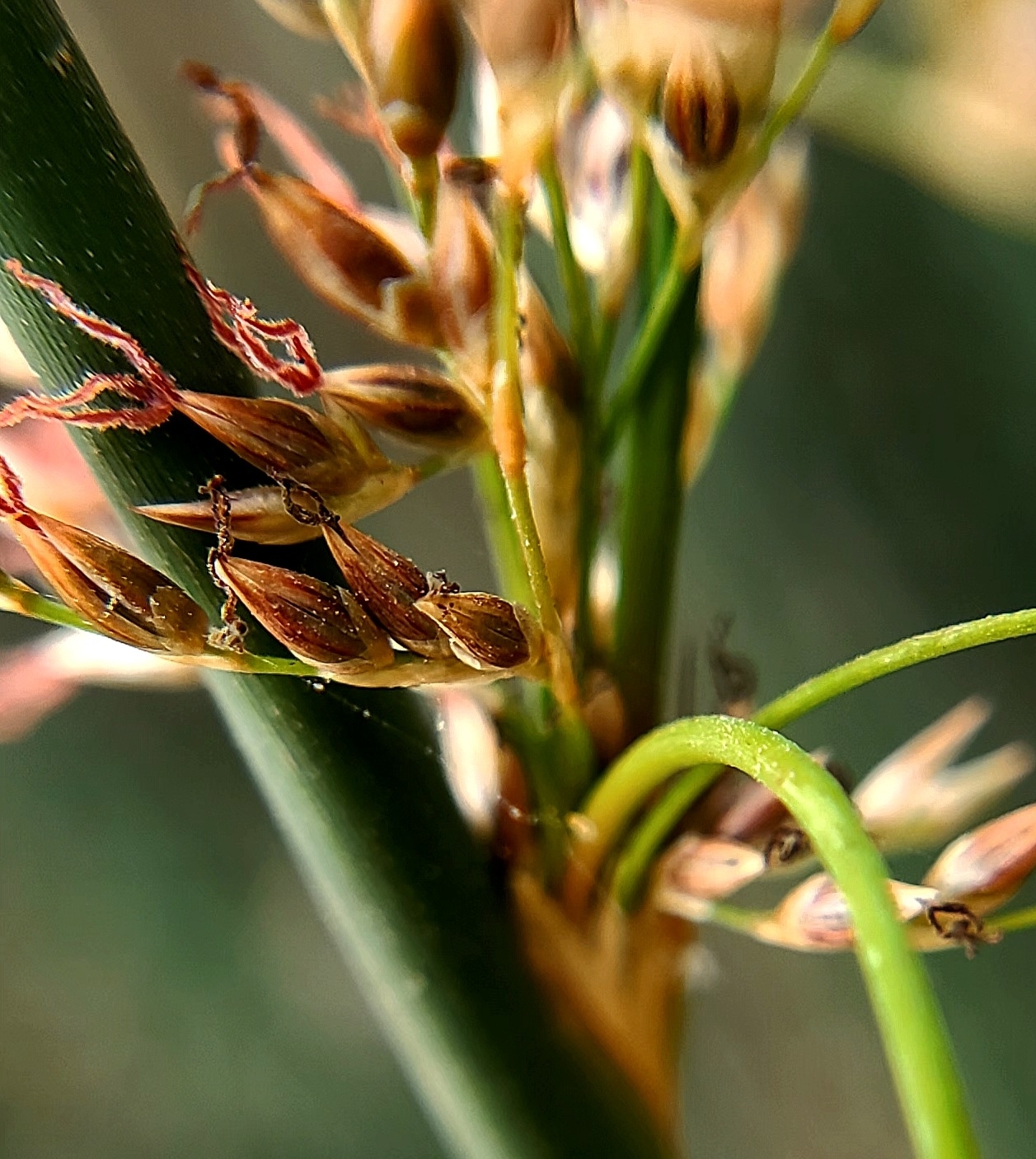
The inflorescence is a large, bushy cluster that branches out from the side of the stem, well below the tip, splitting into many long branches that carry numerous small flowers. Each flower has pointed, greenish-brown tepals, and the overall effect is a loose, airy spray quite different from the tight, ball-like heads of Brown-headed Rush.
Fruit & Seeds
Small three-chambered capsules follow the flowers, containing numerous tiny seeds that are primarily dispersed by water. The dried flower clusters often persist on the stems into winter, adding textural interest.
Quick Facts
| Scientific Name | Juncus textilis |
| Family | Juncaceae (Rush) |
| Plant Type | Perennial Rhizomatous Rush |
| Mature Height | 3–6 ft |
| Mature Spread | Spreading colonies, 3 ft+ wide |
| Growth Rate | Moderate to Fast |
| Sun Exposure | Full Sun to Part Shade |
| Water Needs | Moderate to High |
| Soil Type | Moist loam, clay, or sandy soils near water |
| Soil pH | 5.5–7.5 |
| Bloom Time | May – August |
| Flower Color | Greenish-brown |
| Fall Color | Evergreen; grayish-green year-round |
| Fruit | Small brown three-chambered capsules |
| Deer Resistant | Yes |
| USDA Hardiness Zones | 8–10 |
Native Range
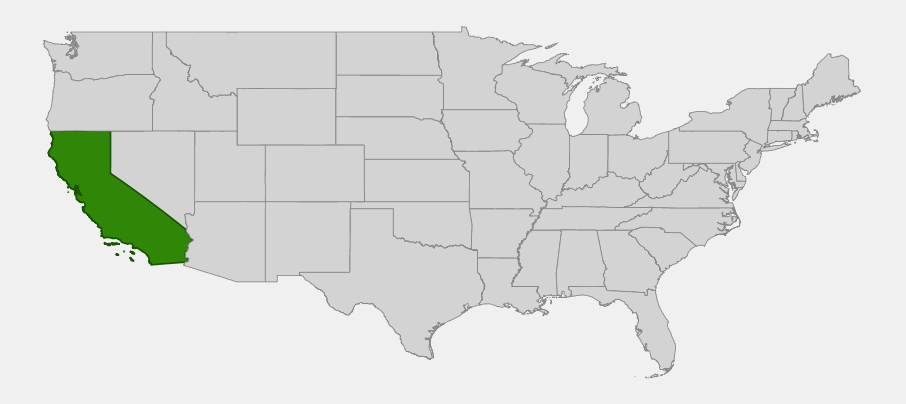
Basket Rush is endemic to California, found along the coast and in the coastal mountain ranges of the southern half of the state, from roughly the Central Coast south through the Transverse and Peninsular Ranges, including the Santa Monica Mountains and Southern California foothills. It is not documented as a reliably native wild population in any other U.S. state.
Within this range, it grows along permanent and seasonal streams, in canyon bottoms, around springs and seeps, and on moist, often rocky slopes where groundwater is close to the surface. It is frequently found alongside other riparian species in canyon woodlands throughout its range, often forming large, conspicuous colonies.
Because Basket Rush is restricted to a fairly specific part of the state, it is best used in gardens and restoration projects within or near its Central and Southern California coastal range, rather than planted further north or in other states as a native species.
📋 Regional plant lists featuring Basket Rush: California & Nevada
Growing & Care Guide
Basket Rush is a vigorous, large-scale rush best suited to gardens and restoration sites with room for its substantial mature size and spreading habit. It is a dramatic choice for anchoring a riparian planting.
Light
This rush performs well in full sun along the immediate coast and tolerates part shade in hotter inland canyon settings, where some relief from afternoon sun helps conserve soil moisture. It typically grows in canyon bottoms that receive a mix of sun and shade through the day.
Soil & Water
Basket Rush needs consistently moist soil to thrive, reflecting its natural habitat along streams and seeps. It tolerates a range of soil textures as long as moisture is reliable, and does best with some summer water in gardens, since it is less drought-tolerant than smaller, more upland rush species.
Planting Tips
Plant from containers in fall to take advantage of the winter rainy season. Give it plenty of room, at least 3 to 4 feet of clearance, since mature colonies spread steadily by rhizome and can become quite large over time. It works well as a dramatic specimen near a pond or stream edge.
Pruning & Maintenance
Cut back old, damaged stems at the base periodically to keep stands looking fresh, particularly after a hard winter. Because of its size and spreading habit, Basket Rush may need occasional thinning to keep it within bounds in a smaller garden.
Landscape Uses
Basket Rush offers bold, large-scale structure for the right setting:
- Riparian restoration along streams and canyon bottoms
- Large pond and water feature plantings as a vertical anchor
- Erosion control on moist slopes and streambanks
- Screening where a tall, evergreen, grasslike texture is wanted
- Basketry and fiber gardens celebrating traditional plant uses
Wildlife & Ecological Value
As a large, structurally significant rush of Southern California riparian corridors, Basket Rush contributes substantially to habitat quality along the streams and canyons where it grows.
For Pollinators
The wind-pollinated flowers offer little direct nectar value, but the dense stands provide shelter for native bees and other insects, especially valuable in the hot, dry canyon habitats where shaded, humid microsites are limited.
For Birds
Dense colonies of Basket Rush provide excellent nesting and roosting cover for riparian birds, including various sparrows and warblers that favor streamside thickets. Seeds from the dried flower heads also provide modest forage in fall and winter.
For Mammals
The tall, dense stands offer cover for small mammals moving along streambanks, and larger mammals such as deer may use the thickets for shelter, though they browse the tough stems only lightly.
Ecosystem Role
With its extensive rhizome system, Basket Rush is an important stabilizer of streambanks and canyon slopes, helping to prevent erosion during the heavy winter rains and flash floods typical of Southern California canyon watersheds. Its large stands also help filter sediment and slow water flow along stream margins.
Cultural & Historical Uses
Basket Rush holds genuine significance in the material culture of Southern California’s Indigenous peoples, including the Chumash and other groups, who prized its long, strong, flexible stems as a premier basketry material, a connection reflected directly in both its common and scientific names. The stems were split, dried, and woven into some of the finest coiled and twined baskets produced in California, valued for their strength and workability.
Because of this traditional importance, Basket Rush is still cultivated and gathered in some areas today by basket weavers continuing these traditions, and conservation of wild stands is important both ecologically and culturally. Access to healthy, sustainably managed Basket Rush populations remains meaningful to tribal communities carrying forward their weaving traditions.
In contemporary restoration and horticulture, Basket Rush is valued more for its dramatic structural presence and habitat value than for commercial basketry, though interest in traditional plant uses has helped raise its profile among native plant gardeners.
Frequently Asked Questions
How big does Basket Rush get compared to other rushes?
Basket Rush is one of the largest California native rushes, reaching 3 to 6 feet tall, considerably taller than Common Rush or Brown-headed Rush, which typically stay under 3 feet.
Is Basket Rush suitable for a small garden?
Not usually. Its large mature size and spreading rhizomes make it better suited to larger properties, restoration sites, or spacious pond and streamside plantings rather than small residential beds.
Why is it called Basket Rush?
The name reflects its long history as a prized material for Indigenous Californian basketry, particularly among Chumash weavers, who used its strong, pliable stems in fine coiled and twined baskets.
Does Basket Rush need year-round water?
It prefers consistent moisture and performs best with some supplemental water during summer, since it naturally grows along streams, seeps, and canyon bottoms where groundwater is reliably available.
Can Basket Rush be grown outside California?
It is not documented as native outside California, and since it is adapted specifically to Southern and Central California’s coastal canyon climate, it is best reserved for gardens within or near its natural range.

Looking for a nursery that carries Basket Rush?
Browse our native plant nursery directory: California