Emperor One Japanese Maple (Acer palmatum ‘Emperor I’)
Last updated: November 3, 2026
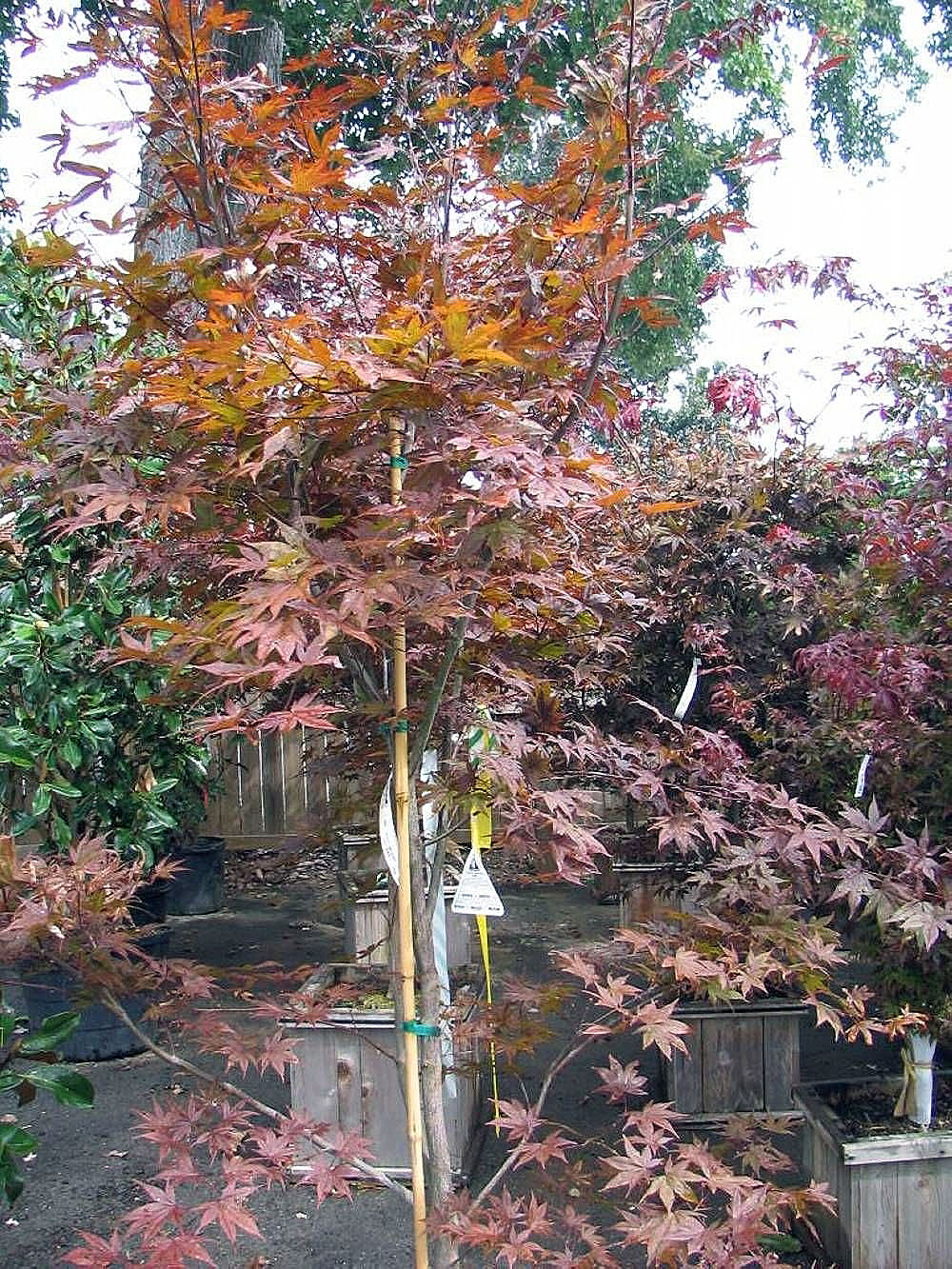
Acer palmatum ‘Emperor I’ — sold and labeled almost everywhere as Emperor One Japanese Maple — is an upright, red-leaved Japanese maple cultivar bred specifically to improve on older red selections such as ‘Bloodgood‘. Its claim to fame is timing: Emperor One leafs out later in spring than most other red Japanese maples, which lets it dodge the late frosts that can blacken and disfigure early-leafing cultivars. Once it leafs out, deeply lobed, purple-red foliage covers a tidy, rounded-to-upright crown through summer, turning bright red in fall.
Gardeners choose Emperor One for the combination of dependable red color, a relatively compact mature size compared with full-size red cultivars, and that late-leafing trait, which is especially valuable in regions with unpredictable spring frosts. It has become one of the standard “patented red maple” choices at nurseries alongside Bloodgood, often marketed as the more frost-safe option of the two.
Japanese maple (Acer palmatum) is not native to North America; the species is native to Japan, Korea and eastern China, and Emperor One is a cultivated, introduced selection of it. It is not on federal noxious-weed lists, but in parts of the eastern U.S., especially the Mid-Atlantic, Japanese maple seedlings occasionally escape cultivation into forest edges. Plant Emperor One away from natural woodland borders and remove any volunteer seedlings nearby.
Identification
Emperor One grows as a small, upright, rounded tree, generally a bit more compact and later-leafing than Bloodgood, which is the easiest way to tell the two apart in a nursery row in early spring — Emperor One’s buds are still closed when Bloodgood is already leafing out.
Bark & Stems
Young stems are reddish-brown, maturing to smooth gray-brown bark, similar to other upright red Acer palmatum cultivars and without the coral coloring of bark-interest cultivars like ‘Sango-kaku‘.
Leaves
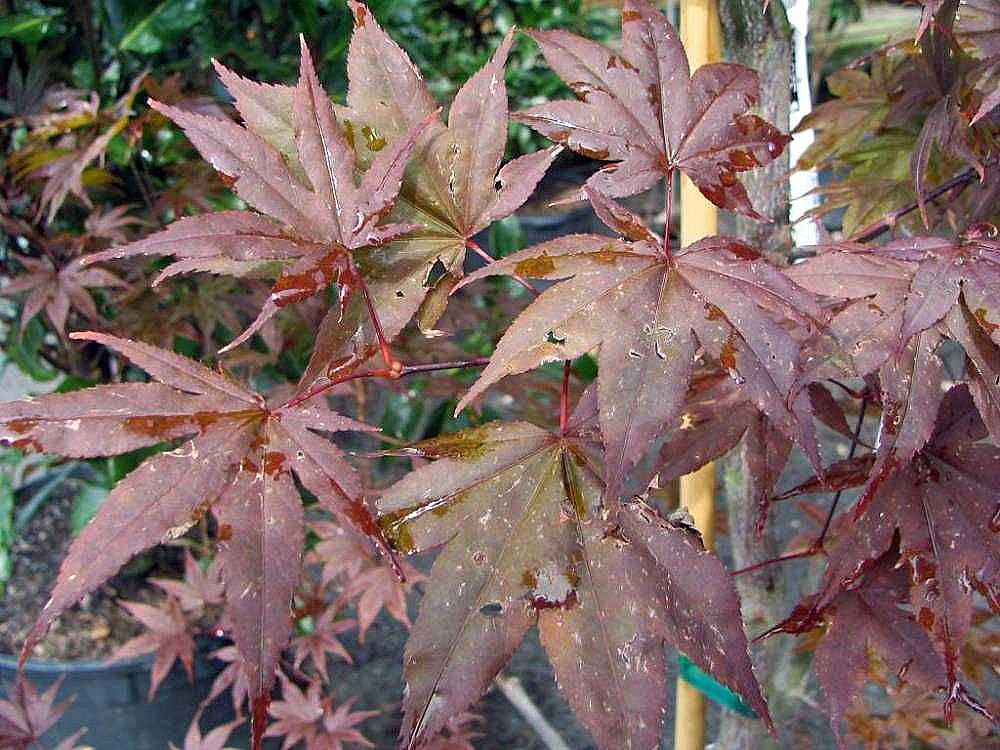
Leaves are palmate with five to seven lobes, deeply and sharply toothed, 2 to 4 inches across. They emerge later in spring than most red cultivars — a key identifying and practical trait — in a deep purple-red that holds through summer with good sun tolerance, then shifts to bright red in autumn.
Flowers
Small, reddish-purple flowers appear in spring in loose clusters, inconspicuous against the emerging foliage and pollinated mainly by wind and small insects.
Fruit & Seeds
Paired winged samaras follow the flowers, red-tinged when young and papery brown by fall. The tree sets viable seed, so occasional seedlings can appear nearby; they will not reliably carry the parent’s late-leafing trait or deep color.
Quick Facts
| Scientific Name | Acer palmatum ‘Emperor I’ |
| Cultivar | ‘Emperor I’ (sold as Emperor One) |
| Family | Sapindaceae (Maple) |
| Plant Type | Deciduous small tree |
| Native to North America | No — introduced; species native to Japan, Korea and eastern China |
| Mature Height | 10–15 ft (some sources cite up to 20 ft with age) |
| Mature Spread | 10–12 ft |
| Growth Rate | Moderate |
| Sun Exposure | Full sun to part shade; afternoon shade in hot climates |
| Water Needs | Average, consistent moisture; some drought tolerance once established |
| Soil Type | Rich, well-drained loam |
| Soil pH | Slightly acidic (about 5.5–6.5) |
| Bloom Time | Spring, later than most red cultivars; inconspicuous |
| Leaf / Fall Color | Deep purple-red spring and summer; bright red in fall |
| Fruit | Red-tinged winged samaras, summer into fall |
| Deer Resistant | Mostly — occasional light browsing reported |
| USDA Hardiness Zones | 5–8 |
| Invasive Status | Not federally listed; watch for and remove escaped seedlings near wild areas in parts of the eastern U.S. |
Origin & Where It Grows
Acer palmatum is native to the woodlands and mountain slopes of Japan, Korea and eastern China, where centuries of selective cultivation produced hundreds of named garden forms. Emperor One descends from that long tradition of selection but is a comparatively modern cultivar, developed and introduced in the United States and protected by plant patent, specifically to combine strong red color with later spring leaf emergence.
That late-leafing habit is Emperor One’s defining breeding goal: nurseries promote it as more reliably frost-safe in spring than older red cultivars, since its buds stay closed through many late cold snaps that would otherwise blacken newly emerged leaves on earlier-leafing types.
In U.S. gardens, Emperor One performs well across USDA zones 5 through 8, including regions with unpredictable spring frosts where its delayed leaf-out is a real practical advantage — the Mid-Atlantic, Midwest, and parts of the upper South and Pacific Northwest.
Growing & Care Guide
Light
Full sun to light shade gives the deepest, most sun-fast red color. In hot-summer climates, afternoon shade helps prevent scorch on the thin leaves without sacrificing much color.
Soil & Water
Plant in rich, well-drained soil; avoid low spots that stay wet. Water regularly through the first two to three seasons; established trees tolerate brief dry spells but perform best with consistent moisture during droughts.
Planting Tips
Plant at the same depth as the nursery pot in spring or fall, mulch to conserve moisture, and choose a site shielded from strong wind. Because Emperor One leafs out later, it is a good choice for a known frost pocket where earlier-leafing cultivars have struggled.
Pruning & Maintenance
Prune while dormant in late fall or winter to avoid heavy sap bleeding and to shape the canopy; remove dead, crossing or crowded growth. Minimal routine maintenance is needed once established.
Propagation
Emperor One is a patented cultivar propagated commercially by grafting onto seedling rootstock, which preserves its late-leafing trait and deep color; home propagation from cuttings or seed will not reliably reproduce the named cultivar, and patent protection may restrict commercial propagation.
Landscape Uses
- Specimen tree in frost-prone sites where other red Japanese maples are regularly damaged by late freezes
- Foundation and entry plantings, thanks to its compact, upright habit
- Container growing on patios, with winter root protection in colder zones
- Paired plantings with evergreen shrubs for contrast against the red foliage
Wildlife & Ecological Value
Emperor One offers limited wildlife value compared with native maples. Its spring flowers attract a modest number of pollinating insects, and birds and squirrels occasionally eat the seed, but relatively few native insect species are adapted to feed on Acer palmatum foliage, so it does not support caterpillars and other native insect larvae the way a native maple or oak does. Treat it as an ornamental accent and rely on native species elsewhere in the landscape for stronger wildlife support.
Native Alternatives
For a similarly sized native tree with good fall color or fine texture, consider:
- Vine maple (Acer circinatum) — a native with a graceful, multi-stemmed form and colorful fall foliage
- Red maple (Acer rubrum) — widespread, fast fall color, though larger at maturity
- Rocky Mountain maple (Acer glabrum) — a compact western native maple
- Bigtooth maple (Acer grandidentatum) — drought-tolerant with strong fall color
- Fringetree (Chionanthus virginicus) — a native small flowering tree for accent use
History & Uses
Red-leaved Japanese maples have been prized in Japanese and Western gardens for generations, but older red cultivars often share a practical flaw: they leaf out early and are vulnerable to late spring frost damage. Breeders working with Acer palmatum in the United States developed Emperor One specifically to address that weakness, selecting for a tree that holds its buds closed longer in spring while still delivering the deep purple-red color gardeners expect from a premium red maple.
Since its introduction and patenting, Emperor One has become a standard offering alongside Bloodgood at nurseries across frost-prone regions, often marketed directly on the strength of its later leaf-out as the more weather-safe choice for colder or more variable climates.
Like other ornamental Japanese maple cultivars, Emperor One has no significant food, medicinal or commercial wood uses; it is grown purely as a landscape and container ornamental.
Frequently Asked Questions
Is Emperor One Japanese maple native to North America?
No. Acer palmatum is native to Japan, Korea and eastern China. Emperor One is a patented cultivar selected from that introduced species, not a North American native.
What makes Emperor One different from Bloodgood?
Emperor One was bred to leaf out later in spring than Bloodgood and many other red Japanese maples, which reduces the risk of late-frost damage to new growth. It is also generally a bit more compact at maturity.
How big does Emperor One Japanese maple get?
Typically 10 to 15 feet tall and about 10 to 12 feet wide at maturity, though some older specimens are reported taller; it stays smaller than many full-size red cultivars.
Does Emperor One Japanese maple need full sun?
It colors best in full sun to light shade; afternoon shade is helpful in regions with intense summer heat to prevent leaf scorch.
Is Emperor One Japanese maple invasive?
It is not listed as invasive federally, but as an introduced species it can set viable seed, and Japanese maple seedlings occasionally escape cultivation in parts of the eastern U.S. Plant away from woodland edges and remove any volunteer seedlings.