
Crimson Queen Japanese Maple (Acer palmatum var. dissectum ‘Crimson Queen’)
Last updated: November 3, 2026
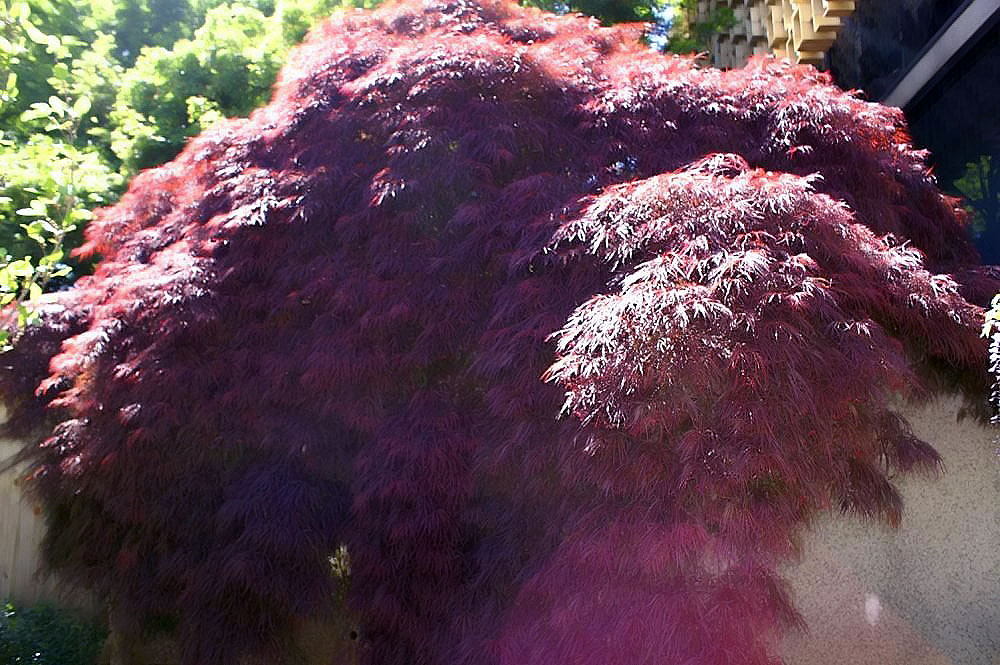
Acer palmatum var. dissectum ‘Crimson Queen’, the Crimson Queen Japanese Maple, is a weeping, mound-forming cutleaf (dissectum) cultivar grown for its finely lacy, deep red-purple foliage that cascades over a slowly spreading, dome-shaped frame. Unlike many red laceleaf cultivars that fade to bronze-green by midsummer, Crimson Queen is valued for holding its reddish-purple color through the growing season before turning bright crimson in fall.
Gardeners plant Crimson Queen as a living sculpture: its dense, cascading branches and threadlike leaves give it textural interest even without flowers, and its relatively compact, slow-growing habit makes it a good fit for smaller gardens, courtyards and rock gardens where a full-size upright maple would overwhelm the space.
Japanese maple (Acer palmatum) is not native to North America — it is native to Japan, Korea and eastern China — and Crimson Queen is an introduced, cultivated selection of that species. It is not on federal noxious-weed lists. As a dissectum (laceleaf) cultivar, it sets relatively little viable seed compared with full-size, broad-leaved cultivars, so its risk of escaping into wild areas is low; even so, avoid planting it directly against natural woodland edges and remove any seedlings that do appear nearby.
Identification
Crimson Queen grows as a dense, rounded mound of cascading branches rather than an upright tree, typically wider than tall, with branches that arch and weep toward the ground as the plant matures.
Bark & Stems
Young stems are slender and reddish, becoming woody and gray-brown with age; the fine branching structure is visible and attractive in winter once the leaves have dropped.
Leaves
Leaves are deeply dissected into narrow, almost threadlike lobes with finely toothed edges, giving the foliage a lacy, feathery texture quite different from the broader palmate leaves of upright cultivars like Bloodgood. New growth is deep reddish-purple, generally holding that color better through summer heat than many other dissectum cultivars, before turning bright crimson in fall.
Flowers
Small, inconspicuous reddish-purple flowers appear in spring, mostly hidden within the dense branching, pollinated by wind and small insects.
Fruit & Seeds
Flowers are followed by small winged samaras; Crimson Queen, like other dissectum forms, tends to set less seed than full-size, broad-leaved cultivars, and many garden specimens are grafted standards that produce little if any viable seed.
Quick Facts
| Scientific Name | Acer palmatum var. dissectum ‘Crimson Queen’ |
| Cultivar | ‘Crimson Queen’ |
| Family | Sapindaceae (Maple) |
| Plant Type | Deciduous weeping dwarf tree/large shrub |
| Native to North America | No — introduced; species native to Japan, Korea and eastern China |
| Mature Height | 8–10 ft (some sources cite up to 10–12 ft) |
| Mature Spread | 10–12 ft |
| Growth Rate | Slow |
| Sun Exposure | Part sun to part shade; protect from hot afternoon sun and drying wind |
| Water Needs | Average, consistent moisture; the fine leaves scorch quickly in drought |
| Soil Type | Rich, well-drained loam |
| Soil pH | Slightly acidic (about 5.5–6.5) |
| Bloom Time | Spring, inconspicuous |
| Leaf / Fall Color | Deep reddish-purple spring and summer; bright crimson in fall |
| Fruit | Small winged samaras, sparse compared with upright cultivars |
| Deer Resistant | Mostly — occasional light browsing reported |
| USDA Hardiness Zones | 5–8 |
| Invasive Status | Not federally listed; low seed-escape risk as a dissectum form, but remove any volunteer seedlings near wild areas |
Origin & Where It Grows
Acer palmatum is native to the forests and mountain slopes of Japan, Korea and eastern China. The dissectum, or threadleaf, form has been cultivated in Japanese gardens for centuries, prized for its delicate, lace-like foliage and naturally weeping habit, long before Western nurseries began breeding named dissectum cultivars of their own.
Crimson Queen was introduced in the United States in the mid-20th century as nurseries worked to develop a red-leaved dissectum cultivar that held its color through summer heat better than older selections, which often faded to bronze or green by midsummer. It quickly became one of the most widely grown red weeping Japanese maples in American gardens.
In U.S. gardens, Crimson Queen grows well across USDA zones 5 through 8, performing best where it gets some relief from the most intense afternoon sun — the Pacific Northwest, Mid-Atlantic, and parts of the Midwest and upper South with afternoon shade.
Growing & Care Guide
Light
Crimson Queen prefers part sun to part shade. Morning sun with afternoon shade gives strong color while protecting the fine, delicate leaves from scorch; in hot climates, too much direct afternoon sun can brown the leaf edges.
Soil & Water
Plant in rich, well-drained soil and keep it consistently moist — the thin, finely cut leaves dry out and scorch faster than broader-leaved cultivars during drought or in windy sites. Mulch to conserve soil moisture and moderate root temperature.
Planting Tips
Choose a sheltered spot out of strong, drying wind, which can shred and brown the fine foliage. Plant at the same depth as the nursery container, in spring or fall, and stake loosely if needed while the graft union establishes.
Pruning & Maintenance
Prune while dormant in late fall or winter to limit sap bleeding, removing dead or crossing interior branches to maintain the cascading form and let light into the canopy. Little other maintenance is needed once established.
Propagation
Crimson Queen is propagated by grafting onto upright seedling rootstock, which is also how it is trained into its common “standard” form with a straight trunk topped by a weeping crown. Cuttings and seed-grown plants do not reliably reproduce the cultivar’s exact color and form.
Landscape Uses
- Focal point or specimen in a small garden, courtyard or Japanese-style garden
- Rock gardens and raised beds, where its cascading form reads well against stone
- Container growing on patios, with root protection in winter in colder zones
- Near water features, where the weeping habit echoes the movement of water
Wildlife & Ecological Value
Crimson Queen provides modest wildlife value. Its spring flowers draw some pollinating insects, and the dense, low-branching form offers cover for small birds, but relatively few native insect species use Acer palmatum as a host plant, so it does not support caterpillars and other native insect larvae the way a native tree does. It is best considered an ornamental accent rather than a wildlife planting.
Native Alternatives
For a native plant with a similar weeping or finely textured look, consider:
- Vine maple (Acer circinatum) — a native with graceful, arching branches and good fall color
- Rocky Mountain maple (Acer glabrum) — a small, multi-stemmed native maple for western gardens
- Red maple (Acer rubrum) — for strong native red fall color, though a much larger tree
- Bigtooth maple (Acer grandidentatum) — drought-tolerant with good fall color
- Fringetree (Chionanthus virginicus) — a native small accent tree with fine spring flowers
History & Uses
Dissectum, or threadleaf, Japanese maples have been cultivated in Japan for centuries as garden and bonsai subjects, selected for their lacy foliage and naturally weeping or mounding habit. Western nurseries began breeding their own named dissectum cultivars in the 20th century, often focused on improving color retention and vigor compared with older, sometimes fussier selections.
Crimson Queen was introduced as part of that effort, bred and selected in the United States to hold its reddish-purple color through summer heat better than many earlier red dissectum cultivars, which tended to fade toward green by midsummer. It became, and remains, one of the most commonly planted red weeping Japanese maples in American gardens.
Beyond ornamental landscaping and container use, Crimson Queen has no significant food, medicinal or timber value.
Frequently Asked Questions
Is Crimson Queen Japanese maple native to North America?
No. Acer palmatum is native to Japan, Korea and eastern China. Crimson Queen is a cultivated selection of that introduced species, not a native North American plant.
How big does Crimson Queen Japanese maple get?
Most mature specimens reach about 8 to 10 feet tall and 10 to 12 feet wide, forming a dense, mounded, weeping shape; it grows slowly, so reaching full size can take many years.
Does Crimson Queen hold its red color all summer?
It generally holds reddish-purple color better than many other dissectum cultivars, especially with some afternoon shade, though intense heat or too much shade can shift the tone toward bronze-green.
Does Crimson Queen Japanese maple need shade?
It prefers part sun to part shade. Morning sun with afternoon protection usually gives the best balance of color and leaf health, especially in hot climates.
Is Crimson Queen Japanese maple invasive?
It is not listed as invasive federally, and as a dissectum cultivar it sets relatively little viable seed compared with full-size, broad-leaved Japanese maples, so its risk of escaping into wild areas is low.

