
Mikawa-yatsubusa Japanese Maple (Acer palmatum ‘Mikawa-yatsubusa’)
Last updated: November 3, 2026
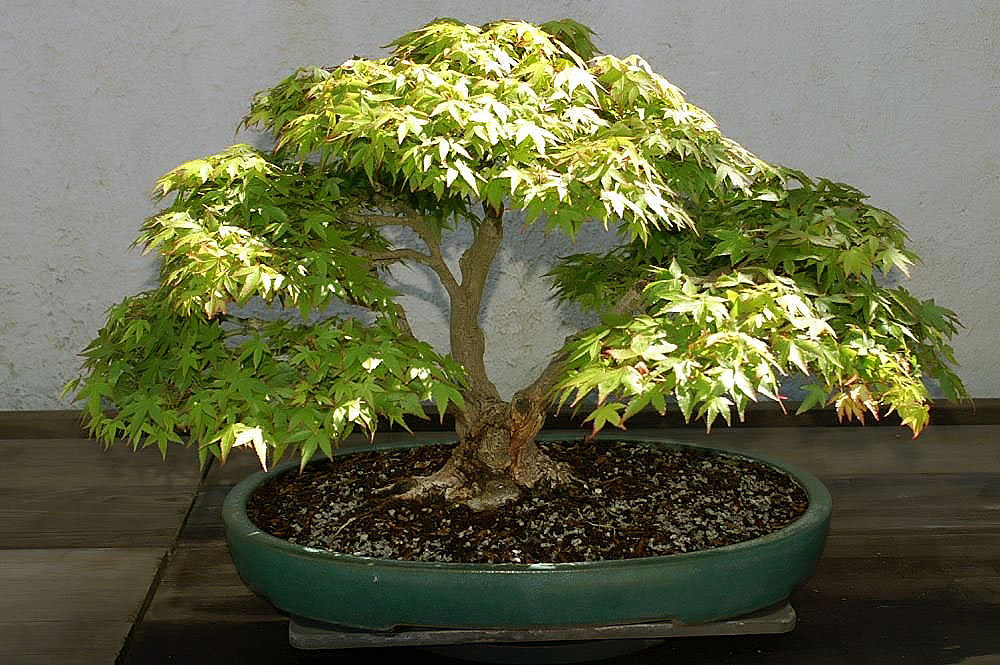
Acer palmatum ‘Mikawa-yatsubusa’ is a dwarf Japanese maple cultivar grown for its extremely dense, tightly layered habit, one of the most distinctive growth forms among all Japanese maples. Rather than the open, spreading branches of a typical maple, ‘Mikawa-yatsubusa’ stacks short, closely spaced branches into neat horizontal tiers, giving even young, unpruned plants a sculpted, almost cloud-pruned look. It is one of the most popular dwarf Japanese maples grown specifically for bonsai and container culture, precisely because that naturally compact structure needs so little coaxing.
Gardeners grow ‘Mikawa-yatsubusa’ for its slow, controlled size and its curiously layered silhouette, which stays interesting through the seasons: the tightly packed, crinkled green leaves give way to excellent fall color, and the dense branching shows off well in winter too. Its Japanese name is often translated as referring to its origin near the Mikawa region, combined with “yatsubusa,” a term widely used in Japanese horticulture for dwarf, densely branched growth habits found across many plant groups, not just maples.
Japanese maple (Acer palmatum) is not native to North America; the species is native to Japan, Korea and eastern China, and ‘Mikawa-yatsubusa’ is a selected dwarf cultivar of it. It is not listed as a federal or state noxious weed, but Japanese maple seedlings have been documented escaping cultivation into forest understories in parts of the eastern United States, especially the Mid-Atlantic. Dwarf cultivars like this one, grown slowly and usually in containers, are not known to be significant self-seeders, but as with any Japanese maple it is sensible to keep it away from the immediate edge of natural woodland and to remove any volunteer seedlings nearby.
Identification
‘Mikawa-yatsubusa’ is identified primarily by its growth habit: a dense, slow-growing mound built from short internodes and closely layered branching, quite unlike the airy, spreading look of most Japanese maples.
Bark & Stems
Stems are notably short between leaf nodes (short internodes), which is what packs the foliage so tightly and gives the plant its mounded, almost contorted appearance even without training. Bark on young wood is smooth and gray-brown, thickening slightly with age, but the stems themselves rarely dominate the look of the plant the way they do on more open cultivars, since they are mostly hidden by foliage.
Leaves
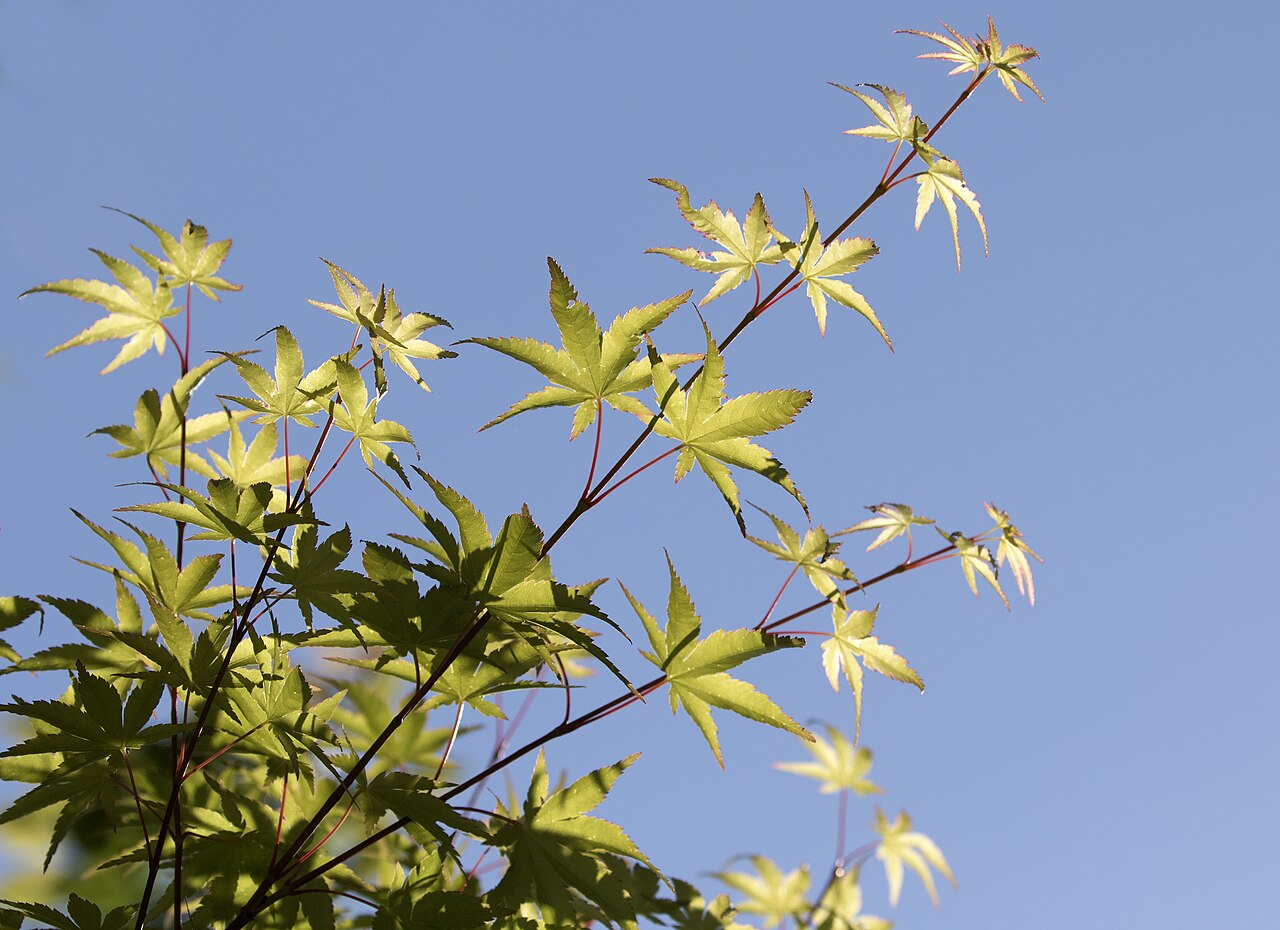
Leaves are small, palmate, and often slightly cupped, crinkled or ruffled rather than flat, adding to the plant’s textured, almost gnarled look. They emerge green in spring, stay green through summer, and turn strong shades of orange, red and gold in fall, a display widely considered one of the best of any dwarf Japanese maple.
Flowers & Fruit
Small, inconspicuous reddish flowers appear in spring among the dense foliage, followed by small winged samaras. Neither is a significant ornamental feature; the plant’s value lies in its structure, texture and fall color.
Telling It From Other Dwarf Yatsubusa Types
“Yatsubusa” describes a general dwarf, densely branched growth habit shared by dozens of distinct Japanese maple cultivars, so a plant simply labeled “yatsubusa” is not necessarily ‘Mikawa-yatsubusa’. True ‘Mikawa-yatsubusa’ is distinguished by its particularly tight, horizontally layered, almost shelf-like branching and its small, crinkled leaves; related dwarf cultivars can share the compact size but differ in leaf shape or branching pattern, so buying from a reputable, correctly labeled source matters.
Quick Facts
| Scientific Name | Acer palmatum ‘Mikawa-yatsubusa’ |
| Cultivar | ‘Mikawa-yatsubusa’ (also written ‘Mikawa Yatsubusa’) |
| Family | Sapindaceae (Maple) |
| Plant Type | Deciduous dwarf shrub; popular for bonsai and containers |
| Native to North America | No — introduced; species native to Japan, Korea and eastern China |
| Mature Height | 5–6 ft in 10 years; stays dwarf and slow-growing long-term |
| Mature Spread | 3–4 ft in 10 years |
| Growth Rate | Very slow; about 4–6 in. per year |
| Sun Exposure | Full sun to part shade; afternoon shade helps in hot climates |
| Water Needs | Average, consistent moisture; container plants need regular watering |
| Soil Type | Rich, well-drained loam or quality bonsai/container mix |
| Soil pH | Slightly acidic to neutral (about 5.5–7.0) |
| Bloom Time | Mid-spring; flowers inconspicuous |
| Leaf / Fall Color | Green, crinkled summer foliage turning orange, red and gold in fall |
| Fruit | Small winged samaras; not ornamentally significant |
| Deer Resistant | Somewhat (occasional browsing on young plants) |
| USDA Hardiness Zones | 5–8 |
| Invasive Status | Not listed as invasive; species occasionally self-seeds into eastern U.S. woodlands |
Origin & Where It Grows
Acer palmatum is native to the forests and mountains of Japan, the Korean peninsula and parts of eastern China. Over centuries, Japanese horticulturists selected and named a huge range of cultivars from this variable species, and dwarf, densely branched forms, broadly called “yatsubusa” types, became a specialty in their own right, valued for use in bonsai and small-space gardens.
‘Mikawa-yatsubusa’ itself is reported to have originated as a wild tree found in the Tokai region of central Japan, an area that includes the historical Mikawa province that lends the cultivar its name. Its combination of dwarf stature, tight layered branching and reliable fall color made it a standout selection, and it has since become one of the most widely grown dwarf Japanese maple cultivars in nurseries worldwide, prized above all by bonsai growers.
In the United States, ‘Mikawa-yatsubusa’ is grown wherever Japanese maples perform well, from the Pacific Northwest through the Mid-Atlantic and Northeast and into parts of the Upper South, both in the ground as a small specimen shrub and, very commonly, in containers or bonsai pots where its slow growth and tight branching are easiest to appreciate up close.
Growing & Care Guide
‘Mikawa-yatsubusa’ is easy to grow for its small size, though its very slow pace rewards patience more than quick results.
Light
Full sun to part shade both work well; in hot-summer climates, afternoon shade helps prevent leaf scorch on the tightly packed foliage, which can trap heat more than on an open-branched maple. In cooler regions, more sun generally deepens fall color.
Soil & Water
In the ground, plant in rich, well-drained soil and keep it evenly moist, especially while establishing. In containers or bonsai pots, use a fast-draining, high-quality mix and expect to water more frequently than an in-ground planting, since small pots dry out quickly, particularly in summer.
Planting Tips
Because ‘Mikawa-yatsubusa’ stays naturally compact, it fits well in small garden beds, rock gardens and container groupings where a full-sized Japanese maple would be impractical. Give it some shelter from harsh winter wind if grown in a container, since exposed roots in a pot are less insulated than roots in the ground.
Pruning & Maintenance
Very little structural pruning is needed, since the dense, layered habit is the plant’s natural form rather than something achieved by training. Light thinning to remove crossing or dead twigs in late winter keeps air circulating through the dense canopy, which helps prevent fungal issues in humid climates. Bonsai growers often do additional selective pruning and wiring to refine the layered tiers further.
Propagation
‘Mikawa-yatsubusa’ is propagated by grafting onto seedling Acer palmatum rootstock, since seed-grown plants do not reliably inherit the dwarf, tightly layered habit. Rooted cuttings are also used by specialist growers, though grafting remains more common in the trade.
Landscape Uses
- Bonsai and penjing, where its naturally tiered branching needs minimal training
- Rock gardens and small borders where a full-sized maple would quickly overwhelm the space
- Container specimens on a patio or terrace, viewed up close
- Entry and courtyard plantings where a sculptural, slow-growing accent is wanted
- Mixed dwarf conifer gardens, where its texture and fall color contrast nicely with evergreens
Wildlife & Ecological Value
‘Mikawa-yatsubusa’, like Japanese maple generally, offers modest wildlife value in North American gardens. Its small spring flowers provide some nectar for early-season bees, and its dense branching can offer a bit of shelter for small insects and birds, but it does not support the variety of native caterpillars and other insects that native maples do, since North American wildlife did not evolve alongside this Asian species. It is best appreciated as a sculptural ornamental rather than a habitat plant.
Native Alternatives
Gardeners wanting a small, structural native tree or shrub instead of a dwarf introduced maple have several good choices:
- Vine maple (Acer circinatum) — a native Pacific Northwest understory maple that stays small and multi-stemmed, with good fall color and an attractive branching habit.
- Downy serviceberry (Amelanchier arborea) — a compact native tree or large shrub with spring flowers, summer fruit and fall color on a manageable scale.
- Fringetree (Chionanthus virginicus) — a small, slow-growing native tree that works well as a garden specimen where space is limited.
- Bigtooth maple (Acer grandidentatum) — a smaller native maple with strong fall color, a good choice where a full-sized maple is too large.
History & Uses
Dwarf, densely branched “yatsubusa” Japanese maples have a long history within Japanese horticulture, where growers prized unusual, compact mutations found on seedling trees and propagated them as distinct named selections. ‘Mikawa-yatsubusa’, discovered as a wild tree in the Tokai region, became one of the most celebrated of these dwarf selections for the regularity and tightness of its layered branching.
Its popularity owes a great deal to the bonsai community, where a naturally compact, well-ramified tree like ‘Mikawa-yatsubusa’ offers a head start that more open-growing cultivars cannot match; its short internodes and small leaves scale down convincingly even in a small pot. That same quality has made it popular with ordinary gardeners looking for a slow, low-maintenance accent plant for small spaces.
Its use remains entirely ornamental, valued in gardens, containers and bonsai collections rather than for any commercial product.
Frequently Asked Questions
Is Mikawa-yatsubusa Japanese maple native to North America?
No. It is a dwarf cultivar of Acer palmatum, a species native to Japan, Korea and eastern China. It is introduced, not native, though not considered invasive; as with any Japanese maple, avoid planting it at the edge of natural woodland in the eastern U.S. and remove any stray seedlings you find.
Is Mikawa-yatsubusa good for bonsai?
Yes, it is one of the most popular Japanese maple cultivars for bonsai, thanks to its naturally short internodes, small leaves and tightly layered branching, which give it a mature, refined look even in a small pot without heavy training.
How big does it get?
Expect roughly 5 to 6 feet in height and 3 to 4 feet in spread after about 10 years, growing only about 4 to 6 inches per year. It stays genuinely dwarf and slow-growing for decades, unlike many other “compact” maple cultivars that eventually reach small-tree size.
Is any Japanese maple labeled “yatsubusa” the same as Mikawa-yatsubusa?
No. “Yatsubusa” is a general term for dwarf, densely branched growth habits used across many Japanese maple cultivars, not a synonym for this specific one. Buy from a reputable, correctly labeled source to be sure you are getting true ‘Mikawa-yatsubusa’.
Does Mikawa-yatsubusa have good fall color?
Yes, its fall color is considered one of the best among dwarf Japanese maples, typically turning strong shades of orange, red and gold, a notable bonus on a cultivar primarily grown for its structure.

