Koto-no-ito Japanese Maple (Acer palmatum ‘Koto-no-ito’)
Last updated: November 3, 2026
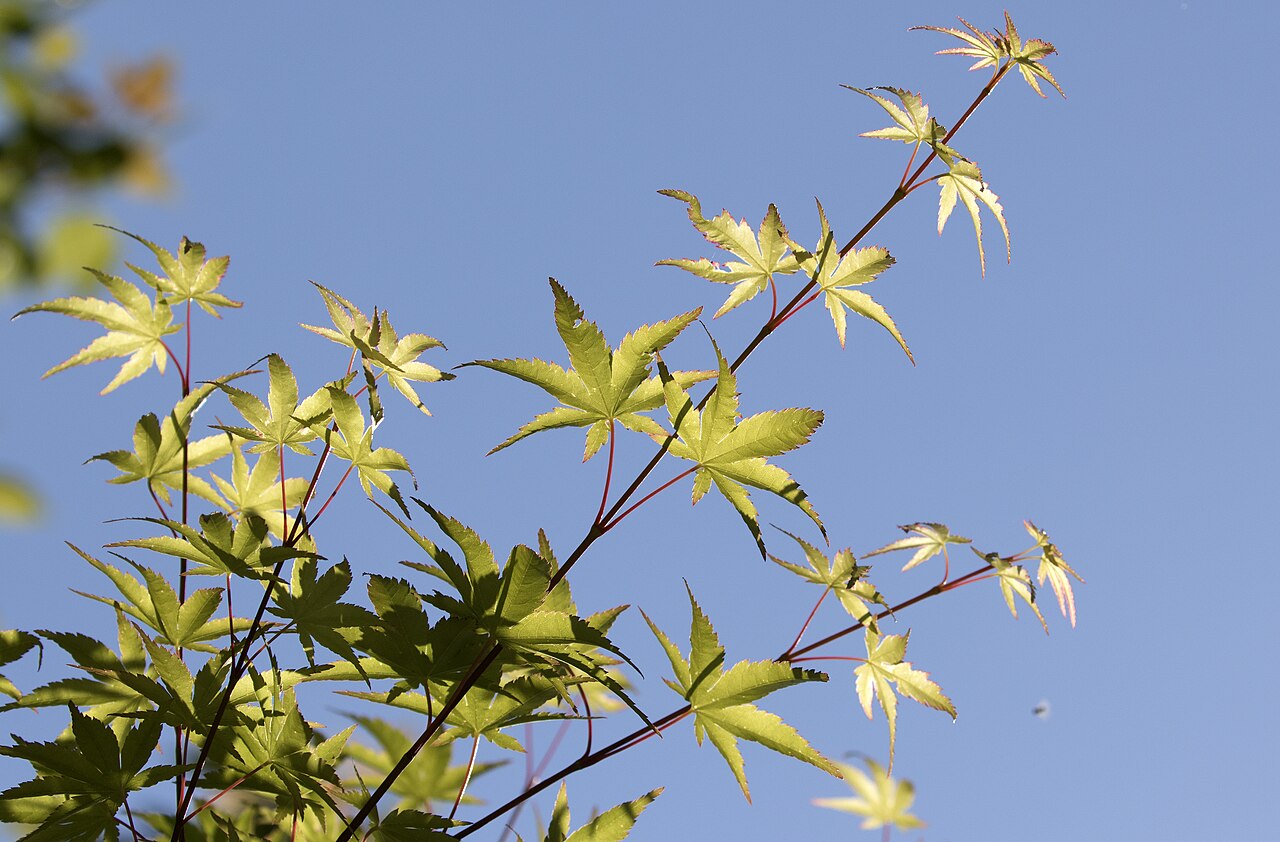
Acer palmatum ‘Koto-no-ito’ is a Japanese maple cultivar in the linearilobum group, a line of Japanese maples selected for unusually narrow, thread- or strap-like leaf lobes rather than the broader, pointed lobes of a typical maple leaf. Its name translates to “strings of a harp,” a fitting description of foliage so finely divided that from a distance the leaves can look more like tufts of green thread than conventional maple leaves. The effect gives ‘Koto-no-ito’ a fine, airy texture that sets it apart even among the many hundreds of Japanese maple cultivars.
Gardeners grow ‘Koto-no-ito’ for exactly that delicate texture, paired with an upright, somewhat spreading habit that is more substantial than many thread-leaf cultivars, which tend to weep. New spring growth emerges with a crimson tint on its narrow lobes before settling into green for summer, then finishing in good golden-yellow fall color. Because its leaves are so narrow, a mature ‘Koto-no-ito’ reads as a soft, feathery green form in the landscape rather than a solid mass of foliage, a texture contrast that designers often use deliberately against broader-leafed companions.
Japanese maple (Acer palmatum) is not native to North America; the species is native to Japan, Korea and eastern China, and ‘Koto-no-ito’ is a selected cultivar of it, not a wild-collected plant. It is not on any federal or state noxious-weed list, but in parts of the eastern United States, particularly the Mid-Atlantic, seedling Japanese maples have been documented escaping cultivation into forest understories. As with any Japanese maple, it is good practice to plant ‘Koto-no-ito’ away from the edge of natural woodland and to remove any volunteer seedlings nearby.
Identification
‘Koto-no-ito’ is identified primarily by its leaves, which are narrower and more deeply thread-like than almost any other Japanese maple cultivar outside its own linearilobum group.
Bark & Stems
Stems are slender and reddish when young, maturing to smooth gray-brown bark. The habit is upright and somewhat spreading rather than strongly weeping, giving ‘Koto-no-ito’ more height and a more open, airy crown than many other fine-leaved cultivars, which tend to cascade.
Leaves
Leaves are palmate with five to seven lobes, but each lobe is reduced to an extremely narrow, almost linear strap, sometimes twisting or spiraling slightly as the leaf matures. Vigorous young growth or strong new shoots can produce somewhat wider lobes than older, settled wood, so leaf width can vary a little on the same plant. New leaves emerge with crimson-tinted edges and petioles in spring, turn green through summer, and finish golden yellow in fall.
Flowers & Fruit
Small reddish-purple flowers appear in spring, mostly hidden among the emerging foliage, followed by the small winged samaras typical of Japanese maple. Neither is an ornamental highlight; the thread-fine leaf texture is the plant’s main attraction.
Telling It From Other Linearilobum Maples
Several named cultivars share the linearilobum group’s narrow-lobed leaf trait, including older selections sometimes sold simply as ‘Linearilobum’. ‘Koto-no-ito’ is distinguished by its particularly fine, sometimes spiraling lobes and crimson-tinted new growth, along with its upright, moderately spreading (rather than strongly weeping or very dwarf) habit; confirm cultivar identity with a reputable, correctly labeled nursery rather than relying on “thread-leaf maple” as a generic description.
Quick Facts
| Scientific Name | Acer palmatum ‘Koto-no-ito’ |
| Cultivar | ‘Koto-no-ito’ (linearilobum group) |
| Family | Sapindaceae (Maple) |
| Plant Type | Deciduous upright, moderately spreading small tree/shrub |
| Native to North America | No — introduced; species native to Japan, Korea and eastern China |
| Mature Height | 6–10 ft at maturity |
| Mature Spread | 5–8 ft |
| Growth Rate | Slow to moderate |
| Sun Exposure | Full sun to part shade; afternoon shade helps in hot climates |
| Water Needs | Average, consistent moisture |
| Soil Type | Rich, well-drained loam |
| Soil pH | Slightly acidic to neutral (about 5.5–7.0) |
| Bloom Time | Mid-spring; flowers inconspicuous |
| Leaf / Fall Color | Crimson-tinted new growth, green in summer, golden yellow in fall |
| Fruit | Small winged samaras; not ornamentally significant |
| Deer Resistant | Somewhat (occasional browsing on young plants) |
| USDA Hardiness Zones | 5–8 |
| Invasive Status | Not listed as invasive; species occasionally self-seeds into eastern U.S. woodlands |
Origin & Where It Grows
Acer palmatum is native to the forests and mountains of Japan, the Korean peninsula and parts of eastern China. Among the many cultivar lines Japanese horticulturists developed from this species, the linearilobum group stands out for leaves reduced to narrow, strap-like lobes, a striking departure from the broad-lobed form typical of maple leaves generally.
‘Koto-no-ito’ is one of the more refined selections within that linearilobum group, valued for leaves even finer and sometimes more twisted than other narrow-lobed cultivars, along with attractive crimson-tinted new growth. Its name, meaning “strings of a harp,” reflects the delicate, thread-like look of the mature foliage. It has been grown in Japanese and Western collector gardens for many years as a specialty texture plant.
In the United States, ‘Koto-no-ito’ grows well across much of the range suited to Japanese maples generally, including the Pacific Northwest, Mid-Atlantic, Northeast and parts of the Upper South. Public collections such as the Seattle Japanese Garden maintain specimens of this cultivar, underscoring its status as a respected, if less common, addition to Japanese maple plantings.
Growing & Care Guide
‘Koto-no-ito’ is grown much like other Japanese maples, with a bit of extra care to protect its unusually fine, thread-like foliage.
Light
Full sun to part shade suits this cultivar well. In hot, dry climates, some afternoon shade helps prevent the narrow leaf lobes from scorching or drying out at the tips, since their reduced surface area and fine texture make them more prone to wind and heat stress than broader-leafed cultivars.
Soil & Water
Plant in rich, well-drained soil and keep it evenly moist, particularly through the first few growing seasons. Because the thin leaf lobes lose moisture readily, consistent watering during hot, dry spells helps keep the foliage from crisping at the edges.
Planting Tips
Choose a site sheltered from strong, drying winds, which can damage the fine leaf lobes more readily than they would a broader-leafed maple. ‘Koto-no-ito’s moderately upright, spreading habit works well as a textural accent near a patio or path where its fine foliage can be appreciated up close.
Pruning & Maintenance
Routine pruning needs are light: remove dead, damaged or crossing branches in late winter while the plant is dormant. Because the foliage is so finely divided, wind or hail damage shows up more visibly than on broad-leafed cultivars, so a sheltered planting site reduces maintenance over time.
Propagation
Like other named Japanese maple cultivars, ‘Koto-no-ito’ is propagated by grafting onto seedling Acer palmatum rootstock, which preserves the narrow, thread-like leaf trait. Seedlings grown from its seed will not reliably reproduce the linearilobum leaf form.
Landscape Uses
- Texture contrast plantings next to broad-leafed shrubs, hostas or ferns
- Specimen accents near a patio, entry or garden path where the fine foliage can be seen closely
- Japanese-style and collector gardens, where thread-leaf cultivars are a traditional feature
- Mixed borders as a lighter, airier counterpoint to bolder foliage plants
Wildlife & Ecological Value
‘Koto-no-ito’, like Japanese maple generally, offers limited wildlife value in North American gardens. Its small spring flowers provide some nectar for early bees, and its branching offers modest shelter for small birds, but it does not support the range of native caterpillars and other insects that native maples such as vine maple or red maple do, since North American insects did not evolve alongside this Asian species. It is best valued as an ornamental texture plant rather than a habitat planting.
Native Alternatives
For gardeners who want a similarly fine-textured or distinctive native tree instead of an introduced thread-leaf maple:
- Vine maple (Acer circinatum) — a native understory maple with a graceful, open branching habit and good fall color, though its leaves are broader-lobed than ‘Koto-no-ito’.
- Striped maple (Acer pensylvanicum) — a native maple valued for its understated, airy form and distinctive striped bark.
- Fringetree (Chionanthus virginicus) — a small native tree with fine, fringe-like spring flowers that add their own delicate texture to the garden.
- Rocky Mountain maple (Acer glabrum) — a native maple with a lighter, more open canopy than many shade trees, useful where a finer-textured native alternative is wanted.
History & Uses
The linearilobum group of Japanese maple cultivars, with their narrow, thread-like leaf lobes, represents one of the more unusual directions Japanese horticulturists took the species over centuries of selection, favoring extreme leaf texture over the broad, classically shaped maple leaf. ‘Koto-no-ito’ is a refined example of that tradition, its name evoking the fine strings of a traditional Japanese harp.
Cultivars like ‘Koto-no-ito’ have long been grown in specialty and collector gardens, both in Japan and, more recently, in Western nurseries catering to Japanese maple enthusiasts. Public gardens with Japanese-style collections, including the Seattle Japanese Garden, maintain specimens specifically to showcase this kind of unusual cultivar alongside more familiar broad-leafed types.
Its use remains entirely ornamental, grown for its uncommon foliage texture rather than for wood, syrup or any other product.
Frequently Asked Questions
Is Koto-no-ito Japanese maple native to North America?
No. It is a cultivar of Acer palmatum, a species native to Japan, Korea and eastern China. It is introduced, not native, though not considered invasive; as with any Japanese maple, avoid planting it at the edge of natural woodland in the eastern U.S. and remove any volunteer seedlings you find.
What does “linearilobum” mean?
It describes a group of Japanese maple cultivars, including ‘Koto-no-ito’, selected for leaves with very narrow, strap-like or thread-like lobes instead of the broader, pointed lobes of a typical maple leaf.
Why do some leaves on my Koto-no-ito look wider than others?
Strong, vigorous new shoots, especially on young plants or after hard pruning, often produce somewhat wider leaf lobes than older, settled branches. This is normal and the narrower, more thread-like form typically becomes more consistent as the plant matures.
How big does Koto-no-ito get?
Expect roughly 6 to 10 feet in height with a 5- to 8-foot spread at maturity, growing at a slow to moderate pace. It is more upright than weeping, with a somewhat spreading crown.
Does Koto-no-ito need shelter from wind?
It benefits from it. Because its narrow leaf lobes have less surface area to work with than broader maple leaves, they can dry out or brown at the tips more readily in strong or hot, drying winds, so a sheltered planting site helps keep the foliage looking its best.