Striped Maple (Acer pensylvanicum)
Acer pensylvanicum, commonly called Striped Maple, Moosewood, or Goosefoot Maple, is a small, slow-growing understory tree of the eastern forests — and the only snakebark maple native to North America. It gets its best-known common name from the smooth, green bark marked with crisp white vertical stripes, a feature most vivid on young trunks and branches. Where taller trees shade out almost everything else, Striped Maple persists for years as a modest shrub-sized tree, waiting for a gap in the canopy.
This is one of the most shade-tolerant trees in eastern North America, capable of living for decades in deep, dim forest understory on little more than filtered light. When a nearby canopy tree falls and opens a gap, a long-suppressed Striped Maple can respond with a burst of growth, flowering, and seed production — a strategy that makes it a quiet, persistent presence in the forest rather than a dominant one. It rarely grows tall enough to join the canopy itself, instead occupying its own layer as a large shrub or small tree beneath oaks, maples, and conifers.
For woodland gardens and shaded native plantings from the Appalachians to New England and the Great Lakes, Striped Maple offers understated four-season interest: pink-tinged spring growth, drooping chains of yellow-green flowers, bright yellow fall color, and that unmistakable striped bark that stands out all winter. It asks for cool, moist, acidic soil and genuine shade — qualities that make it a poor choice for hot, sunny, or compacted sites, but a natural fit for a shaded native woodland border.
Identification
Striped Maple is a large shrub or small deciduous tree, typically 16 to 33 feet tall, with a short, often forked trunk up to about 8 inches in diameter that divides low into arching, spreading branches. The overall form is broadly columnar to irregularly flat-topped, and the tree is unusually easy to identify year-round thanks to its bark.
Bark & Stems
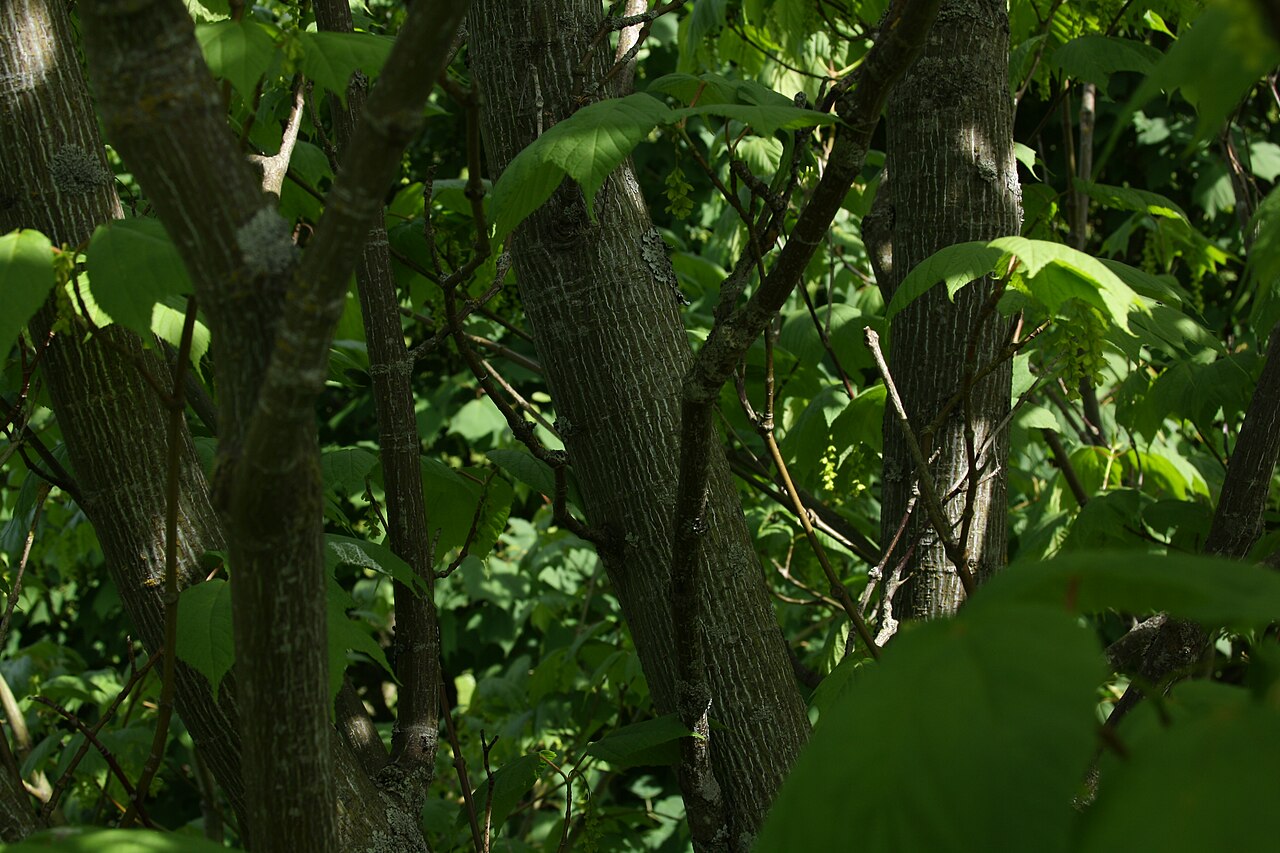
Young bark is smooth and green with prominent vertical white stripes — the feature that gives the species both its common name and part of its scientific grouping as a “snakebark” maple. With age the bark darkens to a brownish or grayish green, the stripes fade toward reddish-brown, and on old trunks the striping can disappear almost entirely. Twigs are smooth, often with a reddish or greenish cast, and buds are relatively large with a few visible scales.
Leaves
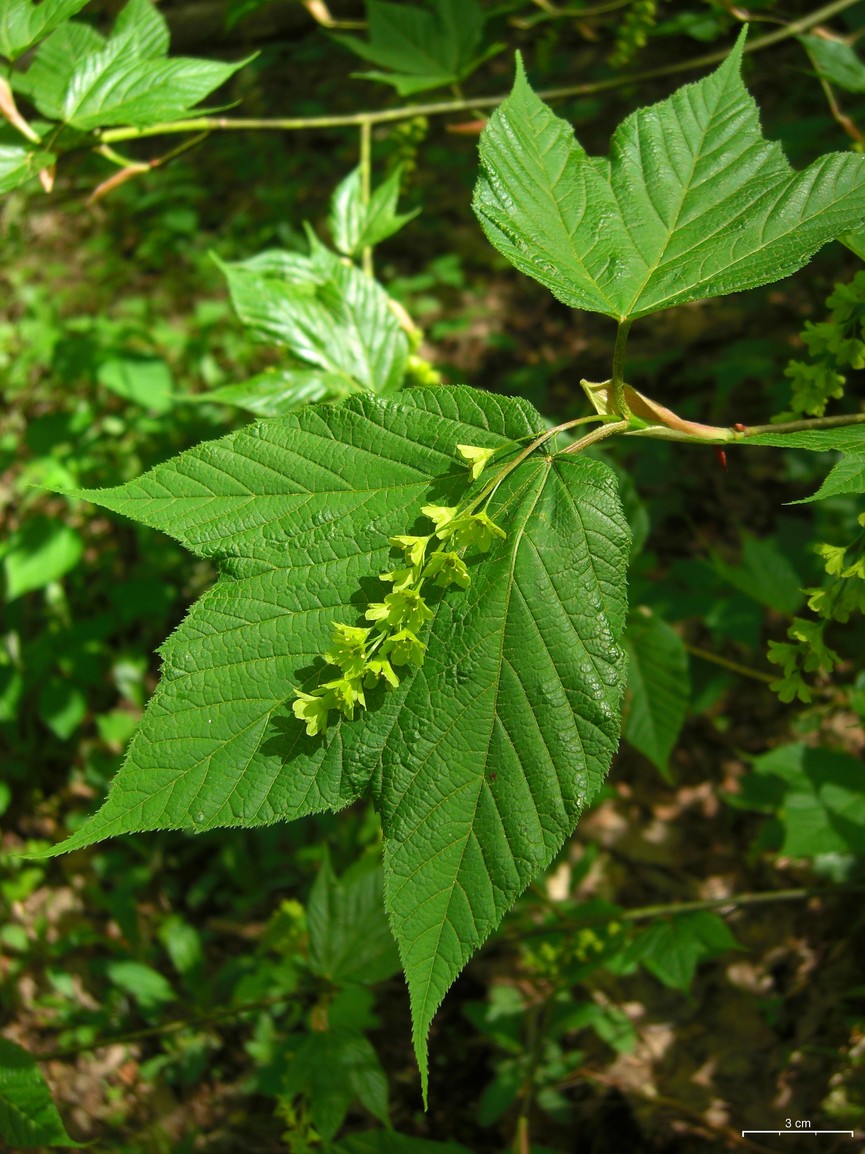
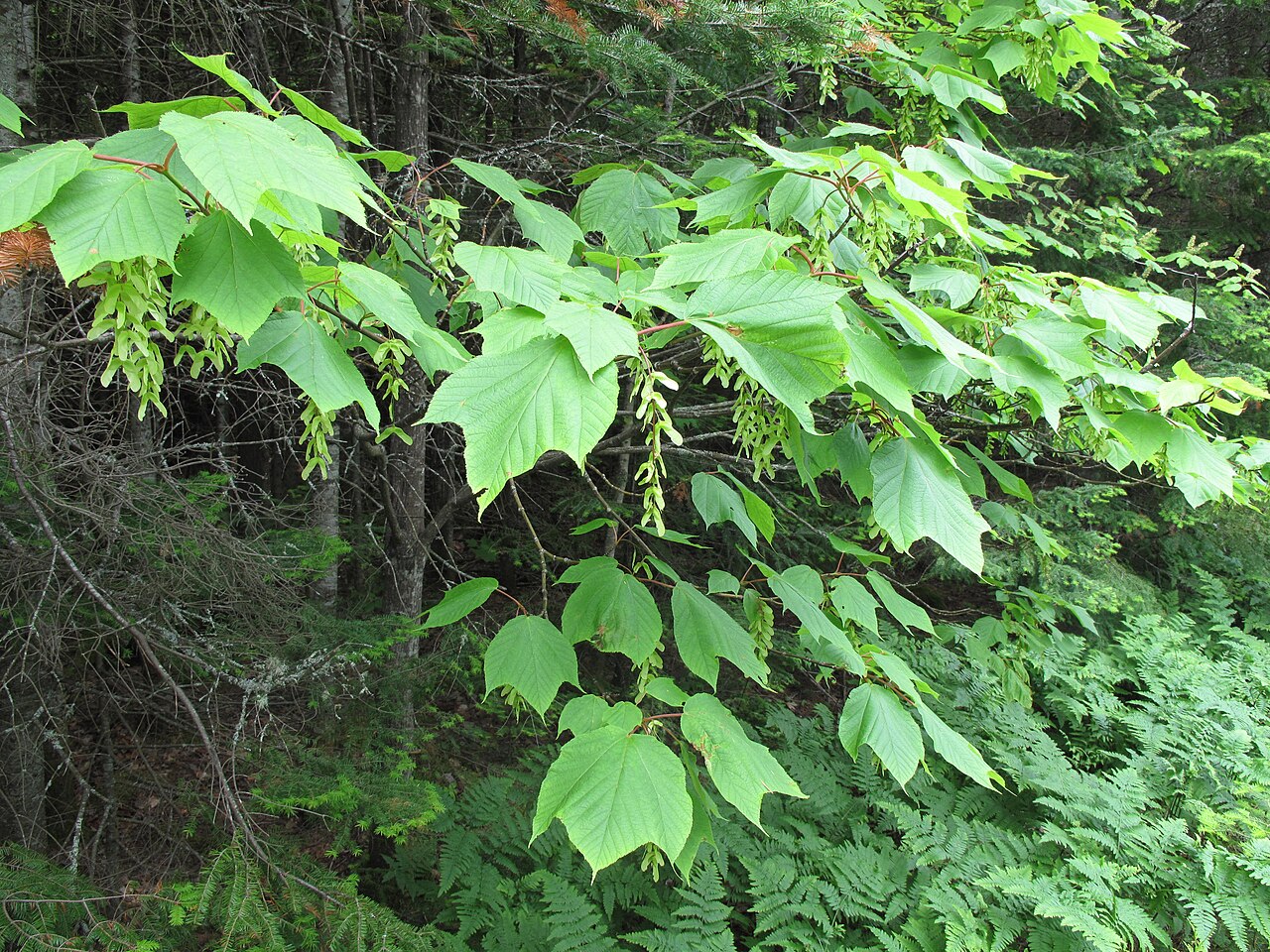
Leaves are large and soft-textured, 3 to 6 inches long and 2.5 to 4.5 inches wide, with three shallow, forward-pointing lobes that give the leaf a goose-foot outline — the source of its other common name. Margins are finely double-serrated. New leaves emerge in spring with a distinct pink or reddish tinge before maturing to rich green through summer, then turning clear, bright yellow in fall.
Flowers
In late spring, after the leaves have expanded, Striped Maple produces yellowish-green, bell-shaped flowers held in long, slender, drooping clusters (racemes) at the branch tips. Unusually among trees, Striped Maple is a sequential hermaphrodite: individual trees can change sex from one year to the next, most often shifting from male to female, apparently in response to stress, vigor, and environmental conditions. Female trees tend to be less vigorous overall, and a significant share die back at season’s end after a heavy seed crop.
Fruit & Seeds
The fruit is a typical maple samara, about 1 inch long, paired with a wide wing angle of roughly 145 degrees and a noticeably veined stalk. Samaras form in the same long, hanging clusters as the flowers, ripening from a faint red tone to tan or light brown before dispersing in late summer to early fall.
Quick Facts
| Scientific Name | Acer pensylvanicum L. |
| Family | Sapindaceae (Maple) |
| Plant Type | Deciduous Understory Tree / Large Shrub |
| Mature Height | 16–33 ft (5–10 m) |
| Trunk Diameter | Up to 8 in (20 cm) |
| Growth Rate | Slow |
| Sun Exposure | Part Shade to Full Shade |
| Water Needs | Moderate |
| Soil Type | Moist, well-drained sandy loam |
| Soil pH | 5.0–6.5 (acidic to slightly acidic) |
| Bloom Time | Late May – June |
| Flower Color | Yellowish-green |
| Fall Color | Bright yellow |
| Fruit | Winged samara, tan to light brown |
| Deer Resistant | No (heavily browsed by deer and moose) |
| USDA Hardiness Zones | 3–7 |
Native Range
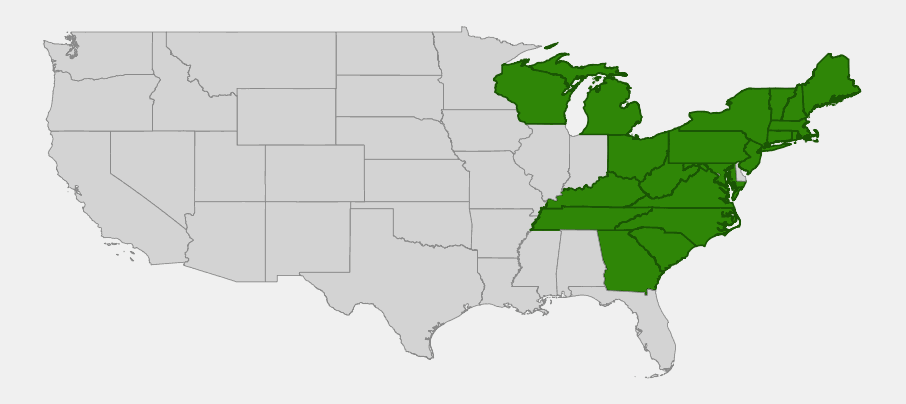
Striped Maple is native to the cool forests of eastern North America, from Nova Scotia and the Gaspé Peninsula of Quebec west through Ontario to Michigan and Wisconsin, south through New England and the mid-Atlantic, and along the spine of the Appalachian Mountains as far south as northern Georgia and eastern Tennessee. It is most abundant in New England, New York, Pennsylvania, and the higher-elevation forests of the central and southern Appalachians, becoming scarcer and more scattered toward the western and southern edges of its range.
Within this range, Striped Maple is an understory specialist of cool, moist forests, especially favoring the shaded, north-facing slopes of deep valleys and ravines. It grows best in well-drained, moist, sandy loam soils but tolerates nutrient-poor, leached ground where little else thrives in the shade. It is almost always found beneath a closed or nearly closed canopy of larger hardwoods or mixed hardwood-conifer forest, rather than in open or disturbed ground.
Striped Maple does not tolerate heat or drought well, and its range is expected to come under pressure as summers warm; it is already classified as critically imperiled at the extreme western edge of its range in Wisconsin. The species is also vulnerable to the Asian longhorned beetle, an invasive pest that preferentially attacks maples and has been shown to increase mortality where infestations occur.
📋 Regional plant lists featuring Striped Maple: New Hampshire, Maine & Vermont · Connecticut, Massachusetts & Rhode Island · New York, Pennsylvania & Northern New Jersey · Maryland, Virginia & West Virginia · North Carolina & South Carolina · Georgia, Alabama & Mississippi · Kentucky & Tennessee · Ohio & Indiana · Michigan, Wisconsin & Eastern Minnesota
Growing & Care Guide
Striped Maple is a patient, low-drama tree for the right spot: cool, shaded, and consistently moist. It is not a tree for hot sun, compacted soil, or dry sites, but where those conditions are met it needs very little intervention once established.
Light
Plant Striped Maple in part shade to full shade — it is one of the most shade-tolerant deciduous trees in eastern North America and genuinely prefers a shaded understory position beneath taller trees. Too much direct sun, especially combined with heat, stresses the tree and can scorch its soft leaves.
Soil & Water
Give it moist, well-drained, acidic to slightly acidic soil, ideally a sandy loam on a cool, north-facing slope. It tolerates nutrient-poor, leached soils better than many trees, but it does not tolerate drought — keep the root zone consistently moist, particularly during the first several years, and mulch to conserve moisture and moderate soil temperature.
Planting Tips
Choose a shaded site under an existing tree canopy or on the north or east side of a building where it won’t bake in afternoon sun. Plant in fall or early spring. Because it is naturally an understory tree, it transplants and establishes well in shaded woodland settings but struggles if placed in an open, sunny lawn. Space plants to allow their arching, spreading branch habit room to develop.
Pruning & Maintenance
Prune only to remove dead, damaged, or crossing branches, ideally in late winter while dormant. Avoid heavy pruning or attempts to force a single-leader tree form — the naturally forked, multi-stemmed habit is typical of the species and part of its appeal. Watch for Verticillium wilt and gray mold spot, and inspect for stem galls caused by flatheaded borer beetles, though serious problems are uncommon in a well-sited planting.
Landscape Uses
Striped Maple is best suited to:
- Woodland and shade gardens beneath an existing tree canopy
- Native understory plantings restoring structure to a managed forest edge
- Winter-interest plantings, where the striped bark stands out against snow
- Wildlife gardens that support browsing mammals and seed-eating birds
- Cool, north-facing slopes and ravine edges where little else will thrive
Fire & Disturbance Ecology
Striped Maple is unusual among trees in being rated both fire-resistant and moderately fire-tolerant, and it readily resprouts from the base after top damage. Its real ecological strategy, though, is built around canopy gaps rather than fire: it can persist as a suppressed understory shrub for years and then respond quickly to increased light when a nearby tree falls, flowering and fruiting heavily until the gap closes again.
Wildlife & Ecological Value
Striped Maple plays an outsized ecological role for a tree that rarely reaches the canopy, serving as a key browse and structural species through the understory of eastern forests.
For Mammals
This is a favorite winter browse for white-tailed deer and moose, which eat the twigs, buds, and bark, and the name “moosewood” reflects just how heavily moose rely on it in parts of its range. Beavers, porcupines, and rabbits also feed on the bark and stems, and beavers will turn to Striped Maple when their preferred tree species are scarce.
For Birds
Ruffed Grouse eat both the samaras and the buds, particularly valuable food sources in late winter when little else is available in the forest understory. The tree’s layered, shrubby growth beneath the main canopy also adds vertical structure that supports nesting and foraging for a range of understory and mid-story songbirds.
For Pollinators
The hanging clusters of yellowish-green flowers, blooming after most spring ephemerals have finished, provide a useful nectar and pollen source for native bees and other early-summer forest insects at a time when relatively few other woody plants are still flowering in the deep shade.
Ecosystem Role
By persisting for years as a suppressed understory tree and then responding rapidly to canopy gaps, Striped Maple helps stabilize forest structure between major disturbance events, adding mid-story vegetation density that benefits everything from nesting birds to browsing mammals. Woodland caribou browse it during summer months farther north, underscoring its importance across a broad swath of the eastern and boreal-edge forest.
Cultural & Historical Uses
Several Northeastern Woodlands peoples used Striped Maple medicinally. The Penobscot of Maine, who call the tree atohkímosi, made a poultice from steeped bark to relieve swelling in the limbs and used compound infusions in treating coughing up of blood, kidney trouble, and other ailments. The Haudenosaunee prepared decoctions from the bark for use as an emetic and laxative, and the Mi’kmaq, who call it wapoq, used bark decoctions in their own traditional medicine. These are documented historical and ethnobotanical practices, not guidance for modern self-treatment.
The species was formally described in 1753 by Carl Linnaeus from a specimen collected in Pennsylvania, which is reflected in its scientific name pensylvanicum — technically a misspelling of “Pennsylvania,” but retained because it was the name used in the original description. It was introduced to England as an ornamental in 1760 and spread into continental European gardens shortly after, prized even then for its unusual striped bark.
In modern gardens, Striped Maple is grown mainly as a specialty ornamental for shaded sites, valued for its bark and fall color rather than for wood or food use — the wood is soft and of little commercial value, and no part of the plant is used as food today. The cultivar ‘Erythrocladium,’ discovered in Germany around 1904 and known for coral-red winter twigs, remains uncommon in the trade because it is difficult to propagate.
Frequently Asked Questions
Why is it called Striped Maple?
Young bark is smooth green marked with crisp vertical white stripes, a pattern most visible on young trunks and branches. The stripes fade and darken as the bark ages, and can disappear almost entirely on old trunks.
Can Striped Maple really change sex?
Yes. It is a sequential hermaphrodite, and individual trees can shift between male and female flowering from year to year, most commonly moving from male to female. Female flowering and heavy seed production appear to be more physically demanding, and a notable share of female trees decline or die back after a heavy seed year.
Will Striped Maple grow in full sun?
It can survive brief sun exposure but performs poorly there — it is adapted to shaded forest understory and does not tolerate heat or drought well. Plant it in part to full shade for a healthy, long-lived tree.
Is Striped Maple good for wildlife?
Very much so. It is an important winter browse for deer and moose (hence “moosewood”), its samaras and buds feed Ruffed Grouse, and its layered growth adds structural habitat value to the forest understory.
Why does my Striped Maple stay small for years and then suddenly grow?
That’s normal. As a shade-adapted understory species, it can persist for years as a small, slow-growing shrub under a closed canopy, then grow rapidly, flower, and fruit once a nearby canopy tree falls and opens up more light.

Looking for a nursery that carries Striped Maple?
Browse our native plant nursery directory: Connecticut & Georgia · Kentucky, Massachusetts, Maryland, Maine & Michigan · North Carolina, New Hampshire, New Jersey, New York & Ohio · Pennsylvania, Rhode Island, South Carolina, Tennessee, Virginia & Vermont · Wisconsin & West Virginia