Joshua Tree (Yucca brevifolia)
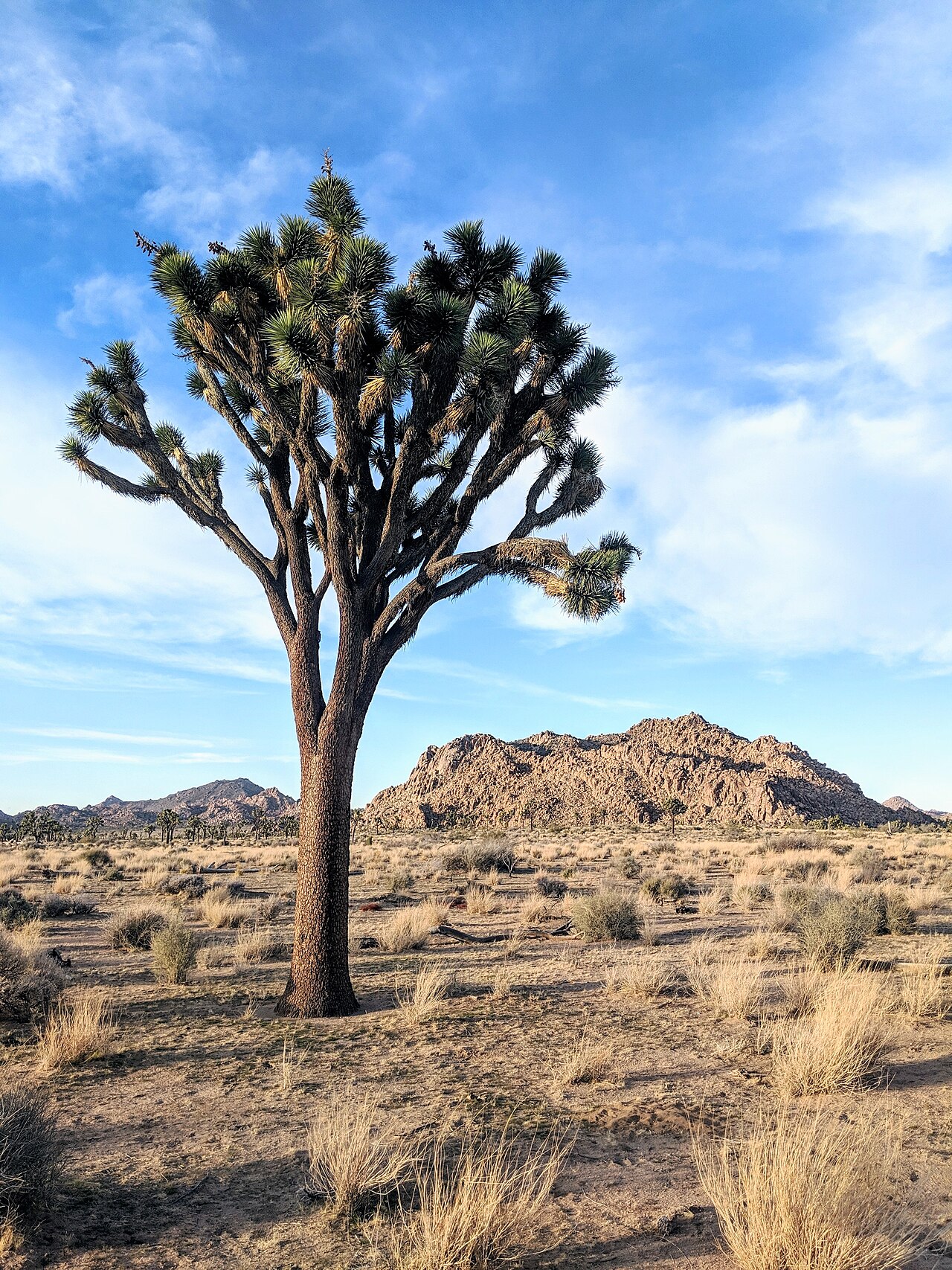
Yucca brevifolia, commonly known as the Joshua tree, is one of the most recognizable native plants of the American Southwest — a shaggy-leaved, tree-sized yucca that has come to symbolize the Mojave Desert itself. Part of the agave subfamily within Asparagaceae, it is not a true tree at all but a giant monocot, more closely related to lilies and agaves than to any oak or pine. Its twisted, top-heavy silhouette, spiky evergreen foliage, and slow, deliberate growth give it an almost prehistoric presence on the desert skyline.
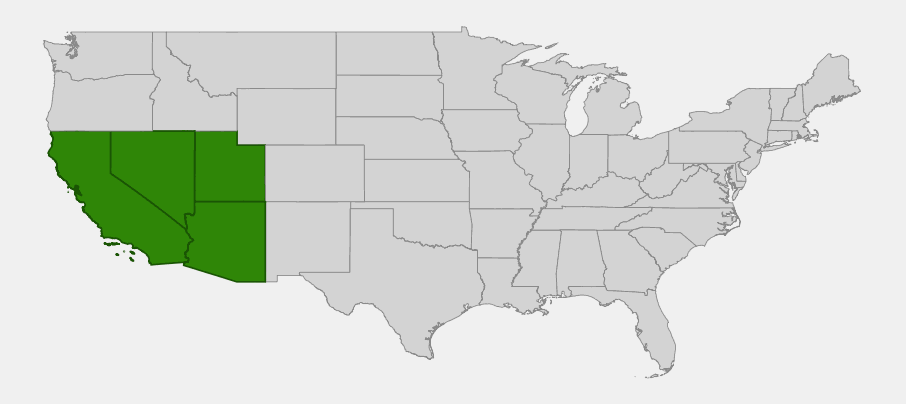
Joshua trees grow in open desert grassland and scrub between roughly 1,300 and 5,900 feet in elevation, almost entirely within the boundaries of the Mojave Desert in California, Nevada, Arizona, and Utah. They depend on a single insect, the yucca moth, for pollination — a relationship so specialized that neither species can reproduce without the other. The trees themselves can live for a few hundred years, branching only after they first bloom, and sometimes not blooming again for years at a stretch.
For home gardeners and restoration plantings in the low desert, Joshua tree is an architectural, extremely low-water choice that asks for almost nothing once established: full sun, sharp drainage, and patience. It is a poor fit outside its native arid climate — hard winter wet, humidity, or heavy clay soil will kill it quickly — but within its range it is a genuine icon, now facing real pressure from wildfire, invasive grasses, and a warming, drying climate.
Identification
A mature Joshua tree is unmistakable: a thick, often multi-branched trunk topped with dense rosettes of stiff, dagger-like leaves, giving the plant a shaggy, bearded look where old dead leaves droop and persist down the trunk for years. Trees typically reach 15 to 40 feet tall, with exceptional individuals approaching 49 feet. The trunk is fibrous and spongy rather than woody, and because it lacks annual growth rings, its true age is difficult to pin down — estimates for old individuals run into several hundred years.
Trunk & Form
Young Joshua trees grow as a single unbranched spike for years, sometimes decades, before they bloom for the first time — branching typically begins only after that first flowering, or if the growing tip is damaged by the yucca-boring weevil. Established trees develop an irregular, top-heavy branch structure, each branch ending in its own spiky leaf rosette. The bark is thick, gray-brown, and deeply checkered or fissured on older trunks and limbs.
Leaves
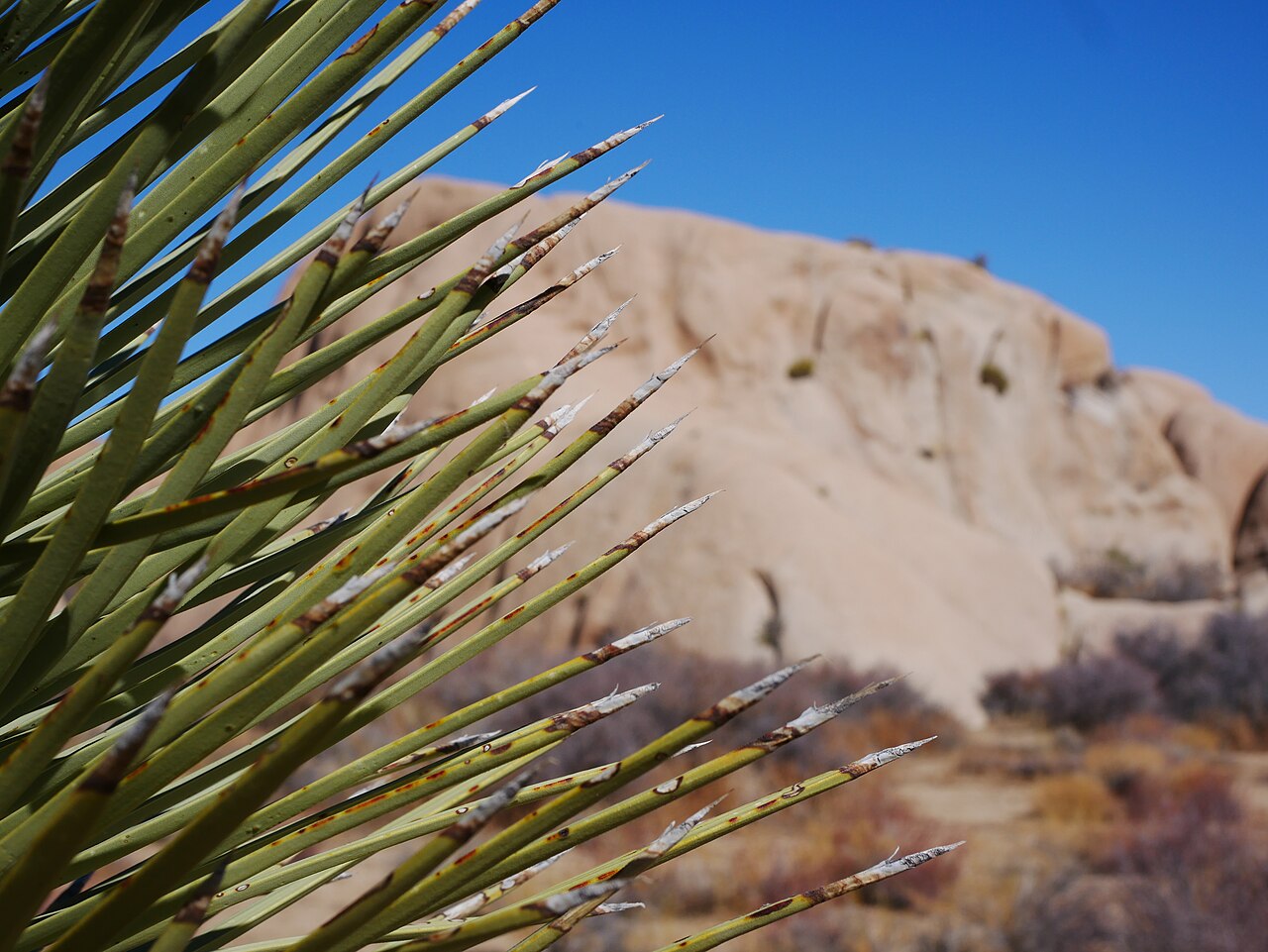
The evergreen leaves are linear and bayonet-shaped, 6 to 14 inches long and ⅓ to ⅝ inch wide at the base, tapering to a sharp, rigid point capable of drawing blood. Leaf margins are finely serrated and pale, almost whitish, in contrast to the dark blue-green blade. Leaves are held in dense spiral clusters at the branch tips; as new leaves emerge at the growing point, older leaves die but often remain attached, curling down against the trunk and forming the tree’s characteristic “beard.”
Flowers & Fruit
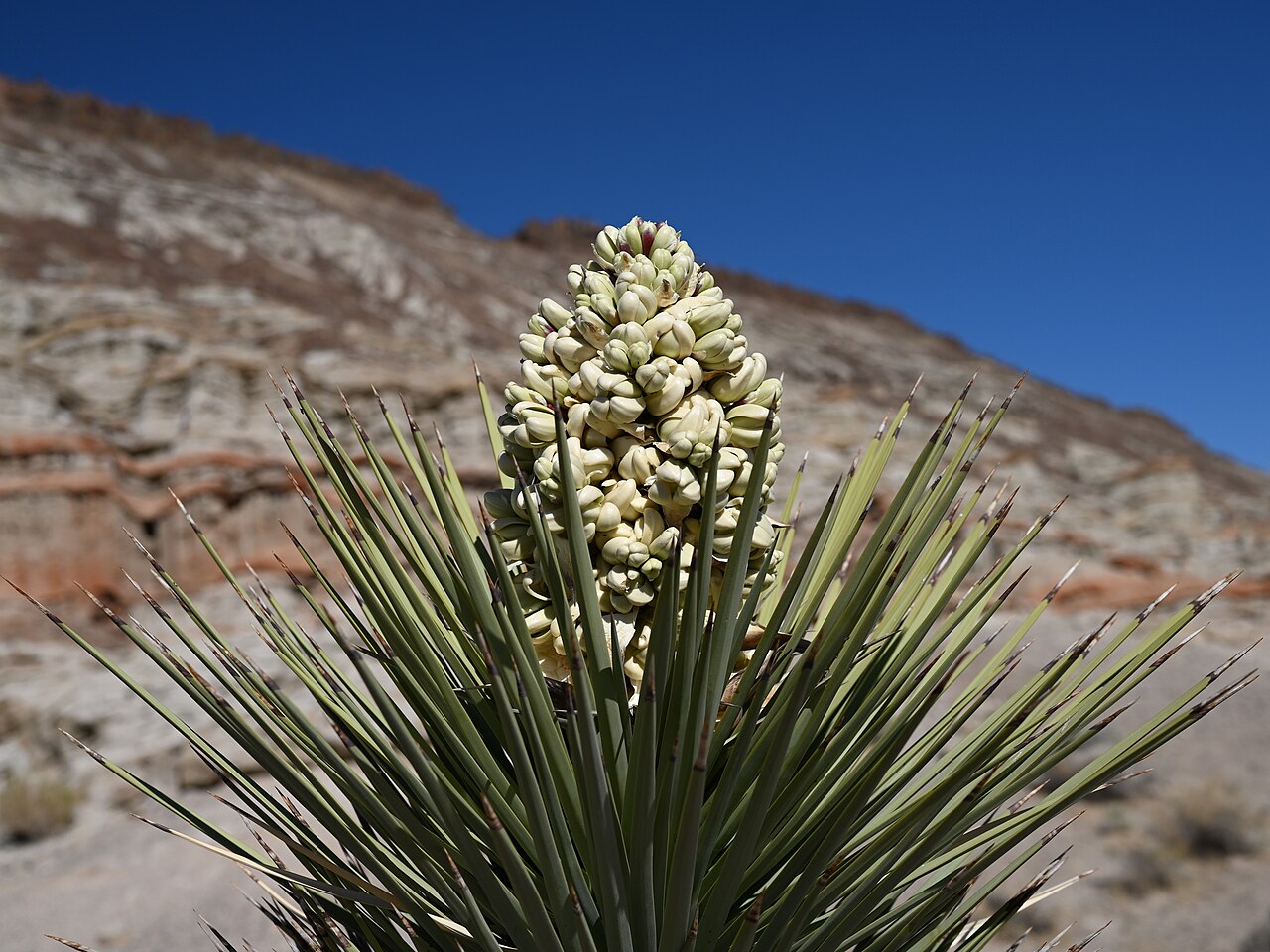
Flowering is irregular and depends on well-timed rainfall plus a winter cold snap — a tree may skip blooming for several years running. When conditions align, large branched flower clusters (panicles) 12 to 22 inches tall and nearly as wide appear at branch tips from February into April, crowded with upright, waxy, creamy white to pale green bell-shaped flowers 1.5 to 3 inches tall. Pollination is carried out almost exclusively by the yucca moth (Tegeticula synthetica), which deliberately packs pollen onto the flower’s stigma while laying her own eggs inside the ovary — her larvae then eat a portion of the developing seeds, but enough survive to keep both species going. The fruit is a semi-fleshy, green-brown, elliptical capsule containing many flat black seeds.
Quick Facts
| Scientific Name | Yucca brevifolia Engelm. |
| Family | Asparagaceae (Agave subfamily) |
| Plant Type | Evergreen tree-form yucca (monocot) |
| Mature Height | 15–40 ft (occasionally to 49 ft) |
| Mature Spread | 10–20 ft, irregular and branching |
| Growth Rate | Slow to moderate (~3 in/yr first decade, then ~1.5 in/yr) |
| Sun Exposure | Full Sun |
| Water Needs | Very low once established |
| Soil Type | Dry, sharply drained sand or gravel |
| Soil pH | 6.5–8.5 (alkaline tolerant) |
| Bloom Time | February–April (irregular, not annual) |
| Flower Color | Creamy white to pale green |
| Fall Color | None (evergreen) |
| Fruit | Green-brown elliptical capsule |
| Deer Resistant | Yes (rigid spiny leaves deter browsing) |
| USDA Hardiness Zones | 6–10 |
Native Range
Joshua tree is native to the southwestern United States and is one of the defining indicator species of the Mojave Desert, where its range almost exactly tracks the desert’s boundaries. It occurs across the Mojave in California, southern Nevada, northwestern Arizona, and southwestern Utah, typically between about 1,300 and 5,900 feet in elevation. Some of its densest stands grow in the open grasslands of Queen Valley and Lost Horse Valley inside Joshua Tree National Park, and in the Antelope Valley north of Los Angeles.
Within this range, Joshua tree grows on gently sloping bajadas, desert flats, and rocky foothills with sharply drained soils, almost always in full, unshaded sun. It is frequently found growing alongside other Mojave Desert natives such as Mojave yucca, creosote bush, and various cholla and barrel cacti, forming the open, widely spaced “Joshua tree woodland” plant community that gives large stretches of the high Mojave its distinctive look.
The species faces mounting conservation concern. Models of a warming, drying Southwest project that suitable climate for Joshua tree within Joshua Tree National Park could shrink by as much as 90 percent by the end of this century, and large wildfires fueled by invasive annual grasses — including the 2020 Dome Fire, which killed over a million trees in the Mojave National Preserve — have already eliminated dense stands that may take centuries to recover, if they recover at all. In California, the western Joshua tree is protected under the Western Joshua Tree Conservation Act (2023), so cutting, moving or removing one there requires a permit from the state.
📋 Regional plant lists featuring Joshua Tree: Arizona & New Mexico · Utah & Western Colorado
Growing & Care Guide
Joshua tree rewards patience rather than fussing. In the right low-desert setting it needs almost no supplemental care once it’s through its first couple of years, but it has zero tolerance for wet feet, shade, or humid climates outside its native range.
Light
Give Joshua tree full, unobstructed sun all day. It is a true desert plant and will grow weak, leggy, and prone to rot in any significant shade. Choose the open, hottest, brightest spot in the landscape.
Soil & Water
Sharp drainage is non-negotiable — plant in sandy or gravelly soil, ideally on a slight slope or raised bed, and never in heavy clay or a low spot where water collects. Once established, Joshua tree is extremely drought tolerant and should be watered only sparingly, if at all, beyond natural rainfall; overwatering, especially in winter, is the most common cause of death in cultivation. Young plants benefit from an occasional deep soak during their first one to two summers to encourage root establishment.
Planting Tips
Plant container-grown Joshua trees in fall or spring when soil temperatures are moderate. Dig a wide, shallow hole rather than a deep one, since the root system spreads widely but stays relatively shallow — roots have been documented reaching over 30 feet from the trunk in search of moisture. Stake young plants loosely in windy sites until the root system anchors, and resist the urge to amend the planting hole with rich organic matter, which holds moisture the roots don’t want.
Pruning & Maintenance
Joshua tree needs essentially no pruning. Old, drooping dead leaves persist naturally along the trunk and branches and can be left in place, trimmed close for a tidier look, or removed for fire-safety clearance near structures — any approach is fine, since the tree doesn’t depend on them. Avoid cutting live growing tips, since that is one of the few things that triggers unwanted branching.
Landscape Uses
In the low desert, Joshua tree works well as:
- Architectural specimen — a single strong focal point in a xeriscape or rock garden
- Desert habitat restoration plantings within its native Mojave range
- Waterwise landscaping paired with other low-water Mojave natives
- Wildlife garden anchor for birds and desert mammals that use it for cover and nesting
- Night-garden interest — its silhouette is dramatic under moonlight or uplighting
Climate & Fire Notes
Joshua tree is poorly adapted to fire; its trunk and leaves are highly flammable, and fire typically kills the entire plant outright since it does not resprout reliably from the root crown the way many desert shrubs do. Historically, the wide spacing of desert vegetation kept fire rare in Joshua tree woodland, but invasive annual grasses such as red brome now fill those gaps and carry fast-moving fires through stands that evolved with almost no fire pressure at all, making wildfire one of the greatest modern threats to the species.
Wildlife & Ecological Value
Joshua tree is a keystone species of the Mojave Desert, structuring habitat for an entire community of animals that depend on it for food, nesting, and shelter in a landscape with few other large plants.
For Pollinators
The relationship between Joshua tree and the yucca moth (Tegeticula synthetica) is one of the most specialized pollination partnerships in North America: the tree produces no nectar to attract generalist pollinators, and instead relies entirely on the female yucca moth, which actively gathers and packs pollen onto the flower’s stigma while laying her eggs inside the developing ovary. Neither species can complete its life cycle without the other, and different Joshua tree populations across the range are pollinated by distinct, co-evolved moth lineages.
For Birds
Dead and living Joshua trees provide some of the only elevated nesting and perching structure in the open desert. Ladder-backed Woodpeckers and other cavity nesters excavate holes in the trunks, which are later used by Western Bluebirds, Ash-throated Flycatchers, and other secondary cavity nesters. Scott’s Orioles are closely tied to Joshua tree woodland and often weave their nests directly into the leaf clusters, while raptors use larger trees as hunting perches overlooking open desert.
For Mammals & Insects
Desert woodrats build dens at the base of Joshua trees, using the spiny leaf litter as a natural defense against predators, and various lizards and the threatened desert tortoise use the shade and cover it creates. The yucca-boring weevil and several moth species complete their life cycles solely on Joshua tree tissue, and when their larvae damage the growing tip, the resulting branching actually increases the structural complexity — and wildlife value — of older trees.
Ecosystem Role
As one of the few large, long-lived plants in its habitat, Joshua tree functions almost like a desert “tree” in miniature — providing the only significant vertical structure, shade, and nesting substrate across vast stretches of open Mojave scrub. Its loss to fire or climate stress doesn’t just remove one plant; it removes a disproportionate share of the available habitat structure for the entire local animal community.
Cultural & Historical Uses
Long before Joshua tree acquired its present-day name, it held deep significance for Indigenous peoples of the Mojave Desert. The Cahuilla people call it hunuvat chiy’a or humwichawa, and used its tough leaf fibers to weave sandals, baskets, and cordage, while the flower buds and seeds were gathered and roasted as a food source. Other desert tribes similarly relied on the plant’s fiber and seasonal flowers as part of a broader seasonal foraging economy adapted to the harsh Mojave environment.
The common name is popularly attributed to Mormon pioneers crossing the Mojave in the mid-1800s, who are said to have seen in its upraised, gesturing branches a resemblance to the biblical Joshua leading them onward — though no firsthand account from that era actually records the naming, and the name only appears in writing after Mormon settlement of the region. Ranchers and miners working alongside those early settlers used Joshua tree trunks and branches as fencing material and fuel for ore-processing steam engines, a practice that locally reduced some stands in the late 1800s and early 1900s.
Today Joshua tree is far better known as a cultural icon than a resource — it gave its name to Joshua Tree National Park and has become shorthand for the Mojave Desert itself in art, photography, and music. It is not used medicinally or as food in modern practice, and given its slow growth and ecological importance, wild specimens should never be collected; nursery-propagated plants are the appropriate source for home landscaping.
Frequently Asked Questions
How fast does a Joshua tree grow?
Slowly. Seedlings grow around 3 inches a year for their first decade, then slow to roughly 1.5 inches a year. A tree that looks modest might already be many decades old, and large specimens can be several centuries old.
Does a Joshua tree bloom every year?
No. Blooming depends on well-timed rainfall and a sufficient winter chill, so a given tree may skip flowering for several years in a row and then bloom heavily when conditions align.
Can I grow a Joshua tree outside the desert Southwest?
Not successfully outdoors in most climates. It needs full sun, very sharp drainage, and a dry, mild-winter climate; humidity, wet soil, and hard freezes with wet ground are all likely to kill it. Gardeners outside USDA zones 6–10 arid regions are better off choosing a different native for their area.
Why are Joshua trees in trouble?
Climate change is drying and warming the Mojave faster than the slow-growing species can shift its range, while invasive grasses such as red brome now carry wildfire through stands that evolved with almost no fire at all. Large burns, including the 2020 Dome Fire, have killed over a million trees in a single event.
What pollinates the Joshua tree?
Only the yucca moth. The tree produces no nectar and depends entirely on this one insect, which intentionally pollinates the flower while laying her eggs inside it — a textbook example of an obligate, single-species pollination partnership.

Looking for a nursery that carries Joshua Tree?
Browse our native plant nursery directory: Arizona · California · Nevada · Utah