Pacific Scrub Oak (Quercus pacifica)
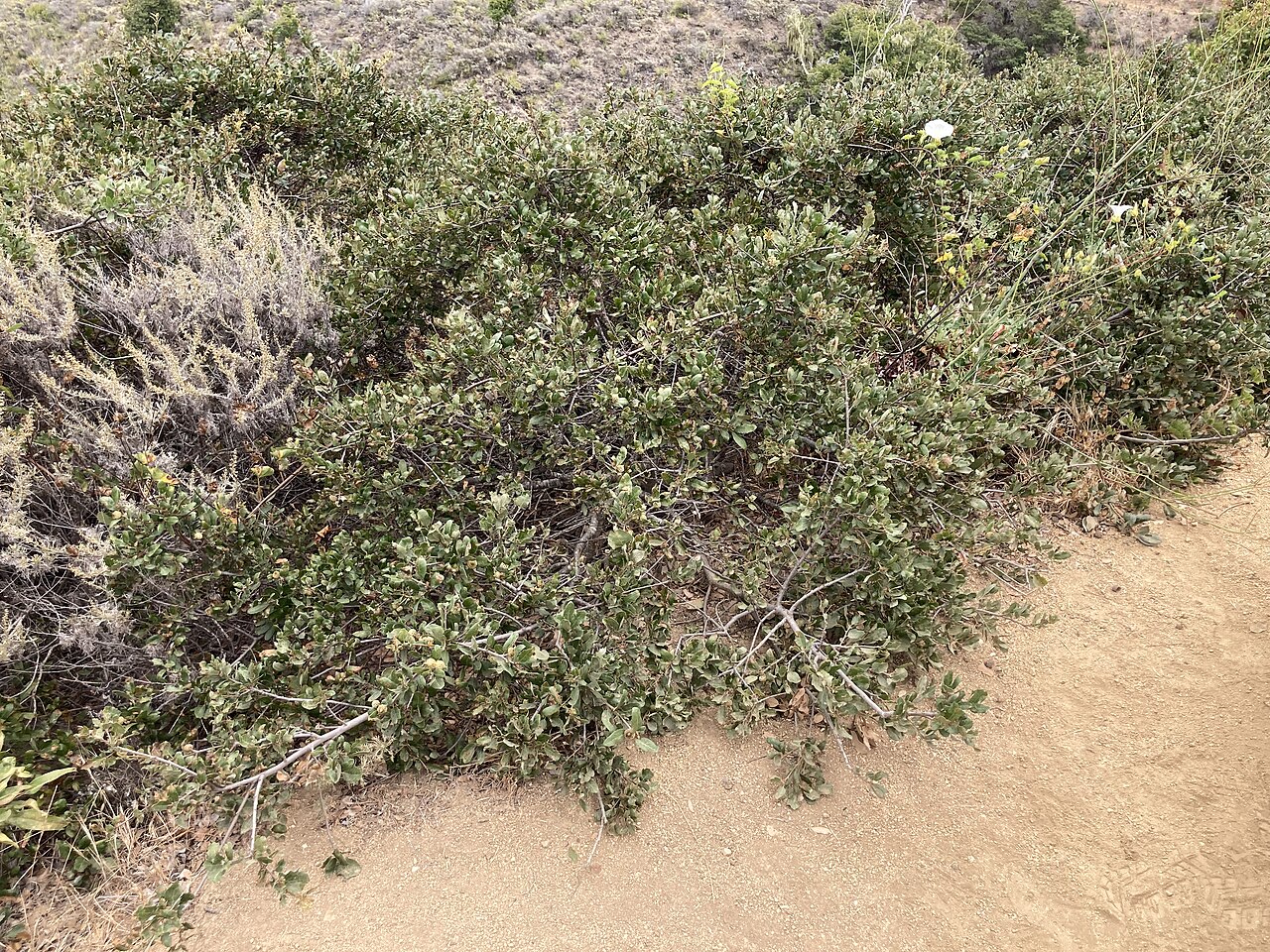
Quercus pacifica, the Pacific Scrub Oak (also called Channel Island scrub oak), is an evergreen oak found nowhere on Earth except three of California’s Channel Islands: Santa Cruz, Santa Rosa, and Santa Catalina. It belongs to the scrub oak group within the red oak lineage, a cluster of tough, low-growing oaks that have adapted to the thin soils and relentless wind of the California coast and islands.
Where it grows, Pacific scrub oak is anything but rare — it forms dense, rounded thickets across canyon slopes and ridgelines, its small spiny leaves packed tightly along stiff, wind-sculpted branches. Botanists consider it a distinct island endemic rather than a mainland species that simply reached the islands; genetic studies have found it to be more closely related to other island oaks than to any single mainland scrub oak, the product of long isolation and occasional hybridization with the oaks that reach the islands’ shores.
Pacific scrub oak is not a tree for most home gardens on the mainland, since nursery stock is uncommon and the species is best appreciated in restoration plantings within its native island range or in botanic collections. Where it is available, it rewards very little water and poor soil with a dense, durable evergreen thicket that asks for almost nothing once established. The California Native Plant Society lists it as a plant of limited distribution (Rank 4.2), worth watching though not currently imperiled.
Identification
Pacific scrub oak grows as a rounded, many-branched shrub, typically 6 to 20 feet tall, occasionally taller in sheltered canyons where it can become tree-like. Plants spread as wide as they are tall, forming dense, nearly impenetrable thickets that knit together on exposed slopes. Growth is slow, and old specimens can be many decades old despite their modest size.
Bark & Stems
Young twigs are slender and often finely hairy, maturing to smooth, gray-brown bark on older stems. Branching is dense and somewhat tangled, a growth habit that helps the shrub shed wind and salt spray rather than fight them.
Leaves
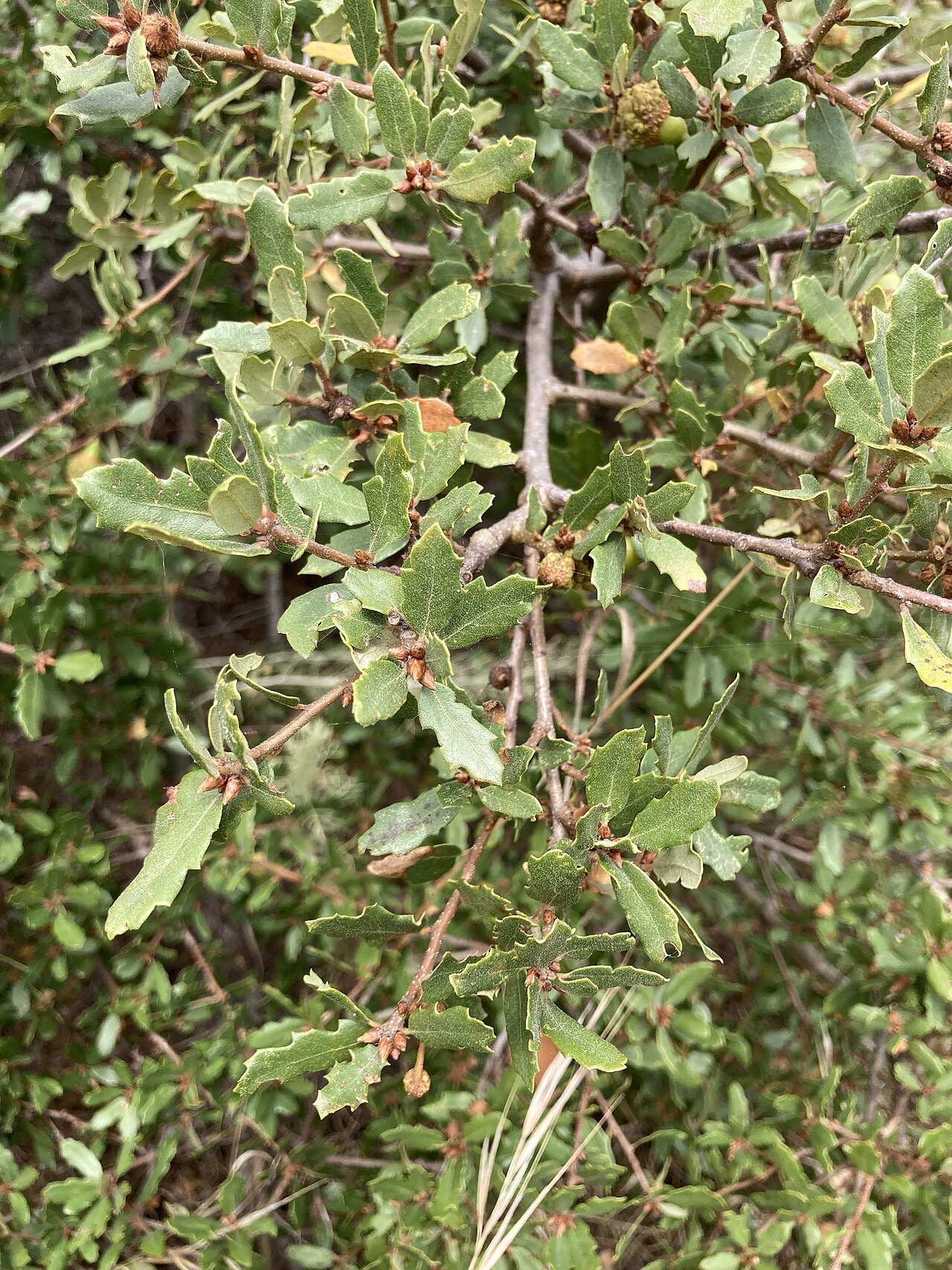
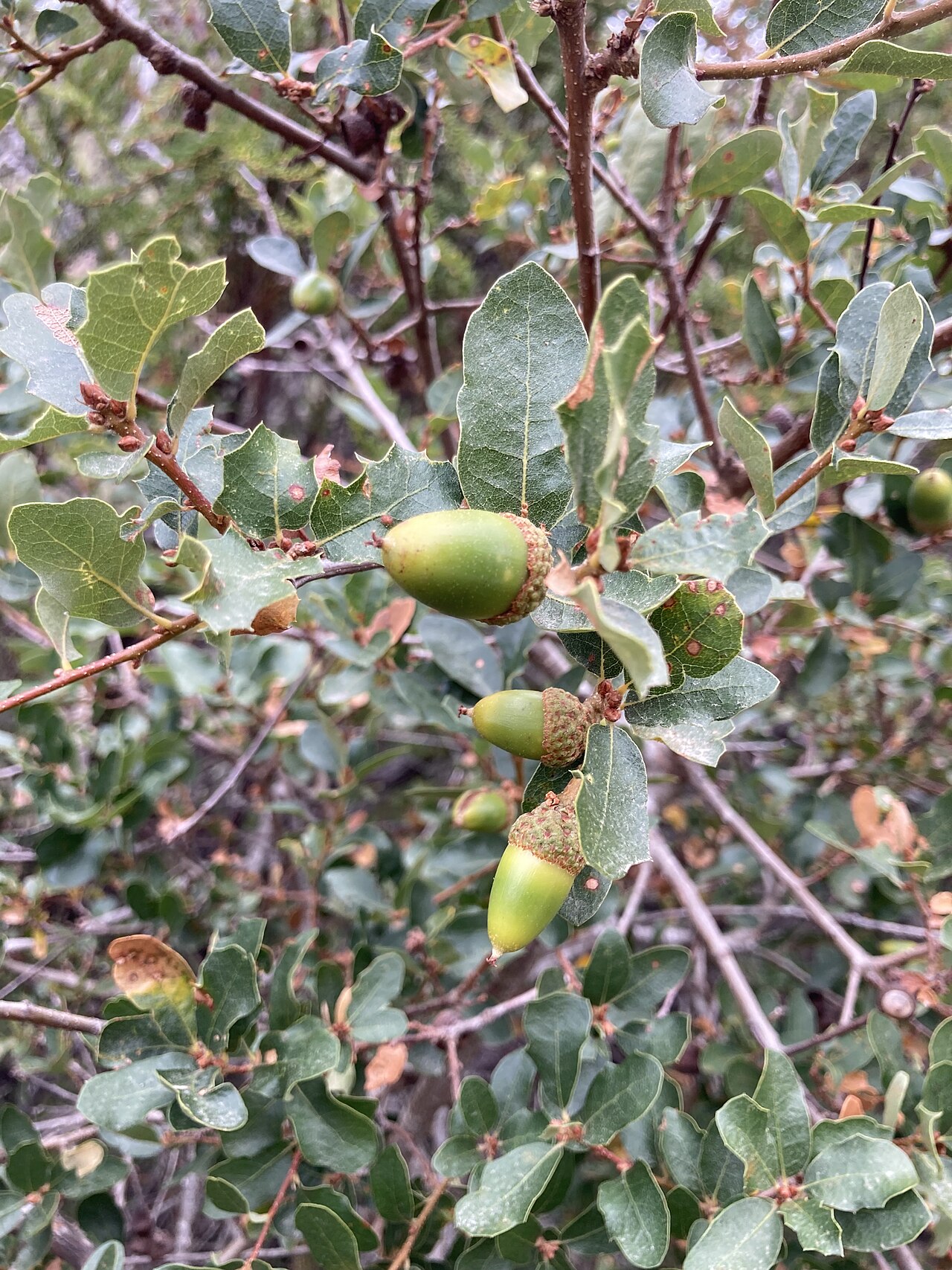
The evergreen leaves are small and tough, roughly oval and up to about 1.5 inches long, with spine-tipped teeth along the margins that give the shrub its “scrub oak” character. The upper surface is glossy dark green; the underside is pale, waxy, and finely hairy, with tiny glandular hairs that help the leaf conserve moisture in the island’s dry summers. Leaf shape is variable even on a single plant, from nearly flat-edged to strongly spiny, which can make field identification tricky without checking acorns.
Flowers & Fruit
Like other oaks, Pacific scrub oak is wind-pollinated, with inconspicuous green-and-cream catkins appearing in spring. Acorns follow in the same year, maturing by autumn with a shallow, scaly cap up to about ¾ inch wide covering roughly a third of a nut that reaches up to an inch long. Acorn crops vary considerably from year to year, as in most oaks.
Quick Facts
| Scientific Name | Quercus pacifica |
| Family | Fagaceae (Oak) |
| Plant Type | Evergreen shrub, occasionally small tree |
| Mature Height | 6–20 ft |
| Mature Spread | As wide as tall; forms dense thickets |
| Growth Rate | Slow |
| Sun Exposure | Full Sun |
| Water Needs | Very low once established |
| Soil Type | Rocky, shallow, well-drained |
| Soil pH | Slightly acidic to neutral |
| Bloom Time | Spring |
| Flower Color | Green, cream (inconspicuous catkins) |
| Fall Color | None (evergreen) |
| Fruit | Acorns to 1 in, ripening in one season |
| Deer Resistant | Yes (tough, spiny foliage) |
| USDA Hardiness Zones | 9–10 |
Native Range
Pacific scrub oak is a true island endemic, found only on Santa Cruz, Santa Rosa, and Santa Catalina Islands off the Southern California coast. It does not grow naturally anywhere on the mainland, and plants sold or grown outside this narrow island range are garden specimens, not wild populations. Within its islands, though, it is a common and important shrub, often the dominant woody plant across large stretches of slope and canyon.
It grows in island chaparral and coastal sage scrub, favoring canyon sides and open slopes from near sea level up to roughly 1,400 feet. The island climate is mild and strongly seasonal, with cool, foggy summers moderated by the surrounding ocean and most rainfall arriving in winter. Soils are typically thin, rocky, and derived from the islands’ volcanic and sedimentary bedrock, draining quickly after rain.
Because the species exists only on three islands, its total range is small, and the California Native Plant Society tracks it as a watch-list plant (Rank 4.2) — not currently at serious risk, but worth monitoring given its limited distribution and the islands’ history of disturbance from historic grazing by introduced sheep and cattle, now largely removed as part of long-running island restoration efforts.
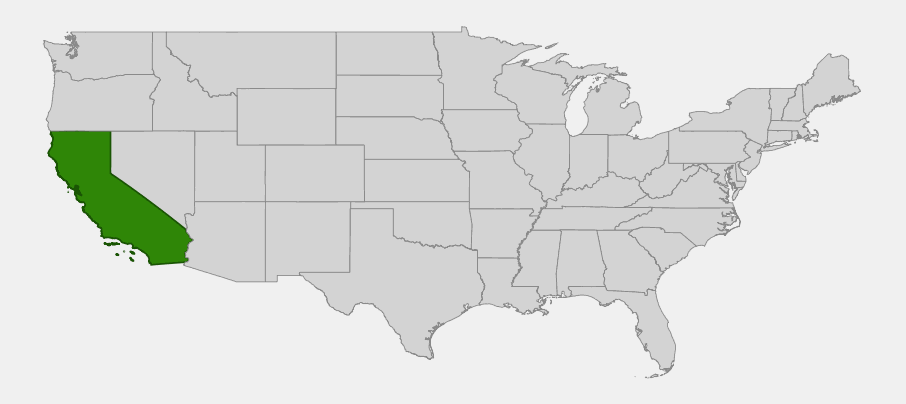
📋 Regional plant lists featuring Pacific Scrub Oak: California & Nevada
Growing & Care Guide
Pacific scrub oak is rarely sold outside specialty native plant nurseries, but where it can be found — or where it already grows wild in a Channel Islands restoration project — it is an easy, low-water shrub once it has rooted in.
Light
Give it full sun. In its island home it grows in open, exposed chaparral with little canopy overhead, and it keeps its tight, compact form best with plenty of direct light.
Soil & Water
Plant it in well-drained, rocky or sandy soil; it has no tolerance for heavy, waterlogged ground. Water regularly through the first one to two summers to establish a deep root system, then taper off sharply — mature plants expect to survive on winter rainfall alone and resent regular irrigation, which can encourage root disease in mainland gardens far from the islands’ moderating fog.
Planting Tips
Set out container plants in fall, ahead of winter rains, so roots can establish before the dry season. Because the species naturally forms dense thickets, space plants accordingly if a hedge-like mass is the goal, or give a single specimen room to spread into its full rounded shape. Coastal or near-coastal mainland sites with mild, fog-influenced summers are the best match for its island-adapted constitution.
Pruning & Maintenance
Established plants need very little upkeep. Remove dead wood as needed, and avoid heavy shearing, which spoils the natural mounded form. Once settled in, Pacific scrub oak is remarkably self-sufficient and tolerant of neglect.
Landscape Uses
- Bank and slope stabilization, where its dense root system and thicket habit hold soil in place
- Informal native hedge or screening planting in low-water, coastal gardens
- Island and coastal restoration plantings, its primary modern use
- Wildlife habitat plantings alongside toyon and other chaparral shrubs
- Waterwise gardens; see our broader guide to waterwise gardening for hot climates
Wildlife & Ecological Value
On the Channel Islands, Pacific scrub oak is a keystone shrub, providing structure and food across an otherwise windswept, often grass-dominated landscape.
For Pollinators
Though wind-pollinated and not a nectar source itself, the shrub’s dense thickets shelter the insects — native bees, moths, and other pollinators — that service the many flowering chaparral plants growing alongside it.
For Birds
The island scrub-jay, found only on Santa Cruz Island, relies heavily on scrub oak acorns as a food source and, in doing so, helps bury and disperse the next generation of oaks — a close ecological partnership unique to that single island. Other island birds use the dense branching for nesting cover and protection from predators and weather.
For Mammals
Acorns are consumed by the island fox, the islands’ native carnivore, along with other small mammals. The thickets themselves provide essential cover from the islands’ open, wind-exposed terrain.
Ecosystem Role
As one of the few substantial woody shrubs on islands otherwise dominated by grassland and low coastal scrub, Pacific scrub oak adds vertical structure, shade, and soil stability wherever it grows. Decades of island restoration work — removing introduced grazing animals and controlling invasive plants — have allowed scrub oak stands to recover and expand on several islands after historic overgrazing thinned them.
Cultural & Historical Uses
Like oaks across California, Pacific scrub oak’s acorns were historically an important food resource for the Indigenous Chumash people, who inhabited the Channel Islands for thousands of years before European contact and processed acorns from island oaks, along with mainland species, into a staple meal after leaching out the bitter tannins.
The species has little commercial history beyond this; it was never a timber tree, given its shrubby stature, and remains largely unknown outside botanical and conservation circles. Its modern significance is primarily ecological and scientific — researchers studying island biogeography and oak evolution have used Pacific scrub oak as a case study in how isolation on islands shapes a species over time.
Today, the shrub’s main human connection is through island restoration programs on Santa Cruz, Santa Rosa, and Santa Catalina, where protecting and replanting native scrub oak stands is part of broader efforts to restore the islands’ ecosystems following over a century of grazing by introduced livestock.
Frequently Asked Questions
Can I grow Pacific scrub oak outside the Channel Islands?
It can be grown on the adjacent Southern California mainland, especially in mild, coastal, fog-influenced areas, but nursery availability is very limited since it is a true island endemic rarely propagated commercially. Most plantings occur as part of island restoration projects rather than home gardens.
Is Pacific scrub oak the same as mainland scrub oak?
No. It is a distinct species restricted to Santa Cruz, Santa Rosa, and Santa Catalina Islands, genetically and morphologically separate from mainland scrub oaks such as California scrub oak, even though the two can look similar at a glance and occasionally hybridize where their relatives meet on the islands.
How much water does it need?
Very little once established. In the wild it survives entirely on winter rainfall and summer fog drip, and in cultivation it should be weaned off supplemental water after its first couple of years.
Is Pacific scrub oak endangered?
It is not federally listed, but the California Native Plant Society tracks it as a plant of limited distribution (Rank 4.2) because its entire range is confined to three islands. It is not rare within that range, where it remains a common and recovering chaparral shrub.
Do the acorns matter to island wildlife?
Yes, significantly. The island scrub-jay, found only on Santa Cruz Island, depends on scrub oak acorns and in turn helps disperse and plant new oaks by caching them — one of the closer bird-and-oak partnerships documented anywhere in California.

Looking for a nursery that carries Pacific Scrub Oak?
Browse our native plant nursery directory: California