
Milo Tree (Thespesia populnea)
Last updated: November 5, 2026
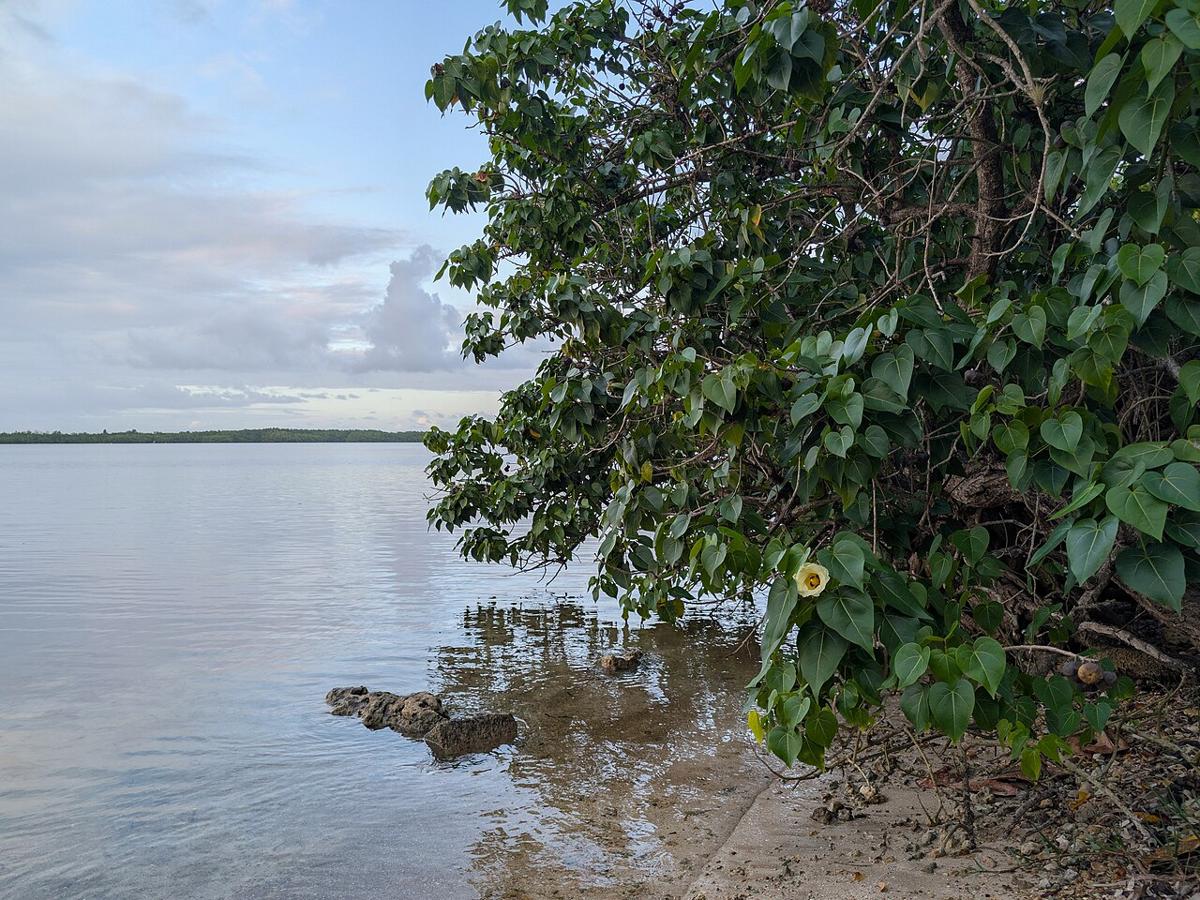
Thespesia populnea, commonly called milo, portia tree, Pacific rosewood, or Indian tulip tree, is a small evergreen tree in the mallow family (Malvaceae) that grows wild on warm coastlines around much of the world’s tropics. It has heart-shaped, glossy leaves and hibiscus-like flowers that open pale yellow in the morning and fade to dusty pink or maroon by evening, a color change that makes a single tree look like it is carrying two kinds of blooms at once.
Gardeners in frost-free coastal climates grow milo for its toughness: it shrugs off salt spray, wind, and sandy or rocky soil better than almost any other broadleaf tree, and its dense, rounded crown makes a reliable windbreak or shade tree right at the ocean’s edge. In Hawaii it also carries deep cultural weight, prized for generations as the finest wood for carving ‛umeke (wooden bowls), because its reddish-brown heartwood does not impart flavor to food.
Milo is not native to the continental United States. Its own origins are debated even among botanists: most authorities trace it to the Old World tropics of coastal Africa and southern Asia, while others, including Plants of the World Online, treat it as native across much of the Pacific as well. In Hawaii its status is genuinely contested — some sources (including Hawaii state agencies) treat it as indigenous, while many botanists classify it as a “canoe plant,” carried and planted by Polynesian voyagers roughly a thousand years ago rather than arriving on its own. What is not in dispute is that milo is introduced and has become invasive in parts of Florida, where it forms dense, impenetrable thickets on beaches, dunes, and mangrove edges that crowd out native vegetation and can interfere with nesting sea turtles. Do not plant milo in Florida; see the invasiveness notes below before planting it anywhere else.
Identification
Milo is a shrubby, often multi-trunked small tree, usually 15 to 40 feet tall with a crown as wide as it is tall. On exposed shorelines it is commonly shorter and more twisted, with trunks leaning away from the prevailing wind; in sheltered sites it grows more upright with a single trunk.
Bark & Stems
Young twigs are covered in fine, rust-colored scales. Bark on older trunks is gray-brown and fairly smooth, becoming slightly fissured with age. Branches often arch and spread wide, giving the whole tree a low, rounded silhouette rather than a tall, narrow one.
Leaves
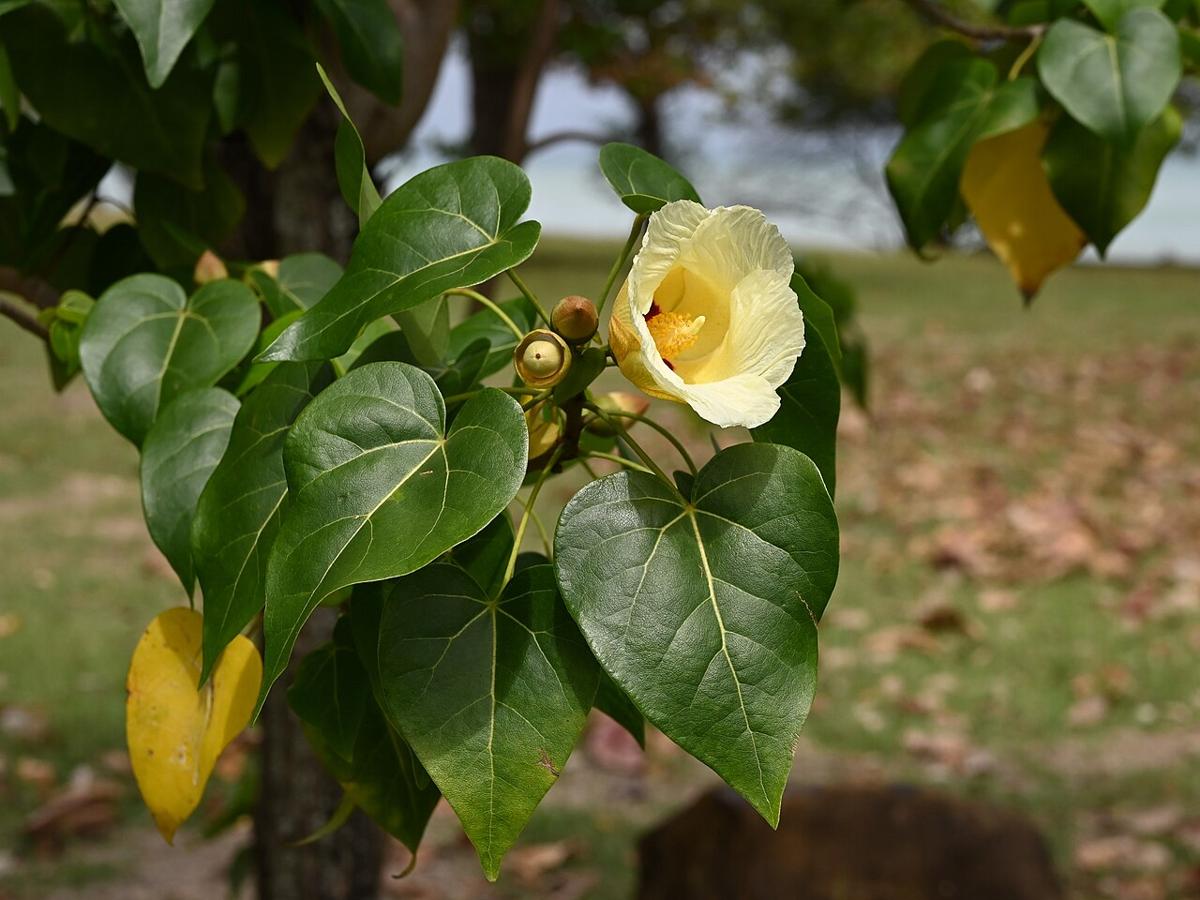
Leaves are alternate, simple, and heart-shaped (poplar-like, which is the source of the species name populnea), 3 to 8 inches long, with a long pointed tip and usually four main veins radiating from the leaf base. They are glossy dark green above and paler below, carried on petioles 2 to 4 inches long. The related beach hibiscus (Hibiscus tiliaceus), sometimes confused with milo, has wider leaves with dense star-shaped hairs on the underside; milo’s leaves are smoother and glossier below.
Flowers
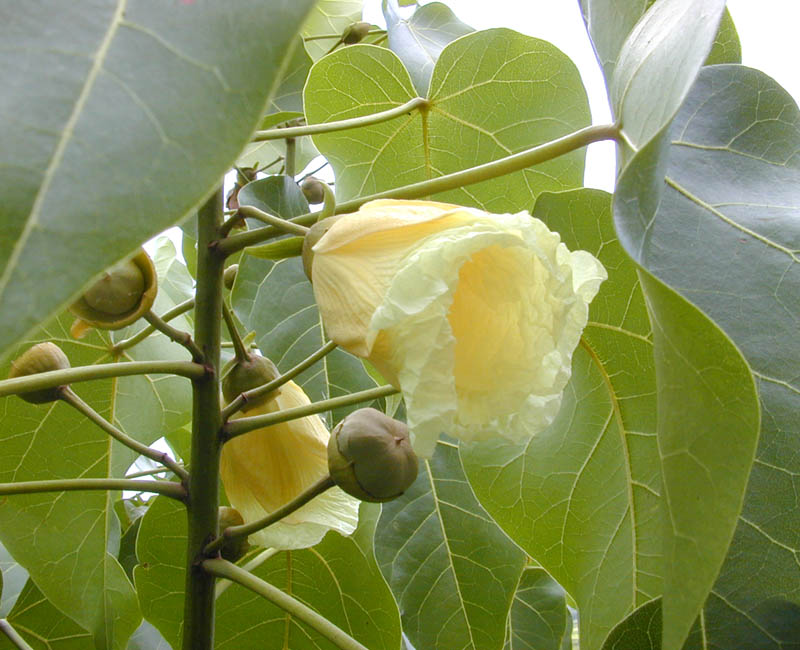
Flowers are hibiscus-like, up to 3 inches across, borne singly in the upper leaf axils, and present nearly year-round in frost-free climates. They open pale yellow with a dark maroon-red throat in the morning, then fade through orange to deep pink or maroon by the time they fall the following day — so a tree in bloom often shows both fresh yellow and spent pink-maroon flowers at once.
Fruit & Seeds
Fruit is a leathery, somewhat flattened, globose capsule about 1.5 inches wide that turns from green to brown to black as it dries, often persisting on the tree unopened for a time. Each capsule holds several brown, hairy seeds that are buoyant and can survive months floating in seawater, which is how the species spread naturally between islands and coastlines long before people were carrying it.
Quick Facts
| Scientific Name | Thespesia populnea |
| Cultivar | N/A — this page covers the wild species, not a named cultivar |
| Family | Malvaceae (Mallow) |
| Plant Type | Evergreen coastal tree or large shrub |
| Native to North America | No — Old World/pantropical coastal origin; Hawaiian status debated (indigenous per some sources, Polynesian “canoe plant” introduction per others); introduced and invasive in parts of Florida |
| Mature Height | 15–40 ft, usually 20–33 ft |
| Mature Spread | Often as wide as tall, sometimes wider on exposed coasts |
| Growth Rate | Moderate to fast in warm, humid climates |
| Sun Exposure | Full sun |
| Water Needs | Low to moderate once established; very drought and salt tolerant |
| Soil Type | Sand, coral rubble, limestone, or basalt-derived soils; tolerates poor, rocky ground |
| Soil pH | Neutral, about 6.0–7.4 |
| Bloom Time | Nearly year-round in frost-free climates |
| Leaf / Fall Color | Evergreen; no fall color change |
| Fruit | Woody, flattened capsule to 1.5 in, green turning brown/black, buoyant seeds |
| Deer Resistant | Generally yes (not a known deer browse plant) |
| USDA Hardiness Zones | 10b–12 (cold-sensitive below about 35°F) |
| Invasive Status | FISC (Florida Invasive Species Council, formerly FLEPPC) Category I invasive in Florida; do not plant there |
Origin & Where It Grows
Milo’s native range is one of the more debated among coastal trees. Most botanical authorities place its confirmed native range in the Old World tropics — coastal East Africa and southern and southeastern Asia — with natural, wave-dispersed spread east through Malesia into the western Pacific. The IUCN and USDA extend its native range further, into parts of the Pacific and the American tropics, while treating only Florida as clearly introduced and invasive. In Hawaii specifically, state sources commonly list milo as indigenous, but many botanists consider it a Polynesian-era “canoe plant,” deliberately carried to the islands by voyagers roughly a thousand years ago rather than arriving by ocean currents on its own. Either way, it is a long-naturalized, culturally important tree of Hawaiian coastlines.
Outside Hawaii and the Pacific, milo has been widely planted and has naturalized along warm coasts worldwide, including the Caribbean, the Gulf Coast, and south and central Florida, where it was documented as naturalized by the 1930s. It now forms dense stands on beaches, dunes, mangrove edges, and disturbed coastal land in the Keys and south Florida, and is also reported as naturalized and invasive in the Bahamas, Puerto Rico, and parts of Brazil.
In the continental United States, milo can only be grown outdoors year-round in the mildest, frost-free parts of south Florida, coastal south Texas, and similar zone 10b–12 microclimates such as coastal Southern California with protection; it is killed or badly damaged by any hard frost. Given its invasive behavior in Florida, gardeners there should choose a native alternative instead (see below); where it is grown elsewhere, keep it well away from natural coastal and wetland habitat.
Growing & Care Guide
Where it can be grown responsibly — essentially Hawaii and similarly frost-free, non-Florida coastal climates — milo is low-maintenance once established, built for exactly the harsh conditions that stress most other trees near the ocean.
Light
Full sun. Milo is naturally adapted to open, intensely sunny, exposed coastal sites and does not perform well in shade.
Soil & Water
Milo tolerates a wide range of coastal soils, from loose sand and coral rubble to rocky limestone or basalt-derived ground, and is unusually tolerant of salt spray, salt-laden soil, and wind. It needs regular water as a young plant but becomes quite drought tolerant once its roots are established, handling the periodic dry spells typical of many coastal climates.
Planting Tips
Plant container-grown trees in warm weather so roots establish before any cool season. Give milo plenty of open space — at least 20 to 25 feet from structures — since mature trees spread as wide as they are tall and develop a dense, low crown. Stake young trees loosely in exposed, windy sites until the root system anchors them.
Pruning & Maintenance
Milo tolerates pruning well and can be shaped to a single trunk or allowed to grow as a multi-stemmed, naturally rounded form. Remove crossing or storm-damaged branches after flowering. The tree is generally pest-tolerant, though it is a known host of the cotton stainer bug, so avoid planting it near cotton or okra crops.
Propagation
Milo is easily grown from seed, which germinates readily in warm, moist sand after the hard seed coat is nicked or soaked. Because the buoyant seeds disperse so effectively on tides and currents, planted trees near open coastline or waterways can seed into surrounding habitat — another reason to avoid planting it in or near wild Florida coastal areas, and to collect and dispose of fallen capsules where it is grown.
Landscape Uses
- Coastal windbreaks and screening in frost-free, non-Florida shoreline landscapes, where few broadleaf trees tolerate the salt spray as well
- Specimen or shade tree valued for its long bloom season and rounded, low-branching form
- Hawaiian cultural and craft gardens, where the wood is traditionally prized for carving ‛umeke (bowls) and other turned objects
- Beach and dune stabilization plantings in regions where it is already naturalized and management, not new planting, is the goal
Wildlife & Ecological Value
Milo’s flowers are visited by a range of generalist pollinators, including bees and the cotton stainer bug, though it is not known for standout wildlife value compared with regional native coastal trees. In its naturalized Florida range, the dense, impenetrable thickets it forms along beaches and dunes actually reduce habitat quality for native wildlife: the thickets have been documented taking over nesting beaches used by sea turtles and crowding out the native dune and strand vegetation that supports regional insects, birds, and small animals. Where milo is naturalized, it should be thought of as a management problem rather than a wildlife asset.
Native Alternatives
For gardeners in Florida and other coastal U.S. climates, the following native trees and shrubs offer similar salt tolerance and coastal toughness without milo’s invasive risk:
- Sea Grape (Coccoloba uvifera) — a Florida coastal native with large, rounded leaves and a similarly tough, salt-tolerant habit, often used the same way as a beachfront screen or specimen tree
- Green Buttonwood (Conocarpus erectus) — a true Florida mangrove-associate tree, extremely salt and wind tolerant, commonly used for coastal screening and privacy
- Cocoplum (Chrysobalanus icaco) — a native evergreen shrub for coastal hedges and screens in similarly sandy, salt-exposed sites
- American Sweet Olive (Osmanthus americanus) — a native evergreen small tree with a similarly dense, rounded form, for sites slightly back from direct salt spray
- Yaupon Holly (Ilex vomitoria) — a tough, salt-tolerant native evergreen for Gulf and Atlantic coastal landscapes
History & Uses
Milo has one of the richest cultural histories of any coastal tree in the Pacific. Its reddish-brown to chocolate-brown heartwood, prized for not imparting flavor to food, made it the preferred wood across Polynesia for ‛umeke (ceremonial and everyday wooden bowls), and in old Hawaiian society ‛umeke made of milo were considered sacred items reserved for ali‛i (royalty). The tree itself was regarded as sacred and was commonly planted at marae and other ceremonial sites alongside other culturally important trees. Beyond Hawaii, milo wood has been carved into drums in Tahiti and New Ireland, used for canoe parts and house timbers in Tonga, and was reportedly used for the rongorongo tablets of Easter Island.
In South and Southeast Asia, where the tree has long been cultivated as a shade and ornamental tree near the sea, its bark, leaves, and other parts have been used in various traditional folk remedies, though these are not supported by modern clinical evidence and are not a reason to plant the tree.
In the modern landscape trade, milo is grown mainly as a tough, salt-tolerant shade and screening tree in frost-free coastal regions, and continues to be valued in Hawaii both for its wood-carving tradition and its usefulness in dry coastal forest restoration projects alongside clearly native species such as Dodonaea viscosa and Cordia subcordata.
Frequently Asked Questions
Is milo tree native to the United States?
No, not to the continental United States. Its status in Hawaii is debated — some sources treat it as indigenous, others as a Polynesian-era introduction — but in Florida it is clearly introduced, and it is listed as a Category I invasive species there. Avoid planting it in Florida.
Is milo tree invasive?
Yes, in parts of Florida, where it forms dense coastal thickets that crowd out native vegetation and have taken over sea turtle nesting beaches. It is also reported as naturalized and invasive in the Bahamas, Puerto Rico, and parts of Brazil. It is not considered invasive in Hawaii, where it has a long cultural history.
Why is milo wood valued in Hawaii?
Milo heartwood ranges from tan through yellow to deep reddish-brown and does not impart flavor to food, which made it the traditional wood of choice for ‛umeke (wooden bowls) and other carved items in Hawaiian culture.
Why do milo flowers change color?
Milo flowers open pale yellow with a maroon throat in the morning and progressively fade to orange, pink, and finally deep maroon by the next day, then drop. This is a normal part of the flower’s one-to-two-day lifespan, not a sign of stress or disease.
How cold-hardy is milo tree?
Not very. Milo is reliably hardy only in USDA zones 10b to 12 and is damaged or killed by temperatures much below about 35°F, which restricts it to the mildest frost-free coastal climates in the continental U.S.
Related Reading
- Most Common Trees in Florida
- 5 Best Trees for Privacy to Grow in Florida
- Florida Strangler Fig (Ficus aurea) — another tree with a complicated native/invasive story in Florida landscapes

