
Florida Boxwood (Schaefferia frutescens)
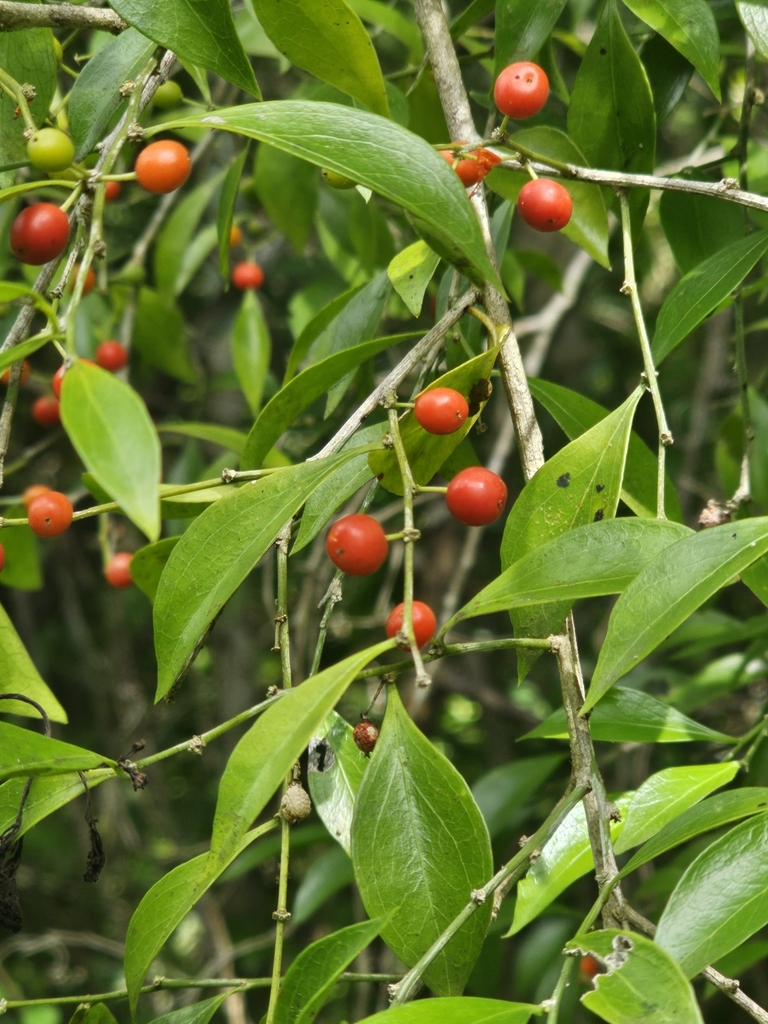
Schaefferia frutescens, the Florida Boxwood (also called yellowwood), is an evergreen shrub or small tree of tropical hardwood hammocks. In the United States it grows wild only in the upper Florida Keys and Miami-Dade County, and it is also native to Puerto Rico and the U.S. Virgin Islands, the rest of the West Indies, eastern Mexico, Central America and northern South America.
Florida boxwood is listed as Endangered by the State of Florida (FDACS Regulated Plant Index). Its few wild Florida populations are mostly on protected land, and gardeners should buy only nursery-propagated plants and never collect plants, cuttings or seed from the wild.
It is not related to the true boxwoods (Buxus); it belongs to the staff-tree family (Celastraceae). The name comes from its small, glossy leaves and its hard, fine-grained yellow wood, which has been used as a boxwood substitute. In south Florida landscapes it makes a neat, slow-growing accent or hedge plant, and female plants carry small red fruits that birds eat.
Identification
Florida boxwood looks like many other small-leaved hammock shrubs. Its combination of thin, bright yellow-green leaves, pale ridged bark, tiny greenish flowers and bright red, pea-sized fruits on separate female plants helps tell it apart.
Growth Form & Bark
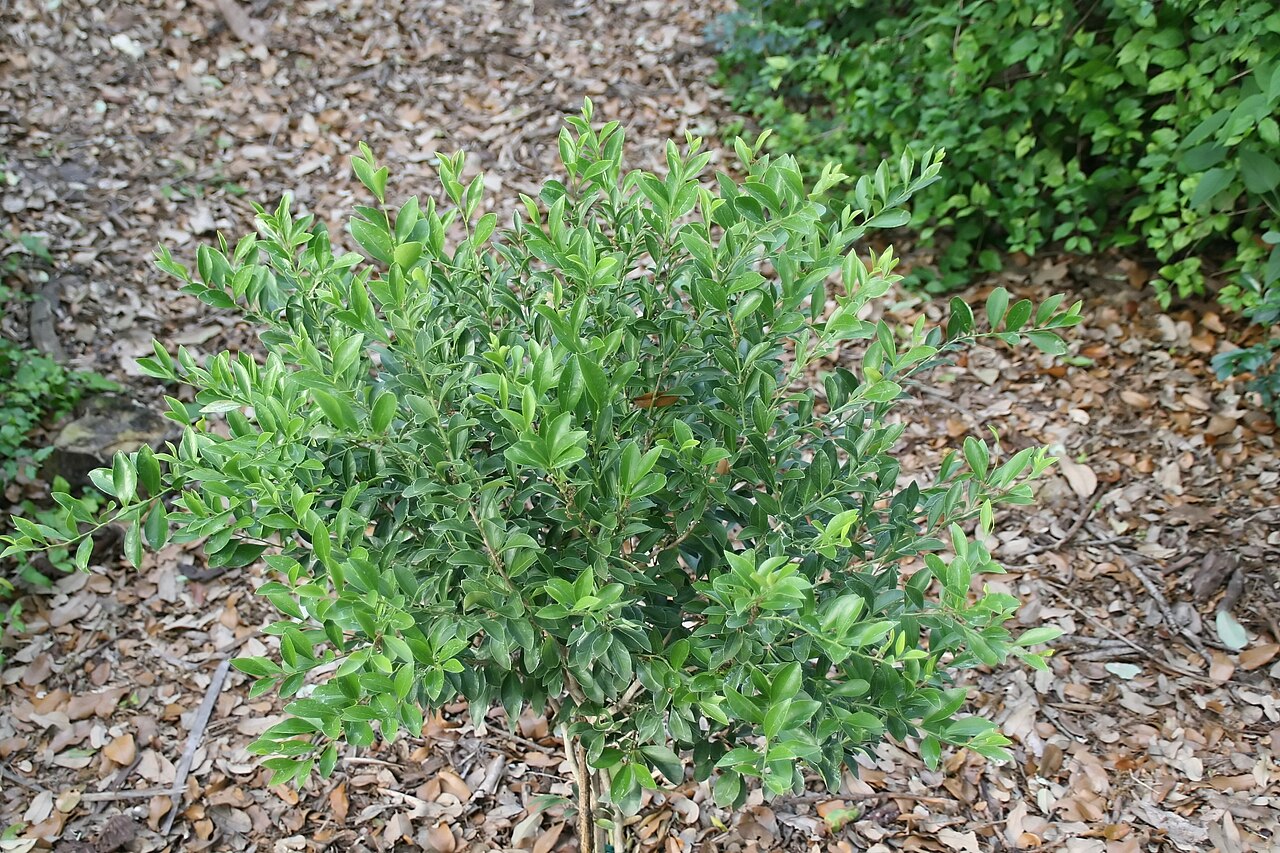
It is usually a multi-stemmed shrub or small tree 10 to 20 feet tall in south Florida, occasionally taller, with an erect trunk and a fairly narrow, dense crown. Trunks are rarely more than 8 inches thick. The bark is pale gray to light brown and roughened by many narrow ridges.
Leaves
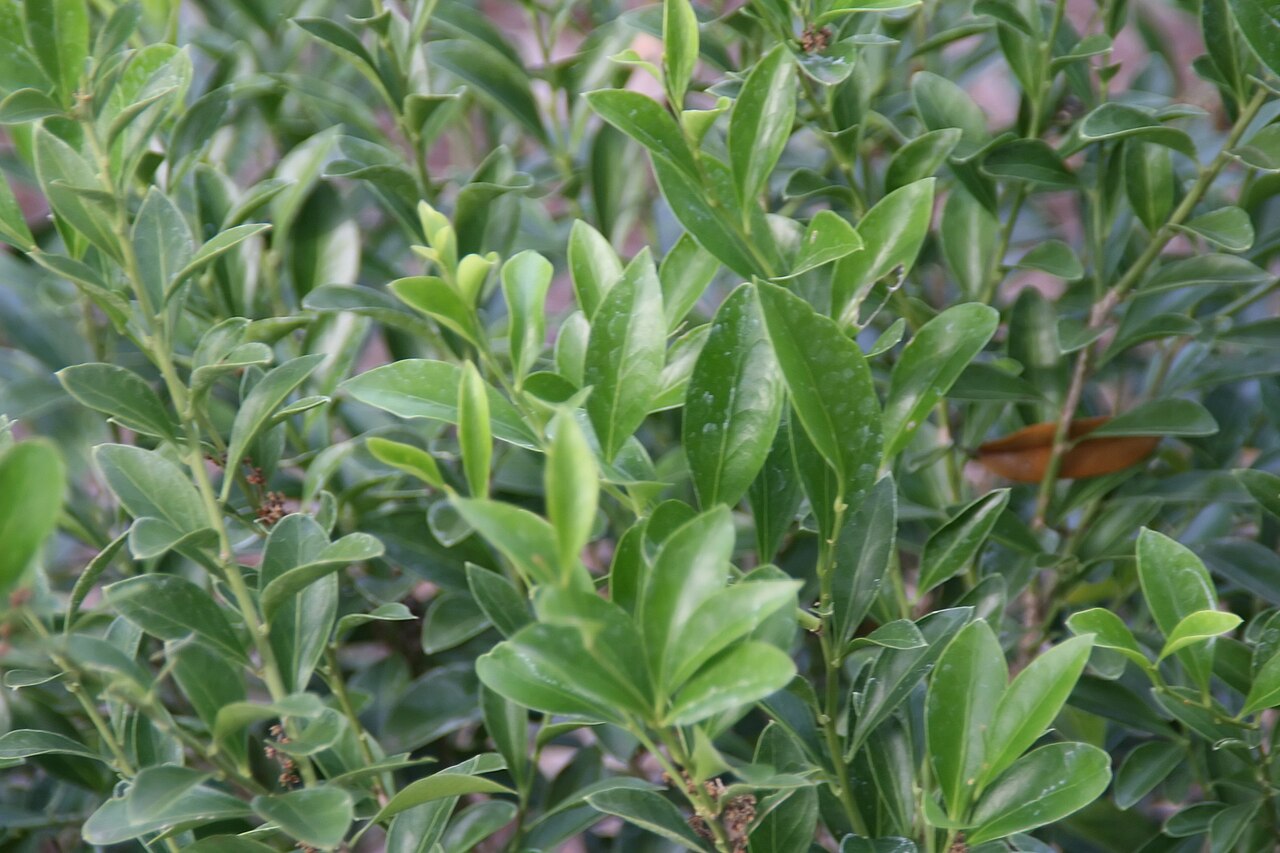
The leaves are alternate, simple and evergreen, about 1½ to 2½ inches long and ½ to 1 inch wide, elliptic to oblanceolate with a rounded or bluntly pointed tip and smooth edges. They are leathery but fairly thin and usually bright yellow-green, giving the shrub a light, fine-textured look.
Flowers
Florida boxwood is dioecious: male and female flowers grow on separate plants. The flowers are tiny, greenish white and four-parted, borne singly or in small clusters in the leaf axils. They are inconspicuous and can appear in any month, with a peak in spring.
Fruit
Female plants produce round, glossy fruits (drupes) about ¼ inch across that ripen from green to orange-red and then bright red, each with two small seeds. Male plants never fruit, so plant both sexes if you want berries.
Quick Facts
| Scientific Name | Schaefferia frutescens |
| Family | Celastraceae (staff-tree family) |
| Plant Type | Evergreen shrub or small tree |
| Mature Height | 10–20 ft (rarely to about 27 ft in Florida) |
| Mature Spread | 6–12 ft |
| Growth Rate | Slow |
| Sun Exposure | Light shade to full sun |
| Water Needs | Moderate; moist, well-drained soil, tolerates short droughts |
| Soil Type | Limestone and other well-drained soils with some organic matter |
| Soil pH | About 7.0–8.0 (neutral to alkaline) |
| Bloom Time | Year-round, peaking in spring |
| Flower Color | Greenish white (inconspicuous) |
| Fall Color | None (evergreen) |
| Fruit | Red drupes about ¼ in across, on female plants |
| Deer Resistant | Unknown |
| USDA Hardiness Zones | 10b–11 |
Native Range
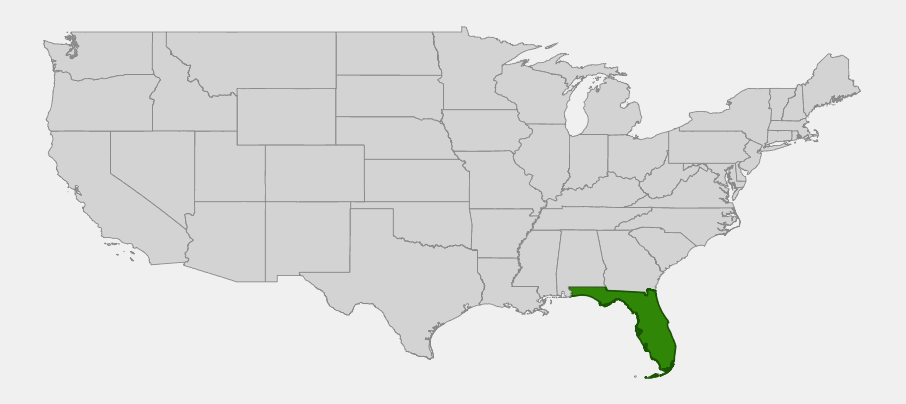
In the continental United States, Florida boxwood is native only to south Florida. According to the Institute for Regional Conservation, it grows in the upper Florida Keys of Monroe County and in Miami-Dade County, where wild plants are known from the islands of Biscayne National Park around Elliott Key; a mainland record from Brickell Hammock dates to 1906. It is very rare or perhaps gone from the Keys south of Upper Matecumbe Key. Outside Florida it is widespread in Puerto Rico, the U.S. Virgin Islands and the rest of the Caribbean, and it reaches eastern Mexico, Central America and northern South America.
Its habitat is rockland hammock, the tropical hardwood forest that grows on limestone in the Keys and along the Miami Rock Ridge. There it grows in light shade among other West Indian trees and shrubs on thin, well-drained soils with a layer of leaf litter. In Puerto Rico it also occurs in dry coastal forests.
Florida boxwood is listed as Endangered by the State of Florida (FDACS Regulated Plant Index) because so few wild plants remain, most of its hammock habitat has been lost to development, and the survivors are exposed to hurricanes and sea-level rise. Wild plants in parks and preserves are protected; buy nursery-propagated plants from a native nursery and never collect from the wild.
📋 Regional plant lists featuring Florida Boxwood: North & South Florida
Growing & Care Guide
Florida boxwood is a good choice for frost-free gardens in south Florida and the Keys. It is slow-growing and tidy, and it is available from native plant nurseries in south Florida. Because it is state-listed as Endangered, buy only nursery-propagated plants and never take plants, cuttings or seed from the wild.
Light
In nature it grows in the light shade of hammocks, and it does well in light to partial shade in the garden. It also tolerates full sun once established, where it grows denser but may need more water.
Soil & Water
It needs well-drained soil and does well on the limestone and sandy soils of south Florida, especially with a layer of mulch or leaf litter for organic matter. Keep it evenly moist while it establishes; after that it tolerates short dry spells but grows best with occasional deep watering in long droughts. It has low salt tolerance, so keep it out of the salt-spray zone and away from areas that flood with brackish water.
Planting Tips
Plant it as an accent shrub, in a mixed hammock planting or as an informal hedge or screen. Since only female plants fruit, buy several plants, ideally from a nursery that can tell you the sex, or plant a small group so you have both. It is cold-tender and suited only to frost-free areas of zones 10b and 11. As a state-endangered species, it should come only from nursery-propagated stock; never collect from the wild.
Pruning & Maintenance
It needs little care. Light shaping keeps it compact, and it takes clipping well enough to use as a hedge. Avoid heavy pruning in winter, when cold snaps can damage fresh growth. Leaving fallen leaves under it mimics the leaf litter of a hammock.
Propagation
Grow it from fresh seed cleaned from ripe red fruits and sown in a well-drained mix; seedlings grow slowly. Use seed only from cultivated plants or from nursery sources, never from wild populations.
Landscape Uses
- South Florida hammock gardens: a small understory tree for shaded native plantings
- Hedges and screens: its small leaves and dense habit take light clipping
- Bird gardens: female plants produce red fruits eaten by birds
- Rare-plant conservation: growing nursery-propagated plants helps keep this state-endangered species in cultivation
Wildlife & Ecological Value
Like many hammock shrubs, Florida boxwood is a small but steady contributor to the food web of south Florida’s tropical forests.
For Pollinators
The small greenish flowers are visited by small bees, wasps and flies. Because flowering can occur through much of the year, it offers a modest but long-lasting resource.
For Birds
The bright red fruits on female plants are eaten by birds, which disperse the seeds. In the Keys these include resident hammock birds and migrating songbirds passing through in spring and fall.
For Mammals
It is of minor importance to mammals, although small animals may eat fallen fruit.
Ecosystem Role
Florida boxwood is one of the many West Indian species that reach their northern limit in south Florida. It adds to the dense, shaded understory of rockland hammocks, which buffers the forest’s humid microclimate and shelters many rare plants and animals.
Cultural & Historical Uses
The genus Schaefferia honors Jacob Christian Schäffer, an 18th-century German naturalist and clergyman. The species name frutescens means “shrubby.” It was described by Nikolaus Joseph von Jacquin from plants he saw in the Caribbean.
The bright yellow heartwood is close-grained and heavy. According to the Flora of North America, it is sometimes used as a substitute for boxwood in engraving, which is the source of the names Florida boxwood and yellowwood.
Florida boxwood has never been common in Florida. Like other rare tropical plants of the Keys, it depends on the protection of parks such as Biscayne National Park and Everglades National Park, and on nurseries and botanic gardens that keep it in cultivation.
Frequently Asked Questions
Is Florida boxwood a real boxwood?
No. It is in the staff-tree family (Celastraceae), not the boxwood family. It gets its name from its small, glossy leaves and its hard yellow wood, which resembles boxwood.
Is Florida boxwood endangered?
Yes. It is listed as Endangered by the State of Florida (FDACS Regulated Plant Index). Buy only nursery-propagated plants and never collect plants, cuttings or seed from the wild.
Why doesn’t my Florida boxwood have berries?
Florida boxwood has male and female flowers on separate plants. Only females produce fruit, and they need a male plant nearby for pollination.
Can I grow Florida boxwood in central or north Florida?
It is tropical and frost-sensitive, so it is reliable only in frost-free parts of south Florida and the Keys (zones 10b–11). Farther north it needs winter protection or a container that can be moved indoors.
Does Florida boxwood tolerate salt?
Only a little. It does not tolerate flooding with salt or brackish water, and salt wind can burn its leaves. Plant it in a sheltered spot rather than on the dune line.

Looking for a nursery that carries Florida Boxwood?
Browse our native plant nursery directory: Florida