Gumbo Limbo (Bursera simaruba)
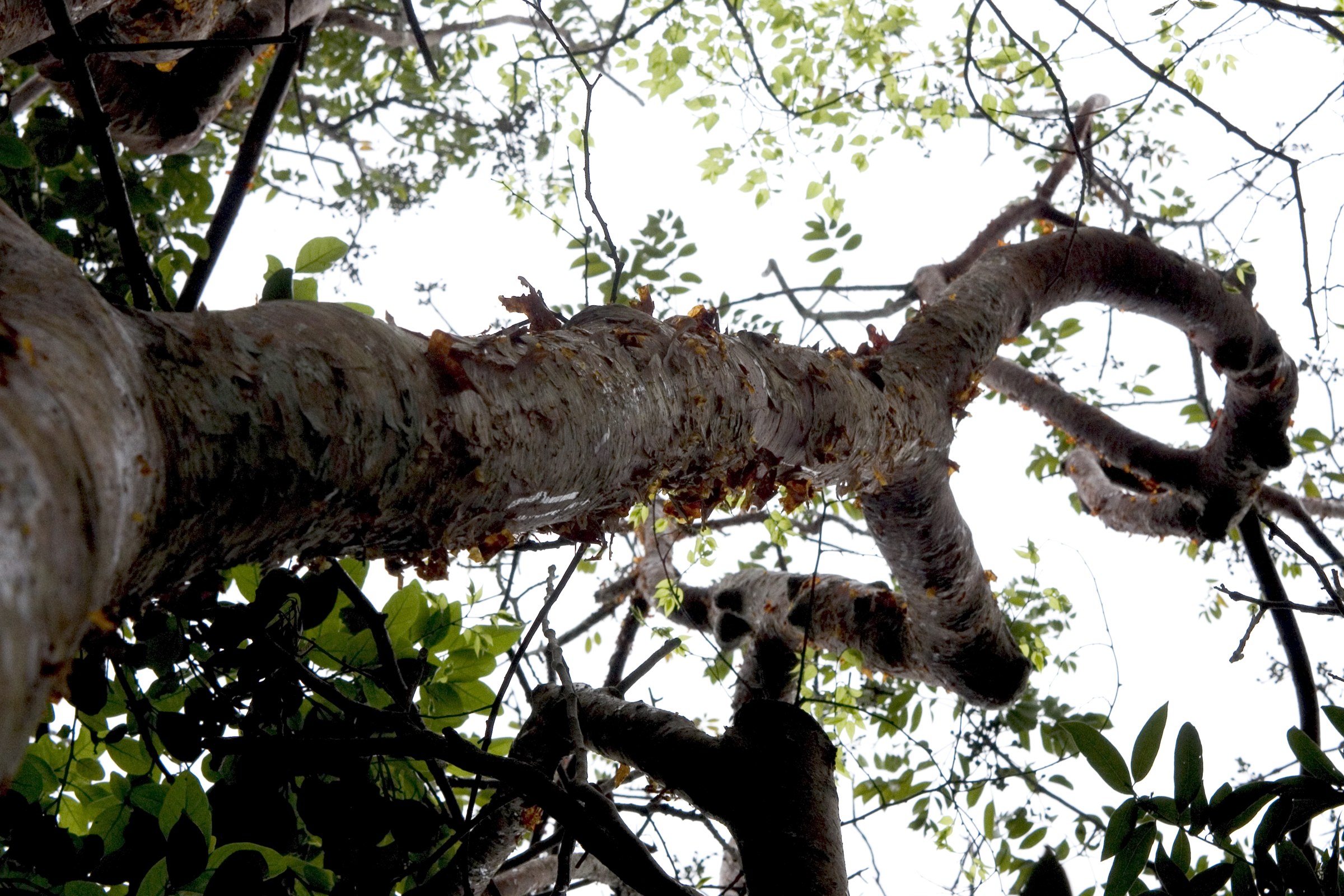
Bursera simaruba, commonly called Gumbo Limbo, is one of the most recognizable native trees of South Florida, instantly identified by its smooth, coppery-red bark that peels away in thin, papery curls. Florida gardeners and naturalists have long nicknamed it the “tourist tree,” a joking reference to the way its red, peeling bark resembles a sunburned visitor fresh off the plane. A member of the Burseraceae, or torchwood family, Gumbo Limbo shares its aromatic, resinous sap with relatives like frankincense and myrrh, and that same sticky sap gave the tree a long history of practical uses among the Indigenous Taino and later Florida settlers.
In the wild, Gumbo Limbo is a signature canopy tree of tropical hardwood hammocks — the dense, broadleaf forest “islands” scattered across the Florida Keys, the Everglades, and the Miami Rock Ridge. It grows quickly into a broad, rounded tree 25 to 60 feet tall, with a thick trunk and heavy, spreading limbs that can look almost sculptural with age. Few native Florida trees combine fast growth, striking bark, and genuine toughness in quite the same way: established Gumbo Limbos shrug off drought, salt spray, and poor rocky soil, and they are famous for surviving hurricanes that topple less flexible trees.
For home landscapes in frost-free South Florida, Gumbo Limbo offers shade, wildlife value, and a low-maintenance constitution all in one package. It is equally at home as a single specimen tree, a shade tree for a hammock-style yard, or — continuing a centuries-old Florida tradition — as living fence posts that root and leaf out from nothing more than a cut branch stuck in the ground.
Identification
Gumbo Limbo is usually a single-trunked tree with a broad, rounded crown, though multi-trunked specimens are common where branches have been cut and re-rooted. Mature trees typically reach 25 to 60 feet, with occasional old hammock specimens exceeding 80 feet. The trunk can grow quite stout, sometimes 2 to 3 feet in diameter, and the wood is notably soft, light, and easily damaged compared to denser hammock hardwoods like live oak.
Bark
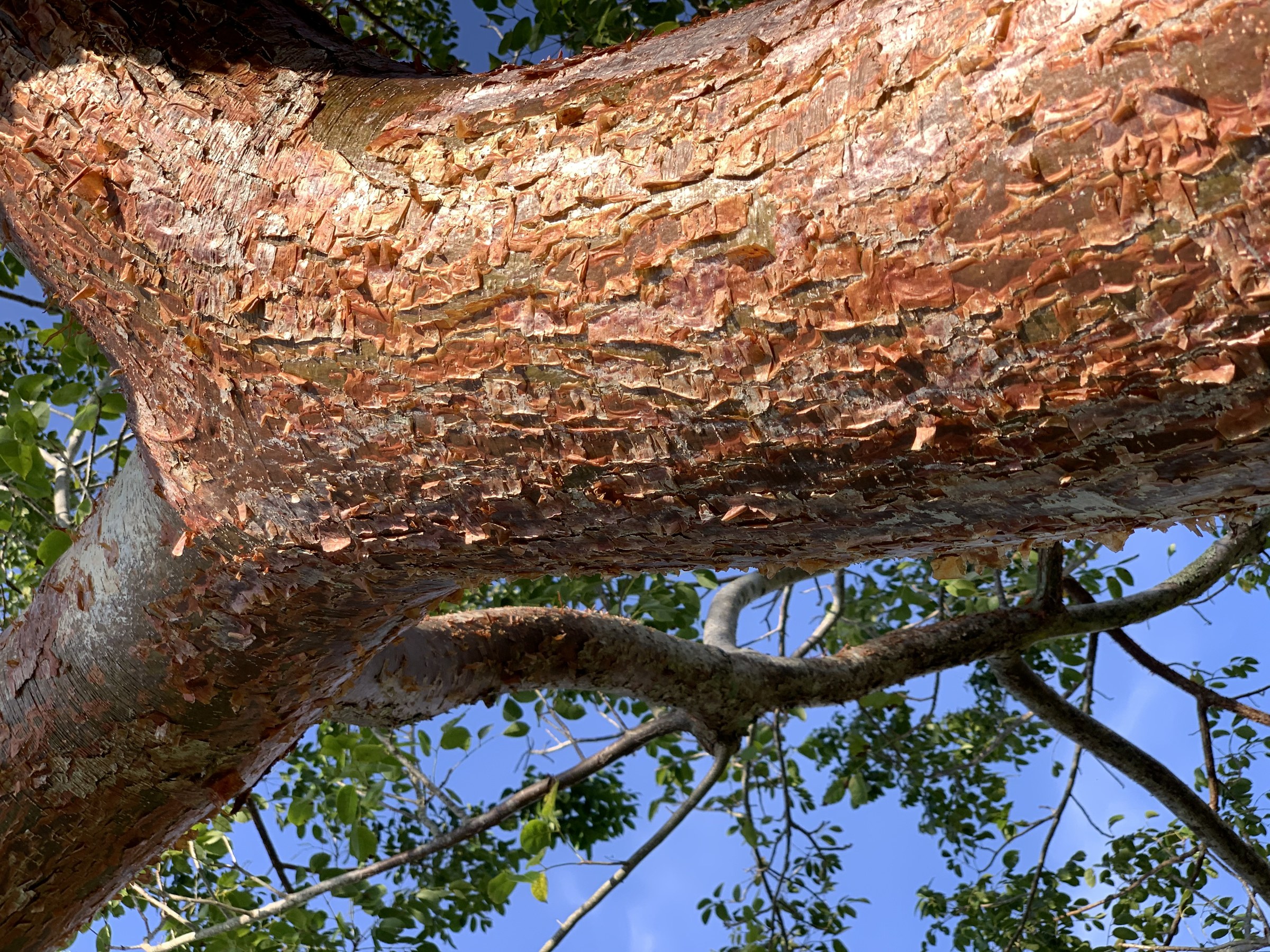
Bark is the tree’s signature feature: smooth, thin, and a distinctive coppery-red to reddish-brown color, constantly peeling away in thin, papery curls to reveal greenish new bark underneath. This continuous shedding is thought to help the tree rid itself of epiphytes, vines, and bark-boring insects. No other common Florida native tree shares this exact look, which makes Gumbo Limbo one of the easiest hammock trees to identify at a glance, even from a moving car.
Leaves
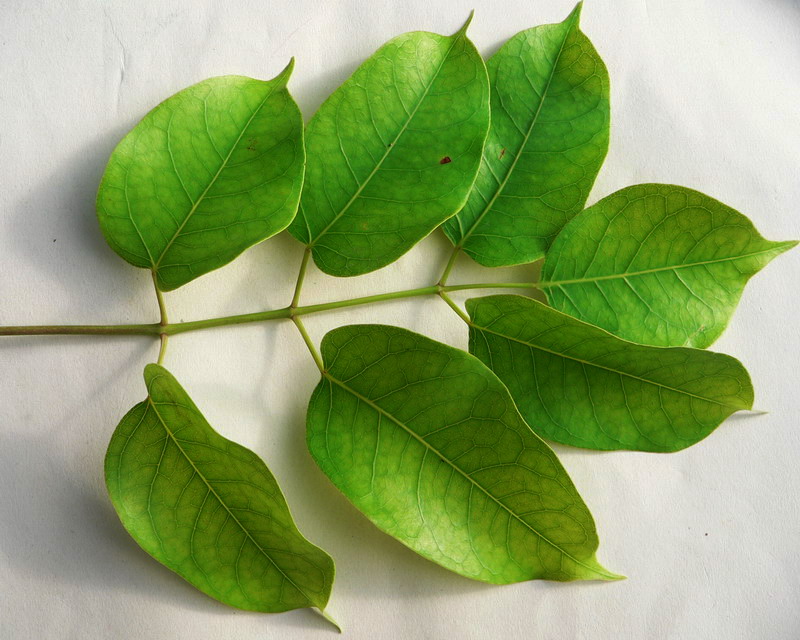
Leaves are pinnately compound, 6 to 8 inches long, made up of 3 to 9 (usually 5 to 7) oval to elliptical leaflets with smooth margins and a glossy, deep green upper surface. The tree is deciduous to semi-evergreen depending on rainfall: in much of its South Florida range it drops its leaves during the winter dry season (roughly December through March) and leafs back out with the spring rains, though trees in consistently moist sites may hold leaves much of the year.
Flowers
Small, greenish-white, five-petaled flowers appear in loose clusters at the branch tips in spring, typically March and April, often as the new leaves are emerging. Individual flowers are inconspicuous, only about ¼ inch across, and male and female flowers are usually borne on separate trees (the species is functionally dioecious).
Fruit & Seeds
Fruit is a small, three-angled capsule about ⅓ to ½ inch long that ripens from green to reddish-brown in fall and winter. The capsule splits open to expose a single hard seed wrapped in a fleshy red-orange aril, a combination that is highly attractive to fruit-eating birds. Fruiting coincides with the fall and winter songbird migration through South Florida, making Gumbo Limbo an important stopover food source.
Quick Facts
| Scientific Name | Bursera simaruba |
| Family | Burseraceae (Torchwood/Frankincense) |
| Plant Type | Deciduous to Semi-Evergreen Tree |
| Mature Height | 25–60 ft (rarely to 80 ft) |
| Mature Spread | 20–35 ft |
| Growth Rate | Fast |
| Sun Exposure | Full Sun |
| Water Needs | Low to Moderate |
| Soil Type | Sandy or rocky limestone; well-drained |
| Soil pH | 6.0–8.0 (tolerates alkaline) |
| Bloom Time | March – April |
| Flower Color | Greenish-white |
| Fall Color | None; leaves drop green to yellow-green |
| Fruit | Reddish-brown capsules with red-orange aril |
| Deer Resistant | Yes, generally |
| USDA Hardiness Zones | 10b–11 |
Native Range
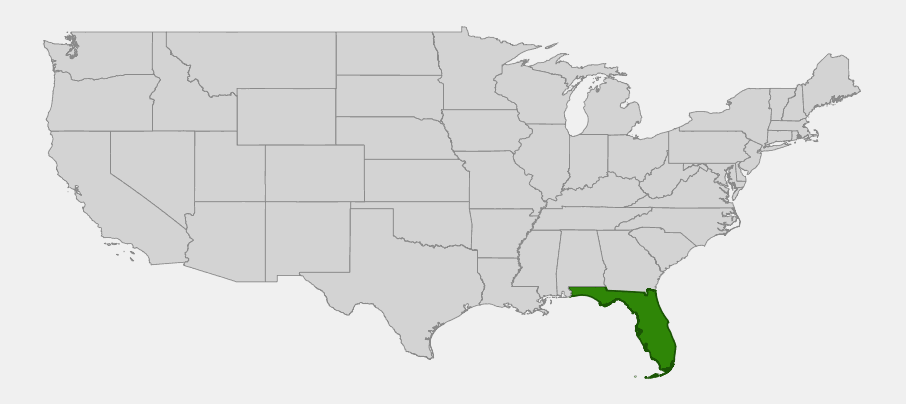
In the United States, Gumbo Limbo is native only to Florida, where it occurs naturally from roughly the central peninsula south through Miami-Dade County and the Florida Keys. It does not occur as a native tree outside Florida within the continental U.S.; the species is also native to Puerto Rico and the U.S. Virgin Islands, and more broadly ranges through Mexico, Central America, the Caribbean, and the northern coast of South America.
Within Florida, Gumbo Limbo is a defining canopy species of tropical hardwood hammocks — the dense, broadleaf forest patches that rise slightly above the surrounding pine rockland, marl prairie, or mangrove wetlands on old limestone outcrops. It is common along hammock edges and coastal berms in the Keys and Everglades National Park, and it is also widely planted well north of its natural range as a street and yard tree wherever winters stay frost-free.
Because it is so frequently planted outside its native hammock habitat throughout frost-free South and Central Florida landscaping, it is worth noting clearly: Gumbo Limbo’s true native range in the U.S. is limited to Florida, and gardeners elsewhere in the Southeast should not treat it as a native species for their region.
📋 Gumbo Limbo is not currently featured on any of our regional native plant lists — browse all native plant profiles instead.
Growing & Care Guide
Gumbo Limbo is one of the easiest native trees to grow in frost-free South Florida, asking little from the gardener once it is established. Its main requirement is warmth — it has essentially no cold tolerance and is strictly a tree for USDA zones 10b and warmer.
Light
Plant Gumbo Limbo in full sun for the best form and densest canopy. It will tolerate light shade, especially as a young tree establishing in a hammock setting, but open, sunny sites produce the fastest growth and the most attractive, evenly peeling bark.
Soil & Water
This tree is remarkably unfussy about soil, growing naturally in shallow, rocky limestone soils as well as sandy coastal sites. Good drainage matters more than fertility. Young trees benefit from regular watering during their first year, but established Gumbo Limbos are genuinely drought-tolerant and need supplemental water only during extended dry spells. The species also tolerates salt spray and brief saltwater flooding, making it useful in coastal landscaping.
Planting Tips
Gumbo Limbo transplants easily from container stock at any time of year in frost-free areas, though spring planting lets roots establish before the summer rainy season. Give it plenty of room: a mature tree needs 20 to 35 feet of spread. Famously, large cut branches (often called “trash can” or stake cuttings) will root directly in the ground with minimal care, a technique South Florida gardeners have used for generations to grow living fence posts.
Pruning & Maintenance
Prune to remove crossing or storm-damaged limbs, ideally in late winter before spring growth begins. Because the wood is soft and brittle compared to denser hammock hardwoods, avoid heavy pruning cuts that can invite decay, and never top the tree. Gumbo Limbo is otherwise low-maintenance, with few serious pest or disease problems and strong resistance to wind damage in storms.
Landscape Uses
Gumbo Limbo earns its popularity in South Florida landscapes through sheer versatility:
- Shade tree for yards, parks, and streetscapes in frost-free areas
- Living fence posts rooted directly from large cuttings
- Coastal and salt-tolerant plantings near the shoreline
- Hammock restoration and naturalized hardwood plantings
- Wildlife gardens, especially to support fall and winter migrant birds
- Specimen tree prized for its sculptural, peeling bark
Wildlife & Ecological Value
As a dominant hammock canopy tree, Gumbo Limbo supports a disproportionate share of South Florida’s hardwood hammock wildlife, from migrating songbirds to specialized native insects.
For Birds
The red-aril seeds ripen in fall and winter, exactly when millions of migratory songbirds pass through or overwinter in South Florida, making Gumbo Limbo an important stopover food source. White-crowned Pigeons, a species of conservation concern in Florida, rely heavily on Gumbo Limbo and other hammock fruit trees. Warblers, thrushes, and other fruit-eating migrants also feed on the seeds.
For Insects
Gumbo Limbo is a larval host plant for the Gumbo Limbo spindle moth (Dasylophia anguina) and several other native moths, and its flowers attract small native bees and other pollinating insects during the spring bloom.
Ecosystem Role
As one of the larger, faster-growing trees in the tropical hardwood hammock, Gumbo Limbo helps form the closed canopy that defines this rare Florida plant community, moderating temperature and humidity for the shade-loving plants and animals beneath it. Its flaking bark also limits the buildup of epiphytic vines and mosses on the trunk, subtly shaping hammock structure.
Cultural & Historical Uses
Gumbo Limbo’s soft, light wood and abundant aromatic resin gave it a long history of practical use in Florida and the wider Caribbean. The resin, which hardens into an amber-like substance, was historically burned as incense and used as a glue and varnish, while the soft wood was carved into toys, carousel horse bodies, and other lightweight items, and was once a preferred wood for crafting bottle stoppers and fishing floats.
Across the Caribbean, Indigenous and later Afro-Caribbean communities applied the sticky sap topically as a folk remedy for skin irritations, insect bites, and sunburn, and brewed the bark and leaves into traditional teas; these remain historical practices rather than medically verified treatments, and no part of the tree should be used medicinally without professional guidance.
In Florida, the tree’s most enduring practical legacy is the living fence: a simple technique, refined over generations, of planting large cut branches directly in the ground as fence posts. The cuttings root and leaf out within a season, producing a fence line that is literally alive, still a familiar sight on older South Florida homesteads today.
Frequently Asked Questions
Why is Gumbo Limbo called the “tourist tree”?
Its smooth, coppery-red bark constantly peels away in thin curls, a look Floridians have long joked resembles a sunburned tourist peeling after a day at the beach.
Is Gumbo Limbo native anywhere outside Florida in the U.S.?
No. Within the United States, Gumbo Limbo is native only to Florida (plus Puerto Rico and the U.S. Virgin Islands). It is frequently planted as a landscape tree much farther north and outside the country, but it is not native to those areas.
Can you grow a Gumbo Limbo from a cut branch?
Yes. Large cut branches root readily when planted directly in the ground, a technique long used in South Florida to create living fence posts. This works because of the tree’s unusually strong capacity to form new roots from stem tissue, not because the wood is treated or prepared in any special way.
Is Gumbo Limbo cold hardy?
No. It is reliably hardy only in USDA zones 10b and 11, and young trees can suffer serious damage even from light frost. Gardeners outside the warmest parts of South and Central Florida should not expect it to survive outdoors.
Do Gumbo Limbo berries attract wildlife?
Yes. The small capsules split to reveal a red-orange aril that is highly attractive to fruit-eating birds, particularly during fall and winter migration, including the White-crowned Pigeon, a species that depends heavily on hardwood hammock fruit trees like this one.

Looking for a nursery that carries Gumbo Limbo?
Browse our native plant nursery directory: Florida